Notes on Untrue: Why Nearly Everything We Believe about Women Is Wrong
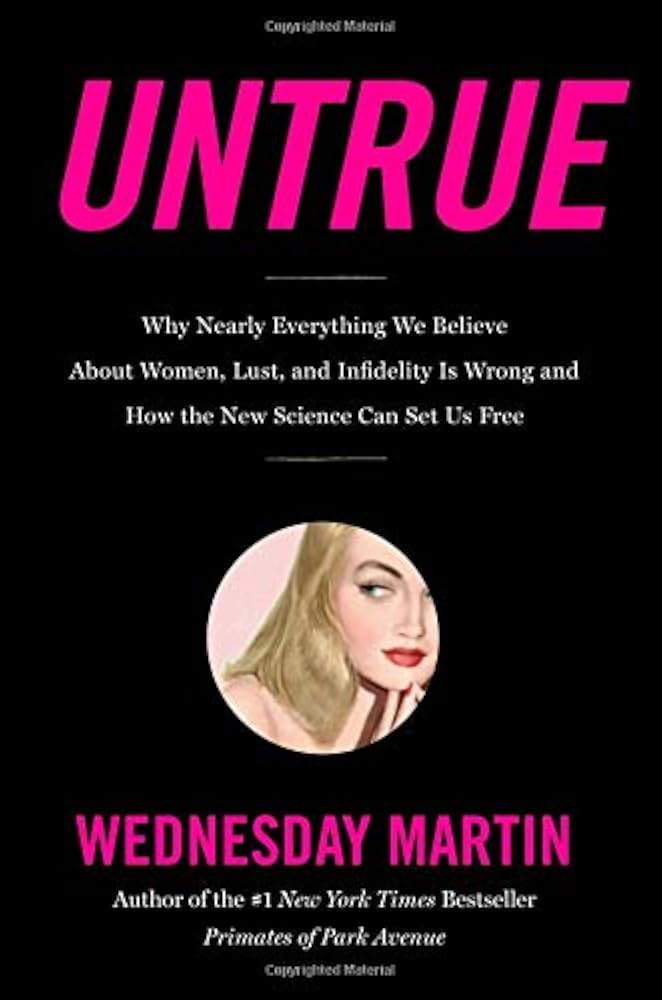
Untrue: Why Nearly Everything We Believe about Women, Lust, and Infidelity Is Wrong and How the New Science Can Set Us Free by Wednesday Martin
Original notes here.
The author’s elegant, highly educated friend, when talking about people who cheat, repeatedly brings up the words “illness” and “mental instability”; the author’s research into female infidelity is accompanied by intense curiosity as well as condemnation.
The author finds it astonishing that people promise to stay together for life without ever discussing sexual exclusivity, but then realizes she is no different herself.
Books on non-monogamy, affairs, and related subjects have sprung up everywhere. When Good People Have Affairs implicitly suggests that people think those who cheat are not good people; Tristan Taormino’s Opening Up has become a long-selling title; all her divorced female friends and friends in their twenties are reading The Ethical Slut.
Three forms of non-monogamous relationships: open relationships (you can fool around; I don’t want to know); swingers (the two of you play around with others, sometimes together, sometimes separately, but you may discuss it); polyamory (multiple partners, usually initiated by women).
Therapist Mark Kaupp, who supports non-monogamous relationships, argues that the greater your attachment security, the more love you are capable of giving—even beyond one person, potentially to an unlimited number of people.
The proportion of people who cheat at some point in their lives is 20–37.5% (Walker, 2001; S. Luo, 2010). It is difficult to obtain precise statistics because people are reluctant to admit it.
In 2010, 40% of Americans said marriage was becoming obsolete. That year, 51% of Americans were married, the lowest figure in history.
In 1976, 50% of highly educated GSS respondents said having an affair was always wrong; by 2008, the figure had risen to 75%. Yet people had become more tolerant than before of divorce, premarital sex, and homosexuality. Infidelity had become the final sexual taboo.
According to the 2013 General Social Survey, women cheating on their husbands had increased by 40% compared with 1990, while the rate for men remained as before.
After excluding outliers, the ratio between women and men was almost the same (P. Druckerman, 1993, 2008); four national surveys conducted between 1991 and 1996 showed that among people under 45, the rates of infidelity for women and men were nearly identical (D. C. Atkins, 2001).
A 2017 study found that among women aged 25–29, experience with group sex and threesomes was the same as among men of the same age (D. Herbenick, 2017).
Women experience opportunities for alternative forms of sex—including sex dungeons, leather/BDSM, polyamory, and sex parties—at nearly twice the rate of men.
Women frequently experience responsive sexual desire, a concept associated with Rosemary Basson: they become aroused only after encountering sexual stimulation, rather than experiencing spontaneous desire (like feeling hungry and wanting to eat).
A 2014 study found that men and women described the intensity of desire in essentially the same terms. Meredith Chivers of the Sexuality and Gender Laboratory argued that the way desire had traditionally been measured might be flawed; if responsive sexual desire were measured instead, the results should be the same.
The following are all findings from Chivers’s research: heterosexual women’s bodies responded regardless of what kind of pornography they watched, including footage of bonobo mating; straight men, by contrast, showed their strongest responses to scenes that matched their self-reported sexual preferences.
For a heterosexual woman, sex with a male friend produced less arousal than sex with either a long-term partner or a stranger.
When imagining having sex with a stranger, female subjects showed levels of arousal comparable to those of straight men.
A 2017 study of 11,000 British men and women aged 16 to 74 found that living with a partner was twice as likely to result in loss of sexual desire for women as for men. This overturned the conventional belief that women need intimacy and familiarity in order to engage sexually.
Marta Meana’s further research found that the problem was that familiarity and intimacy could actually kill women’s sexual desire. For straight men, by contrast, being able to have sex with a long-term partner actually gave them a much greater chance of being sexually satisfied.
In her recent research on women’s “erotic self-focus,” Meana found that women who had sex in front of a mirror looked at themselves far more often than they looked at their partners.
Alicia Walker of Missouri State University interviewed 46 female users of the Ashley Madison extramarital-dating website and found that having sex with people outside the relationship was, for them, a way of maintaining their primary relationships. This shattered several myths, including the ideas that women cheat because they are unhappy in their marriages, that women want emotional connection rather than sexual satisfaction, and that women cheat only accidentally.
Research found that when women were assured that casual sex would be both pleasurable and safe, they were just as likely as men to have it (T. D. Conley, 2011); women chose sexual partners based on sexual attractiveness just as often as men (P. W. Eastwick, 2008); and among people under 40, there was no difference between men and women in rates of non-monogamy (M. W. Wiederman, 1997).
A married woman, Sarah, fell in love with Paul. After several dates, he invited her to a hotel. She had been intensely aroused during the previous week, but there was always a voice telling her that what she was doing was wrong. In the end, she did not cross that line that day (which she later regretted). She became too nervous, overwhelmed by guilt, and began to cry. Afterwards, Paul either felt hurt and rejected or was simply annoyed, and he cut off contact.
The “sexual double standard” regarding infidelity has deep historical roots.
A 2008 study by the Institute for Economic Studies found that 27% of women fell into poverty after divorce, three times the rate for men. For Sarah, getting divorced meant sacrificing everything, so she unconsciously calculated the costs and benefits in her mind.
Sarah eventually decided that wanting to be with Paul was a sign that her marriage was beyond saving. In the end, she divorced. She dated several men afterward, but none of it compared with being with Paul.
Compared with today, women who had affairs in the 1960s were not treated as pathological figures. An affair could serve as a bridge through a transitional period, a potential exit from one marriage into the next.
They first spent their younger years saying “I do,” with colorful sex within marriage; today we have sexual experience first and settle down afterward. They could never have imagined it.
Modern Manhattanite Annika, who had immigrated from the Nordic countries, said that America was extremely conservative and that sex education was inadequate. In the Nordic countries, she said, it was practically shown to you firsthand. It was perfectly ordinary for Nordic girls to bring their boyfriends home for the night, whereas in America everything had to be kept secret. Back home in the Nordic region, there were excellent childcare services that supported women after childbirth in all kinds of ways; by comparison, America had nothing.
Before giving birth, Annika’s husband lost interest in sex, and she lived a colorful life of affairs. After childbirth, her husband persuaded her to move with the whole family to the suburbs. Occupied with raising the children and physically and mentally exhausted, she was no longer able to have affairs.
She eventually discovered that the real purpose of the move had been to make it easier for him to meet his affair partners while isolating his wife.
It was like the Malian tradition of forcing women to stay in menstrual huts during their periods.
Research found that when rhesus monkeys were kept in cages, mating was always initiated by the males. Once they were no longer confined, however, the females became the initiators, persistently following the males and even slapping the ground to demand sex.
After mating with all the males they lived with for several years, they became bored. But once something new came along, they became sexually frenzied again.
Human women are the same. It was only with the rise of agriculture that they became subordinate.
Anthropologists are gradually reaching a consensus that humans did not evolve into monogamous creatures, but instead evolved cooperative child-rearing alongside continual multiple mating that reinforced social bonds.
Indigenous women in the Americas could exercise sexual autonomy. Among the Wyandot, there was even a ritual in which female desire could help save a life: a girl would identify the boy she wanted to sleep with, and the next day the two would be summoned together before a sick woman to perform a ritual.
Hoe-based agricultural cultures still required women’s labor. But under plow agriculture, men suddenly gained a physical advantage, leaving women as the sole dependent population. They lost autonomy entirely and became costly possessions maintained by men, while the problem of uncertain paternity became more troublesome than at any other point in history.
In the Bible, Jezebel, the Phoenician princess who worshipped Baal and caused her husband’s kingdom to convert to her religion, represents women’s power in the pre-plow era. After the rise of plow agriculture, she was repeatedly rewritten, and the metaphor of adultery kept reappearing, with uncontrolled female desire used as a metaphor for worshipping gods other than the one true God.
Even the famously sexually indulgent ancient Romans were subject to a new moral code under Augustus, who went so far as to exile his promiscuous daughter Julia.
In 2013, a team of economists from Harvard and UCLA pointed out that the plow was a key factor shaping attitudes toward gender and the degree of female autonomy. Even cultures that had used the plow only once—and whose contemporary environments had changed dramatically—showed lower levels of women’s rights. People were more likely to believe that jobs should be given to men first and that political leaders were better suited to be men.
Today’s etiquette and gender norms—including women believing they can belong to only one man, being taught from childhood to sit with their legs together, and the ideas that men are naturally highly sexual and entitled to be promiscuous while women should stay at home—are all legacies of the intolerant plow culture.
The WHO stated in 2012 that the main factors placing women at risk of sexual violence were gender inequality and cultures that demanded sexual purity.
Large numbers of American women are fascinated by vaginal rejuvenation surgeries whose effectiveness has not been proven, simply in order to please men.
Among the Himba of Africa, polygyny is practiced but adultery is not taboo. Marriages are sometimes arranged by parents and sometimes freely chosen. Professor Scherz explored how the two arrangements affected the life histories of each woman’s children.
Since Darwin, sexual-selection theory has emphasized males competing for females, portraying females as passive. In 1856, a 24-year-old married woman who wanted sex was regarded as ill and subjected to abusive “treatments” designed to suppress her sexual desire (Groneman, Nymphomania: A History).
Angus Bateman’s experiments showed that male fruit flies’ reproductive success increased exponentially with the number of mates, whereas female fruit flies could not benefit from multiple mating in the same way. This theory had a major influence on the formation of gender roles at the time.
The Darwin–Bateman paradigm was challenged by primatologist Sarah Blaffer Hrdy, who discovered that female langurs used promiscuous mating strategies to protect their offspring (male monkeys would kill the offspring of females they had not mated with). She wrote The Woman That Never Evolved, and further evidence of female promiscuity began to emerge.
Female primates did not consciously think through reproductive strategies; they simply felt that it was “comfortable” because of their physiology. Humans have inherited this legacy as well.
The density of nerve receptors in the clitoris is fourteen times that of the most sensitive part of the penis, and its only function is pleasure. As Rachel Carlton Abrams says in The Multi-Orgasmic Woman, women can have multiple orgasms; Hrdy argues that this is what drives female primates to seek repeated mating.
The female orgasm is elusive. Elizabeth Gordon’s research found that women need ten to twenty minutes of foreplay and stimulation before orgasm, while men need only two and a half to eight minutes.
When having sex with a familiar partner, heterosexual men reach orgasm 22% more often than women (J. R. Garcia, 2014).
Hrdy points out that female humans, chimpanzees, bonobos, and macaques all have the same O-shaped orgasmic facial expression, the “O face.”
Back to Eden? How Sex in Ancient Times Shaped Who We Are Today points out that the human cervix, like that of macaques, can filter sperm.
Men’s testicles are larger than those of gorillas and similar to those of chimpanzees, indicating sperm competition. The coronal ridge is effective at removing another man’s semen; the penis ultimately ejaculates a substance resembling a spermicide that blocks subsequent competitors.
Primatologist Zanna Clay found that bonobo sexual swelling and mating calls are signals sent by females to males within hearing range.
Taken together, physiology suggests that women are suited to experimenting sexually all day and all night, which is incompatible with cultural constraints.
The fewer women there are, the more autonomous they are, the less capable the men are, and the less they inherit, the more often women have more than one partner.
Anthropologists have found at least eighteen tribes in which children can have more than one father, known as partible paternity. Among the Aché of eastern Paraguay, different kinds of fathers are called by different terms. Stephen Beckerman found that 80% of Barí children with a second father survived to age 15, compared with only 64% of those with just one father.
Many scholars believe that a cooperative child-rearing culture involving multiple sexual partners was one of the reasons for Homo sapiens’ success.
On a fair comparison, sperm is not “cheap” (as the evolutionary myth suggests) but metabolically costly; combined with the lower success rate of fatherless children, lifetime reproductive success was numerically similar for males and females, further undermining the assumption that males were responsible for spreading their seed everywhere.
Patricia Gowaty found in 2012 that the results of Bateman’s enormously influential experiment could not be replicated.
Scherz’s research found that nearly 32% of married Himba women had given birth to at least one child fathered by an affair partner during their lives. These were called omoka children—omoka means going far away to fetch water and was a euphemism for a secret rendezvous. Among children of married mothers, 18% were fathered by someone other than their husbands. When Himba women asked Scherz why he slept alone in a tent, he replied that he was married, which they found hilarious.
Himba men tolerate uncertain paternity because women control inheritance resources, marrying a wife requires no bride price, children contribute to the group from a young age, and they require relatively little care. Affairs also help with childcare and lower the costs involved. The men themselves often have lovers at distant cattle camps.
Why, then, were only 32% of children born from affairs? Scherz found that all the marriages in which women had affair children had been arranged; none had been freely chosen for love, and none of the freely chosen marriages produced an affair child.
Why accept an arranged marriage? Compared with freely chosen unions, women who had arranged marriages and lovers had more children who survived beyond age five, demonstrating a reproductive-success advantage to multiple mating.
Female primates are highly sexually active; multiple mating is the norm, and they prefer unfamiliar faces.
Bonobos love promiscuous sex. Females have sex with one another, and they have large clitorises that sometimes penetrate the vagina.
In species where males remain in their place of origin, female status is low; this seems to apply across primates. Bonobos are the exception: females form alliances that dominate the males, allowing them to receive grooming and eat first.
Records from the San Diego injury logs show that among 25 cases of severe violence involving bonobos, 24 were female attacks on males. Even more strikingly, males often did not want to accept sexual advances and were frequently forced to have sex.
The author attended an all-female sex party hosted by Skirt Club, and felt even more strongly that humans and bonobos share common ground.
Dr. Diamond, who proposed the idea of female sexual fluidity, found that gold-star lesbians—women who have had sex only with women—are a minority. A study of men in Salt Lake City also found sexual fluidity (the footnote refers to an interview with the doctor).
The doctor believes that women are considered to have more fluid sexual orientations because of the social control imposed by heterosexual men. She points out that women who have had sex with women are better able to communicate their desires. She agrees that novelty is part of human nature, but says that when couples engage in novel, stimulating activities together, they can often see each other from a new angle and experience the feelings of first love all over again.
A Boise State University study of 333 self-identified heterosexual women found that 43% had been intimate with another woman.
Glamour magazine surveyed more than 1,000 women aged 18 to 44. Forty-seven percent said they had been attracted to another woman, and 31% had had a same-sex experience.
Black women are often seen as savage or hypersexual. This kind of social oppression creates real physical danger: white female college students may feel that if the victim of a sexual assault is a Black woman, there is less need to intervene, and may even assume that the victim enjoyed it. Some Black women writers are now trying to break this pattern.
In the emerging world of online dating, white men encountering Black women likewise assume that they are highly sexual, into BDSM, anal sex, willing to do anything, and so on.
Black girls are more often perceived as adults than white girls of the same age, and receive less care and protection.
The author recounts how a close male friend, knowing that she was writing this book, confided his story to her. His wife had an affair and honestly admitted that they both loved someone else. He accepted it. Several months later, he let his wife’s boyfriend come to their home. The boyfriend would help cook for their son. The two men never displayed affection in front of him and treated one another with respect. He himself had also had several extramarital affairs, which felt wonderful, but he had also encountered awkward situations, such as one affair partner’s husband becoming furious at him (he had assumed that the husband knew about the affair). After that, he stopped getting involved with women whose husbands he was not certain knew what was going on.
The author admits that before writing the book, she would have assumed that couples each had problems that needed to be dealt with, or that there must be some emotional trauma involved. She now realizes that they are working hard to adapt and preserve their relationships, and believes the women are extremely sincere and faithful.
Carrie Jenkins, a tenured professor and philosopher at the University of British Columbia and author of What Love Is: And What It Could Be, was subjected to public vilification simply for openly discussing her experiences with polyamory. She believes that her academic prestige threatened the image of promiscuity people held in their minds.
Michelle fell in love with Delia, a married and prominent figure in the lesbian community. She initially resisted but was eventually seduced. Delia said she and her wife were unhappy and already on the verge of breaking up. When her wife eventually discovered the affair, she stormed into Delia’s office and caused a scene. Although Delia was extremely unhappy about it, she returned to her wife out of codependency. Michelle felt guilty that she had fought for same-sex marriage rights only to help destroy someone else’s marriage.
Delia and her wife underwent marriage counseling, and the wife agreed that the two could continue seeing each other. But several months later, she again demanded that Delia break things off with Michelle. Before Delia could decide, Michelle cut off the relationship herself. She still loved her deeply and regretted not trying harder to win her back.
Some husbands have particular sexual fetishes and enjoy watching their wives sleep with other men, or even deliberately arrange it. This is known as the “cuckold lifestyle.”
Kai Ma’s “Take My Wife, Please” introduces some cuckold husbands who appear extremely dominant. Some recruit a “bull” on the condition that his penis be larger than theirs. The participating wives are called “hotwives.”
Some cuckold enthusiasts enjoy humiliating themselves after their wives return from sleeping with another man: “Now you can taste what another man left behind.” This can become intensely arousing; some dull marriages have even been rescued by this new arrangement.
David Ley’s Insatiable Wives says that couples who adopt this lifestyle all do it differently, but the common ingredients of success are connection, intimacy, and communication skills.
Advertisements seeking Black bulls may simply reinforce racial stereotypes.
A hotwife may initially participate merely to please her husband, but some later begin pursuing what they want for themselves.
When men and women involved in affairs answer questions, they may feel compelled by social and cultural scripts to answer in particular ways. These cultural scripts can amplify post hoc rationalizations and the slippery-slope fallacy of overinterpreting causal relationships.
Victoria Milan asked 2,000 female users why they cheated. The number-one answer was: to add excitement to their lives.
The author mentions Claus Wedekind’s famous “Sweaty T-shirt study”, which found that heterosexual people were most attracted to individuals whose MHC was most genetically different from their own.
Finished reading on August 25, 2020