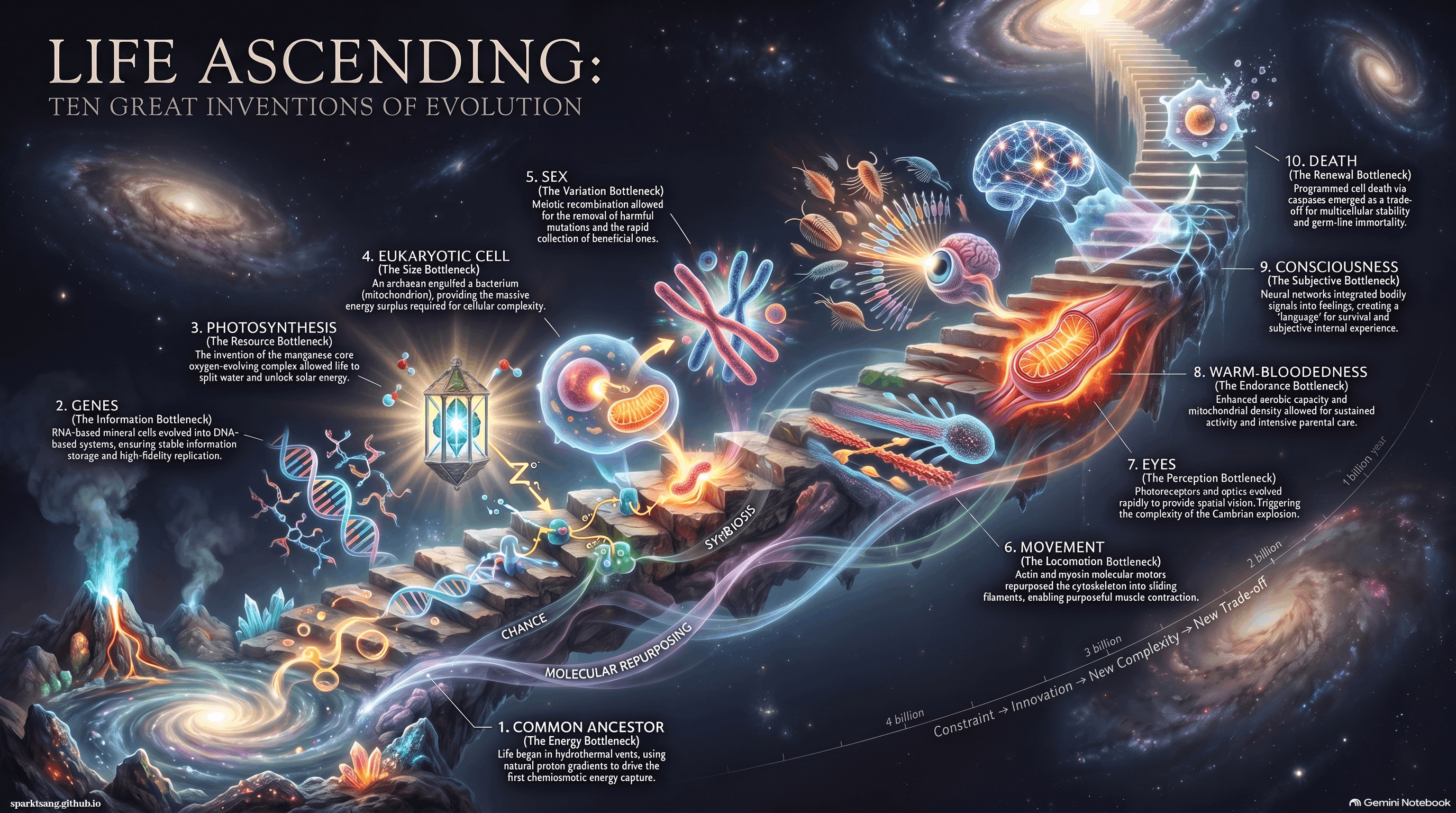
Notes on Life Ascending: The Ten Great Inventions of Evolution
Life Ascending: The Ten Great Inventions of Evolution by Nick Lane
Original notes here.
Read until the end to get a bonus. Enjoy reading.
Conditions for an evolutionary innovation to rank among the greatest innovations in the history of life:
- It transforms the entire living world of the planet.
- It goes beyond our understanding of what is important (such as the addictive power of sex and the mystery of death).
- It is the result of natural selection (rather than cultural evolution).
- It is iconic (like the universally recognized perfection of the eye, which is often used to challenge Darwin).
A celebration of how modern scientific tools have now pushed beyond the limits of genes and fossils, making great strides in deciphering the language of life—for example, X-ray technology can reveal that two bacteria possess citrate synthases whose gene sequences differ enormously while their structures almost completely overlap, like two great cathedrals built to exactly the same design even though every brick has been replaced.
The Common Ancestor
The 1953 primordial-soup experiment demonstrated that inorganic molecules could produce amino acids, but it was later discovered that Earth had never had an atmosphere filled with ammonia, methane, and hydrogen.
Scientists subsequently discovered organic molecules in space, rescuing the primordial-soup theory, but there was still a problem: from a thermodynamic perspective, the primordial soup was not in disequilibrium. There was no reason for any molecule to “want” to react.
In the 1970s, scientists discovered dynamic disequilibrium at hydrothermal vents where they met the deep sea. Sulfur bacteria extracted hydrogen from a hydrogen-sulfide-rich environment and combined it with carbon dioxide to produce organic molecules. The process required oxygen. The first person to propose that such a special environment might be related to the origin of life was Baross, a marine scientist at the University of Washington in Seattle.
However, the early Earth had no oxygen, or only very little of it. Moreover, primitive bacteria could not have respired hydrogen sulfide and oxygen to generate energy in the same way as modern organisms.
All of the above are bottom-up approaches. Conversely, we can start by tracing back to LUCA, the Last Universal Common Ancestor. It should have had characteristics including these: it was unlikely to have been photosynthetic (only a very small number of bacteria can photosynthesize), it was made of cells, its genes were made of DNA, every organism used the same coding system to map amino acids during protein translation, the same energy currency, ATP, and the same Krebs cycle as a metabolic pathway.
The Krebs cycle obtains organic molecules from food, releases hydrogen and carbon dioxide, and produces ATP. It has recently been discovered that the reactions can, in rare cases, run in reverse, taking in carbon dioxide and hydrogen to form new organic molecules. This consumes ATP—but requires ATP in the first place.
Besides the reverse Krebs cycle, there is another reaction that allows carbon atoms to enter the organic world: directly combining hydrogen atoms with carbon dioxide to produce organic molecules, while also generating energy. But it requires a catalyst and a tiny amount of energy to get started.
The enzymes that catalyze this reaction today closely resemble minerals found around hot springs, and hydrothermal vents can also provide the energy source.
The most important discovery was an unexpected reaction product, acetyl-CoA CH3CO–S–CoR’ (a thioester). When carbon dioxide reacts with it, it produces not only energy but also pyruvate CH3COCOO−—the very starting point of the Krebs cycle that made biochemists sit up and take notice.
When phosphate reacts with a thioester, it can produce acetyl phosphate, which performs a function similar to ATP.
The problem is that once you leave the hydrothermal-vent environment, there are no more free radicals. Chemical reactions must consume ATP to proceed, but ATP cannot be divided up, so there is no small change to save for later.
The solution came from Peter Mitchell, winner of the 1978 Nobel Prize in Physiology or Medicine, who proposed the chemiosmotic theory: a membrane can create a proton concentration gradient.
This made it possible to store surplus energy. Today, almost all life on Earth possesses the same chemiosmotic mechanism.
Acidity and alkalinity are defined by the concentration of protons, or hydrogen ions. When an alkaline fluid enters an acidic ocean, it naturally produces a proton gradient, automatically driving chemiosmosis.
Harnessing its own concentration gradient requires DNA and genes, so life must already have evolved considerable complexity while being incubated among minerals.
If this reasoning is correct, LUCA lived in a maze of rocks as a mineral cell, surviving on naturally occurring proton concentration gradients.
Genes
The four DNA bases, ATGC: adenine, thymine, guanine, and cytosine.
A can pair only with T, and G only with C; RNA uses AUGC, with U standing for uracil.
The human body has 15 trillion cells, so developing from a fertilized egg into a human being requires at least 15 trillion cell divisions.
A copying error occurs once in every billion letters; this is called a point mutation.
Sequence similarities can be found in the genes of different species, ranging from 25% (there is a one-in-four chance of changing back to the original letter) to 100%.
Textbooks all mention 20 amino acids: how can four DNA letters encode 20 amino acids?
This is related to the way tRNA works during translation. Combinations such as AAA are meaningless; four are eliminated, while ATC/TCA/CAT have only one meaningful reading, leaving 60 meaningful combinations corresponding to just 20 amino acids.
But why this particular genetic code? There seems to be no physical or chemical connection between an amino acid and its corresponding codon.
It turns out there is a code within the code: amino acids synthesized from pyruvate all have T as their first letter; the second letter is related to whether the amino acid dissolves easily in water, with hydrophilic amino acids all having A; for eight amino acids, the third letter of the codon has no meaning and therefore allows greater flexibility, because the third codon position arose later.
The chicken-and-egg problem of DNA and proteins: in the mid-1980s came the astonishing discovery that RNA can act as a catalyst. In the hypothetical RNA world, RNA could play both roles, serving as both DNA and protein.
This hypothesis shifted the problem from “How does the DNA code correspond to proteins?” to “What is the concrete reaction between RNA and amino acids?” Yet there is still no definitive answer.
More recently, American biochemist Harold Morowitz and others have suggested that very short fragments of RNA may also have catalytic power. The author points out that this is the line of reasoning that should be adopted for explaining the origin of the genetic code.
The problem of how RNA molecules appeared: when nucleotide concentrations become high enough, they form RNA molecules. Once the concentration falls, RNA spontaneously degrades into individual nucleotides. Every time it copies itself, it consumes nucleotides and lowers the concentration.
A crucial 2007 paper by Russell pointed out that hydrothermal vents could accumulate nucleotides to astonishing concentrations.
The problem of how the RNA world evolved: even if additional energy is supplied, all it does is make replication faster. Blind RNA would never sacrifice replication speed to manufacture proteins. The only way this could happen would be for natural selection to operate at a higher level. But what kind of selective condition would favor the formation of cells rather than simply allowing RNA to race ahead reproducing itself?
The answer is almost staring us in the face: hydrothermal vents were constantly producing inorganic mineral cells. If a particular cell contained materials especially well suited to producing more material and copying itself, it would reproduce; conversely, a collection of RNA molecules that knew only how to copy themselves but could not produce the materials required for self-replication would eventually lose out.
Computational geneticist Eugene Koonin: although DNA evolved only once, the DNA replication system evolved twice, once in archaea and once in bacteria.
The advantage of DNA: within mineral cells, mutually cooperative RNA molecules each carried a small portion of the relevant genes. Those that cooperated well could spread to neighboring cells and win out under selection. Their fatal weakness was the risk that a population would become mixed up with incompatible partners. If one cell could convert all the RNA fragments that worked happily together into a single stretch of DNA, it would possess the entire genome and preserve all the advantages. It could reproduce in a manner similar to retroviruses, transcribing all its genes into RNA and infecting neighboring cells, allowing all the genetic information to be stored back in the DNA bank. Each RNA population would then be cast directly from this bank, making errors less likely.
Converting RNA into DNA is not particularly difficult: first remove an oxygen atom—deoxygenate it—which involves only free radicals; then add a methyl group, CH3, to U to turn it into T. Methyl groups are free-radical fragments of methane, and both are abundant around hydrothermal vents.
How can one manufacture a DNA sequence identical to the RNA sequence? A reverse transcriptase is required. Today these are carried by retroviruses such as HIV. Life began in the form of retroviruses.
Photosynthesis
Without photosynthesis, Earth would be a dead world: its green color comes from chlorophyll; its blue sky from oxygen removing haze; its oceans exist because ozone blocks ultraviolet radiation and prevents hydrogen atoms in the sea from escaping into space.
The energy generated by other reactions is no match for aerobic respiration, which has an energy efficiency of 40%. Among animals and plants, only tiny nematodes can do without oxygen.
Using iron or sulfur instead of oxygen has an efficiency of less than 10%, which cannot support the predatory lifestyles of large food webs.
Collagen requires free oxygen atoms to cross-link protein fibers, so it can exist only when oxygen is abundant.
Respiration, conversely, prevents carbon dioxide from being converted entirely into biomass, allowing photosynthesis to continue.
But to keep respiration from burning through all organic molecules, some molecules must be sequestered so that they do not combine with other elements.
To this day, most of the organic carbon buried deep underground lies inside rocks rather than being accessible to human industrial technology; even if we burned all fossil fuels, oxygen levels would fall by only 0.001%.
For tens of millions of years, the two processes have maintained a balance, keeping atmospheric oxygen at 21%.
Geological events can oxygenate the Earth: when glaciers melt, enormous amounts of rain fall, and minerals and nutrients in rocks are washed by ice and rain into the sea. Photosynthetic organisms then proliferate, vast amounts of life are buried, the amount of buried carbon soars, and atmospheric oxygen consequently rises.
The emergence of lignin, which cannot readily be broken down for energy, also caused huge amounts of carbon to be buried underground.
Oxygen concentration affects ecosystems: during the Carboniferous, 300 million years ago, levels exceeded 30%, producing dragonflies the size of seagulls and centipedes a meter long. Yet these were all organisms that depended on passive diffusion of gases for respiration.
Photosynthesis did not originally have to produce oxygen: the oxygen comes from water, and photosynthesis can use iron ions or hydrogen sulfide instead of water.
The basic concept of photosynthesis is simple: solar energy splits water molecules into hydrogen and oxygen; carbon dioxide is given some electrons, then some protons are added to balance the charge, producing a sugar molecule. It is easier to obtain electrons from unstable molecules, whereas water molecules are extremely stable. Textbooks all say that water was used only after the original raw materials had been exhausted, but the geological record shows that oxygenic photosynthesis appeared very early.
Each chloroplast contains thousands of photosystem complexes, divided into Photosystem I and Photosystem II. It took us almost a century to unravel how they work.
Photosynthesis not only produces organic molecules but simultaneously produces ATP: the Sun generously serves two lunches at once. The popular science book Eating the Sun comes highly recommended.
A photon strikes the first photosystem, exciting an electron to a higher energy state. The electron passes through several steps, releasing energy to synthesize ATP. It then reaches the second photosystem, where another photon excites it to an even higher energy state, after which it is transferred directly to carbon dioxide to synthesize sugar. The pathway resembles a Z or N and is known as the Z-scheme.
Water molecules are extremely stable, so stealing electrons from them is extraordinarily difficult and requires a powerful oxidizing agent. Carbon dioxide is also highly stable, and only a powerful reducing agent can donate electrons to it. The two functions are performed by different forms of chlorophyll, the latter involving NADPH.
The system has five stages: the Oxygen-Evolving Complex holds water molecules in place and extracts electrons from them one by one, releasing oxygen; Photosystem II is activated by light and captures the electrons; they are then passed along continuously, releasing energy to generate ATP; at Photosystem I, another photon pushes the electrons to a higher energy state, where NADPH stores them; finally, NADPH activates carbon dioxide and converts it into sugar.
Photosynthesis evolved only once. Chloroplasts have their own genes, like bacteria living inside a host as parasites. Their closest relatives are cyanobacteria, the only bacteria capable of oxygenic photosynthesis.
Chloroplasts entered their hosts more than a billion years ago, and their ancestral hosts gave rise to the two great kingdoms of plants and algae.
Scientists today have little disagreement about the positions of the 46,630 atoms in Photosystem II. When the author wrote this book, however, he had just attended a Royal Society symposium where there was considerable disagreement over the precise positions of five atoms in the Oxygen-Evolving Complex. The reason for digging so deeply into this question is that it bears directly on the detailed chemical mechanism by which water is split, which in turn is crucial to solving the world’s energy problem.
Blankenship demonstrated that the core structures of the two photosystems are the same, meaning they evolved from a common ancestor.
How did two systems that work in opposite directions evolve in opposite directions and then reconnect to function together?
Outside cyanobacteria, the two photosystems never occur together in bacteria. Some bacteria have only Photosystem I; others have only Photosystem II. Studying them may answer the question above.
Bacterial Photosystem I: it pulls electrons from inorganic substances and gives them to carbon dioxide to make sugar, again using NADPH. This can be chemically synthesized at hydrothermal vents. Therefore, the only innovation in plants was learning to harness light energy instead of chemical energy. Converting light into chemical energy, however, is something almost all pigments can do: after absorbing a photon, a pigment can push an electron to a higher energy state, making it easier for a neighboring molecule to capture it. This leaves the pigment positively charged, so it takes an electron from an inorganic substance. Chlorophyll is a porphyrin, and porphyrins can be synthesized inorganically, so the system only needs a pigment to use light energy to pull electrons from inorganic matter.
Bacterial Photosystem II: it cannot produce organic molecules, but it can convert light energy into chemical energy. A photon strikes chlorophyll, exciting an electron so that another molecule can capture it. The electron then passes through an electron transport chain, releasing energy to synthesize ATP. It is like respiration, except the electron is not passed to oxygen to produce water; instead, it returns to the original chlorophyll.
How did the two systems merge? The author cites Allen’s hypothesis. In bacteria, turning genes on and off in response to environmental changes is extremely common. When the environment lacks a particular raw material, the bacterium shuts down the production line for the proteins that process that material until a new signal arrives. Bacteria may already have possessed both photosystems, but used only one at a time. When hydrogen sulfide was available, they activated Photosystem I to make organic molecules; when the raw material became scarce, they switched to Photosystem II to use sunlight to produce ATP and bide their time. To protect proteins from being shattered by ultraviolet radiation, bacteria use manganese atoms as shields. This process releases electrons, clogging the electron transport chain of Photosystem II, as if everyone had caught a ball and no one could pass it on. At this point, all that was needed was a small mutation that put Photosystem I in place to absorb the excess electrons, and the two systems merged. A tiny mutation produced a world-changing transformation.
How did the system go from taking electrons from manganese to taking them from water? The Oxygen-Evolving Complex is a peripheral structure of Photosystem II. It consists only of four manganese atoms, one calcium atom, and several oxygen atoms woven together. Oxidized manganese atoms can pull electrons out of water. Once this system became associated with chlorophyll, the latter gradually adapted to the task, and electron flow accelerated. This became the ultimate source of food and oxygen.
Chemists around the world are competing to synthesize this tiny manganese core artificially. If water can be split and hydrogen and oxygen then allowed to react again, energy can be released, and the hydrogen economy could solve the energy crisis without pollution.
Eukaryotes
The evolution of bacteria into complex cells happened only once in the history of life. The earliest complex cell became the common ancestor of all complex life, that is, eukaryotes.
Bacteria are structurally extremely simple, stripped down to the minimum and highly efficient, retaining the smallest possible number of genes. Under environmental pressure, they can pick up additional genes from other bacteria and simply discard them when they are no longer needed.
Complex life has a nucleus and is called eukaryotic life; bacteria are prokaryotic life, without a nucleus. A eukaryotic cell is on average 10,000 to 100,000 times larger by volume than a bacterium, packed with different structures, each with its own function. The most important is the mitochondrion, the cell’s power plant, of which a typical eukaryotic cell contains hundreds.
Almost all eukaryotic cells have male and female forms and reproduce sexually; some cells can digest other cells, such as immune cells that engulf bacteria.
From four billion to one billion years ago, bacteria dominated. Around 2.2 billion years ago, the Great Oxidation Event permanently transformed Earth. There were other dramatic environmental changes as well, but bacteria remained bacteria; all the spectacular radiations in the history of life were accomplished by eukaryotes.
Modern gene comparisons can identify relationships among eukaryotes and draw a tree of life. But because there is a one-in-four chance of changing back to the original letter, statistical uncertainty is unavoidable. The only solution is to carefully choose the genes used for comparison.
Genes inside eukaryotic cells fall into two major categories. One class resembles those found in bacteria; the other is unique to eukaryotes. The latter evolved so rapidly that they are difficult to compare.
In the 1970s, American microbiologist Carl Woese selected a gene from the former category that transcribes RNA belonging to the ribosome and is responsible for core cellular information processing. From it he constructed the three-domain tree of life. Before this, archaea had simply been treated as a kind of bacteria. The distinction gradually became clear: their membrane lipids are produced by different enzyme systems, their cell-wall components differ, and their internal metabolic processes are different.
Archaea and eukaryotic cells, by contrast, are closely related: their core information-processing systems are similar, their genes are wrapped around similar proteins, and their mechanisms for copying and reading genes and making proteins are similar.
Yet when other genes that also evolve slowly are compared, it becomes increasingly clear that eukaryotic cells did not evolve in the traditional way. They are half-archaean, half-bacterial chimeras.
Two processes disrupt the traditional tree of life: horizontal gene transfer and whole-genome fusion.
If eukaryotic cells evolved in the traditional manner, there should be a gradual central lineage: a primitive predatory cell that, at some point, swallowed a mitochondrion.
The difficulty is that no eukaryotic cell lacking mitochondria has survived to the present day. Every eukaryotic cell alive today has had mitochondria at some point.
At the same time, mitochondria are power plants, not places for storing genes. Why, then, have they retained some genes rather than transferring all of them to the nucleus?
Allen: mitochondria need constant feedback to provide energy, so they cannot be controlled from a central command center. A bacterium that can respire only through its outer membrane cannot control respiration across a much larger inner membrane and, under natural selection, cannot split off several groups of genes in the way mitochondria do. It therefore cannot become larger and more complex.
Thus the two bacteria formed an alliance, breaking the energy constraint that had kept bacteria forever as bacteria. It was a fantastically rare encounter in which chance and necessity converged.
Once the encounter occurred, just as in symbiotic relationships among prokaryotic cells, the two would evolve together, redundant functions would disappear, and the engulfed bacterium would ultimately be left responsible only for its core service.
Why is a nucleus necessary? Martin and Koonin: early eukaryotes were constantly disrupted by introns produced by jumping genes that replicated themselves furiously and infected other genomes. Half of the human genome consists of intact jumping genes or their decayed remnants.
An intact jumping gene cuts itself out, but a remnant does not. To solve the disturbance they caused, eukaryotic cells evolved a system that uses the jumping genes’ own RNA scissors to cut out unwanted RNA.
But the scissors were too slow. To give them enough time, a membrane with a large opening could be used to separate ribosomes from neighboring genes.
Once jumping genes ceased to be a threat, introns became useful. They allowed genes to be combined and recombined in novel ways to splice together different proteins, turning eukaryotic cells into tireless experimenters: just 25,000 human genes can produce at least 60,000 different proteins.
Another advantage was that eukaryotic cells could expand their genomes, accumulating almost unimaginable quantities of DNA and making the complex world of multicellular life possible.
Bacteria reproduce too quickly, and their ribosomes translate proteins too quickly for the scissors to work. How they avoid the harm caused by jumping genes and introns remains unknown.
Sex
Sex can be lethal. Two good genes can combine to become bad ones; sexually transmitted diseases run rampant; sex carries biological costs, such as the peacock’s display attracting predators; offspring inherit only half of their genes; asexual reproduction can double reproductive success; and sex throws the door wide open to disruptive selfish genes.
Yet almost all eukaryotes are addicted to sex. Species that have returned to asexual reproduction, such as dandelions, have usually done so for only a few thousand years. Bdelloid rotifers, with histories extending back tens of millions of years, are extraordinarily rare exceptions.
Darwin: offspring produced by distant relatives are healthier. But the problem is that this is a benefit of outbreeding—the mixing of different chromosomes—not a benefit of sex itself.
Weismann: sex can collect multiple beneficial mutations and pass them on to future generations. Under asexual reproduction, beneficial changes must accumulate consecutively within a lineage to achieve the same result.
Muller: under asexual reproduction, harmful mutations accumulate because mutants happen to encounter periods of abundant food and survive. This degeneration of fitness is known as Muller’s ratchet. Sex can recombine the mutation-free genes.
Kondrashov: two premises. First, the mutation rate is faster than previously imagined, with every individual acquiring at least one harmful mutation per generation. Second, most organisms can tolerate a collection of mutations before they begin to deteriorate. Therefore: first, even populations of enormous size cannot escape Muller’s ratchet; second, sex can eliminate multiple harmful mutations at once by removing the affected individuals.
By the first half of the twentieth century, the idea that sex could combine benefits and eliminate harmful mutations, thereby benefiting populations, had become a consensus.
Fisher’s concern emerged in the mid-1960s: natural selection acts on the level of the individual, not the population.
Williams: initially, sexual organisms must have an advantage beneficial to individual organisms before sex can spread through the whole population.
He also proposed that sex is advantageous under dramatic environmental change, but this did not fit actual environmental data.
Hamilton argued that sex was beneficial in competition with parasites, but Maynard Smith, based on computer simulations, pointed out that infection rates would have to be extremely high and their effects on hosts enormous before sex would necessarily become advantageous.
The mathematical models of Barton and Otto finally demonstrated that sex benefits not only populations as a whole but individuals as well:
In a finite population, without recombination, a chromosome and all the genes on it form a single fate-sharing unit. Beneficial mutations are often cancelled out by weak selection acting on the other genes—this is selection interference. For a beneficial mutation to spread, it has to carry the entire chromosome and all its other genes with it, causing genetic diversity in the population to disappear.
Studies show that poor genetic variation is widespread among asexual organisms, and even species that reproduce sexually only occasionally suffer badly from it.
When genetic variation is high, mutation rates are high, and selection pressure is high, the three together bring the advantage of sex to its peak.
It is now a consensus that the common ancestor of eukaryotes was sexual, and its ability to eliminate asexual relatives is related to mitochondria: whenever one of these bacteria died, its genes were released and randomly incorporated into the host chromosome. The host had no way to prevent these jumping genes from copying themselves, eventually causing its circular chromosome to be cut into a linear form—the common form of eukaryotes.
Evolution became extremely rapid and variation became high, but only a small fraction of mutations were beneficial. One beneficial mutation could open a thousand divergent paths. Only sex could collect the various beneficial mutations and bring the nucleus, cytoskeleton, and targeted protein-transport systems together in a single cell.
Was there enough time for sex to evolve? Yes. It requires only three steps:
Cell fusion: all that is needed is the loss of the cell wall.
Chromosome segregation: mitosis needed only a small change to become meiosis. When a cell could no longer completely digest the cohesin proteins that hold chromosomes together, the residual protein could confuse the cell, making it mistake the situation for a signal and triggering a second round of chromosome division before the first had been fully completed.
Genetic recombination: as in bacteria, the advantage of recombination is an expanded gene pool. Making recombination a routine part of meiosis should likewise have been fairly simple.
Movement
When the populations of many species are evenly matched, ecosystems become highly complex. After the Permian mass extinction, ecological complexity rose rapidly. Wagner argued that this was because the expansion of mobile organisms promoted interactions among species, giving animals goals toward which they could move.
Movement also drove the evolution of flowers and fruit: these were all plants’ responses to the animal world.
Scientists knew as early as the Victorian era that muscles consisted of thousands of fibers, each divided into segments called sarcomeres, the basic units of contraction. Muscle contraction is driven by electricity, and the principal protein is myosin, but how the system actually worked was still unknown.
The sliding filament theory gradually unraveled the mystery of muscle function. Muscle contraction depends on myosin, which is eight times larger than an ordinary protein, shaped like two sperm heads side by side with their tails intertwined, and actin. Thick and thin filaments consist of the two respectively, each bundled into a strand and arranged in parallel. Cross-bridges set at right angles can swing back and forth like long oars.
The mechanism: cross-bridges projecting from the thick filament, as subunits of myosin, attach themselves to actin fibers. Once attached, they can bind to an ATP molecule. The energy is sufficient to drive the entire process, after which the cross-bridge is released, swings forward by 70 degrees, and attaches again to the actin.
Saitou Naruya and Ohta Satoshi: the proteins of mammalian skeletal muscle and insect striated muscle are extremely similar, indicating that they came from the same common ancestor.
The divergence between striated and smooth muscle can be traced even further back, to before the appearance of bilaterians.
A startling study showed that even organisms without muscles, such as slime molds, possess actin. All complex cells have a cytoskeleton formed from actin.
Around the turn of the millennium, scientists used crystallography to discover that the cytoskeletal proteins of bacteria and eukaryotic cells can be completely superimposed structurally. The cytoskeleton can move itself without the assistance of motor proteins.
Actin fibers and microtubule fibers are both formed by linking repeated protein subunits into long chains, making polymers. What is remarkable about the cytoskeleton is that its structure remains in a dynamic equilibrium between assembly and disassembly.
Mitchison: in sickle-cell anemia, mutated hemoglobin polymerizes inside cells into a mesh-like structure, demonstrating that a tiny mutation can give a protein the ability to polymerize spontaneously into fibers.
Remarkable movement depends on only a small group of proteins and their countless transformations.
Eyes
Of the 38 animal phyla, only six have eyes, yet 95% of animal species have eyes.
The first eye appeared 540 million years ago. Parker’s In the Blink of an Eye argues that the spatial vision produced by eyes caused the Cambrian explosion.
Larvae of blind shrimp from the Mid-Atlantic Ridge possess complete eyes, but adults have only exposed retinas: resolution and sensitivity cannot both be maximized. Sensitivity is the ability to detect light; to push it to the limit, everything that makes images sharp must be sacrificed. The largest possible aperture is therefore no aperture at all.
Neuroscientist Land: adding a lens to the nautilus eye increases sensitivity 400-fold and resolution 100-fold.
According to the conservative calculations of Nilsson and Pelger, 500,000 years is enough time to evolve a complete eye.
Trilobites possessed the first true eyes, but they were not the most memorable innovation in evolutionary history, because they had no lenses, only mineral crystals: any lens is better than no lens.
The transparent, blood-vessel-free human lens is made of cells that have lost all their normal functions. Of the 11 lens proteins we can distinguish, only three are found in all vertebrates, each recruited independently to work in the eye.
Tunicates have lens proteins in their brains, and the genes regulating their activity are the same as the genes that control lens development in vertebrates, revealing the origin of the vertebrate lens.
The common inheritance of vision is now accepted: inserting a mouse gene into a fruit fly can make it grow compound eyes. The genes controlling eye development are the same set, and photoreceptor cells evolved only once.
The marine ragworm Platynereis is a living fossil of the common ancestor of vertebrates and invertebrates. Two kinds of photoreceptor cells have been found in it. One is used for the biological clock, and even bacteria use the same kind of biological clock. Later studies confirmed that rhabdomeric photoreceptors evolved from the common ancestor; they subsequently split in two, one becoming associated with eyes and the other with the biological clock. Vertebrates and invertebrates then chose the opposite cell types for these two functions.
The range of visible light depends on visual opsins. Red- and green-sensitive opsins were duplicated from the primate common ancestor, giving primates trichromatic vision again (most other mammals have only dichromatic vision). This may help them distinguish red fruit from green leaves, or perhaps process emotional signals: trichromatic primates all have hairless faces.
The other vertebrates all have tetrachromatic vision. Insects can also see ultraviolet light, so a white flower is filled with entirely different colors and patterns in their eyes.
Unexpectedly, the rhodopsin of Volvox appears to be the ancestor of all animal visual opsins. It may have come from chlorophyll or its cyanobacterial ancestor, perhaps obtained through the ingestion of a chloroplast by some protist.
Warm-Bloodedness
Birds and mammals can produce 10–15 times more internal heat than lizards, but they must eat 30 times as much to maintain their metabolism.
Most reptiles are remarkably good at absorbing sunlight and can raise their core temperature to levels comparable to birds and mammals.
Large reptiles have higher body temperatures because they have a lower surface-area-to-volume ratio.
The advantages of warm-blooded animals include nocturnal activity, expansion of territory, and support for larger brains. But they produce far fewer offspring, the cost remains severe, and most animals still have to sleep at night.
The core advantage is endurance: cold-blooded animals rely on anaerobic respiration and cannot sustain activity for long, quickly becoming immobilized by lactic acid buildup.
The more muscle fibers there are, the greater the force, but the less room there is for capillaries and mitochondria, so endurance declines.
Bennett and Ruben’s 1979 aerobic-capacity hypothesis: natural selection did not select for body temperature itself, but for increased activity. Pawel Koteja supplemented this with the resulting advantage of intensive parental care.
Bennett and Ruben connected the two into an explanation of warm-bloodedness: maximum metabolic rate is correlated with resting metabolic rate. Animals that metabolize rapidly even at rest are therefore warm-blooded.
Recent research: the emergence of warm-bloodedness was mostly associated with enhanced organs and dense populations of mitochondria.
At the beginning of the Triassic, 95% of herbivorous land animals were Lystrosaurus. By the middle, cynodonts had gradually replaced them. They displayed characteristics of high aerobic capacity: hard palates, broad chests, and respiratory turbinates, which occur in birds and mammals but not reptiles. By the late Triassic, archosaurs dominated.
Bird lungs can extract two to three times more oxygen than mammalian lungs. In 2005, O’Connor of Ohio University and Claessens of Harvard published research showing that other theropods possessed air sacs and hollow bones, making it highly likely that they had, like birds, the most efficient respiratory system among vertebrates.
Combined with feathers and a four-chambered heart, inherited from archosaurs, theropods should have possessed endurance.
Return to the Permian mass extinction: enormous amounts of carbon dioxide, methane, and toxic gases entered the atmosphere, while oxygen fell from 30% to below 15%. The survivors were the animals best able to breathe. Endurance was the lifesaving elixir of the time.
Why did theropods, rather than animals that already resembled warm-blooded organisms, come to dominate? An authoritative 2008 paper argued that herbivores need to consume enough nitrogen, which means taking in excess carbon atoms. The solution is to burn them off, thereby creating warm-bloodedness. Cold-blooded animals cannot do this, which is why there were very few herbivorous lizards and not a single herbivorous snake.
This may explain why carnivorous theropods, which did not face the problem of nitrogen balance, did not need to become warm-blooded, while the ancestors of birds became warm-blooded after adopting herbivory and needing to consume large quantities of food. Semi-herbivorous dromaeosaurs have now been discovered.
Consciousness
In 1996, the Pope acknowledged evolution but argued that the metaphysical mechanisms of the mind lay far beyond what science could see, thereby distinguishing the Church’s teaching authority and placing it above evolutionary theory.
How neural signals produce sensations is a biochemical problem. External objects never enter the brain; only neural signals do. After being reprocessed by the brain, they are projected back to their original locations.
Dr. P, who suffered from visual agnosia, mistook his wife for a hat. Patients with Capgras syndrome see family members but, because the neural connections linking them to emotional responses have been severed, they fail to experience the emotions they should and the brain concludes that the person is an impostor in disguise. Patients with Cotard syndrome experience no emotional response to any stimulus, so the brain tells them they are already dead. Brain injuries follow patterns.
Several decades ago, in volunteers with severe epilepsy, scientists discovered that stimulating particular regions of the brain could produce intense feelings of depression, recall of musical melodies, sensations of leaving the body, and so on.
The “God Helmet,” which generates a magnetic field, can make 80% of people feel that God or a demon is present in the room.
Damasio: emotions are real bodily experiences, while feelings are secondary projections in which we become conscious of those experiences.
Edelman proposed neural Darwinism: combinations of neurons are selected according to whether they can form the greatest number of synaptic connections. During the first few months after birth, 20% to 50% of neurons die, hundreds of billions of weak synapses disappear, while tens of trillions of synapses are strengthened.
The neural handshake theory: neurons that fire more rapidly are used to distinguish different features, while slower neurons integrate all the information into a unified consciousness.
Yet none of the above explains how neurons produce sensations, nor what the material basis of sensations is. James believed there was something like mind-dust distributed everywhere. Although he was famous in academia, few people followed this line of thought.
Chalmers: if feelings correspond to none of the known properties of matter, then matter must possess additional subjective properties that can be selected by natural selection as our internal experiences.
Cairns-Smith: feelings are produced by a group of proteins vibrating coherently through quantum effects. But it is difficult to explain how quantum vibrations could leap across the synaptic gap; replacing the universe of neural networks with a quantum universe does not solve any problem either.
Edelman: a particular pattern of neural signals must necessarily be accompanied by a particular sensation.
Musacchio: brain surgery is completely painless. The mind does not feel the existence of the brain. The basis of consciousness is that “you only need to know this much.”
It is like natural selection selecting proteins rather than gene sequences. Protein-coding genes are subject to strict constraints, but only genes can be inherited, so there is no difference in the end. If a particular group of neurons consistently produces the same sensation when firing a particular signal, then natural selection can effectively select for the neural property itself.
The author: sensation is a complex and ineffable language. Red itself does not actually exist; it is simply a particular structure of neural signals. The language used to describe sensations is itself the product of another pattern of neural signals, like translation between languages.
Children with hydrocephalus who lack most of the cerebral cortex can nevertheless display clear signs of consciousness. The roots of consciousness therefore seem not to lie in the cortex but in older regions, although the cerebral cortex certainly makes consciousness vastly more sophisticated.
Feelings seem so real because of the significance forged through the brutal testing of natural selection, and that significance concerns life and death.
Death
Algal blooms three billion years ago could disappear without warning, just as they can today, because they could kill themselves in complex ways.
Death may have originated as something driven by viruses, causing the strongest individuals to become spores ready to form the next algal bloom, while their weaker siblings killed themselves to avoid suffering the consequences.
Caspases, enzymes capable of shredding cells from within, may have evolved in cyanobacteria.
The Weismann Barrier explains the mystery of death in multicellular organisms: somatic cells are supporting actors whose function is to help immortal germ cells, and their time of death is determined by the needs of the latter.
Mitochondria also possess caspases, inherited perhaps from cyanobacteria or from the common ancestor of the two.
Eukaryotes independently evolved multicellularity five times: red algae, green algae, plants, animals, and fungi. Yet all use a caspase-based death machinery to regulate cells and punish those that overstep the bounds.
Medawar: individuals that mature and die earlier are more likely to leave more descendants than those that move more slowly through life.
Williams: genes that promote early success are retained even when they cause severe damage later. For example, Huntington’s disease, which causes complete deterioration in middle age, is associated with greater sexual success when the patient is young. The ApoE4 gene, which has been shown to be associated with a series of degenerative diseases, may likewise provide major benefits earlier in life.
Most diseases of aging are influenced by interactions among numerous genetic and environmental factors, rather than by a single cause.
In 1998, Friedman and Johnson discovered the age-1 mutation in nematodes, which can extend their lifespan by more than twofold, shocking the scientific community. From fungi to mammals, the same special mechanisms are used to control lifespan, establishing the relationship between aging and age-related disease.
Caloric restriction has revealed that some biochemical reactions force longevity and sexual activity to trade off against each other. Yet there are also mutations in some longevity genes that can simultaneously extend lifespan and improve health while having only a minimal suppressive effect on sex.
Two such longevity genes, SIRT1 and TOR, have attracted particular attention. Resveratrol activates the former, while rapamycin, which affects the latter, has become one of the most successful immunosuppressive drugs. But both affect such a wide range of processes that using them as anti-aging drugs creates problems. As for which of the genes they influence are actually responsible for extending lifespan and preventing disease, and what their precise mechanisms are, there is still no consensus.
Harman proposed in the 1950s that free radicals attack cells and cause aging, and that antioxidants could delay the process. It is now known that this was completely wrong: free radicals activate important proteins, while antioxidants interfere with signal transmission.
Lifespan is nevertheless related to the rate of free-radical leakage. When mitochondria suddenly leak large quantities of free radicals, cells activate their death machinery. This can also explain why animals of similar metabolic rate and body size can have very different lifespans: pigeons live ten times longer than rats because their free-radical leakage is lower.
The mitochondrial-DNA research of Masashi Tanaka’s team confirmed that a variation that slightly reduces free-radical leakage cuts the likelihood of being hospitalized at age 80 to half the normal rate and doubles the proportion of people who live to 100.
Quoting the great evolutionary biologist Theodosius Dobzhansky: without the light of evolution, nothing in biology makes sense. If we devoted even some of the effort currently spent on modern medical research to understanding the mechanisms of aging, it would be surprising if we still could not find an elixir of youth within 20 years.
Neurons cannot be replaced. Based on each individual’s unique experiences, they form 10,000 synaptic connections. To replace them all with new ones would mean that the price of immortality is the sacrifice of humanity.
30/11/2021 Finished reading at Eslite Bookstore, Starlight Walk
Thank you for reading until the end. This is a bonus infographic just for you.