Notes on Masters of the Planet
Masters of the Planet: The Search for Our Human Origins by Ian Tattersall
Original notes here.
Read until the end to get a bonus. Enjoy reading.
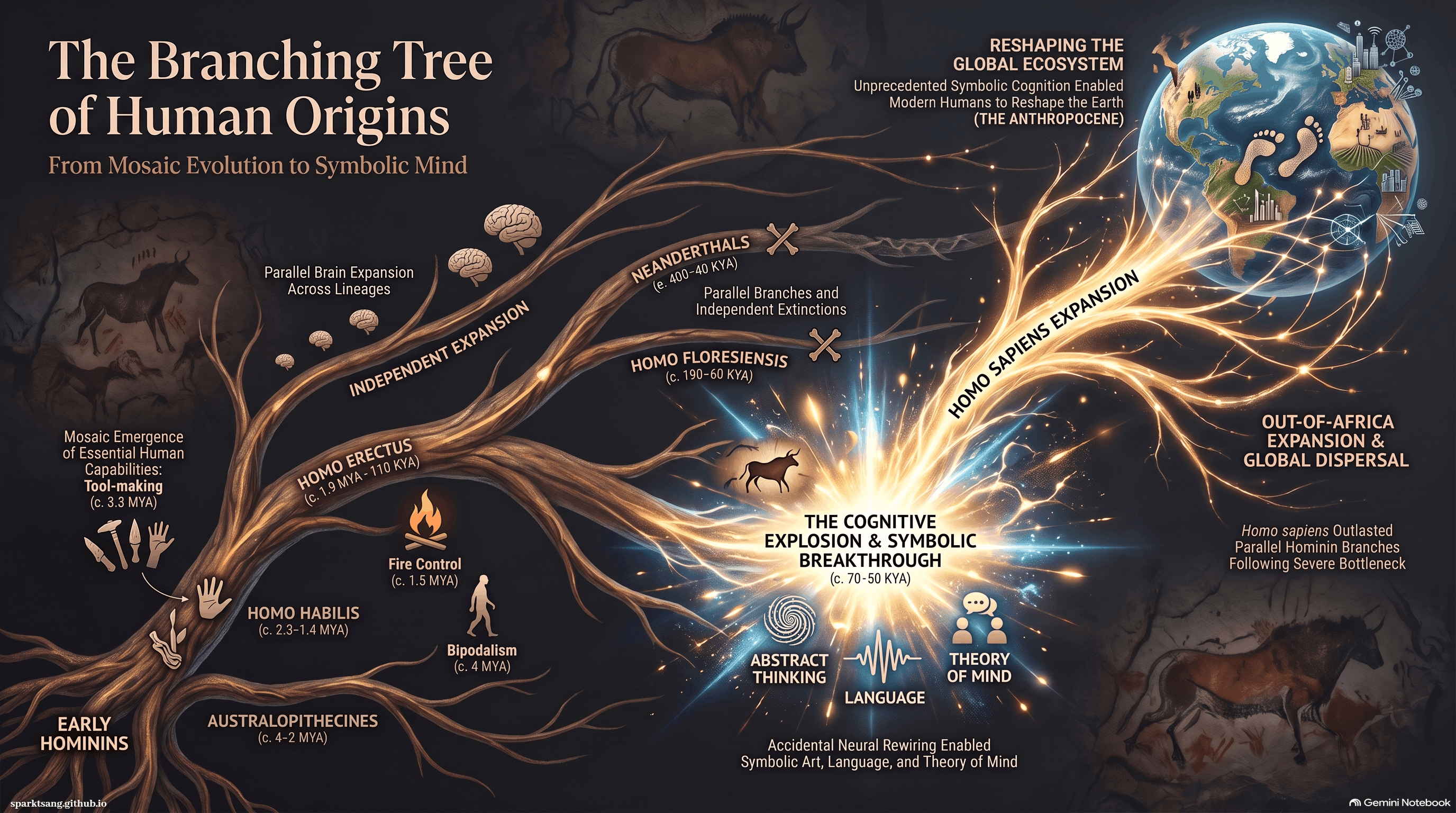
The art of the Altamira Cave in Spain, the Lascaux Cave in France, the Chauvet Cave, and others is extraordinarily outstanding. It is not entirely realistic but also carries symbolic meaning, showing that early humans possessed a highly developed mind and the capacity for symbolism
Symbolic reasoning is absent in humanity’s living closest relatives, and even the earliest humans who appear almost identical to us seem to be no exception
Apes walk quadrupedally on their knuckles, while humans stand upright and walk bipedally. In principle, our common ape-human ancestor should also have walked on its knuckles, and our ancestors should therefore show some evolutionary traces of this; yet Ardipithecus, nicknamed “Ardi,” neither walked on its knuckles nor showed any anatomical traces of a knuckle-walking ancestry, and its feet were unlike those of hominins, being good for climbing but poorly suited to walking on the ground
No comparable body-skeletal structure can be found today, so even if it belongs to the hominins, it is not an ancestor of modern hominins
Why did hominins take to the ground in the first place? Darwin’s theory that freeing the hands provided an advantage is uncertain, because hominins first came down to the ground and only made tools much later
Was it related to energy? Although bipedal walking can consume less energy, running consumes more, so it is unlikely that energy efficiency was the reason
The thermoregulation theory: standing upright in the open reduces the surface area exposed to the scorching sun, while losing body hair would likewise help with sweating; but hominins had already come down to the ground before the forest canopy disappeared
The farther-visibility theory: there was no real savanna at the time; the fruit-gathering theory: chimpanzees only need to stand up occasionally to reach fruit, with no need for prolonged upright posture
The advantages and disadvantages of bipedalism seem to have arrived all at once. Quadrupedal animals would not violate their instincts and stand up merely because of the potential advantages imagined by modern researchers; rather, the associated evolutionary hurdles must have been overcome, making standing upright a perfectly natural act
Just as orangutans remain upright among the trees and walk on two legs when they occasionally come down to the ground
Bipedal walking in apes is like a pair of compasses: each foot has to use the other as its pivot to draw a large circle, consuming enormous amounts of energy, so they quickly become tired
The oldest hominin whose bipedalism is one hundred percent certain is Australopithecus anamensis. Its finger bones show that it could still climb deftly, while its skull looks ape-like; it is the ancestor that currently seems the best candidate for Australopithecus afarensis
The representative of Australopithecus afarensis is Lucy. The angle between the femur and tibia exhibits the “carrying angle” characteristic of bipedal walking, and it also possessed a human-like pelvis. Its age is closer to the common ancestor of apes and humans than to modern humans, yet its form does not resemble what one would expect between ape and human; its foot proportions were longer and better suited to life among the trees, while its diet was more omnivorous than that of apes
Bipedal footprints dating to 3.6 million years ago were also discovered at Laetoli, but whether they should be attributed to Australopithecus afarensis remains controversial
Alongside “Selam,” cut marks from stone tools were found, yet no durable stone tools could be found, strongly suggesting that although they did not make formal stone tools, they were able to use sharp stones to cut up large animals. This was 3.4 million years ago, whereas the earliest stone tools were discovered only 2.6 million years ago
The famous bonobo Kanzi, despite extensive training, was still unable to make stone tools. In the end, he could only smash stones against the ground to obtain the sharpest fragments and use them to cut ropes and get at his food
The modern human digestive tract is more like that of a herbivore, yet many independent lines of evidence suggest that hominins had been eating meat for a long time; tapeworms, for example, may have entered the human body through sharing antelope carcasses with carnivores
Signs of skeletal deformity were found in material dating to 1.7 million years ago, seemingly caused by excessive vitamin A intake, while vitamin A may have come from the livers of carnivores
Carbon isotopes in bones can reveal dietary content, and C4 pathways show that several australopithecine species ate meat
Since they could neither run fast nor grow large, they could only have been scavengers, yet this is uncommon among primates: a carcass that is not fresh is poisonous, and chimpanzees eat a fresh carcass only once in ten encounters, so they may have been able to steal fresh carcasses hidden by other animals
Chimpanzees can use sharpened sticks to kill infant monkeys and sometimes hunt red colobus monkeys collectively, but this has nothing to do with dietary requirements. It is also common for foraging chimpanzees simply to ignore passing red colobus monkeys. Males are more likely to share with other males, while food given to females usually comes after mating, so this seems unrelated to attracting mates and more about maintaining alliances
Chimpanzees may suggest that early hominins likewise did not initially rely on hunting as their primary food source
Driving large carnivores away from kills, using only the throwing of heavy objects, suggests that early hominins were already living in large, tightly integrated groups
Evidence shows that when butchering the carcasses of large animals, they would bring suitable heavy stones with them. These australopithecines were evidently the smartest creatures around at the time; chimpanzees only use whatever happens to be available on the spot
A great deal of evidence indicates that early hominins were frequently preyed upon, making group living and maintaining a flexible social organization even more necessary
A recurring pattern throughout hominin evolution: new technologies usually have nothing to do with the appearance of new hominin species; instead, an old hominin species starts making new things
Mirror self-recognition is extremely rare outside humans and apes, and it is almost certain that the mechanism underlying it is different from that in apes and humans
The distinguished chimpanzee cognitive scientist Povinelli points out that chimpanzees lack the ability to recognize that others have an inner mental world, and therefore should likewise lack the capacity for introspection; this should presumably apply to other early hominins as well
The concept of preadaptation: the ancestors of birds first possessed feathers and only flew many years later; the ancestors of quadrupeds acquired limbs in a completely marine environment: the potential to make stone tools likewise lay dormant for a very long time before being expressed through invention
Hominins entered new adaptive zones, followed by adaptive radiation; chimpanzees, by contrast, did not become more diverse after expanding their range
Australopithecine species underwent vigorous adaptive radiation and can be divided into robust and gracile forms. Both were opportunistic fruit-eaters (one could say omnivores, unlike the forest-based diet maintained by chimpanzees). For most of the year their diets were similar, but when food became scarce, the two forms had different fallback foods: those of the robust form were hard and brittle, while those of the gracile form were easier to bend
Defining the ancestors of the genus Homo is extraordinarily difficult, mainly because the fossil evidence is so fragmentary
Adaptive radiation is now firmly supported by the evidence, but the idea of gradual hominin evolution has long dominated academia. The ornithologist Mayr, for example, strongly argued that only one human species might exist at any given time; for a period, paleoanthropologists were afraid to use zoological names at all, and even after they dared to, they tended toward extreme minimalism
Later the situation improved, and some fossils removed from the genus Homo were assigned to the newly established genus Kenyanthropus
The Turkana Boy, dating to 1.6 million years ago, is the nearly complete skeleton of an East African Homo ergaster, with body proportions basically identical to those of modern humans and a medium-sized brain
No intermediate species between australopithecines and Homo ergaster has been found, and perhaps precisely because there is none: newly discovered protein-coding genes account for only about 2% of the entire genome, while the remaining genes regulate these coding genes, affecting when their development begins and how long it lasts. Mutations in them can therefore dramatically alter a species’ morphology, such as in benthic sticklebacks, where the entire set of spines can be removed at the base
At birth, apes have a brain volume equal to 40% of their adult capacity, whereas human newborns have only 25% of the adult brain volume. In this respect, Homo ergaster and other Homo erectus are more ape-like than human, and cognitively quite different from modern Homo sapiens; moreover, Homo sapiens is itself a major outlier in brain size relative to body size, while the gap among these earlier forms is not striking
An endocranial cast of the Turkana Boy revealed Broca’s area, associated with language, showing the potential to generate speech, while neurological evidence establishes that they did not possess language
Overall, since the time of the Turkana Boy, the thickness of the limb bones has declined dramatically, reflecting the growing secondary importance of physical strength
Homo ergaster’s brain had already enlarged and required a high-quality diet. The gut and brain consume comparable amounts of energy, so the reduction in gut size was both a necessary trade-off for brain expansion and a factor that increased the demand for high-quality food
But the Turkana Boy lived in the dangerous African savanna—how did they adapt? It may have been fishing, or, having already become naked apes that could sweat more efficiently, they may have been able to pursue antelope for long periods until the animals suffered heatstroke and collapsed. They may even have had water-storage containers
Primates are not naturally good at digesting raw meat unless it is cooked. Direct evidence is still lacking, but during the period of Homo ergaster, fires were already burning at hominin sites, and fire could also scare off predators
The earliest members of Homo ergaster used the same stone tools that their ancestors had used for hundreds of thousands of years, showing that hominins tended to use existing toolkits in new ways rather than invent new technologies
The size of Homo ergaster groups remains conjectural. Since their females had no fur for infants to cling to, the infants may have required a separate means of accommodation
Dmanisi fossils dating to about 1.8 million years ago provide the first evidence that hominins left Africa. They demonstrate that leaving Africa was not caused by improved tools or larger brains, but by changes in body form; climatic change may also have been involved
The clearly seasonal climate of the time is strong evidence that the Dmanisi hominins were versatile
One skull belonged to an old male with only a single tooth remaining, and most of his other teeth had disappeared long before his death, providing strong evidence of compassion and communal cooperation (although toothless chimpanzees can occasionally survive for a while, their food is soft)
The Acheulean culture, named after the French site where it was first identified, produced large numbers of deliberately made handaxes and cleavers (invented first in Africa and later spreading elsewhere). Their makers had to be able to envision the finished product in advance and distinguish good from bad, implying complex mental abilities
Some enormous and spectacular handaxes would have been impractical for daily use and may have been used in rituals
Hominin brain size remained unchanged during the australopithecine period, but after the appearance of Homo it continued to increase, while the differences in brain size among hominins also widened
At least three lineages within Homo independently evolved increased brain size, showing that this was not the trend of a single lineage
But there are exceptions to this trend. Homo floresiensis, discovered in Liang Bua Cave in Indonesia, lived only 18,000 years ago yet had a very small brain, and normal insular dwarfism does not fully explain it
Heidelberg humans, spread across the world from 500,000 to 200,000 years ago, had an endocranial cast showing a larger Broca’s area. Their prefrontal cortex was shaped differently from that of modern humans, though the significance is unclear
The earliest clear evidence of controlled fire, wooden tools, and the use of pigments
The composite tools they used required their makers to plan ahead and conceptualize several steps
Before the origin of Homo, the global climate gradually deteriorated. The collision in the Americas created the Isthmus of Panama, whose land barrier blocked warm currents from the Pacific, accelerating cooling and drying in Africa, while the Arctic ice cap began to form
The regularity of Pleistocene conditions repeatedly fragmented already sparse hominin populations, helping to promote speciation and perhaps explaining the astonishing pace of hominin evolution during the Pleistocene
Temperature fluctuations occurred frequently in the early Pleistocene, and the closer they came to the present, the more intense the swings became
The 1.2-million-year-old western European hominins discovered at the Sima de Elefante site cannot be identified to species, and there is clear evidence of cannibalism without special processing; it may even have been habitual behavior
A 15-meter-deep prehistoric pit was discovered in the Atapuerca region, containing at least 28 well-preserved skeletons of Neanderthal ancestors as well as the remains of other carnivores. Their enamel attests to abundant food, while finely crafted handaxes may provide evidence of ritual, or perhaps burial
Neanderthals were widely distributed across Europe and extended deep into western Asia, while coexisting with Heidelberg humans in Europe
They have long been regarded as the result of adaptation to extreme cold, but in fact they seem to resemble the characteristics of an intensive modern foraging strategy in a changing environment
And calculations show that an 80-kilogram Neanderthal would have required an additional 50 kilograms of subcutaneous fat to withstand the cold, making clothing the only possible alternative
Compared anatomically, it is apparently we who deviate from the ordinary hominin form, being unusually slender and gracile
Their development took longer than that of other hominins but was still shorter than ours. Like us, however, they had elongated skulls because this was necessary for newborns to pass through the birth canal; only after the first year of life did the skull become more globular, a change that may have been related to a reorganization of the internal structure of the brain
Neanderthal genes flowed unidirectionally into modern humans across Eurasia, at roughly 1% to 4%. Gene transfer may have been a source of innovation. A team of molecular biologists in Chicago discovered a rapidly spreading variant of the microcephalin gene, which is critical for regulating brain size; it entered the human genome only 37,000 years ago, and the species that introduced the variant had split from us a million years earlier, making Neanderthals a suitable candidate
Fossil evidence shows that 120,000 years ago Neanderthals hunted only older animals, probably taking the remaining portions of heads left behind by carnivores. By 50,000 years ago, the environment was much colder, animal remains were mostly prime-aged individuals, and body parts were found from all over the carcasses. The density of stone-tool use was also higher, indicating that they knew sophisticated ambush-hunting techniques and brought whole carcasses back to their settlements for butchering
They could control fire, and the remains of an old man with an atrophied arm indicate communal care
A consensus emerged in archaeology: Neanderthals were top-level predators. Their extremely high nitrogen-15 ratios (recording the amount of high-protein food consumed) reflect a diet of animals such as mammoths and woolly rhinoceroses, which naturally have high nitrogen-15 levels; they could not have obtained this by chance scavenging, but through active hunting
At the same time, they also ate large quantities of plants that presumably required processing, which is not inconsistent with the nitrogen isotope ratios
The 12 Neanderthal remains at El Sidrón were apparently ambushed and eaten by another group of the same species. Their enamel shows dietary stress, and the stone material originated several kilometers away; some researchers speculate that they entered another group’s territory to obtain stone and were killed there
The Neanderthal stone-tool-making tradition known as the Mousterian is aesthetically pleasing but rather monotonous and stereotyped. For soft materials they used only wood and did not use the abundantly available animal bones. There is no evidence proving that they possessed symbolic thought; definitive evidence of this appears in the products of modern humans, such as cave art dating back 40,000 years
The Châtelperronian culture was originally thought to belong to the Neanderthals but is now attributed to Cro-Magnons, the modern humans who appeared in Europe
The two species are unlikely to have had no contact whatsoever, but the form that interaction took remains a mystery
The anatomical breakthrough of Homo sapiens was just like the situation with Homo ergaster. Paleoanthropologists once again followed their long-standing tendency to search for a “Neanderthal species of modern humans,” muddying the question of the origin of Homo sapiens
One such case is the Aterian culture, which differs little from the Mousterian. At the first stop after humans left Africa, they may have been able to make arrowheads; but given the shared African origin, ancestry, environment, and timing, they seem more like a hybrid population of modern humans and North African Aterian people
Within a single isolated population in West Africa, mitochondrial DNA diversity among its members exceeds that of all modern humans combined, which could demonstrate either that the human species originated quite recently or that its population size was extremely small
Detailed analysis of the distribution of modern human DNA variation reveals that ancient humans experienced one or more bottlenecks in the late Pleistocene, when their numbers were severely reduced. The most pronounced bottleneck occurred when Homo sapiens first left Africa, roughly between 75,000 and 60,000 years ago
The bottleneck was caused by the Toba volcanic eruption in Indonesia. The volcanic ash cloud may have persisted for years, compounded by Marine Isotope Stage 4
Climate destruction affects only relatively small and fragmented populations. It is quite possible that an African population of modern humans possessing the full suite of symbolic thought emerged from the environmental ordeal and migrated across the globe
By 50,000 years ago, humans were already living in Australia, requiring a crossing of 80 kilometers of open sea. Such a heroic feat required exceptional seafaring skills
Humans could only have spread across such a vast territory through simple population expansion if they possessed unprecedented abilities
As Homo sapiens spread throughout the world, the other hominins that had survived the harsh conditions of Marine Isotope Stage 4 suddenly became extinct
More than 100,000 years ago, people at Skhul were already drilling holes in small sea-snail shells and stringing them into beads. Decorating themselves in this way carried highly symbolic meaning
At Aterian sites, sufficiently reliable evidence of beads began appearing 80,000 years ago. At coastal sites in North Africa, beads dated to 76,000 years ago are now widely accepted as personal ornaments
The earliest evidence of symbolic objects: geometric designs on engraved ochre plaques from Blombos Cave in southern Africa, dating to 77,000 years ago, together with an advanced “pressure-flaking” technique
Very few Paleolithic technologies can be regarded as deriving from a symbolic mind, but the exception at Pinnacle Point involved multiple appropriate heating and cooling steps and seems to have required a mind capable of visualizing a long chain of causal relationships
Extending the inference of molecular anthropologists, humans possessing modern cognitive abilities originated from a small population in eastern Africa, whose survival probably postdated the Blombos Cave period
Symbolic innovations blossomed between 80,000 and 60,000 years ago. Groups in non-southern African arid regions found it difficult to influence one another, and symbolic thinking may have appeared very early
Most primates differ from their closest relatives, but even after taking into account the fragmentary record of closely related species, Homo sapiens appears remarkably unique and unprecedented
Symbolic thought did not arise from increased brain size. Since the time of the Cro-Magnons, our brain volume has actually shrunk by 10%
The FOXP2 gene associated with language is necessary but not sufficient. Even Neanderthals, who lacked language, possessed it. Most likely, the new cognitive ability was a by-product of an accidental genetic combination involving extremely complex interactions among genes
There should have been a time lag between acquiring a remarkable ability and learning how to exploit it. This is a common phenomenon in evolutionary history, and the stimulus for learning to use it should have come culturally. One potential source of stimulation was Theory of Mind: humans can process up to six levels of intentionality without becoming confused (“he believes that she thinks that they intend to…”). Another was language, which is easily transmitted
A lower larynx is a condition for vocalization but can cause choking, making its evolutionary functional context difficult to determine
It is difficult to imagine thought processes without language. We know that complex connections can be achieved without an abstract process because early hominins could use fire, invent composite tools, and build shelters against wind and rain; but language prompted a new way of processing information and gave us an entirely new perspective on the world
《A Man Without Words》 recounts how the modern Ildefonso lived for 27 years without symbols or language and then, under instruction, suddenly grasped that everything in the world has a name and became desperately hungry for symbols
Studies of differences between human and ape brains have found that both possess spindle neurons associated with complex emotions such as trust, sympathy, and guilt, but humans have far more of them
In the 1960s, the Colombian neurobiologist Norman Geschwind proposed that the ability to recognize objects as discrete entities (that is, to name them) is the basis of language. Together with the above, this is also the basis of symbolic cognition, arising from the brain’s ability to establish direct connections between different areas of the cerebral cortex without passing through the older emotional centers. The prefrontal cortex is especially important, responsible for organizing information coming from the entire brain and serving as the seat of higher-level executive functions
The “angular gyrus” is very likely a key structure underlying the ability to issue commands. It is active when understanding metaphors, and other primates either lack it entirely or possess only a very small one
Increasing technological complexity has also been regarded as evidence of increased working memory. The final major step was taken sometime between 90,000 and 50,000 years ago
Most traits show a normal distribution. The only “human universal” may perhaps be cognitive dissonance
Our domination of the world was not an intended result. The human brain was accidentally assembled over hundreds of millions of years, but these new abilities really have changed every inch of the Earth without our noticing. Many geologists feel awkward about the proposal of the “Anthropocene,” because there has never been a geological epoch defined according to the predatory destruction of a single species
Although there may be little major change biologically, from a cultural perspective the future still holds infinite possibilities
Notes last updated on August 3, 2020
Thank you for reading until the end. This is a bonus infographic just for you.