Notes on Socratic Dialogues
Original notes here.
Read until the end to get a bonus. Enjoy reading.
Contents
- Prologue
- Apology Ap.
- Crito Cri.
- Charmides Chrm. (On Temperance)
- Laches Lch. (On Courage)
- Lysis Ly. (On Friendship)
- Euthyphro Euthphr. (On Piety)
- Lesser Hippias L.Hp. (On Evil)
- Ion Ion (On Poetry)
- Gorgias Grg. (On Justice)
- Protagoras Prt. (On Virtue)
Prologue
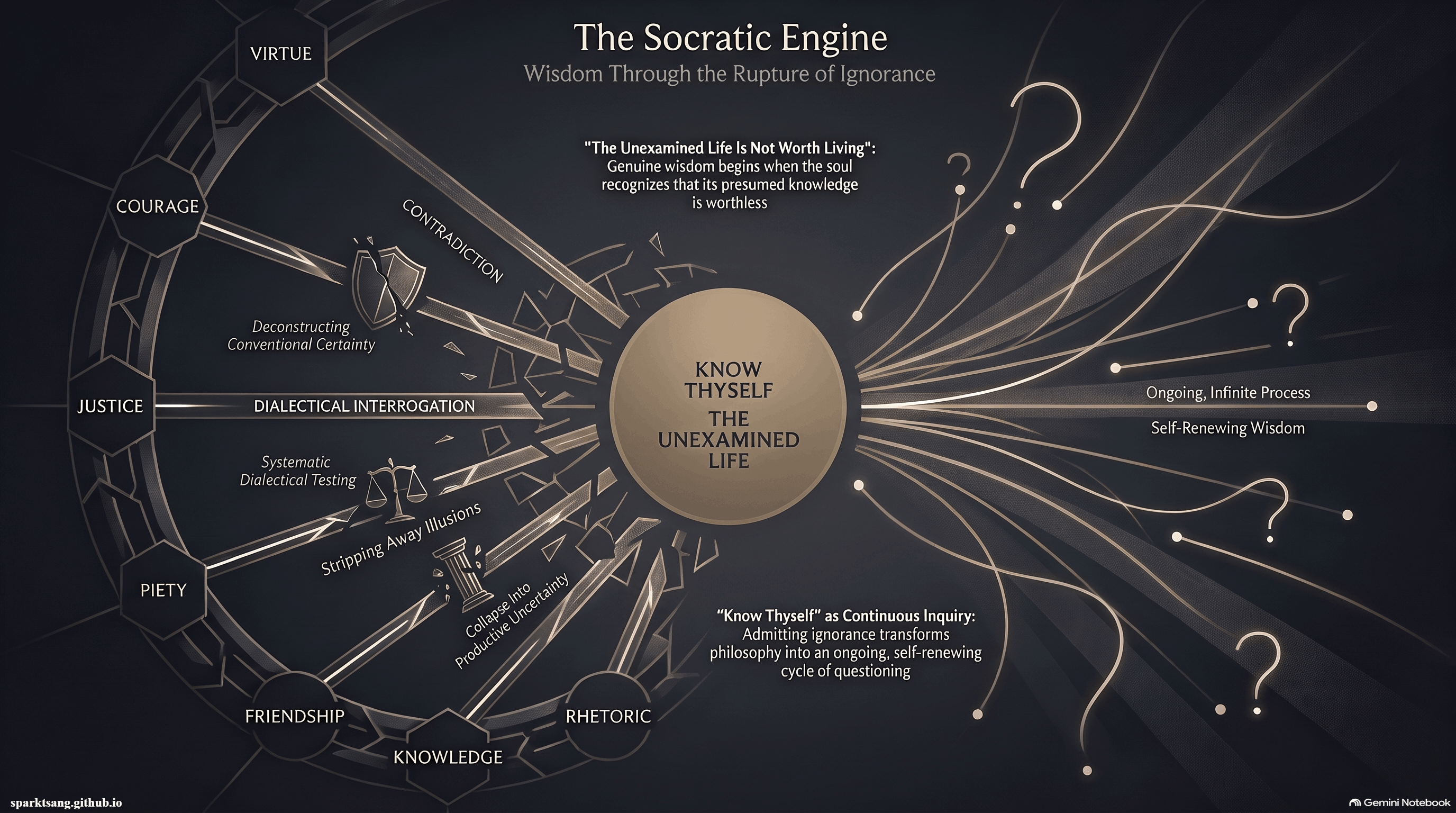
Socrates shifted the central subject of ancient Greek philosophy from nature to the human being himself. He repeatedly invoked the inscription “Know thyself” at the temple, and accomplishing this task required the study of the human soul.
He argued that virtue is knowledge, using inductive reasoning to examine various definitions of virtue; he also believed that some people lacked virtue because distorted perceptions and inflated desires warped their rational nature, which education was needed to restore. He overlooked, however, the role of consciousness and emotion in the formation of virtue.
This volume selects the dialogues not according to whether Socrates actually appears in them, but according to whether the ideas expressed belong to Socratic thought.
Apology Ap.
At the outset, Socrates asks the jury to focus on whether what he says is just, rather than on the manner in which he speaks.
The gist of the indictment: Socrates acts unjustly, spending all day investigating things in heaven and on earth, making the weaker argument appear the stronger, and teaching this to others. Socrates says all of this is false.
Someone went to the priestess of Apollo at Delphi to seek an oracle and received the answer that no one was wiser than Socrates. Socrates considers himself not wise, so he can only visit and examine those reputed to be wise in order to test the god’s meaning. In the end, he always concludes that he is wiser than they are, because neither side actually knows anything, yet they think they do, whereas he knows that he is ignorant and recognizes that he does not know.
The results of his inquiries make many people hate him. Socrates believes the oracle means: “Socrates is the wisest among you because he knows that his wisdom is worthless.”
Young people follow him voluntarily and imitate his questioning, making people angry with them. They feel that Socrates corrupts people like a plague, but they cannot explain how he corrupts them. Thus arise the charges that can be attached to everyone who loves wisdom: things like “the things in heaven and on earth,” “not believing in the gods,” and “making the weaker argument stronger.”
Under Socrates’ questioning, one of the accusers, Meletus, claims that everyone helps teach the young to be good, while Socrates alone deliberately corrupts them by teaching them not to believe in the gods but to believe in other divine beings. Yet he also admits that divine beings are gods or the children of gods. Since anyone who believes in the children of gods must necessarily believe in gods, Meletus contradicts himself.
The god has assigned him to examine himself and others. To fear death is merely to be unwise while imagining oneself wise, to not know while imagining oneself to know. Even if the jury offered him exile instead of death, he would not accept it. Serving the god is the greatest good, and all he has done is urge people to care above all for the best possible condition of their souls rather than for their bodies or wealth.
To put an unjust man to death does greater harm to the people who kill him than to the man himself. Socrates is defending them so that they do not misuse the god’s gift. The city-state is like a noble horse: because it is large and sluggish, it needs a gadfly to stimulate it. He has abandoned all private affairs to attend to those around him and has never charged a fee. They are like people awakened from sleep who resent the person who woke them.
His divine sign has opposed his entering public office; otherwise, he would have died long ago.
He has never been anyone’s teacher. He is always ready to answer questions and discuss matters with anyone. Others willingly spend time with him because they enjoy hearing him question people who think they are wise but in fact are not. None of their relatives, parents, or brothers has ever accused him of corrupting them.
To plead with the judges would undermine justice and amount to disrespecting the law.
(After being found guilty.) If another 30 votes had gone to the other side, he would have been acquitted. Meletus proposes death, while Socrates argues that, given his character, he deserves to dine at public expense in the Prytaneum instead of receiving a death sentence. With more time, he believes he could persuade them that he has done no wrong.
Even if he were exiled, other young people would still listen to him. He could not simply remain quiet and stop examining others, because “the unexamined life is not worth living”; this is the greatest good for a human being.
(After being sentenced to death.) “My killers, by Zeus, the punishment will soon come upon you, and it will be more cruel than my death sentence: you think you can live without being examined, but the opposite will happen. In the future, there will be many who examine you. The best way to escape examination is not to silence public opinion, but to do your utmost to become the best person you can be.”
To the jurors who voted to acquit him: whenever he is about to do something wrong, the voice of his daimonion (divine sign) always stops him. This time it said nothing. This was no coincidence; it clearly indicated to him what was right.
Death is either annihilation or a migration of the soul. The former is like dreamless sleep, a wondrous state; the latter means arriving in Hades to live among the gods and the dead, which is supremely happy. He would gladly die many times.
He does not hate those who sentenced him to death. He asks everyone that if their sons grow up caring more about money and power than virtue, or thinking themselves important when they are nothing of the sort, they should treat them as he has been treated and repay them in kind.
I go to die; you go on living. No one knows which of us has the better fate. Only the god knows.
Crito Cri.
Crito visits Socrates in prison and says that the sacred ship will soon return to Athens (by custom, no execution is carried out while the sacred ship is away). The day of his death is approaching, so he must make up his mind.
If he refuses rescue, people will think that all his friends stood by and let him die, leaving them with a disgraceful reputation. Taking the risk to save him is only natural, so he should not worry about putting everyone in difficulty. The jailers demand little; many people have already come to help, and they can certainly manage it. If he throws away his life, his sons will be left fatherless. That is neither kind nor courageous, and it would betray virtue. The absurd outcome of allowing him to die will make their side seem cowardly and timid, leaving matters to get out of control; it would be evil and shameful.
Socrates says that he will not casually accept advice. Even if fate has made things turn out this way, he cannot abandon the principle of argument.
He asks whether Crito agrees that some people’s opinions should be listened to and others should not; that good opinions deserve respect, not bad ones; that the former come from the wise and the latter from fools. Crito agrees to all of it.
He asks whether Crito agrees that the opinion of an expert should outweigh the opinion of the multitude: someone who cares about gymnastics should not ignore the advice of his trainer and listen to outsiders instead, because that would ruin his body and make his life not worth living—and virtue is more valuable than the body. Crito agrees to all of it.
Therefore, the opinions of the multitude need not be considered when they are unjust. What matters most is not merely staying alive, but living well and justly. Crito agrees.
One must never do wrong willingly, nor return evil for evil; when one has reached a just agreement with another, one should keep it. Crito agrees to all of this.
If he escapes, he will destroy the laws of the city and turn the court’s judgment into scraps of paper. When the city comes to question them, what could they say? “The city mistreated me, and its decision was wrong.” Yet a virtuous person cannot think he has the right to retaliate against the state, which deserves more honor than one’s parents. To return evil for evil is shameful.
An Athenian citizen who is dissatisfied is free to take his property and leave for another place at any time. A rebel, however, violates the obligation to honor the city as one honors one’s parents, the gratitude owed to the state for raising and nurturing its citizens, and the justice of the agreement between citizen and city. Socrates has spent seventy years in the city, raised his family here, and remained here all this time, apart from military campaigns. He has clearly been more satisfied with Athens than the average Athenian and has unquestionably chosen us, thereby agreeing to the arrangement of living as a citizen under our rule. Moreover, when he was on trial, he could have proposed exile at any time. The agreement was fair, free of pressure, deception, or coercion. Escape and exile would therefore be a betrayal, placing friends and relatives in danger. A civilized city that is well governed would reject a lawbreaker like him, leaving him to wander in some chaotic and disordered place, living as a coward afraid to die. What then becomes of all the justice and virtue he is always talking about? As for his children, his friends will take care of them; otherwise they would hardly deserve to be called his friends.
Crito has nothing left to say.
Charmides Chrm. (On Temperance)
σωφροσύνη refers to sound understanding, modesty and benevolence, self-restraint, and self-control.
Socrates returns from military service and goes to the wrestling school. Critias tells him about Charmides, whose handsome appearance has left everyone spellbound.
Socrates mentions his soul. Critias says that it is excellent as well. Socrates asks why he does not let that part of himself be exposed; Critias replies by asking why Socrates does not tell him about a remedy for headaches.
Charmides arrives, and Socrates feels his lust flare up instantly, almost uncontrollably.
Socrates says that just as one cannot treat the eyes without first treating the head, and cannot treat the head without first treating the soul, he has learned an incantation that can make the soul sound and well-balanced. But if Charmides is already sound, there is no need for this step and the remedy can be applied immediately. He asks Charmides whether he thinks he is sound-minded.
Charmides cannot answer. He says that denying it would make others liars, while admitting it would make him seem disagreeable. Socrates suggests that they examine the question together. Charmides agrees that if soundness is present in him, he must have some conception of what soundness is. Socrates asks him to explain what soundness means.
Charmides’ definition: “Calmness.”
Socrates points out that soundness is something admirable, but in many activities calmness is no better than speed or agility.
Charmides’ second definition: “Modesty.”
Socrates cites Homer to show that modesty is not a good quality in a beggar, whereas whatever is admirable makes the person in whom it appears better.
Charmides’ third definition: “Minding your own business.”
Charmides says he heard this from someone else. Socrates points out that an orderly city would never require people to weave only their own cloth and wash only their own clothes while leaving other people’s affairs alone. So unless the speaker was a fool, it must be a riddle. Charmides looks at Critias and laughs, saying that perhaps the person who said it did not know what he meant either.
Although Critias had earlier denied that this was his own definition, he becomes agitated and challenges Charmides: “Just because you do not know what it means, does that mean you think the person who said it does not know either?” At Socrates’ suggestion, he agrees to take over the argument.
Critias gives the example that when a craftsman “makes” something for another person, he is still “doing” his own business. Both work and action belong to the latter category, so he offers a clearer explanation.
Critias’ explanation: “Doing good.”
Critias agrees when Socrates points out that the treatment a doctor provides as an act of doing good may benefit both himself and others. Yet he admits that a doctor does not necessarily know exactly when his work benefits him or when it does not. Thus a person may sometimes do good without knowing that he is doing so.
Socrates asks again: can a person act with soundness while knowing nothing at all about it? Critias thinks not, and offers a new definition.
Critias’ new definition: “Know thyself.”
This is the inscription carved at the temple of Apollo at Delphi, and Critias believes it has a special purpose.
Critias agrees with Socrates that it is a kind of knowledge, and knowledge of itself.
Socrates asks: architectural knowledge can build houses, medical knowledge can provide health—what can this kind of knowledge provide?
Critias replies that not every kind of knowledge produces something in this way. Arithmetic, for instance, cannot produce anything.
Socrates asks: arithmetic gives us knowledge of odd and even, weighing gives us knowledge of light and heavy—so what does this kind of knowledge know?
Critias answers that this knowledge differs from all the others. It is knowledge of itself, knowledge of other kinds of knowledge, and knowledge of the absence of knowledge. A sound-minded person can know himself and examine what he knows and does not know, and can examine others in the same way. He agrees with Socrates that they must investigate two central questions together: whether this knowledge-of-knowledge is possible, and whether it has any benefit.
Socrates says Critias’ account is strange, because there is no such thing in the world as a sight that is sight of sight itself and of other sights, while also being sight of non-sight; nor is there such a kind of hearing, sensation, desire, hope, love, or fear. One can see only when there is something colored to see, and hear only when there is something audible to hear. Seeing sight would therefore require sight to be colored, and hearing hearing would require hearing to be audible. Nothing can be both greater and smaller than itself. Critias agrees.
Socrates therefore asks Critias to clarify how such knowledge could possibly exist. Critias also senses the difficulty but does not want to admit that he cannot answer, so he can only fumble his way through a response. Socrates then asks: assuming such a thing really is possible, would it not be even more possible to know what one knows and what one does not know?
Critias agrees. Whoever possesses knowledge-of-knowledge must know himself. Socrates points out that this is not what puzzles him. What puzzles him is why possessing knowledge-of-knowledge must necessarily mean knowing what one knows and what one does not know. Critias thinks the two are the same thing.
Both agree that knowledge of knowledge itself is a way of distinguishing things, one being knowledge and the other not being a capacity.
Socrates then points out that the sound-minded person seems little different from an ordinary person. If someone who does not know medicine becomes ill, he goes to a doctor; even a sound-minded person cannot distinguish whether the doctor’s judgment is right or wrong unless he himself is a doctor. It seems that ordinary people also know what they know and do not know, and simply find someone who knows what they do not know. Yet soundness of mind, as a virtue, ought to have enormous benefits. The distinction is therefore genuinely puzzling.
Under Socrates’ questioning, Critias says that this knowledge can enable a person to distinguish good from evil, but when Socrates presses him further, he cannot say what benefit it produces. In the end, he can only admit that it produces none.
Socrates is troubled for Charmides, because he has a sound soul yet seems to have discovered that soundness is completely useless. But he says he cannot believe that this is really the case. He considers soundness a great good and would rather think of himself as a useless investigator; if one possesses soundness, he believes one can be happy.
Charmides says he does not know whether he is sound-minded, but clearly needs the incantation. He follows Critias’ instructions, and once Socrates is permitted to cast the spell, he will listen to him about everything, great or small.
Laches Lch. (On Courage)
This dialogue begins with the education of the young and turns to the question of courage.
At a gathering, Lysimachus speaks on behalf of himself and Melesias. He reproaches their famous fathers for having indulged them while they were growing up, leaving them now too ashamed to talk about their own achievements. Having heard someone recommend armed combat training, they have brought their sons along to ask everyone, including famous generals, how they should educate them.
The general Laches suggests asking Socrates. Socrates, however, says they should first ask others.
Another general, Nicias, believes such training is beneficial: it is good for health; it helps when a battle line breaks down and soldiers have to fight alone, enabling them to protect themselves from injury; it stimulates the study of tactics, raises self-confidence, and prepares one for the skills of generalship; it also makes a person bold, courageous, and impressive.
Laches points out that armed instructors would not go to Sparta, the city most concerned with warfare, to perform their demonstrations, and that those who practice such fighting perform the worst in actual war.
Lysimachus wants Socrates to “cast the deciding vote.” Socrates persuades everyone that they should listen to the expert rather than the multitude, and first determine what field the expert in question belongs to.
Socrates then elaborates: this field is not combat. Combat is merely the form of instruction; the real aim is the souls of the young. Therefore, what they need is an expert who cares about the soul, just as someone with an eye problem should seek advice from someone who understands the eye.
Socrates continues that such an expert must possess a good and beautiful soul and must already have made many other souls better. He says he has not yet discovered such an art himself, and encourages the two generals to explain whether they have found anyone who has mastered it.
As moderator, Lysimachus leaves it to the two generals to decide whether to answer Socrates fully. Nicias says Socrates is bound to examine every detail thoroughly, and whenever Socrates is around, the topic quickly turns back to the person being questioned. He does not think this is a bad thing, and asks Laches how he feels about it. Laches says Socrates’ courage is exemplary and asks him for guidance. Lysimachus asks Socrates to take over as moderator.
Socrates returns to the field they have just discussed. To make someone’s soul better, something must be added to it, just as adding sight to an eye makes vision better. First, one must determine what that addition is.
Laches agrees that adding virtue to the young can improve their souls, and also agrees that virtue is too broad a subject, so they should begin with courage, which is relevant to combat.
Laches’ definition: “Standing firm in the ranks and driving back the enemy” is courage. Under questioning, he admits that this is merely the courage of a heavily armed infantryman, not something that can describe courage in everyone.
Laches’ second definition: “A wise endurance.” Laches proposes endurance. Socrates points out that foolish endurance is not admirable, so Laches revises the definition.
Socrates asks whether spending money wisely and displaying endurance is courage. He then asks whether persevering wisely because one knows reinforcements are coming is courage. Laches says it is more courageous to endure when the situation is unfavorable.
At this point, Socrates points out that Laches has agreed that enduring in unfavorable circumstances is more foolish, yet also more courageous. The conclusion is that foolish endurance is courage.
Socrates suggests that they continue exploring courage bravely, like good hunters pursuing their prey, and calls on Nicias to join the hunt.
Nicias’ definition: courage is “knowledge of what is to be feared and what is to be dared.”
Under questioning from Laches and Socrates, he denies that doctors, prophets, or beasts especially possess this knowledge.
Guided by Socrates, Nicias agrees that things that are fearful or hopeful are future goods and evils.
Nicias also agrees that every field of knowledge concerns its object in the past, present, and future, not only the future, just as medicine concerns health in the past, present, and future.
Therefore, Nicias’ definition must be revised to “knowledge of good and evil in the past, present, and future.” But this is not merely a part of virtue; it is the whole of virtue, so the argument fails.
In the end, everyone asks Socrates to take responsibility for the boys’ education. Socrates points out that in their discussion everyone has fallen into difficulty and cannot take on this task themselves. They should join forces and find a teacher.
Lysis Ly. (On Friendship)
Hippothales invites Socrates into the wrestling school, saying that everyone there is beautiful.
Socrates asks who is the most beautiful. Hippothales blushes. His companion Ctesippus says that he is always talking about the handsome boy Lysis, drowning everyone in love poems written for him.
Socrates points out that if he has already conquered the other person, then all his praise and songs of adoration merely become praise of himself. But if the boy runs away, the more fervent all the praise becomes, the greater the loss will obviously be, and he will deserve ridicule. Thus, an experienced lover does not praise his beloved before he has won him over. Praise makes someone conceited and makes them even harder to win, just as a hunter who frightens his prey makes it more difficult to catch.
Hippothales asks Socrates how to make his boyfriend like him. Socrates says that perhaps he can demonstrate by talking with Lysis.
Socrates talks with Lysis and reveals that although Lysis’ parents love him, they prevent him from doing many things while allowing their slaves to do them instead. Lysis says this is because he is not yet an adult. Socrates then reveals that his parents allow him to write and play the lyre without waiting until he is grown up. Lysis explains that this is because he is knowledgeable about those things. Under Socrates’ guidance, he then agrees that if a person is competent at something, all sorts of people will entrust him with all sorts of tasks.
Socrates concludes that once a person becomes wise, everyone will become his friend, and points out that Lysis is not yet an expert, because he has not yet had his soul trained. Lysis says Socrates has “forced him to this point.”
Socrates looks at Hippothales, who had asked him for advice in the beginning, and thinks to himself that this is how he should defeat them, rather than flattering them.
Lysis’ companion Menexenus returns, and Socrates speaks with him.
Socrates says that compared with everything else in the world, he would rather have one good friend. He points out that Menexenus and Lysis already possess what he wants, and proposes that they discuss how to become one another’s good friend.
Socrates offers the definition: “The beloved is the friend of the lover.”
This does not work. It implies that the hated one is the enemy of the hater. If you love someone but he hates you, some people become friends to their enemies and enemies to their friends.
Socrates offers another definition: “Like is friend to like.”
A wise man once said that like attracts like. But good people are self-sufficient; those who are self-sufficient need nothing else, and therefore will not value anything else. If they do not value anything, they will not love it, and someone who does not love cannot be a friend. Evil people are unstable and constantly changing, and may not even resemble themselves, so they cannot become friends with others either.
Socrates offers another definition: “Opposites are friends.”
Hesiod said something like this. But the good are not friends with the evil.
Socrates then proposes: “What is neither good nor bad becomes a friend to the good because of the bad and the good.”
Since the good cannot be friends with one another, and the bad cannot be friends with anyone, this seems to be the remaining possibility. The body itself is neither good nor bad, yet because of the bad thing called disease, it seeks health and becomes a friend of the good thing called the doctor.
But this means that good things in themselves are completely useless, and that once bad things are eliminated, there would be nothing left for anything to be friends with.
Socrates can only admit that although he regards himself as a friend of the young, he does not know what a friend is.
Euthyphro Euthphr. (On Piety)
Socrates, accused of impiety, encounters Euthyphro, who is prosecuting his own father for murder. His father had tied up a servant who had killed another household servant. Before he could ask the authorities how the matter should be handled, the murderer died from exposure and starvation. Euthyphro believes that his father killed a murderer and that prosecuting him is just, with personal feelings irrelevant. He even boasts that he possesses precise knowledge concerning piety, to the point that he knows what he is doing is pious.
Socrates says he would like to become Euthyphro’s student so that he can rebut those accusing him of impiety. He asks what piety is.
Euthyphro says that what he is doing now is pious, and gives as an example Zeus binding and punishing his own father for unjustly killing his brother. Socrates says he is asking for the definition of piety itself, not one or two examples.
Euthyphro’s definition: “What is loved by the gods” is pious.
Under questioning, he revises this to “what all the gods love,” because something loved by one god may be hated by another.
Socrates points out that a loved thing is loved because it is loved; it is not loved because it is a loved thing. A pious thing is loved because it is pious, not for some other reason. Euthyphro agrees.
Euthyphro’s second definition: “The part of justice concerned with serving the gods.”
Under Socrates’ guidance, Euthyphro puts it this way. Under questioning, he agrees that serving cattle and sheep benefits the cattle and sheep, whereas serving the gods does not benefit them, since they have no need of anything from humans. Therefore, “serving” here means pleasing the gods and becoming close to them.
Socrates points out that being close to the gods is no different from being loved by the gods, so the argument has returned to where it started. He asks Euthyphro once again for clarification. Euthyphro uses the excuse that he is in a hurry and leaves.
Lesser Hippias L.Hp. (On Evil)
Hippias cites Homer and says that Achilles is better than Odysseus: the former is truthful, while the latter lies.
Under Socrates’ questioning, Hippias agrees that a liar has ability and intelligence, and is clever at lying. But someone capable of lying is also capable of telling the truth. Socrates points out that the conclusion is therefore that the same kind of person can tell the truth and tell lies. He then goes further and suggests that knowingly lying is better than unknowingly lying, and knowingly doing wrong is better than unknowingly doing wrong. Hippias cannot accept this and criticizes Socrates for creating confusion through his argument.
Under further questioning, Hippias agrees that in every field, knowingly being bad is better than unknowingly being bad, just as knowingly being slow at running is better than unknowingly being slow. Therefore, he must accept that knowingly doing evil is better than unknowingly doing evil. Hippias describes the conclusion as horrifying.
Socrates also gets Hippias to agree that capable and good souls act knowingly when they act unjustly, whereas worthless souls act without knowing what they are doing; good people have good souls, bad people bad souls. Based on the previous conclusion, this would mean that good people knowingly do evil while bad people unknowingly do evil. Hippias cannot agree.
Socrates says that he himself, like ordinary people, wavers back and forth on these matters. But if even people as clever as Hippias are like this, then that is truly frightening.
Ion Ion (On Poetry)
Ion and others win prizes in poetry recitation contests in foreign lands and encounter Socrates, who asks him questions.
Ion says he only knows how to recite Homer. Homer is the greatest poet, everyone agrees that he recites Homer well, yet he knows nothing about other poets.
Under questioning, he agrees with Socrates that mastery of a particular art enables a person to identify who is excellent or poor within that field and to speak about all practitioners of it. He then asks Socrates why he himself is different.
Socrates says Ion’s recitation is like a poet’s composition: he is possessed by the Muse, stripped of reason so that he can transmit the god’s words, and therefore is expert only in one particular kind of poetry. Ion says he is completely convinced.
Socrates wants to examine whether Ion is in his right mind while reciting. He says that the god pulls everyone’s soul toward whatever place he wishes, like a chain of linked rings. Ion says that when people hear him recite, they would not think he is possessed by a god or out of his mind.
Socrates examines passages in the poetry Ion recites that concern other arts. Ion admits that he knows no better than a doctor what a doctor ought to say in a poem, and the same is true of weavers and shepherds. Yet he claims to know how a general would speak to inspire his troops. Socrates suggests that perhaps he is therefore also a good general. Why, then, does he not command an army? Socrates also points out that saying “because I am a foreigner” does not work.
In the end, Socrates accuses Ion of constantly changing his argument. Under Socrates’ pressure, Ion admits that he is a divinely inspired rhapsode, not a master of any particular art.
Gorgias Grg. (On Justice)
Socrates visits the rhetorician Gorgias and asks what rhetoric is. Gorgias answers that it is an art concerned with speech. Socrates points out that many other arts also deal with speech. Arithmetic deals with speech concerning odd and even, so what exactly does rhetoric deal with?
Gorgias says it concerns the highest good. Socrates points out that a doctor could also say that the health he provides is the highest good.
Gorgias then says it concerns persuasion. Socrates points out that arithmetic also involves persuasion concerning odd and even, and asks what kind of persuasion rhetoric produces.
Gorgias says it is persuasion about justice and injustice. Socrates distinguishes knowledge from belief, and under questioning Gorgias admits that rhetoric produces belief rather than knowledge.
Socrates asks what this art can accomplish. Gorgias gives the example that it can persuade a patient who does not want treatment to take medicine. If someone abuses rhetoric, he says, that is because of the person’s own evil, just as someone who learns boxing may go and beat his parents.
Socrates says he only wants to continue the discussion with people of the same sort: those who regard being refuted as a good thing. Gorgias says that both he and the people here are such people. Socrates then points out Gorgias’ contradictions: if rhetoricians have learned something about justice and injustice, how could they misuse it and commit injustice?
Socrates tries to reveal the essence of rhetoric. The art concerned with the soul is politics; there are also arts concerned with the body, divided into medicine and gymnastics. The corresponding parts of politics are justice and legislation. Pastry-making puts on the disguise of medicine and pretends to know what food is best for the body; it is flattery wearing a medical mask. Cosmetics are flattery wearing the mask of gymnastics. Pastry-making corresponds to medicine, cosmetics to gymnastics, sophistry to legislation, and rhetoric to justice.
Socrates thinks that no one should pay attention to flatterers such as rhetoricians. Gorgias’ disciple Polus says they possess power greater than that of tyrants: they can execute people, confiscate property, and exile others.
Polus agrees that possessing power is a good thing. Socrates points out that if so, rhetoricians and tyrants possess very little power indeed. He then reveals that his view is that committing injustice is pitiable, but failing to receive just punishment for it is even worse. Polus gives Archelaus, the Macedonian king who seized power, as an example and says this is utterly absurd.
Polus says suffering injustice is worse, but committing injustice is more shameful, and therefore worth praising is different from being good, just as bad is different from shameful.
Socrates explains that in every action, what is done and what is suffered, and the degree in which each occurs, correspond to each other. Therefore, if just punishment is worthy of admiration, receiving just punishment should be worthy of admiration as well. What is worthy of admiration is a condition that, when it happens to a person, is good for him. Polus agrees.
Socrates then points out that corruption of wealth, body, and soul includes poverty, illness, and injustice. Injustice is the most shameful form of corruption. Therefore, there is no suffering in receiving just punishment worse than poverty or illness, just as someone who fears surgery and refuses medical treatment does not understand health. A person who continues committing wrong because he fears punishment does not understand justice. He should go before the judge and “pay the price” for his wrongdoing. Paying that price removes the evil and makes him more just. Polus agrees that the point has become clear.
Socrates then goes further: if rhetoric is used to defend injustice, it is useless. It should instead be used to expose one’s own injustice. He also says it could be used to keep a condemned enemy alive longer so that he can continue suffering injustice. Another sophist present, Callicles, asks whether he is joking, pointing out that if this were truly the case, it would require doing the opposite of what people normally do.
Callicles sets out his own view in detail. Polus was forced into contradiction, he says, because Socrates confused nature with convention. Polus had said that injustice according to law is more shameful; Socrates, while arguing, interpreted his meaning as saying that injustice according to nature is worse.
He also says that superior people ought to seize power by force and deserve to rule over the rest and receive more than others. This is natural justice. They should satisfy their desires rather than exercise self-restraint. He further argues that it is admirable for young people to study philosophy, but if adults continue studying philosophy, they deserve to be whipped. Socrates himself could not even prevent a tyrant from using his power to execute him, exile him, and confiscate his property.
Socrates says that Callicles possesses knowledge, goodwill, and frankness, while the other two possess only the first two and lack frankness, which is why they contradict themselves.
Under Socrates’ questioning, Callicles admits that good and bad people experience pleasure and pain in roughly equal measure. Therefore, a good thing is not the same as something pleasurable, and a bad thing is not the same as something painful. Callicles eventually agrees that pleasures can be good or bad, and obtaining one or the other is a different kind of practice.
Socrates explains that what makes a person good is an art, such as medicine; what makes a person feel pleasure is a knack, a form of flattery, such as pastry-making. Callicles admits that he has never seen a rhetorician whose aim was to make people better rather than merely please them.
Socrates also points out that when the body is healthy, a person may satisfy his desires; when the body is weak, he must exercise restraint. Likewise, when the soul is healthy, a person may satisfy his desires, but when it is unjust, he must restrain himself. Health gives the body order just as self-control gives the soul order. Callicles agrees.
Callicles grows impatient and asks Socrates to finish the discussion himself. Socrates therefore asks Callicles to listen to him and refute him wherever he finds disagreement.
Socrates returns to the point that doing injustice is worse than suffering injustice. He also mentions several politicians who were executed or exiled by the people. They were not good politicians, because if they had truly made people better, those who had become better would not have treated them unjustly. Socrates claims that he possesses the true political art, and that when he speaks to people, his aim is not to please them but to make them as good as possible.
Socrates admits that if he were brought before a court, it would be difficult for him to defend himself, just as a pastry-maker might bring a doctor before a court and accuse him of cutting people open, burning them, forcing them to take bitter medicines, and making them hungry and thirsty, leaving the doctor no effective defense. Even so, someone unable to defend himself in such circumstances deserves admiration so long as he remains just, and can meet death calmly.
Socrates concludes that after death the soul is stripped naked and judged. An unjust soul is completely exposed and will be sent to hell; a just soul will instead go to the Isles of the Blessed. No one else can prove that there is any life worth living more than a just life, and in the argument only the case for living justly survives refutation.
Protagoras Prt. (On Virtue)
The young Hippocrates wants to become the student of Protagoras, who is renowned as a sophist. Socrates asks what field he teaches, but Hippocrates cannot answer. Socrates says sophists are like retailers selling education, just as retailers sell food. Only an athlete or a doctor can tell whether a food product benefits the body, and only a doctor of the soul can know what kind of education benefits the soul. Buying something without knowing whether it is beneficial is dangerous.
Hippocrates and Socrates visit Protagoras and explain why they have come. Protagoras understands Socrates’ caution and points out that many sophists, faced with enormous hostility, disguise themselves as teachers of other subjects such as music or poetry. He himself never does so.
When questioned, Protagoras says he can make a person better every day, meaning sound practical judgment: capable of managing his household privately and realizing his greatest potential publicly, and successful in political discussion and action. Socrates says this amounts to the art of becoming a good citizen. Protagoras agrees.
Socrates points out that Athenians rely on experts in architecture and other fields, but when it comes to political deliberation, everyone is allowed to speak. This suggests that Athenians believe virtue cannot be taught: even the father of a good man may not be able to teach his son to be good. Socrates asks Protagoras to demonstrate how virtue can in fact be taught.
Protagoras tells a myth explaining that everyone possesses the foundation of virtue, which is why everyone is allowed to speak in political deliberation. But Athenians also believe that virtue can be carefully cultivated, which is why punishment exists to correct wrongdoing. And cases in which a good father has a bad son also occur in other teachable fields.
At Socrates’ request, Protagoras clarifies that the different parts of virtue are not identical in kind. Virtue is not like a pile of gold, but like a face: courage, wisdom, and justice are like eyes, ears, and nose.
The two agree that the opposite of one thing can only be another thing—for example, fast and slow. Yet Protagoras admits that the opposites of temperance and wisdom are both foolishness.
Socrates feels that Protagoras is resisting the questions. Protagoras then launches into a long speech. Socrates says he has a poor memory and asks him to be brief, but Protagoras refuses. Socrates gets up to leave, but the host Callias stops him while agreeing with Protagoras’ insistence on speaking at length. Alcibiades criticizes long speeches for obscuring the point. Critias asks everyone to work together so that neither Socrates nor Protagoras can end the gathering early. Prodicus says listeners should listen fairly, but fairness does not mean equality. Hippias suggests choosing a supervisor to mediate between the two, and everyone supports the proposal.
Socrates says no one is better than Protagoras at supervising him. If Protagoras does not wish to answer, Socrates should ask and answer the questions himself, and after he finishes, Protagoras can then explain. If Protagoras cannot accept this, they should all join together in pleading with him, just as one might plead with Socrates. Everyone agrees that they should all act as supervisors.
Protagoras raises a question of apparent contradiction about a poem Socrates has praised. After careful thought, Socrates gives a detailed explanation and says they should put poets aside and discuss the matter in their own language. Protagoras reluctantly prepares to accept Socrates’ questioning. Socrates flatters Protagoras as the best person with whom to investigate the question of virtue together.
Returning to the main topic, Protagoras says that among the five virtues, wisdom, temperance, justice, and piety are similar, while courage alone is unlike the others. He also says that courageous people are confident.
Protagoras says that people who are confident despite lacking knowledge are overconfident. Socrates asks whether courageous people are not confident. Protagoras replies that courageous people are confident, but not everyone who is confident is courageous.
Under Socrates’ guidance, Protagoras agrees that courageous people are nobler both when they fear and when they feel confident. Cowardly people are ignorant about the things they fear—that is, they are ignorant of what is worth fearing and what is not worth fearing.
Socrates points out that courage is the opposite of cowardice. Therefore, wisdom about what is worth fearing and what is not worth fearing is courage. Protagoras has nothing to say. He points out that Socrates initially tried to argue that virtue could not be taught, but finally proved that virtue is knowledge and therefore teachable; while he himself initially insisted that virtue could be taught, but by insisting that virtue is not knowledge, he has made virtue appear unteachable.
Finished reading on Feb 25, 2021
Socrates demonstrated that the pursuit of truth requires the ruthless examination of every claim and the courage to expose the ignorance of systemic gatekeepers. But while Socrates fought this battle alone in the Athenian agora, today’s truth remains trapped behind infinitely more complex walls of noise and privilege.
Taking the Socratic method to its final structural conclusion, my philosophy proposes a decentralized framework where all claims must survive the exact kind of relentless, open-source refutation he died defending.
Thank you for reading until the end. This is a bonus infographic just for you.