Notes on Kaku's Physics of the Future
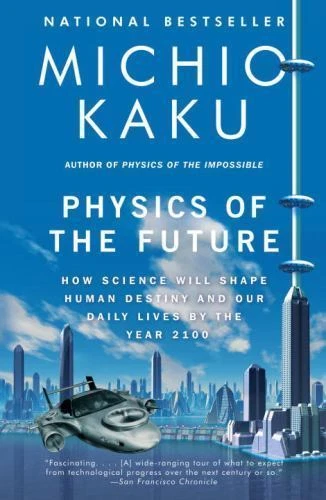
Physics of the Future: How Science Will Shape Human Destiny and Our Daily Lives by the Year 2100 by Michio Kaku
Original notes here.
Inspired by Einstein’s ability to unlock the secrets of the universe, and by his longing to see the future, these two passions complement each other and have fueled the author’s lifelong interest.
Jules Verne and Leonardo da Vinci accurately predicted the world 100 years into the future. This book follows in their tradition, observing leading scientists up close and making projections.
The four fundamental forces have already been uncovered, so there should be no major breakthroughs in that regard; the technological prototypes mentioned in the book already exist.
Predictions such as unmanned cities, virtual tourism, and videophones have not come true because humans follow the caveman principle: our patterns of thought remain similar to those of our cave-dwelling ancestors. We want to see things with our own eyes and depend on physical objects.
Science is a double-edged sword. We should beware of a scenario like the film Forbidden Planet, in which aliens endowed with godlike powers destroy their own civilization.
Brain
The singing chip in the Christmas card you might receive today at Christmas has more computing power than the combined total of all Allied computers in 1945.
At the beginning of the century, digital glasses and self-driving cars will become widespread, 3D imagery will be ubiquitous, all four walls will be screens, computers will be everywhere, and people will be able to touch objects in virtual worlds.
By the middle of the century, Moore’s Law may come to an end because of physical limits. The real world and virtual reality will merge and be applied to tourism, art, shopping, and war. A universal translator will be invented, and holographic technology will become a reality. The main technological bottleneck is the enormous amount of information involved.
By the end of the century, people may achieve telekinesis via Brain-Computer Interfaces; fMRI technology may enable telepathy, and dreams may be recorded.
Intelligence
The field of artificial intelligence has gone through many waves of breakthroughs and winters. Its technological bottleneck lies in two key tasks that the human brain performs effortlessly: pattern recognition and common-sense reasoning.
At the beginning of the century, there will be many AI expert systems, each responsible for a different task.
The author considers Japan the leader in robotics technology because traditional Shinto beliefs hold that spirits inhabit inanimate objects, making robots widely accepted; Japan also faces the serious problems of an aging population and a low birth rate.
By the middle of the century, modular robots that can be assembled like LEGO bricks will exist. Emotional robots will emerge, though they will only be able to imitate emotions and still will not truly feel them. Reverse engineering of the brain may become possible. In 2009, Henry Markram pointed out that the obstacle to creating a human brain is merely money, because it requires enormous computing power and memory.
By the end of the century, robots may possess consciousness. The author believes consciousness can be divided into three parts: perceiving the environment, self-awareness, and setting goals and planning for the future.
Friendly robots or human-machine integration are, in the author’s view, the most likely scenario. The process will be gradual, giving humanity ample time to prepare.
Medicine
The development of medicine has gone through three stages: superstition, witchcraft, and hearsay; germ theory, which began in the 19th century; and molecular medicine, which began in the 1940s.
The $3 billion Human Genome Project was a milestone in the history of medicine.
Nobel laureate David Baltimore: biology today is a science of information.
At the beginning of the century, genomic medicine will mature. Stem-cell technology—stem cells being the mother of all cells and capable of developing into any type of cell—will make growing organs through tissue engineering no longer a problem.
Cloning biotechnology will be perfected, but the commercial demand for cloning humans will be limited.
Gene therapy will be able to treat many genetic diseases, and new drugs designed to attack cancer cells will emerge.
By the middle of the century, it will be possible to design children. Smart mice and strong mice have already been created by Joseph Tsien at Princeton University.
By the end of the century, humans may be able to reverse aging, and the genes that control lifespan will have been identified.
For all organisms studied today, caloric restriction can extend lifespan, but it also causes lethargy, fatigue, and loss of sexual desire. In the future, we may be able to gain its benefits while avoiding its drawbacks.
Recreating extinct organisms may become possible.
Although many diseases will become treatable, some will still evade advanced science.
The threat of biological warfare will remain.
Micro
The phenomena of the atomic world are almost unbelievable: most matter is empty space, yet we cannot walk through walls. This is based on the Pauli exclusion principle: no two electrons can exist in the same quantum state.
In the future, we may be able to manufacture molecules atom by atom. Devices capable of manipulating individual atoms have already been invented by IBM’s Gerd Binnig and others, for which he received the 1986 Nobel Prize.
At the beginning of the century, nanomachines inside the body will be able to target cancer cells, nanocars will travel through the bloodstream, DNA chips will rapidly analyze the human body, and highly conductive carbon nanotubes will be widely used.
The development of alternatives to silicon will determine the future of the world economy and the direction of nations. Possible replacements include transistors made from individual atoms. Molecular crystals are one possible route, and several companies have already announced that they have created them, but they cannot yet be mass-produced or used commercially.
Graphene is a promising candidate for a molecular transistor. In 2004, Andre Geim and others at the University of Manchester successfully isolated it, for which he received the Nobel Prize.
Quantum computers capable of computing at the level of individual atoms already exist, but they can perform at most calculations such as three times five. What obstructs further research is the fact that even the slightest external interference can destroy the delicate balance that allows atoms to remain coordinated. Whoever solves this problem will not only win a Nobel Prize but become the richest person in the world.
By the middle of the century, shape-shifting electronic clay may be widely used. Toys could be programmed to change their form, and even entire cities could suddenly rise up. The technological prototype already exists in Seth Goldstein’s laboratory at Carnegie Mellon University.
By the end of the century, it may be possible to create nanorobots capable of manipulating individual atoms, making it possible to replicate objects. However, scientists remain divided over whether such machines are physically possible.
Complexity may cause capitalism to fail and disrupt the existing order, because people who produce nothing will be able to get whatever they want for free simply by pressing a button.
Energy
Molecular technology requires enormous amounts of energy to operate, while today the Earth depends almost entirely on fossil fuels. Modern civilization rose rapidly in the last century, driven by two things: cheap oil and Moore’s Law.
In 1956, M. King Hubbert predicted that U.S. oil reserves would rapidly decline and was ridiculed. Today, 59% of U.S. oil needs to be imported.
A rough consensus is emerging among energy experts: global oil production today has either reached “Peak Oil” or is about ten years from the critical point of no return.
At the beginning of the century: solar and hydrogen power will generate electricity at several times the cost of coal-fired power, but because technology is steadily advancing, costs will continue to fall, and within ten to fifteen years the two will cross paths.
Wind power will continue to grow, but it faces geographical and climatic limitations. Because of electricity losses, it also needs to be located close to cities and therefore cannot become the main source of electricity.
Electric vehicles themselves produce no pollution, but the energy that powers them still comes from fossil fuels.
Nuclear-weapons crisis: during wartime, the only way to separate uranium isotopes was gaseous diffusion. It depended on the fact that uranium-235, which can be used to make an atomic bomb and accounts for only 0.7% of natural uranium, is 1% lighter than uranium-238, allowing the faster uranium-235 to be extracted from gaseous uranium. Only superpowers could accomplish this. Today, however, only 33% of enriched uranium comes from gaseous diffusion. Second-generation plants use a technology that is cheaper and 50 times more efficient: ultracentrifuges. In 2006, the next generation of the technology, laser enrichment, had already been invented by the Australian company Silex.
By the middle of the century, the global-warming effects of the fossil-fuel economy will peak, flooding Bangladesh and Vietnam.
Despite a long history of scams and false promises, physicists are gradually becoming convinced that fusion power will emerge by the middle of the century. Unlike fission power, which generates electricity by splitting uranium atoms, fusion power releases the nuclear energy of the Sun. Its fuel is simply ordinary seawater, and it produces only a small amount of waste.
Laser fusion and fusion using a “magnetic bottle” are advancing in parallel.
By the end of the century: the last century was the age of electricity, but at some point in this century, the discovery of room-temperature superconductors will usher the world into an entirely new age of magnetism. Much of the energy we use today is consumed merely in overcoming friction.
Superconductors were discovered as early as 1911: mercury loses its resistance at 4 degrees above absolute zero, but it must be cooled with extremely expensive liquid hydrogen. In 1986, IBM researchers discovered ceramic superconductors that could become superconducting at 92 degrees above absolute zero. The current world record is 138 degrees above absolute zero, and they can be cooled with liquid nitrogen, which costs about as much as milk.
The shortcomings are that the technology for cooling with nitrogen is difficult, ceramics are hard to shape into wires, and the superconducting properties of ceramics remain unexplained.
Room-temperature superconductors could generate immense magnetic fields, causing objects to float in midair; even today, this can be demonstrated simply in a laboratory.
Even without room-temperature superconductors, maglev trains already exist in Germany, Japan, and China.
It may also become possible to use hundreds of satellites in space to absorb solar radiation and then beam the energy down to Earth in the form of microwaves at the speed of light. The main obstacle at present is cost.
Travel
The traditional view is that Europa, one of Jupiter’s moons, lies outside the habitable zone (the “Goldilocks Zone”). The discovery of an ocean beneath its ice overturned our understanding and vastly expanded the possible range of life.
After humans landed on the Moon, they dreamed of going to Mars. The dream faded only because of the cost: space travel is extremely expensive. Countries were willing to pay the price only when national prestige was at stake during the Cold War.
At the beginning of the century, the Laser Interferometer Space Antenna (LISA), the next generation of gravitational-wave detectors capable of measuring gravitational waves from the moment of the Big Bang, may serve as an observer of the Big Bang and answer the question of where the universe came from.
Landing on asteroids and the moons of Mars, and establishing permanent lunar bases to collect ice and minerals, may become possible.
By the middle of the century, there may be missions to Mars and even the terraforming of Mars, but colonizing other planets cannot immediately generate enormous economic benefits.
By the end of the century, a space elevator may become possible because its tensile strength makes it prone to breaking, requiring carbon nanotubes stronger than steel.
NASA’s beam-power challenge: create equipment weighing less than 50 kilograms that can climb a one-kilometer-long cable at a speed of two meters per second. The difficulty is that it cannot use fuel, wires, or batteries; its energy must be transmitted from outside by beam. LaserMotive won this challenge in 2009, solving part of the problem of the space elevator.
Starships may become possible. Possible propulsion methods include solar sails, which use a sufficiently large sail to capture the tiny momentum of sunlight; nuclear rockets; ramjet fusion engines, in which a ramjet engine draws air in from the front and mixes it with fuel, while a fusion engine replaces the air with hydrogen and fuses the hydrogen into helium; antimatter rockets, in which antimatter can convert matter into energy with 100% efficiency; and nanocraft, each costing very little, following the strategy of insects that produce enormous numbers of offspring.
Given the cost, even after 2100, most people will still never board a spacecraft.
Wealth
In 1500, China and the Ottoman Empire both possessed brilliant civilizations, while Europe was the most backward.
Yet the former two became trapped in prolonged technological stagnation, while Europe was able to surge ahead because of science:
Newtonian mechanics brought complex steam-powered machines; electromagnetism brought the electrical revolution; nuclear forces unlocked magnetic resonance imaging, computed tomography, positron emission tomography, radiation therapy, and nuclear medicine.
At the beginning of the century, computer chips will follow in the footsteps of electricity, paper, and running water and enter their fourth stage, becoming essentially worthless commodities. The first three stages are: extremely precious and carefully guarded; private ownership becomes possible; mass adoption.
Enormous prosperity encourages capitalists, in search of the next breakthrough, to shift wealth into increasingly speculative ventures, ignoring the fact that the technology is still only in its infancy and thereby causing disastrous consequences.
The bubble burst in 1850: excess wealth generated by the Industrial Revolution.
The bubble burst in 1929: the electrical and automobile revolutions led by Edison and Ford.
Between 1900 and 1925, there were 3,000 automobile startups, far more than the market could possibly support.
The bubble burst in 2008: the high-tech revolution in computers, lasers, satellites, networks, and electronic products.
Astonishing wealth flowed into real estate, land prices soared, people borrowed against property, and banks lent freely, accelerating the bubble.
It seems to be an 80-year cycle. Hopefully, people in 2090 will not ignore what happened before.
By the middle of the century, large numbers of intermediary jobs that require no judgment will disappear.
By the end of the century, perfect capitalism may become possible. Customers will know everything about products, mass customization will become standard, and goods will become dramatically cheaper. The value will lie in human brains, which cannot be mass-produced, and in new software.
One strategy for developing countries is to use manufactured goods to build a sound foundation and then transition into a knowledge economy. China has already successfully adopted this process.
Developing countries have the advantage of coming later: they can reap the benefits of the information revolution without having to start from scratch. For example, they do not need to lay telephone lines everywhere before gaining access to the latest mobile-phone technology.
Although American students rank poorly, U.S. technology continues to perform well. The secret weapon is the H-1B, the so-called genius visa. But the inflow of talent cannot continue indefinitely, and the United States needs a complete overhaul of its education system.
Dyson discovered that Britain’s elite were avoiding the hard sciences and going into finance. This was a sign of the decline of the British Empire. The United States is now facing the same problem.
Humanity
Physicists classify everything, including civilizations, according to the amount of energy they consume.
For tens of thousands of years, humanity was limited to 1/5 horsepower, the power of our bare hands. After domesticating horses and cattle, we reached one horsepower and began to accumulate surplus wealth. The Industrial Revolution allowed wealth to accumulate through machines rather than merely through animal power. Today, wealth is generated by information.
The Kardashev scale classifies civilizations as follows: Type I, a planetary civilization, consuming 10^17 watts; Type II, a stellar civilization, consuming 10^27 watts; Type III, a galactic civilization, consuming 10^37 watts. Humanity is currently at Type 0.7.
All the technological revolutions described in this book are moving toward the creation of a planetary civilization. Mathematical methods suggest that humanity could reach Type I within a century.
Some groups instinctively resist this trend, including Islamic terrorists and authoritarian states.
Any civilization that allows its energy consumption to grow out of control will eventually become suicidal. Energy and information alone are therefore insufficient for survival. By taking efficiency, waste heat, and pollution into account, civilizations can be divided into those that are “entropy-efficient” and those that are “entropy-wasteful.”
The evolution of civilization makes the use of energy more efficient. The enormous steam engines and boilers of the 19th century were extremely wasteful and polluting.
In 1795, Franklin’s A Sketch of the Progress of Man made some radical predictions that nevertheless came true, including that the colonies would become independent and flourish, slavery would end, leisure time would increase, and birth control would become widespread.
Humanity has lived through five thousand generations, but only the people of this century will determine humanity’s ultimate fate—whether humanity can move forward or undergo the greatest transition in human history.
Finished reading on Dec 13, 2020
Kaku asks what humanity may become by 2100. My philosophy asks the question that must come first: how should humanity decide what it ought to become?