Notes on Scale
Scale: The Universal Laws of Growth, Innovation, Sustainability, and the Pace of Life in Organisms, Cities, Companies, and The Pace of Life and Death by Geoffrey West
Original notes here.
Read until the end to get a bonus. Enjoy reading.
Chapter One
Everything in the world is governed by mathematical laws
Animals’ metabolic rates are proportional to body weight (Kleiber’s Law), and mammals have roughly the same total number of heartbeats over a lifetime
The number of patents is proportional to population, while a company’s revenue and assets are proportional to its number of employees
Cities are difficult to destroy, but organisms and companies inevitably die
Since the Scientific Revolution, humanity’s societal metabolic rate has risen to the equivalent energy demand of 12 elephants
A system cannot continue to operate without a sustained supply of energy and its conversion into something useful
Entropy is the Greek word for transformation or evolution
This book deals with the problem of scale: how does a system respond when its size changes?
As cities grow larger, there is a systematic increase in per capita GDP
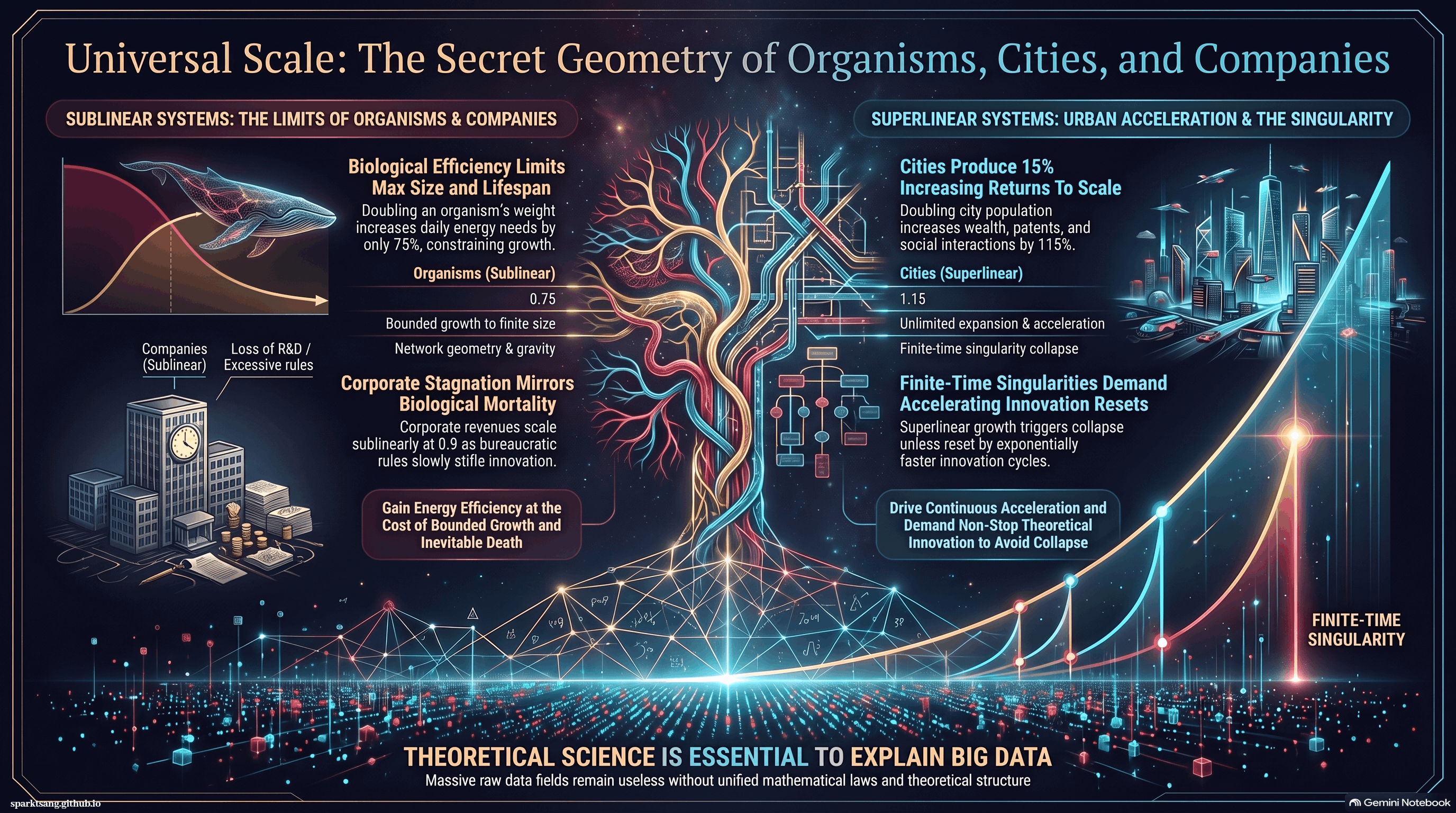
When an animal’s weight doubles, the energy it needs to consume each day rises by only 75% (while its heart rate slows by 25%). Larger animals are actually more efficient. The phenomenon in which energy is systematically saved as the scale of a system increases is called economies of scale
The same is true of cities. Infrastructure such as the length of roads, electrical lines, and water pipes, as well as the number of gas stations, follows the same scaling principle, except that the exponent is not 0.75 but 0.85
The resources being saved above-scale are offset by a systematic increase in quantities of scale to roughly the same degree
When one city is twice the size of another city in the same country, its wages, wealth, number of patents, AIDS cases, violent crimes, and educational institutions are more than twice as large—by 15%—following the scaling law of 1.15
Companies, by contrast, have an exponent of 0.9. Their life trajectories resemble those of organisms: they grow rapidly at first, driven by a wide range of innovative ideas; once they have established themselves, growth gradually slows, direction becomes increasingly narrow, and their product range contracts. More than half of U.S.-listed companies disappear within ten years
Chapter Two
Galileo, the father of modern science who disproved Aristotle’s ancient claim that the speed at which an object falls is proportional to its weight, wrote a dialogue while under house arrest by the Inquisition, explaining why objects cannot be scaled up indefinitely in proportion
When an object’s length doubles, its area becomes four times larger and its volume eight times larger
The efficiency of most heating, air-conditioning, and lighting systems is proportional to the surface area of the machine or window. Therefore, when an entire house is scaled up, the rate at which its efficiency increases is slower than the increase in its volume, which is why features such as elephant ears must become disproportionately larger
The strength of beams, pillars, and limbs is determined by cross-sectional area, which is why elephants also have thick legs
This explains why ants can support weights 100 times their own
The two-thirds scaling exponent between area and weight is consistent with the relationship between the body weight and strength of weightlifting champions, confirming the slope
The dosage of a drug is determined by surface area. In 1962, researchers took a safe dose established in cats and injected the psychedelic into Tusko, an elephant at Lincoln Park Zoo, scaling the dose by volume rather than by the two-thirds power, and not knowing that it needed to be adjusted according to an exponent of two-thirds. The elephant died five minutes later. This was a mainstream study published in a scientific journal
Even today, many drug dosage recommendations are still based on a linear, body-weight-based way of thinking
Body weight should be proportional to the cube of height, so the definition of BMI is seriously at odds with the concept above
Size and growth are finite. Unless certain conditions change, innovation is the main force that drives further expansion, as when large bridges began using stronger steel
Isambard Kingdom Brunel was voted the second-greatest of the 100 Greatest Britons in a BBC survey, behind only Churchill (third was Diana, followed only afterward by the three giants Darwin, Shakespeare, and Newton). He understood that a ship’s cargo capacity increases with the cube of its size, while its resistance to motion increases with the square of its size, so larger ships transport cargo more efficiently than smaller ones. At the time, this conclusion ran against intuition and few people believed it, but it contributed to the success of the Great Western
His much larger follow-up, the Great Eastern, was highly inefficient and ended in economic failure. It became a cable-laying ship, was even reduced to serving as a floating concert hall in Liverpool, and was eventually dismantled
A ship’s dynamic behavior is in fact determined by the Froude number (velocity squared divided by length times gravitational acceleration)
Chapter Three
In 1993, the U.S. Congress canceled the largest scientific project in history involving a super collider. Many opponents argued that although the previous two centuries had been the centuries of physics, the 21st century would be the century of biology
The author believes that for biology to become highly successful, it must accept quantitative analysis like physics and develop a mathematical theoretical framework
The author found similar thinking in his predecessor Wentworth Thompson, who received the Darwin Medal in 1946
As mentioned earlier, increasing mass by four orders of magnitude increases metabolic rate by only three orders of magnitude
Many other relationships—including growth rate, heart rate, mitochondrial density, and lifespan—have relative exponents that are simple multiples of one-quarter
Biological energy is obtained through the conversion between ATP and ADP. Natural selection minimizes the energy required for daily life, producing the consistent mathematical results described above
The area-preserving branching principle determines that the total surface area before and after a blood-vessel branch remains the same, while preventing energy-wasting wave reflections, causing the radius of each pulsatile branch vessel to decrease successively by √2, while the succeeding non-pulsatile vessels decrease by the cube root of 2
The cube-root law of length interacts with the square-root law of radius, together with the linear law of blood volume and the invariance constraint of the terminal units, ultimately producing the 1/4-power allometric scaling exponent found throughout the organism
This reflects the fact that organisms behave as though they operate in four-dimensional space
Remarkably, mammals have the same blood pressure regardless of size. The tiny blood vessels of a mouse have to withstand the same blood pressure as ours. No wonder they have such short lifespans
Lewis Fry Richardson discovered that the length of a coastline increases with the precision of the unit of measurement, and Benoit Mandelbrot proposed the concept of fractal dimension to explain it
Electrocardiograms and stock-market performance are both self-similar fractal patterns, following a power law that can be quantified by an exponent or by its fractal dimension. The latter’s dynamic study gave rise to Econophysics
Mandelbrot wrote The Fractal Geometry of Nature. Fractal laws made photorealistic images in films possible
Chapter Four
If mammals were shrunk indefinitely, pulsatile blood vessels would continually decrease toward zero, reducing efficiency and offering no evolutionary advantage
If they were enlarged indefinitely, then even setting aside the constraints of gravity, the geometry and dynamics of network supply systems would impose limits: each capillary would have to systematically serve more cells
After dimensionless adjustment, different organisms show overlapping growth curves
The life and death of organisms has an exponential relationship with temperature
The total energy required over a lifetime to support one gram of tissue is the same for all mammals
In the past, mortality rates for humans of different ages remained constant, and this can be understood using a half-life. Today, mortality rates have fallen across all ages, with the ceiling converging around 125 years
Interestingly, the total number of engine firings over a car’s lifetime is in the billions, comparable to the total number of heartbeats in mammals
Experiments on mice confirmed that caloric restriction effectively extends lifespan: cutting calorie intake in half extends lifespan by 75%
Chapter Five
Since the technological revolution, the doubling time of system growth has become shorter and shorter, indicating hyperexponential growth
The book revisits the astronomical numbers in the wheat and chessboard problem
Bacteria that divide once every minute will eventually fill a container, yet the jump from half-full to completely full happens only in the final minute
Because each person consumes many times more energy than is required for biological needs, the earth’s actual “effective population” is many times larger than its apparent population
The energy regime has shifted from obtaining energy directly from the sun in ancient times to obtaining it from the closed system of fossil fuels beneath the earth. True sustainability must ultimately return to an open system
Chapter Six
Recommended reading: Jane Jacobs’s The Death and Life of Great American Cities, which had a major influence on globalization, despite her lack of an impressive academic pedigree
The author fought to preserve the integrity of downtown Manhattan and won, vigorously criticizing planners who wanted to sacrifice traditional communities to build highways
Long before the consensus among economists, she had already proposed that cities were the primary engines of economic development—an extremely radical view at the time
Great metropolises stimulate human interaction, create excitement, and nourish the soul. To ignore these crucial dimensions while caring only about buildings and infrastructure would be short-sighted
Chapter Seven
City population and the number of gas stations follow a simple power law. Unlike the 0.75 exponent in biology, the exponent is 0.85, meaning that when a city’s population doubles, it needs only an 85% increase in the number of gas stations
Other forms of physical infrastructure show the same pattern, while socioeconomic quantities across different cities in the same country display a scaling exponent of 1.15, demonstrating increasing returns to scale
Lower costs and more opportunities: this is the gift of the city. The sublinear scaling of infrastructure and energy use mirrors the superlinear scaling of socioeconomic quantities, and the correspondence is not accidental
The pioneering research of Walter Christaller showed that the diffusion of cities also forms a fractal geometry
The interstate highway network brings to mind our circulatory system
Unfortunately, we do not have sufficiently detailed data on traffic flows within cities to analyze this
Cities are giant social incubators. Stanley Milgram’s six degrees of separation theory makes us realize how small the world is
The Millennium Bridge had to undergo $8 million worth of corrective work because of lateral resonance. Systems science can save enormous amounts of money
Milgram, who experimentally demonstrated that people do not have to be bad people to commit extremely cruel and inhumane acts, also demonstrated the indifference of urban dwellers and explained it through “overload”: if city residents cared about everything, they would collapse, so their indifference is an adaptive response to the sensory overload of urban life
Human relationships also follow scaling laws and fractal patterns. The circles of closest family and confidants (people we turn to when faced with serious problems), friends (people we enjoy spending time with), acquaintances (people we usually only invite to gatherings), and ordinary friends (people with whom we have social contact) scale by a factor of three: 5–15–50–150
Robin Dunbar discovered that the maximum number of people one can regard as ordinary friends is 150, and throughout history, groups of all kinds have tended to cluster around this magical number
He and his colleagues also found that primate group size is related to neocortex volume, leading to the conclusion that the evolution of human intelligence was driven by the need to cope with large, complex social organizations. The author, however, proposes that it may instead be a consequence of metabolic ecology
Zipf’s law can be applied to city sizes, word frequency, and company sizes, attracting attention across disciplines. Ordinary people might naturally assume that everything follows the distribution pattern of the Gaussian bell curve rather than a power law
The superlinear scaling of socioeconomic quantities with population size can be explained simply by the total number of connections between people: two people can have at most one relationship, three people three relationships, four people six relationships, given by p (p-1)/2. But because in reality the number of people one person can interact with is limited, the exponent is greatly reduced, and the number of interactions is constrained by physical, fractal infrastructure networks
Chapter Eight
The superlinear dynamics of social networks systematically accelerate the pace of life: disease spreads faster, companies are founded and shut down faster, business transactions happen faster, and people walk faster. Cities are astonishing time-compression machines
Commentary on the acceleration of the pace of life and the resulting loss of culture and values can be found as early as Goethe in 1825
The invention of the microwave oven, washing machine, and dishwasher led earlier thinkers—including Keynes in 1930 and Darwin’s grandson in 1956—to predict that people’s leisure time would increase dramatically. The opposite happened, precisely because of the time-shortening effect
In the 1970s, Israeli transportation engineer Yacov Zahavi discovered that no matter where people lived, they spent roughly the same amount of time traveling each day: one hour. Those whose commutes were shorter than an hour would use other means, such as jogging, to consume the same amount of time. The finding was popularized by Casare Marchetti and became known as Marchetti’s constant. It explains why the radius of a walking city is around five kilometers—the equivalent of an hour’s walking distance
Constrained by physiology, the power-law increase in walking speed is only 0.1
The number of phone calls between British and Portuguese people also follows a power law, with the average value remarkably close to the predicted 1.15
Interestingly, the number of people in a person’s circle of friends does not change with the size of the city they live in
The movement of people in cities is governed by the inverse-square law: suppose n people travel to Boston Common once a month from a distance of four kilometers. From twice that distance, only n/4 people would travel there each month
Under the effect of power laws, fair comparisons of cities should be adjusted for scale. New York turns out to be quite ordinary, only slightly better than predicted; San Francisco is the standout among major cities; and San Jose had already established a trajectory of sustained success long before the birth of Silicon Valley
Among New York’s extraordinary achievements, one of the least frequently mentioned is its water-supply system. The way the diameter of the city’s water-supply system decreases closely resembles that of biological circulatory systems
Taking a specific workplace as one institution, the total number of institutions in a city is linearly proportional to population size. Regardless of city size, every additional 21.6 people correspond to one additional institution
In terms of specialization—the total number of company types—a city’s size can increase by a factor of 100 while the diversity of specializations doubles; that is, the former must multiply by 100 for the latter to increase by just 2%. Among the old economy sectors such as agriculture and mining, diversification grows sublinearly as city size increases, whereas professions such as doctors and lawyers grow superlinearly
Unlike biological metabolism, which scales sublinearly with size and produces economies of scale and constrained growth, cities exhibit superlinear scaling and increasing returns to scale, and therefore possess the potential for unlimited growth
Chapter Nine
A Compustat data analysis costing $50,000, covering 28,853 companies from 1950 to 2009, found that
A company’s number of employees is related by power laws to its net profit, sales, net income, and total assets
The scale effects of Chinese and American companies are also remarkably similar
A company’s total revenue or sales can be regarded as its metabolism, while its expenses can be regarded as maintenance costs
A company’s actual metabolic rate follows the principle of linear scaling, with a slope very close to one
This explains why the economy generally continues to expand at an exponential rate: the overall performance of the market is essentially the average growth performance of all participating companies
But even if a company itself grows exponentially, if its rate of expansion fails to keep pace with the market, it still cannot survive
Because of investment capital and the ability to obtain relatively large loans compared with their size, the maintenance costs of new companies scale nonlinearly, helping drive rapid growth
That is why the ideal growth curve of a company shares characteristics with the typical S-shaped growth curve of an organism
After adjusting for inflation, all companies reach a ceiling once sales have reached five to six orders of magnitude in millions of dollars
The balance between an organism’s metabolism and its maintenance costs is called homeostasis
Companies die more often through mergers and acquisitions than through bankruptcy or liquidation, but surprisingly, companies’ survival and death curves are extremely similar despite different causes of death and therefore across different industries
Because the number of years covered was limited, the Kaplan–Meier estimator was used for survival analysis to avoid systematic error. The results showed that the assessment did not change much: a company’s half-life is nearly 10.5 years (half of companies are gone after 10.5 years)
The length of time companies remain on the list has been declining. In 1958, companies in the S&P 500 were estimated to remain listed for 61 years; today, the figure is only around 18 years
Most of the companies that appeared on the list in 1955 have long since faded into obscurity. How many people still remember Armstrong Rubber or Pacific Vegetable Oil?
Out of every million companies, only 45 survive for more than a century; out of every billion, only one has a chance of surviving beyond 200 years
Most of these ancient companies are not large. They are highly specialized, and their survival depends not on diversification or innovation but on continually providing high-quality goods to a small group of loyal customers, such as the German shoemaker Eduard Meier, founded in 1596, and Nishiyama Onsen Keiunkan in Japan, founded in 705
The oldest is Kongo Gumi, founded in 578 and specializing in the construction of Buddhist temples. It was finally liquidated in 2006
Of companies more than a century old, 90% have fewer than 300 employees
Companies exhibit sublinear rather than superlinear scaling as cities do, reflecting the fact that the former wins through economies of scale while the latter wins through innovation
As companies expand in size, the share of funding allocated to R&D activities systematically decreases
In pursuit of efficiency, following old-fashioned practices and adding more rules and layers of control to facilitate execution often comes at the cost of innovative capacity
Market feedback mechanisms also lead to narrower product spaces and greater specialization, encouraging companies to stick with products validated by the market. Yet companies still need long-term strategies that require them to venture into new territory. How to balance the two has become a major challenge
Chapter Ten
The risk of continuing to pursue limited, single-system approaches without developing a unified framework is that on major issues, enormous amounts of financial and social capital may be wasted, ending in complete failure
We should develop a grand unified theory of sustainability, on the scale of the Manhattan Project or the Apollo Program, to address global sustainability problems
Superlinear scaling leads to a finite-time singularity: at some finite point in time, the quantity becomes infinite
This obviously cannot be sustainable. A transition period is necessary so that the system can escape its original “phase,” just as water becomes vapor or ice
Entirely new innovations must be initiated to reset the clock and avoid the singularity, allowing the system to keep growing instead of collapsing. But the intervals between innovations must become shorter and shorter, like being on a treadmill that is continuously speeding up: you must jump onto another treadmill that is accelerating even faster, and repeat the process at ever-increasing speed. What Ray Kurzweil describes in his book is highly persuasive and supported by more detailed analyses extending over hundreds of years
A series of singularities will continue to accumulate, leading toward what mathematicians call an essential singularity—the mother of all singularities
Afterword
The author discusses the aspiration to pursue a complex grand unified theory, as well as the achievements of the Santa Fe Institute, where he served as director and which has been internationally recognized as “the formal birthplace of interdisciplinary research on complex systems”
Jim Gray regarded the current data revolution as the fourth paradigm. The first three major paradigms are: empirical observation (the pre-Galilean era), theory based on models and mathematics (the post-Newtonian era), and computation and simulation. The author believes that in this sense, it is more like Paradigm 3.1 than 4.0. Yet many people, including Chris Anderson, believe that with the arrival of a new paradigm, traditional scientific methods are no longer necessary: “Correlation supersedes causation”
The Large Hadron Collider generates 150 exabytes of data every day (the total amount of data generated by all devices in the world is only 2.5 exabytes), yet only around 100 of the 600 million collisions per second are important. From them came a crucial discovery about the fundamental laws of physics: the Higgs particle (the mass of all fundamental particles of matter is generated by this particle). This is sufficient evidence that neither science nor data are equal, or equally useful; big data needs a comprehensible theoretical framework in order to make predictions
Finished reading on Nov 13 2020
Thank you for reading until the end. This is a bonus infographic just for you.