Notes on How to Be a Dictator
How to Be a Dictator: The Cult of Personality in the Twentieth Century by Frank Dikötter
Original notes here.
Read until the end to get a bonus. Enjoy reading.
Mussolini
Seizing Power
In 1929, he boasted that his secretaries had submitted 1,887,112 matters for his attention, and that he personally replied to every one of them. More than half of his life was devoted to constructing his own image. He was the ultimate master of propaganda.
After Lenin seized power in Russia, the Italian left began to gain strength in 1920. In 1919, Mussolini launched a movement that developed into the Fascist Party. He promoted it through Il Popolo d’Italia, but failed to win a single seat. Party membership declined, and Mussolini seemed ready to give up.
In September, Gabriele d’Annunzio led his followers in occupying a city. Mussolini realized that power could actually be seized through violence, and also learned that grand spectacle was more attractive than speeches.
In 1921, the government sought to bring the Fascists into an alliance against the left, and even protected Fascist squads. Mussolini began inventing lies and exaggerating the threat from the left, while claiming that Italy needed a dictatorship.
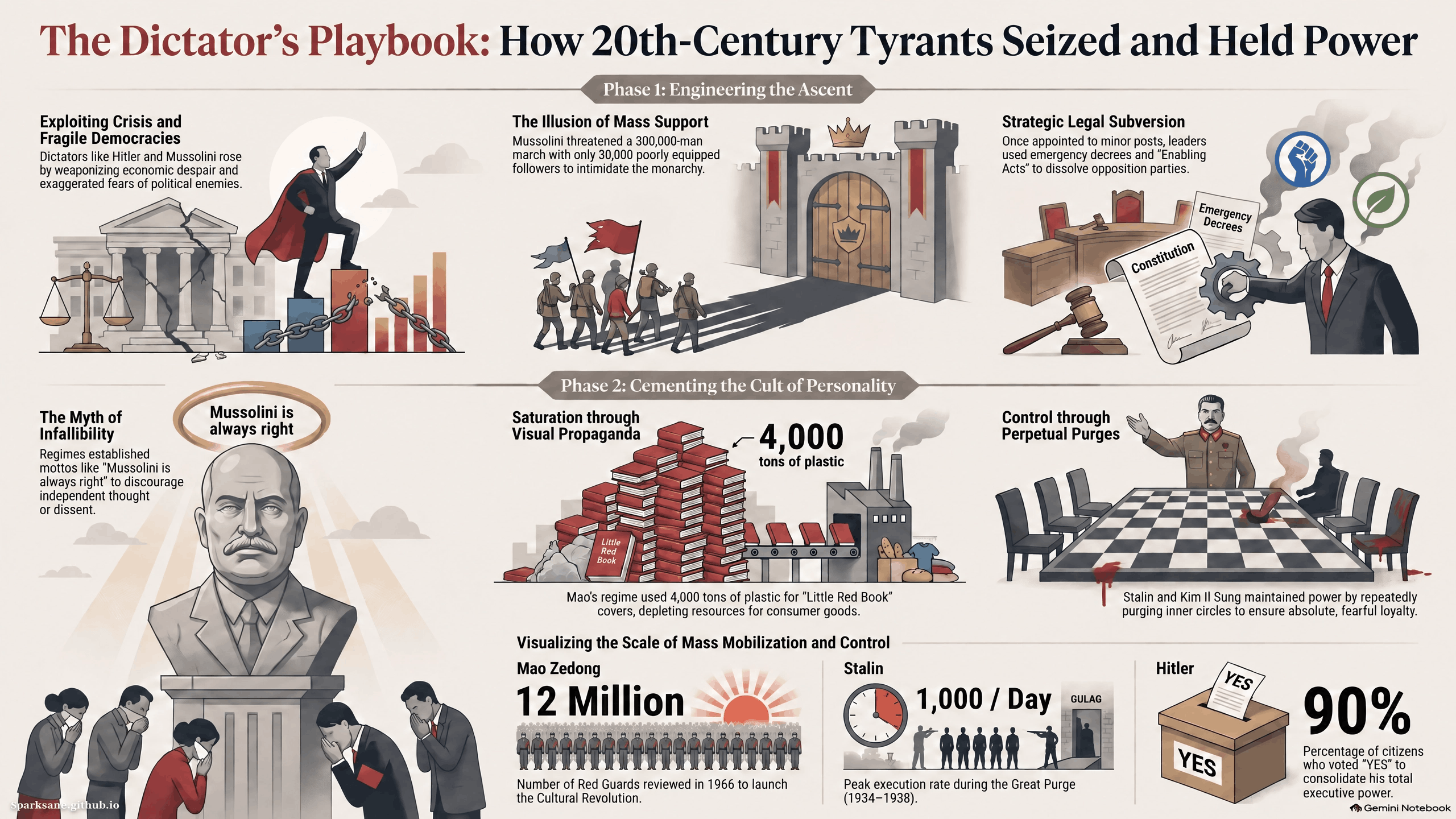
The following year, Mussolini threatened to send 300,000 armed men into the capital, although in reality there were only 30,000 poorly equipped Blackshirts. The king, afraid that Italy might follow the path of tsarist Russia, appointed him prime minister.
Dictatorship
To establish his image, he created the myth of the March on Rome from Milan: the Blackshirts flooded into the capital and destroyed the printing presses of opposition newspapers. He had his brother edit Il Popolo d’Italia and portray him as a demigod.
British journalist George Slocombe noticed that Mussolini was completely different one-on-one from his usual public persona: his muscles were no longer tense, and his voice became warmer.
Mussolini was deeply suspicious by nature. The veterans within the loosely organized Fascist Party accused him of getting too close to members of parliament, so he formed a coalition government and shut his own party out of it to strike back. When he first became prime minister, he frightened dissenters while appearing friendly, and assured everyone that he would respect the constitution, so most people were comfortable handing him power.
He longed for his subjects to submit to his charisma. He made whirlwind tours around the country, often leaving people who had received pink cards that morning and been ordered to attend waiting in vain until dusk before he finally appeared. He also planted his reliable ally Cesare Rossi in the Ministry of the Interior in charge of the press.
In 1924, his subordinate Dumini murdered Matteotti, an opposition leader who had openly criticized him. Mussolini faced a nationwide outcry. When attempts at soothing the public failed, he opened the way to full dictatorship the following year and set Italy firmly on the path of purely Fascist rule. Civil society was trampled. Mass arrests followed. Newspapers could be shut down at will, yet liberal papers still outsold Fascist papers by twelve to one. When an opposition paper such as Corriere della Sera refused to fall in line, police were stationed there and it was turned into a supporter of Fascism.
Totalitarianism
Attempts to assassinate Mussolini appeared again and again, and freedom of association was abolished. In 1925, he obtained complete executive power and no longer had to submit to parliamentary interference. That same year, he appointed Farinacci as party secretary, who carried out a purge of the party and paved the way for personal rule. The following year, Turati took over and further consolidated the cult of personality. Mussolini took control of the Luce Institute’s film archives and produced films glorifying himself; every cinema was forced to screen them. In 1926, he used radio for propaganda, and the voice of Mussolini spread throughout the country. He later published a book declaring that “the sole leader possesses all power.” By 1928, his angry expression had become a serene smile and his smile more gentle. In 1929, a French journalist visiting him remarked that he seemed to be present throughout the entire country. From that year onward, he also began frequently adjusting the height of the stage before major meetings. Biographies circulating at the time included The Life of Mussolini and The Biography of Mussolini.
The entire country imagined that Mussolini never slept and worked constantly. He deliberately kept the lights of the Palazzo Venezia burning all night. The reception rooms were designed to overwhelm visitors with their imposing scale. He often spoke to crowds from the small balcony outside his office. He rehearsed frequently and adjusted his lines and gestures according to the mood of the crowd. Visitors such as Gandhi, Churchill, and Edison all praised Mussolini.
In 1931, Mussolini appointed Starace as party secretary. When a follower protested that he was an idiot, the response was that he was a very obedient idiot. Starace greatly increased party membership. In 1939, one observer remarked that there were no Fascists left in the party; the cult of personality had become more important. “Mussolini is always right” became the regime’s motto. Between 1933 and 1943, the domestic press spent 400 million lire propagandizing the regime and its leader. Foreign publishers also received subsidies; the author of Interpreting the Mind of Mussolini received 79.5K lire.
In 1932, the Exhibition of the Fascist Revolution celebrated the tenth anniversary of the March on Rome. Mussolini received letters and gifts without end. In 1933, he even inherited a villa from the American heiress Henrietta Tower.
Unleashing the Blade
In 1926, Mussolini declared that Rome had to appear before the world like a miracle, as great as it had been under Augustus. The modern Caesar who would build a new Roman Empire therefore had to continue expanding its territory.
In 1929, the military massacred a quarter of the population of Libya and drove out 100,000 Bedouins. The media covered up the atrocities and praised the dictator for bringing them back to civilization.
In 1931, Mussolini demanded that his generals be ready for war within four years. In 1933, Hitler withdrew from the League of Nations, and the dictator accelerated the militarization of Italy. He took control of the army, navy, and air force ministries. Apart from the Ministry of Finance, government power was effectively concentrated in his hands. He also launched the Battle for Grain, the Battle for the Lira, the Battle for Land, and the Battle for Births, as well as a “campaign against flies”, causing steel production to fall and increasing dependence on imported fertilizer. After conquering Ethiopia, he linked Eritrea and Somalia together, completing the unification of Italian East Africa.
Before the war, apart from the king, the dictator consulted no one. In 1935, 27 million people participated in the largest mass rally in human history to hear the declaration of war. The dictator personally took over supreme command and ordered the use of hundreds of tons of mustard gas. Some 250,000 people died in the Ethiopian war, which propaganda portrayed as a liberation. The king was elevated to emperor, and the dictator became the creator of the empire. Mussolini Square was built and a great celebration held on an imperial scale.
Under international isolation, he turned to Hitler. When Hitler visited, he stole the show. The dictator also went to Berlin and was awed by Hitler’s charisma. An English official in Berlin remarked at the time that his appearance had become haggard and disfigured.
The master who had once inspired Hitler now imitated his pupil. Without consulting the Grand Council, he joined Germany and Japan by signing the Anti-Comintern Pact, thereby betraying Austria. Later, when Hitler marched into Czechoslovakia despite having promised Mussolini that he would not invade, Mussolini’s prestige plummeted. He was mocked as Hitler’s governor of Italy.
To keep pace, Mussolini invaded Albania, exposing the weakness of his army’s lack of preparation. He bragged to Hitler that he had 150 divisions when he actually had ten, many equipped with outdated matériel. He briefly expected Germany to lose the war, but after seeing its military successes, came to believe again that it would win.
Under the cult of personality, his inner circle consisted only of flatterers, with no loyal advisers. Mussolini also wanted to control everything. His rule extended to fuel engines, pumice sand, bicycle rims, Latin translations, cameras, mirrors, lamps, and mineral water; he even changed the color of women’s magazine covers from purple to brown.
As in Nazi Germany, the phrase “if only the dictator knew” was constantly on people’s lips. Even though the police state was powerful, public enthusiasm for him was fading in 1939. Underground newspapers were increasing in circulation, while sanctions had left store shelves empty. Mussolini desperately needed the glory of war to conceal popular discontent, so in June 1940 he declared war on the Allies.
Demonic Transformation
Hitler invaded four times without notifying him. The dictator wanted to return the favor with a surprise, so he invaded Greece without even informing his staff. In terrible weather, his forces were driven back into Albania within weeks, while the British destroyed half his warships. The people no longer believed the dictator’s speeches and instead turned to British radio stations for confirmation. The authorities spent 60 million lire trying to suppress the underground London broadcasts, with little effect.
The dictator could only turn to Hitler for help. Hitler intervened, in return gaining the right to penetrate throughout Italy. In his son-in-law Ciano’s diary: “We were not treated as partners, but as eternal slaves.”
Before and after this, Mussolini’s military expeditions ended in defeat. In September 1940, his invasion of Egypt was repelled by the British. In November 1941, he suffered a disastrous defeat at Gondar. By July 1942, his face had grown haggard. For two years he had appeared in public only once on the anniversary of the war. When he appeared again on December 2, 1942, he had become politically irrelevant. People whispered that he had lost his former grandeur.
In July 1943, the king arrested Mussolini. Not a single party member resisted. Angry citizens destroyed his images and statues. Yet one person in the world still refused to abandon him: Hitler, seeing that this was damaging to his own image, sent a commando unit to rescue him, took control of Italy, and installed the dictator as leader of the “Italian Social Republic.” At the final meeting of the Grand Council, Fascist leaders who had voted against him, including his son-in-law, were executed.
In January 1945, he told Madeleine Mollier that he was merely a corpse waiting for the tragedy to end. A few months later, he was captured by partisans and executed on the spot together with his mistress and followers. Starace was also executed shortly afterward.
Hitler
Seizing Power
As a young man he wanted to become an artist, but the academy rejected him. He loved opera and architecture. He had served in the Bavarian military and later made a living lecturing soldiers about the dangers of communism. His talent for speaking was discovered by the Workers’ Party, the predecessor of the Nazi Party. The party believed that a savior would rescue the country, and quickly placed its hopes in Hitler. He then seized power within the party and created the SA to deal with opponents, while promoting a cult of personality.
In 1923, imitating Mussolini, he attempted the Beer Hall Putsch, which failed. During his thirteen months in prison, he wrote most of the manuscript of Mein Kampf, which only became a bestseller in 1933. After his release, although he was banned from public speaking, Hoffmann published three books portraying him as a savior. Because the economy was recovering and Germany had re-entered the international community, support for the Nazi Party remained weak, and the ban was lifted in 1927.
The Wall Street Crash of 1929 brought mass unemployment and inflation. Between May 1928 and September 1930, the Nazi vote surged from 2.6% to 18.3%, but it was still largely confined to its own echo chamber.
In March 1932, Hoffmann published a photo series of Hitler that made him appear more approachable. He still lost the presidential election in April. But in July, the Nazi vote reached 37.2%, making it the largest party. Hitler demanded that President Hindenburg appoint him chancellor, but Hindenburg refused. In November, the Nazi vote fell to less than one third, and newspapers described his halo as having disappeared. Yet the situation suddenly turned in his favor because there was a common political enemy considered even more frightening. In January of the following year, Hitler was appointed chancellor.
Dictatorship
The Reichstag fire was subsequently declared a communist conspiracy. Hindenburg agreed to pass an emergency decree, and the Brownshirts launched mass arrests of opponents. Other opposition parties were intimidated. In February, a Social Democratic mayor was shot dead. In March, the Nazis won 43.9% of the vote, and that same month the Enabling Act was passed, removing limits on Hitler’s power. Large numbers of streets and squares were renamed after Hitler. In May, trade unions were dissolved. In June, every other political party was dissolved. That same year, 100,000 people were detained without trial.
In June 1934, Hitler ordered the SS to purge the SA, and its leader Röhm was shot. In August, Hindenburg died, and the Führer combined the offices of chancellor and head of state.
In August, Hitler posters bearing the word YES covered the country. Ninety percent of citizens supported the merger of the two offices. Victor Klemperer wrote in his diary that one third were driven by fear, one third were out of their minds, and one third were both afraid and out of their minds. The Nazis then organized annual rallies praising the Führer, attended by 700,000 people. Senior officials from other parties seemed to have disappeared entirely from their offices. Mein Kampf declared that when people worship genius, they release their inner strength.
Totalitarianism
From education to clubs, everything was either controlled or replaced by the Nazis. Newspapers all carried the same message. Mein Kampf remained a bestseller. Cheap radios were sold so that the public could hear the Führer’s voice. Loudspeakers filled the streets. The propaganda film Triumph of the Will won awards in Germany, the United States, and France. Hoffmann, the regime’s favored photographer, prospered.
Hitler liked setting his subordinates against one another. He would assign the same task to several people at once, thereby strengthening his own power. Bernhard Rust served as Minister of Education. From their first day of school, children were indoctrinated to worship the leader and obey the party, while being taught the story of the “unknown soldier” who struggled his way into becoming the Führer and saved Germany from collapse.
Hitler carefully staged his retreat at Berghof. Every detail was designed to leave a lasting impression. The sofas were extraordinarily large and deep, forcing visitors to curl up, recline, or perch on the edge, while Hitler sat upright with perfect composure, dominating the room. In 1936, the British prime minister visited Germany and called Hitler the George Washington of Germany. Hitler was also skilled at lowering people’s defenses. He appeared courteous and harmless, creating a false sense of security. In 1932, American journalist Dorothy Thompson published I Saw Hitler!, portraying him as a blurred, indistinct figure who could only attack the weakest opponents. Hitler was pleased when he read it.
Unleashing the Blade
Hitler began implementing the grand vision laid out in his book, but relied on intuition rather than sticking rigidly to a plan. In 1933, Germany withdrew from the League of Nations, restricted exports, controlled prices, built grain reserves, and introduced rationing. In 1935, it expanded conscription to six times the level permitted under the Treaty of Versailles. In 1936, Hitler appointed Göring to oversee the Four Year Plan, with the goal of making the economy self-sufficient within four years. The result was shortages across the country, long lines outside restaurants, and increasingly theatrical government rallies and demonstrations. Some people began to doubt Hitler’s supposed miraculous powers, but many still believed that breaking free from the shackles of Versailles was his achievement; any failures were blamed on subordinates within the party.
That same year, he sent troops into the demilitarized Rhineland. In 1938, he occupied Austria and then persuaded Chamberlain to let him take the Sudetenland. The following year, on his fiftieth birthday, the whole country appeared to be celebrating, but most of the people there had actually been brought in from companies and factories. People were ordered to decorate their own homes for his birthday.
In 1939, he invaded Czechoslovakia and Germany signed an alliance with Russia. Hitler rejected Göring’s advice and gambled that Britain and France would not intervene in Poland. He lost. Hoffmann found him slumped in thought, his face full of confusion and worry. The country fell into extreme despair, yet nobody blamed Britain or France. When German forces reached Warsaw, Berliners remained strangely indifferent.
Under the British and French economic blockade, every commodity was affected. Wage taxes rose to 50%. Half the population had no coal in winter. Public transport stopped on Sundays. The economy was devastated, and that year only 75 people came to his birthday celebration.
Demonic Transformation
Unable to break through the economic blockade, Hitler decided to gamble everything. While he still had supplies, he marched into the Netherlands, Belgium, and France. The whole country erupted in celebration when an armistice was reached, but Britain refused to surrender and the bombing campaign failed.
After the Soviet invasion of Finland ended in costly defeat, Germany became heavily dependent on Russian oil and grain. In 1941, Hitler gambled again and betrayed the Soviet Union by invading it. After Japan attacked Pearl Harbor and declared war on the United States, Hitler did the same, having underestimated American productive capacity in wheat, coal, and steel after dismissing the United States as a non-major power. He ignored his commanders, insisted on continuing the war, and refused to retreat. Hundreds of thousands of soldiers died, and the remnants surrendered in 1943.
Hitler’s hand tremors became severe, and he no longer wanted to appear in public. On the eve of his birthday in 1943, Goebbels explained that a man of talent did not need to keep displaying himself under the spotlight.
Many people realized that this was a turning point. Mussolini fell from power that year, severe criticism emerged, and people discovered how to speak their minds without being punished. People listened to foreign radio broadcasts. Fewer people gave the Hitler salute. Many party members stopped wearing party badges. Increasingly, people said they would rather see the British than the Russians be the first to enter Berlin.
Convinced of his own genius and deeply suspicious, Hitler had several assassination attempts made against him in 1944. By then, he himself had changed. Hoffmann described him as a burned-out wreck of a ship, with white hair, a stooped back, and a shuffling walk. Yet when he entered a room, some of his most loyal followers still sat there chatting as they had in the past.
In February 1945, Soviet troops reached the gates of the city. Hitler predicted that the war would soon turn around, and was mocked by people from all sides. Soldiers openly called him a megalomaniac. Civilians removed Nazi symbols from public buildings.
During the final months he hid in the bunker but continued ordering the fighting to continue. On April 30, he shot himself. A wave of suicides swept through the leadership, and thousands of civilians also killed themselves. Yet no one wept for the Führer’s death. The “Third Reich” disappeared overnight, forgotten by everyone. The arriving Red Army was astonished by how submissive the Germans were.
Stalin
Seizing Power
After Lenin was shot, he did not die, and condolences poured in. When he recovered, the cult of personality returned.
Like Fascism and Nazism, the Bolsheviks had no real blueprint or program. It was the leader who meticulously organized everything and carried out his will and intuition.
In November 1917, even at the height of their popularity, the Bolsheviks won less than a quarter of the vote. They seized power through violence, and the more power they acquired, the more brutal they became.
Because Trotsky opposed his support for the New Economic Policy and its permission for a small market, he selected Stalin as General Secretary in 1922. Before that, communist rule had reduced the economy to ruins.
Stalin turned his lack of charisma into an advantage by presenting himself as a humble servant and practical man. He used Lenin’s recovery to gain power, but the two fell out in 1923. In his testament, Lenin said Stalin was rude and should be removed. Yet even in death Lenin remained an asset. Stalin presented himself as Lenin’s most faithful student. He had Lenin embalmed so that the public could view him, and brought the Lenin Institute under his control to supervise publications. But at the party meeting where Lenin’s testament was being reviewed, he was still so frightened that he offered his resignation. The Central Committee ultimately did nothing.
Dictatorship
In 1924, Stalin turned his sword on his principal political rival. He published an article asking, “Trotskyism or Leninism?” accusing Trotsky’s theory of permanent revolution of violating Lenin’s principles. Trotsky’s influence was gradually reduced. Two years later, he was forced to organize an opposition to resist Stalin, but because factions had already been banned inside the party, it went nowhere. Two years later, he was exiled.
Inside the country, however, Stalin began implementing Trotsky’s policies. Grain supplies fell by one third. He sent people into villages to seize grain from the “kulaks,” leading several years later to the Great Famine. Those who continued supporting Stalin’s original intentions were branded rightists; others became left-wing reactionaries. This was the Great Purge.
To turn the Soviet Union into an industrial power, Stalin required workers to work seven days a week. His propaganda was ubiquitous, beginning with Labor Day, a holiday commemorating the eight-hour workday, even though collectivized Soviet society had no eight-hour working day. He also made May 2 a holiday to consolidate his own power, so that from 1929 onward his position became comparable to Lenin’s. The little-seen, inconspicuous commissar eventually became an unquestionable leader.
In 1930, Stalin was showered with praise at the Congress, although there were complaints as well, to which he gave no response. Journalists such as Lyons and writers such as George Bernard Shaw and Barbusse began promoting a gentle image of Stalin as no dictator. Barbusse said Stalin had only one secretary. Such writers were all lavishly rewarded.
In 1934, the party secretary of Leningrad was assassinated and the Great Purge began. Anyone who had openly defied him was imprisoned. 1.5 million people were arrested, and at the peak as many as a thousand were executed every day. It did not stop until 1938.
The cult of personality reached fever pitch. Subordinates became objects of worship too, and commissars’ names were given to cities. Yet by 1938, only the ceremonial head Kalinin could be mentioned alongside Stalin. Even when his wife was arrested for calling Stalin a tyrant, he dutifully signed every decree. Stalin was everywhere, displaying a benevolent smile. At the end of a 1935 speech, writer Avdeenko thanked the Soviet Union. Stalin’s secretary suggested that he thank Stalin instead. Soon every writer ended every sentence by thanking Stalin. Writers who mocked the leader, such as Mandelstam, died in prison. Vast quantities of literature praising the leader appeared, including the poem: “Stalin, however high the sky, it cannot rise higher than your thought. … Before your shining soul, even the sun turns pale and dim.”
But very soon creativity itself was replaced by the same formula. Repetition was the key. Excessive flattery could also be dangerous. Stalin did not need different varieties of fanaticism; he wanted people to obey without conviction. Like a gardener, he pruned the cult surrounding himself so that it would grow at the right time.
In 1936, a new constitution was drafted, known as the Stalin Constitution. The term Marxism-Leninism-Stalinism was born. But because purges within the party continued endlessly, biographical figures were constantly being replaced, and no official biography was forthcoming.
Totalitarianism
In 1939, Stalin’s sixtieth birthday was celebrated with worship from every direction. Senior officials wrote a twelve-page poem in Pravda to honor him. Hitler also sent congratulations. The two dictators both feared and respected one another. That same year, Stalin signed a non-aggression pact with Hitler and invaded Finland, only to suffer a disastrous defeat. The League of Nations expelled Russia, and socialists abroad also saw Stalin as little different from Hitler.
To respond to Germany’s defensive line, he invaded the three Baltic states, gambling that Germany would lose in France. Instead, he lost. When the Nazis turned against him, Stalin initially thought it was merely a provocation.
German forces were initially welcomed by many starving people, but the Nazis regarded them as inferior. In 1941, Stalin appealed to patriotism and called on the people to resist the enemy. He personally directed the war, ignoring the advice of his commanders and ordering every city to be defended. Fortunately, the winter arrived and American entry into the war shifted the balance in Russia’s favor. By then, however, 2 million Red Army soldiers had been killed and 3.5 million captured.
The Battle of Stalingrad turned the tide. Stalin, who had rarely appeared in public, returned to center stage and appointed himself Marshal. Everyone praised his military genius, including Churchill and Roosevelt. Even some of the people who had hated him during the Great Purge changed their views after enduring the horrors of the war. Yet most people still did not act. A foreign journalist traveling through the country and talking with soldiers and civilians never once heard Stalin’s name mentioned.
The real hero, Zhukov, who led the army in breaking through Hitler’s fortress, was deliberately minimized. A biography published in 1947 did not mention a single general; everything was credited to Stalin.
Under the growing external pressure of the Cold War in 1947, Stalin imposed orthodoxy across every field. He intervened in scientific debates and denounced genetics as bourgeois science, bringing biological research to a standstill. Dissident professors were sent to labor camps. The sole exception was atomic-bomb research. In every satellite state, dissidents were also arrested and sent to camps, independent organizations were dissolved, churches were destroyed, and schools were nationalized.
In 1949, his seventieth birthday reached the peak of the cult. The socialist bloc around the world sent congratulations. North Korea collected 16.76 million signatures to congratulate him. China sent a Mulan statue and rice stamped with Stalin’s likeness.
The purges extended to his family. His wife’s sister was expelled for publishing memoirs that revealed that he had been utterly unremarkable when young. Between 1944 and 1950, the Gulag population doubled to 2.5 million. Great purges continued repeatedly.
In 1953, Stalin died. Hundreds were trampled to death by mourners. All transportation stopped during the funeral, and countless people were devastated with grief. A month later, his name disappeared from the newspapers.
Mao Zedong
Seizing Power
After Stalin’s seventieth-birthday celebration, a brief private meeting was arranged with Mao, but Stalin left without meeting him. Mao, who had led one quarter of humanity onto the communist road, felt slighted.
In 1921, the Comintern gave Mao 200 yuan to travel to Shanghai to attend the founding congress. Because Lenin had realized that Bolshevism was not attracting people outside Europe, he ordered the Chinese Communist Party to form a united front with the Kuomintang. The Communists joined the Kuomintang, which also received Soviet assistance. Chiang Kai-shek wanted to move against the warlords, while Mao followed Soviet instructions and went to organize peasants. Mao became fascinated by the violence of struggle sessions. The Kuomintang, meanwhile, was repelled by violence in the countryside, withdrew from the Soviet model, and launched a bloody purge of the Communists. Mao went underground into the mountains and won the support of peasants who cared little for orthodox Marxism-Leninism. This brought him into conflict with the Shanghai underground Central Committee, which had close ties to the workers. Zhou Enlai even described Mao’s troops as roaming bandits. Mao responded with brutal purges: more than a hundred officers in Futian, Jiangxi, were stripped naked and confined in bamboo cages, and many were stabbed to death.
In 1931, Mao established a Soviet in the mountains of Jiangxi and controlled three million people. The Shanghai Central Committee also arrived, criticized guerrilla warfare, and took command away from Mao and gave it to Zhou. Chiang Kai-shek dealt the Red Army heavy blows, forcing the Communists to flee in what became known as the Long March. Mao seized the opportunity to take power again, regaining command of the Red Army. Of the 86,000 soldiers who set out, only 8,000 remained when they arrived, but they were all loyal to him.
Mao hoped that a world war would trigger a global revolution. Japan indeed invaded China. Stalin encouraged communists abroad to unite with those in power, but this strategy required the authority of a leader, so a campaign of comprehensive praise for Mao began. Mao invited the American journalist Edgar Snow to visit, and his book Red Star Over China became an overnight sensation. Mao declared his willingness to form an anti-Japanese united front. Chiang Kai-shek continued suppressing the Communists but was then caught up in the Xi’an Incident, and the Communists were saved.
Luck kept favoring him. The Japanese army did something the Communists had never been able to do: it badly weakened the Nationalist army. Nationalist territory was humiliated while Communist territory remained secure. Chongqing was bombed with 3,000 tons of bombs, while not a single bomb fell on Yan’an. Mao now had no major rival and took the opportunity to rewrite the past. Former enemies were labeled right-wing or left-wing opportunists or Trotskyists, and accused of committing a series of “line errors,” until Mao emerged victorious from the Long March.
Mao then reinvented himself as a theorist, with Chen Boda’s help, co-writing New Democracy. It promised multiple parties, democracy and freedom, and private property. It was fictional, but attractive, and large numbers of people flocked to Yan’an. Mao, however, demanded submission. In 1942, he launched the Rectification Movement. Its killing atmosphere terrorized the entire party, suppressed independent thought, and established Mao as the sole authority. Under Kang Sheng’s supervision, innumerable political persecutions followed. Mao played the benevolent ruler and made Kang Sheng take the blame. The survivors regarded Mao as their master.
Mao established the Central General Study Committee, turning the entire party into a personal dictatorship. Former enemies were forced to confess their faults and prove their loyalty day and night. Zhou was forced to call himself a political swindler lacking principles. On the 22nd anniversary of the Communist Party, Mao said that the Rectification ensured ideological and political unity within the party. The cult of personality flourished. A headline in the Liberation Daily proclaimed Mao the great savior.
When Japan surrendered, Stalin, to ensure the withdrawal of American forces, agreed that Chiang was the legitimate head of China. But Soviet troops in Manchuria secretly handed rural areas to the Communists, helping the guerrillas turn into a fighting machine. The United States, however, imposed an arms embargo on Chiang. In 1948, the Communists starved Changchun into surrender. Beijing also fell, and Communist rule began.
Dictatorship
Mao Zedong Thought became compulsory. Adults had to return to class, and loudspeakers were installed nationwide to broadcast praise songs. Land reform killed nearly two million people and overturned the old order in the countryside. In the cities, people were assigned class backgrounds and divided into good, middle, and bad categories. These labels determined access to food, education, medical care, and employment. The stigma was passed down to their children and grandchildren.
From 1950 to the following year, the Campaign to Suppress Counterrevolutionaries became a Great Purge. Mao set the quota for executions at one per thousand of the population, but in some areas it was two or three times higher, and people were often killed indiscriminately. Former Kuomintang officials were purged on a large scale, the business community was forced into submission, and by 1953 every organization outside the party had been almost completely eliminated. Literary inquisitions flourished. Commercial Press publication titles fell from 8,000 in 1950 to only 1,234 the following year. Mao’s works were mass-produced in crude form, and Mao personally selected the photographer Hou Bo to print large numbers of photographs.
After Stalin died, despite having warned Mao that economic collectivization was moving too fast, Mao was liberated from restraint and accelerated centralization, reclaiming farmland and taking over all shops, enterprises, and industries.
In 1956, Khrushchev denounced Stalin’s cult of personality, creating ripples that challenged Mao. Liu Shaoqi, Deng Xiaoping, Zhou Enlai, and others supported collective leadership. The Eighth Party Congress, held in September, removed Mao Zedong Thought and rejected the cult of personality. But Mao was furious in private. He believed Khrushchev’s actions and his advocacy of peaceful coexistence with imperialism showed that capitalist culture was still dominant and was eroding communism from within, laying the groundwork for the later Cultural Revolution.
In November, the Hungarian Revolution provided Mao with an opening. He argued that the Hungarian Communist Party had failed to listen to popular grievances, causing the situation to deteriorate. He therefore called for people to be able to express dissatisfaction: “Let a hundred flowers bloom, let a hundred schools of thought contend.” He hoped for praise, but instead tens of thousands took to the streets demanding democracy and freedom. In the end, 500,000 people were branded rightists and sent to labor camps. Mao and his comrades once again united to suppress the people.
In 1957, Khrushchev announced that the Soviet Union would overtake the United States in food production. Mao in turn announced that China would surpass Britain in steel production within fifteen years and become the leading communist power, defeating Khrushchev. He launched the Great Leap Forward, advocated “the correct cult of personality,” and designated 3.6 million party members as right-deviationists, beginning another purge within the party. Only in 1960 did Mao abandon the Leap.
In January 1962, leaders around the country reviewed the failure of the Great Leap Forward. Liu Shaoqi called it a man-made disaster. Lin Biao, however, called it an unprecedented achievement in Chinese history, while Zhou Enlai took responsibility and blamed himself. Mao was pleased with Lin Biao and suspicious of everyone else. In August, he declared that counterrevolutionary forces were everywhere. The following year, he called on the entire country to learn from Lei Feng, seeking to motivate people exhausted by famine. In 1964, Lin Biao promoted Mao’s quotations.
Totalitarianism
In 1966, Mao prepared the Cultural Revolution, targeting political enemies who had reviewed the Great Leap Forward. He had learned from the mistakes of the Hundred Flowers Campaign and prepared more carefully. First he placed the country on a state of alert. In May, four people were arrested and accused of being an anti-party group seeking to restore capitalism. In June, the entire country stopped classes to struggle against teachers; some people even struggled against leaders and were punished by Liu and Deng. In July, Mao accused them of dictatorship. Liu and Deng were marginalized. Lin Biao became the number-two figure. “To rebel is justified” became a slogan of struggle. Between August and November, Mao reviewed a total of 12 million Red Guards.
In September, Lin Biao advocated smashing the old ideas, old culture, old customs, and old habits of every exploiting class. The Red Guards began burning books, opening graves, demolishing temples, destroying shrines, and even raiding homes. In Shanghai, 250,000 households were searched; books, copper, and scrolls were destroyed. Mao said that a new proletarian culture had to be created. Everyone knew that this meant worship of Mao. Every clean wall had to be covered with quotations from Mao or words spoken by him. Loudspeakers broadcast quotations at maximum volume. Air hostesses on domestic flights handed out the Little Red Book. Everyone feared being left behind in the cult. Seven new factories were built in Shanghai to meet demand for photographs, portraits, posters, and books. The plastic needed for Little Red Book covers reached 4,000 tons in 1968. As a result, in August 1966 the Ministry of Commerce restricted production of plastic shoes, slippers, and toys. But the planned economy could not satisfy demand, and the underground black market began to flourish. People stole whatever resources they could get. Some even scraped the aluminum protective layers off valuable factory machinery to make Mao badges, exhausting resources. In 1969, Mao ordered badge production halted.
Factional struggle plunged the entire country into chaos. Every side was convinced that it represented Mao’s true voice. Machine guns and anti-aircraft guns firing at one another became commonplace. The most decisive weapon was a single declaration from Mao branding one faction counterrevolutionary, determining the fate of countless people. The violence seemed endless.
In the summer of 1967, violence spiraled out of control, and Mao called for a grand alliance. In March 1968, the “Three Loyalties and Four Boundless Loves” movement emerged, pushing the cult of personality to a new high. Schools, workplaces, and factories all erected altars to Mao. Everywhere, people had to bow to Mao’s portrait, following the ritual of “asking for instructions in the morning and reporting in the evening” (zao qingshi, wan huibao). The national television station broadcast loyalty dances all night. Mao statues were everywhere. That year Shanghai used 900 tons of tinplate.
In the summer, Revolutionary Committees took over the party and the state. The first stage of the Cultural Revolution came to an end. Real power was now in the hands of the military, which supervised schools, factories, and governments. Millions of “bad elements” were sent to the countryside to receive re-education from poor and lower-middle peasants. Nationwide, people hunted “spies, traitors, and renegades.” To demonstrate loyalty, people everywhere were forced to denounce colleagues, friends, neighbors, and family members.
In April 1969, the Ninth Party Congress drafted a new constitution and reaffirmed Mao Zedong Thought as the country’s guiding principle, overturning the decisions of the Eighth Congress. Liu Shaoqi and dozens of old party members were denounced as “traitors, spies, and capitalist-roaders hidden within the party, as lackeys of imperialism, modern revisionism, and the reactionary Kuomintang, with crimes piled high.” Six months later, Liu died in solitary confinement. A new Central Committee was elected.
Mao became increasingly suspicious of the army, especially Lin Biao. Lin Biao, meanwhile, took advantage of the situation to expand his power and place his own loyalists in key military positions. In 1971, he died in a mysterious plane crash. Military control came to an end and was followed by a purge.
In 1972, in preparation for Nixon’s visit, the entire country was reorganized. Posters were replaced, slogans disappeared, city streets were renewed, and thousands of Mao statues were collected and removed. Mao was smug about it, saying that America had evolved from monkeys into humans but still had a tail. In the last years of his rule, he continued setting one faction against another. Zhou Enlai developed cancer, but Mao refused to let him receive treatment.
When Mao died, people pretended to cry. Privately, no one felt the slightest regret. In Kunming, alcohol sold out in one night, apart from among the true believers.
Mao’s portrait remained hanging everywhere. Unlike Khrushchev, he had turned the party leadership into accomplices, all conspiring together to preserve his image of greatness.
Kim Il Sung
Born into a Christian family, he moved with his entire family to Manchuria to escape Japanese colonial oppression. At nineteen, he joined the Chinese Communist Party. He was once arrested on suspicion of being a Japanese spy. As one of the few surviving Korean communists, he soon took command of several hundred fighters. In 1937, he attacked a Japanese police station. The operation had almost no strategic significance, but because it was the first Korean Communist attack against Japan, it was widely publicized. In 1940, to avoid arrest, he entered the Soviet Union. Two years later he became a captain. Stalin, however, preferred to trust Soviet Koreans who had maintained long-standing ties with Moscow.
One month after Japan surrendered, Kim Il Sung secretly returned to Korea and became acquainted with Soviet officials in Pyongyang. The Soviet Union still selected Cho Man-sik as its puppet leader, but Cho was a Christian nationalist who acted independently and was eventually placed under house arrest. Kim Il Sung finally emerged, and the Soviets helped build his image, praising his mysterious past.
He quickly imposed the Soviet model on every layer of society. Factories were nationalized and radical land reform was carried out. He toured the country giving on-the-spot guidance, and one million people—7–8% of North Korea’s population at the time—set out for Korea.
In 1946, biographies in the Rodong Sinmun repeatedly mentioned him. Many ordinary people came to believe that the guerrilla fighter who had spent years evading Japanese pursuit could fly through the air and dig tunnels through mountains.
In 1948, North Korea was established and the general became its supreme leader. Kim Il Sung wanted to expand the revolution by “liberating” South Korea from Syngman Rhee. In 1949, he asked Stalin, but Stalin refused. By the end of the year, however, Stalin had seen that the United States had abandoned Chiang Kai-shek. In January of the following year, he also declared that Korea was outside the Soviet defense perimeter. Only then did Stalin give the plan the green light, but without providing aid, telling Kim to seek Mao’s support. Mao agreed to help, and war began in June.
The United States convened the United Nations and sent troops to defend South Korea. By August, the tide of the war had turned. But UN forces kept advancing, forcing Mao to intervene in October. The two sides eventually became locked in a stalemate around the 38th parallel.
Ho Ka-i became the scapegoat for the defeat. Kim Il Sung first ordered him purged, then accused him of going too far and had him rehabilitated. Party members who had been expelled were now grateful to Kim as their savior. The cult of personality intensified, and his legend became compulsory reading for the entire nation.
After the war, the border had barely changed and three million people had died, yet Kim Il Sung declared victory: the United States was the aggressor, and the war had successfully stopped imperialist colonialism.
To divert public anger over the war, followers of political rival Pak Hon-yong were arrested in 1953. They confessed in front of the international media and were sentenced to death.
During the famine of 1955, the Soviet Union and China urgently sent 200,000 tons of grain. Meanwhile, demand for portraits of Marx, Engels, and Lenin declined. Enormous statues of Kim Il Sung appeared everywhere. He toured the country constantly giving guidance on everything imaginable. The entire nation published and studied his instructions. After he visited the Sinuiju Pulp Mill in 1956, the plant held daily meetings devoted specifically to discussing his guidance. When he visited ordinary people, he took notes; when he received letters of thanks, he replied with congratulations.
Even the slightest sign of disrespect was punishable. Using a newspaper bearing Kim Il Sung’s photograph to wrap books brought a five-year sentence. Retouching a badly made poster earned five years of forced labor. Complaining about food requisitions while pointing at a portrait of the leader and saying, “You are needlessly tormenting the people,” brought seven years. Thousands became victims.
In 1956, Khrushchev denounced the cult of personality, giving political enemies within the party an opportunity. The ambassador in Moscow complained that the leader was surrounded by flatterers. Khrushchev criticized Kim Il Sung, and more and more Central Committee members boldly denounced the leader. Kim Il Sung accused them of factionalism and dismissed and expelled them. The Soviet Union and China pressured him to compromise, so Kim restored the political enemies and made a symbolic concession.
The suppression of the Budapest uprising in October saved him. Socialist reform stopped, allowing Kim Il Sung to eliminate all his critics.
At a gathering celebrating the fortieth anniversary of the October Revolution the following October, Mao pulled him aside and expressed regret over the joint delegation. Both men rejected de-Stalinization. Kim Il Sung seized the opportunity to persuade Mao to withdraw the Chinese troops and leave Korea under his sole control.
The past was rewritten. Soviet and Chinese traces were erased, while the contribution of the revolutionary masses was greatly exaggerated. From civil engineering to molecular biology, every publication in every field had to mention the leader’s works. Marx, Engels, and Lenin were increasingly ignored. During the urgent Soviet-Chinese grain assistance of 1955, Kim Il Sung articulated the Juche Idea: the people are the masters of their own destiny, and self-reliance can create true socialism. Materialist Marxism-Leninism was displaced.
A nationwide witch hunt followed, much like the purge after China’s Hundred Flowers Campaign. Countless people were placed on registers or sent to labor camps. In 1957, people were divided into three groups according to party loyalty: the core class, the wavering class, and the hostile class. Birth determined everything—food, education, employment—like a caste system passed down from generation to generation.
The following year, the Chollima Movement was launched, much like the Great Leap Forward, seeking to surpass Japan in industrial production and triggering another wave of repression.
In 1965, during a visit to Indonesia, he presented himself as a leader of the Third World and elaborated on the Juche Idea. In 1968, he even refused to attend an international conference hosted by the Soviet Union because of its invasion of Czechoslovakia, using the Juche Idea against Moscow. At home, demands for better living conditions were regarded as threats, and ideological unity was emphasized. In 1967, critics were purged again. Although North Korea did not experience a Cultural Revolution, everything that smelled of bourgeois culture was attacked: love songs, romance stories, popular dramas featuring folk tales, classical music, and even socialist realist novels were banned. The following year, foreign books were confiscated, and studying the original works of Marx and Engels was considered undesirable.
That same year, regular air-raid drills were instituted. The sick and elderly alike had to walk several kilometers to shelters. Nothing could unite the country more effectively than the threat of war. The following year, a general even attempted to assassinate Park Chung-hee, while an American vessel was seized. War seemed imminent, and only prolonged negotiations resolved the crisis. Kim Il Sung quietly removed twelve senior military officers.
In 1972, on his sixtieth birthday, massive construction projects were launched. Contracts were signed to transport cement from the Soviet Union, and even then the project required all miners to dig for cement. Coal needed by power stations was consumed, leaving towns in darkness. American journalist Harrison Salisbury visited and praised him as an extremely shrewd and far-sighted politician. That same year, a new constitution was enacted, making the Juche Idea the highest principle.
In the 1970s, he expanded his diplomatic offensive and accepted freer interviews. In 1975, the United Nations finally recognized North Korea. He then funded fifty countries and more than two hundred organizations to study the Juche Idea. In 1974, an international symposium was held in Tokyo, and the term “Kimilsungism” emerged. By 1978, he realized that these efforts had failed to win respect and had instead made him a laughingstock, ending his brief support in the Third World. Yet by 1981, nine out of ten nightly international news broadcasts reported on overseas seminars related to the leader.
Workers began morning and evening rituals before the leader’s portrait. The leader strongly promoted his heir Kim Jong Il and eliminated those who opposed the succession.
In the 1980s, 9,000 trees were carved with inscriptions praising the revolutionary leader. When he died, under the surveillance of the secret police, everyone tried to appear more grief-stricken than everyone else. One five-year-old even spat on his own face to pretend to cry.
Duvalier
In 1939, he published a theory of racial determinism: biology determines psychology, each race has a collective personality, Blacks are the true Haitians, and they follow Vodou.
His mentor, Estimé, openly opposed the United States and took pride in African ancestry. He worked as a journalist attacking the upper classes and later became a doctor, continuing to study Vodou.
Estimé rose to become Minister of Education and was elected president. Duvalier also rose through the ranks, promoting Vodou. After the upper classes overthrew the government, he lost his position and became an opposition figure who was hunted with a bounty on his head. He was later pardoned.
A president who had lost the army’s support fled. The people forced the military government to hold elections. Duvalier, who appeared easy to control, received military backing, while his opponents were banned from political activity. In 1957, Duvalier became president.
Immediately after taking power, he eliminated political opponents and appointed people based solely on personal loyalty, with no regard for knowledge or experience. His public-relations machine portrayed him as a humble country doctor. His old friend Barbot built a secret police force.
The military government, which actually held power, provoked American protests through excessive repression. Duvalier seized the opportunity to blame his chief of staff and force him out, carrying out a major purge of the military. Some officers attempted a coup, but failed, and the rebels were all killed. Duvalier declared, “Heaven and destiny have chosen me,” granted himself all powers, and stripped away constitutional rights.
He cultivated a militia to counterbalance the regular army. This force was mockingly compared to traditional monsters and called “Tonton Macoute,” or “Uncle Gunnysack / the Bogeyman”. Its members were barely paid and used their privileges to rob, rape, and plunder.
Vodou was promoted, and he proclaimed himself one of its divine spirits. There were rumors that he had stolen the corpse from an opponent’s funeral and used the heart to cultivate magical power.
In 1959, six million dollars in American aid arrived as a timely rain. That same year, he fell ill. Rumors spread that his magical powers had weakened, emboldening political opponents to criticize him. After recovering, he claimed to have uncovered a communist conspiracy, suspended parliamentary immunity, and dealt with the opponents who had attacked him earlier.
Suspicious by nature, Duvalier arrested his chief confidant Barbot and his associates. He expelled a bishop who supported students calling for a strike. The Vatican excommunicated him, but that did nothing to prevent him from practicing totalitarian rule.
In the 1961 election, Tonton Macoute drove people to the polls. Rallies were arranged in the same way. On Flag Day, the people enthusiastically welcomed him, and the Minister of Education declared that Duvalier had to be placed alongside God.
Kennedy disliked him and suspended aid. Duvalier blamed every problem on the United States. He released Barbot, who responded by kidnapping his children. Barbot was eventually shot dead alongside his brother. Tonton Macoute members killed people arbitrarily to settle personal scores. The United States protested five times over human-rights abuses, and the ambassador withdrew staff. But Duvalier was convinced that America needed allies against Cuba, and the United States eventually demanded the restoration of relations.
Duvalier declared himself the Haitian flag and portrayed himself as God incarnate. Other leaders were forced to read prepared scripts begging him to remain in office. The people were forced to march again and again to plead with him to stay. Duvalier became president for life.
Compared with the period when he had campaigned for office, unemployment and illiteracy rose. None of his promises had been fulfilled. Four-fifths of professionals went into exile. Duvalier appeared in public very rarely but controlled everything. His occasional appearances broke the saying that he was so afraid that he never left his hiding place.
In 1966, he declared that the revolutionary period had come to an end and that it was now time to rebuild the economy. The curfew ended, roadblocks were removed, and Tonton Macoute also became more restrained. He re-entered the international scene, hinting at close contact with the American president and fabricating extravagant praise allegedly given by the president of Ethiopia. He attempted to rebuild his image. The Vatican restored relations. Praise poured in from every direction, and a radio program called him the greatest theorist of the century.
On his sixtieth birthday, an ice-cream-truck bombing occurred, and he personally executed nineteen military officers.
The cult of personality intensified. A Little-Red-Book-style work, the Breviary of a Revolution, was published. Duvalier said Haiti was the finest of Black nations and claimed that he had ignited the revolutionary conscience of Black people throughout the universe.
In reality, most people were illiterate, and the radio signal was too weak for them to listen. They were simply ignored. There was no real ideology in the country, so there was no need to control people’s thoughts. Duvalier merely kept “the revolution” on his lips. There was no genuine political party, only subordinates continually competing to demonstrate loyalty, while Duvalier constantly tested them. Even a successful rainy season had to be credited to his magical powers.
Although any professional commando unit could have overthrown him, this never happened. Duvalier exploited the advantages of Cold War alliances and American support. A small-scale coup in 1968 failed, allowing Duvalier to launch a medium-scale political purge. He later repaired relations with the United States again.
In 1971, his son, who was to succeed him, received only one dissenting vote. In 1986, the son was overthrown and the Duvalier family tomb was destroyed by angry citizens.
Ceauşescu
As a young man, he was a fanatical communist who distributed leaflets and was imprisoned. He attached himself to Communist leader Gheorghiu-Dej and spent the Second World War moving between different prisons.
In 1944, the Red Army occupied Romania. By 1956, Gheorghiu-Dej’s position was secure and he was cultivating a cult of personality. Ceauşescu rose rapidly.
In 1965, Gheorghiu-Dej died. His preferred successor, Apostol, was considered too close to the Soviet Union. Veteran leader Maurer backed Ceauşescu as the ideal puppet candidate, and he became General Secretary.
In 1968, the time was ripe. Ceauşescu denounced his predecessor’s policies and rehabilitated people within the party. The old-guard leaders became accomplices and could only bow their heads. When the Soviet Union invaded Czechoslovakia, Ceauşescu became a hero for opposing Moscow. Foreign statesmen saw him as a humane socialist, and Nixon, during his visit, also praised him.
Ceauşescu had the National Congress elect him as party secretary, after which the Central Committee could no longer remove him.
He swept across the country like a whirlwind, visiting everywhere and enjoying the ceremonies. After visiting China and North Korea, he was impressed by their energy and abundance of goods. He then condemned his embassy for falsely reporting shortages, and, inspired by what he had seen, immediately launched a miniature Cultural Revolution at home.
In 1971, the “July Theses” ordered the media to follow socialist ideology. The leadership was purged, and the cult of personality spread. Biographies of him appeared repeatedly. He personally involved himself in everything, even deciding how many copies should be printed, how much foreign writers should be paid, and how department-store windows should be arranged.
Three years later, he expanded his powers again. Maurer, who advocated moderation, was dismissed. With no remaining obstacles, he introduced a press law under which criticism became illegal. The cult reached a new high. He was placed on the same level as the great figures of history and in practice became a secular god. His portrait was legally required to be displayed and placed on the first page of textbooks.
In 1976, he took control of the Central Committee’s ideology commission. Communism wrapped in nationalism became an important doctrine, and he was transformed into a thinker of immense international prestige who had ushered in the most glorious era in a thousand years. Academia showered him with honors. On his sixtieth birthday, he was praised as “the standard by which all life and all things are measured in the sacred land of Romania” and as “Christ incarnate.” Britain and the United States also treated him with respect, silencing domestic opposition.
But secret-police general Pacepa defected to the United States, making Ceauşescu even more suspicious. He came to rely on his family. Members of the family rose en masse and occupied government posts, while his wife, who had only an elementary-school education, received major honors and decorations.
Ceauşescu sought economic self-sufficiency and borrowed heavily to build heavy industry. Then came the energy crisis of 1979, forcing the government to borrow still more. In the evenings, restaurants were empty and fruit was scarce. One third of electric lights were switched off. Public transport stopped on Sundays. The economy was devastated, and the people became listless and avoided celebrations.
In 1981, with $12 billion in foreign debt, Romania could no longer make its interest payments. The government announced austerity and expanded exports. Food was rationed, energy consumption was sharply cut, and the people were plunged into darkness and shivered through the winter. Yet the propaganda machine became even more powerful. Every shortage was blamed on the government, absolving Ceauşescu and the party themselves.
He had a greater ambition. Inspired by the spectacle of Pyongyang, he wanted to build a gigantic new capital over the old city, now known as the People’s Palace. From 1982 onward, houses, villages, and churches were demolished, and even mountains were leveled. Only the house where he had been born was spared. In 1985, a British journalist observed that people across the country were furious but afraid to speak. Yet out of 22 million people, four million were party members who benefited from the system, and the people feared repression by the Red Army more than domestic dictatorship.
When Gorbachev rose to power, Ceauşescu stubbornly defended communism and demanded even greater sacrifice. Western attitudes gradually changed, while domestic discontent grew. In March 1989, six former senior leaders openly criticized the cult of personality.
He suffered from diabetes but trusted neither his doctors nor anyone else. The only person he trusted—his wife—was herself suspicious and ignorant.
In December, mass protests erupted after an effort to evict a dissident pastor. The army opened fire, igniting nationwide resistance. On the 21st, he stood at party headquarters and called on the crowd to unite behind the regime. The crowd did not cheer and began to mock him. His voice trembled as he tried to placate them by promising to raise the minimum wage. The crowd gained courage and rose up.
The following day, the army joined the revolution. He and his wife were arrested, and a military tribunal of the National Salvation Front sentenced them to death.
Notes last updated: 10/3/2022
Still missing: notes on the Ethiopian dictator Mengistu, which have not yet been completed.
Dikötter’s chilling history reveals how 20th-century tyrants seized power through one fundamental mechanism: becoming the absolute gatekeepers of truth, crushing dissent and falsifiability to build their alternate realities. While we recognize the political dictators of the past, we remain dangerously blind to the systemic gatekeepers that still silently control human knowledge today.
How do we ensure that no single authority can ever dictate reality again? My philosophy provides the definitive structural antidote to tyranny: a decentralized framework where no one holds the authority to conclude, and all claims must survive the ruthless, open-source market of refutation.
Thank you for reading until the end. This is a bonus infographic just for you.