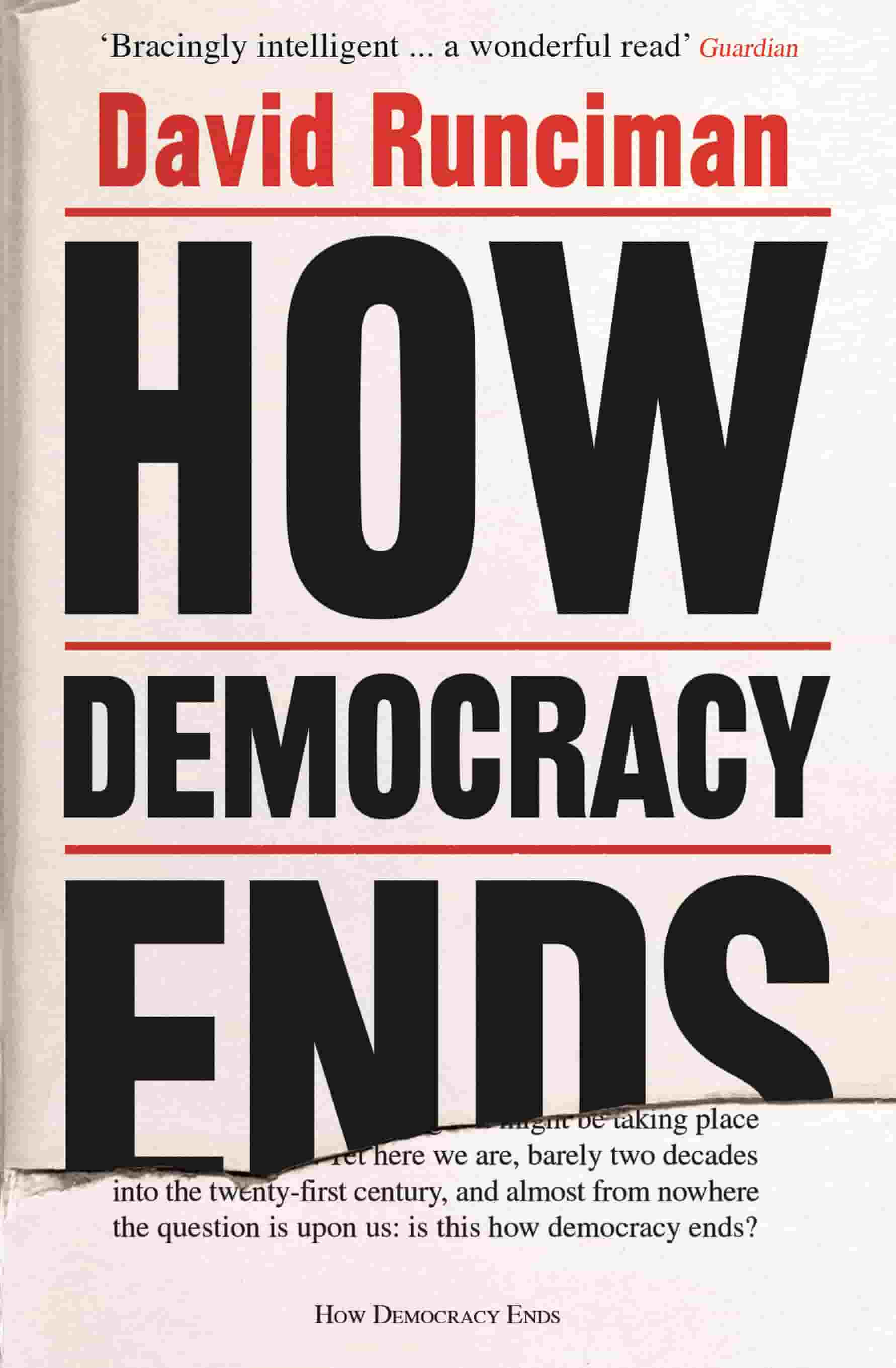
Notes on David Runciman's How Democracy Ends
Original notes here.
Read until the end to get a bonus. Enjoy reading.
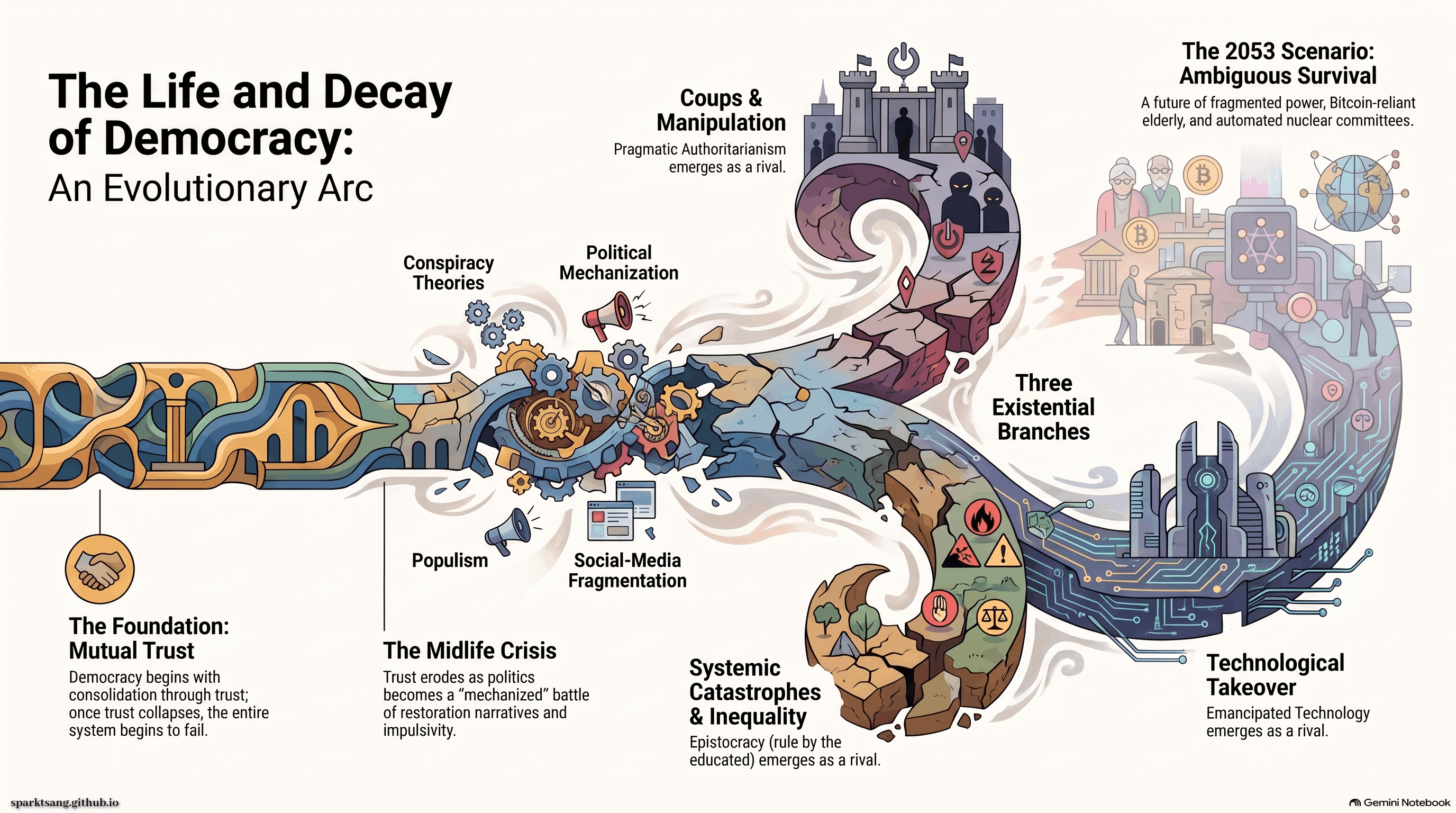
Democratic consolidation is a matter of mutual trust. Once trust collapses, democracy collapses with it.
Western democracy is going through a midlife crisis. Trump’s election was like a middle-aged man impulsively buying a motorcycle.
The risks of democratic failure lie in coups, catastrophes, and technological takeover.
In 1967, a coup in Athens overthrew Greece’s fragile democratic system. The military officers at the time believed that democracy could not solve the country’s problems.
Luttwak’s Coup d’État: A Practical Handbook shows how coups succeed, and in doing so it also shows what is needed to stop them.
But military coups are not the only kind. Others include executive coups, electoral fraud, expansion of executive power, and electoral manipulation—conspiracies carried out within democratic institutions under the cover of democracy. Their likelihood increases in societies where democracy is taken for granted.
Earlier coups had to make their demands explicit. Today’s coups are better off making sure that no one outside knows what is happening. Hence the flourishing of conspiracy theories.
People who believe in conspiracy theories are often those who have failed to benefit from the democratic system.
When the party a person does not support wins an election, that person becomes more inclined to believe in conspiracy theories. This is equally true of Republican and Democratic voters.
Once conspiracy-mongering is treated as a philosophy of governance, the process becomes self-reinforcing.
When a fragile democracy ends, it knows it is finished. The tragedy of a strong, mature democracy is that it doesn’t realize when it has ended.
In July 2016, Erdoğan in Turkey won popular support for crushing a coup, and then used that support to expand executive power dramatically, becoming its greatest beneficiary.
By the late 1930s, there were very few democracies left outside the English-speaking world. The domino effect of democratic collapse was alarming, but the least likely place for history to repeat itself is where the first round had already occurred.
Populism requires the following conditions: economic depression, technological change, widening inequality, and an absence of war. The 1890s brought one of the peaks of populism. American populist William Jennings Bryan lost three presidential elections in a row. France was split into two camps by the Dreyfus Affair in 1894, with civil war seemingly on the verge of breaking out. Dreyfus was eventually acquitted, and the populist wave of the nineteenth century ultimately broke apart.
The populist backlash shows that democracy is not functioning well at present. Political arguments revolve around ideas of restoration and rescue: saving the welfare state, saving the Constitution, saving the economy. Each side wants to recover something it believes has been stolen from it: Democrats stole the freedoms guaranteed by the Constitution, Republicans stole the rights of minorities, Europe stole Britain’s sovereignty, Brexit supporters stole workers’ rights… All these accusations are dressed up as an effort to save democracy.
Capital in the Twenty-First Century points out that the histories of inequality and democracy overlap: democracy solved the problem of violence, but the problem of violence in the past was the precondition for solving another problem—inequality.
Democracy cannot control the risks that exist; it can only hope to avoid being overtaken by them.
In climate politics, conspiracy theories are evenly matched on both sides. The beneficiaries of discrediting the science of climate change are quite clearly the fossil-fuel industry.
On Tyranny: Twenty Lessons from the Twentieth Century warns readers not to assume that the worst cannot happen again. The lesson of mighty Germany is that democracy cannot save itself.
Global finance, energy, communications, health, and transportation are interconnected in ways that no one can control or fully understand. A shock can spread through the entire system before anyone has time to react, much like the dystopian world imagined by E. M. Forster more than a century ago in his short story The Machine Stops, a vision suited to this century.
In The Sleepwalkers: How Europe Went to War in 1914, Christopher Clark examines how particular circumstances surrounding the First World War drove political actors to behave like sleepwalkers, doing what the system required them to do.
Contemporary democratic politics has the character of both sleepwalking and walking a tightrope.
The second chapter ends by returning to contemporary apocalyptic fiction, with Cormac McCarthy’s The Road.
Although Gandhi is revered in India as the father of the nation, his democratic vision—escaping the party machine, bureaucratic machine, and money machine, and achieving village communities and self-government rooted in Indian tradition—was never realized.
We have no way of living as Gandhi advocated, but modern politics is indeed highly mechanized and intensely artificial.
Like Gandhi, Weber saw Western democracy as a system in which people are dominated by political machines. The difference is that he believed there was nothing we could do about it. Modern democracy was destined to become completely mechanized.
As early as Leviathan, the state had already been described as an automaton.
Before the nineteenth century, states and companies competed for territory and influence. The East India Company was eventually nationalized by Britain, further demonstrating the new confidence of the democratic state.
Today, technology giants such as Facebook, Google, Amazon, and Apple have replaced traditional banks and oil companies as the new corporate behemoths. They may be capable of destabilizing the way American democracy operates indirectly, as in Dave Eggers’s 2013 novel The Circle.
In the novel, an especially timid politician voluntarily wears a camera around his neck around the clock. Within weeks, every politician follows suit.
The membership of major political parties has fallen rapidly. The British Conservative Party had more than three million members in the 1950s; today it has only around 100,000.
Resistance to two-party politics has become a global phenomenon. France’s two major parties suffered crushing defeats in the 2017 presidential election. In recent years, the successful parties have been those that could transform or package themselves as grassroots movements.
Trump won the presidency through an anti-Republican-establishment political movement. Sanders nearly defeated the Democratic establishment in much the same way. India’s Modi leads not only a political party but also a personal movement, and Erdoğan in Turkey does the same. Under Corbyn, Britain’s Labour Party underwent a transformation and reform and made highly effective use of social media.
The networked age seems to shift the advantage toward citizens. Leviathan finds itself exposed, while citizens can hide their secrets in the vastness of cyberspace. But in reality, only the machinery of the state still has enough time and human resources to monitor the population.
The networked age makes experiments in direct democracy possible. After the financial crisis, Icelandic voters were able to hold a referendum on a new constitution. In Reykjavík, citizens could vote online to control the city government’s budget. Stockholm also saw the rise of online voting, while Spain, Australia, and Argentina all saw the emergence of networked political parties. The digital revolution’s potential to transform democracy remains boundless.
The British philosopher Nick Land believes democracy will soon become the death of civilization. He advocates replacing democratic governments with government-as-a-business: such entities would merely provide the services needed to operate an efficient, attractive, vibrant, clean, and safe country. Residents or customers dissatisfied with the service could complain to customer service or simply shop elsewhere. He sees this as the only alternative to “The Cathedral” (the decentralized ideological network that pushes all nation-states toward a world government).
He and Curtis Yarvin are sometimes described as neo-reactionaries. The latter advocates restoring monarchy.
The way to begin examining better alternatives is to understand why democracy attracted us in the first place.
Democracy is attractive because it gives individuals dignity, and makes stable prosperity and peace more attainable.
It guarantees both individual dignity and the collective good. As an alternative, twenty-first-century authoritarian regimes such as the Chinese Communist Party promise individual interests and collective dignity (in the form of national confidence).
Trump’s campaign rhetoric also came directly from the playbook of pragmatic authoritarianism. He likewise promised individual interests and collective dignity.
The sinologist Daniel Bell describes China’s system as: democracy at the bottom, experimentation in the middle, and elite rule at the top.
Although it is not unimaginable, people in mature democracies have not yet reached the point where they are willing to give up the dignity of free expression and gamble on something else instead.
The idea of epistocracy, which began among intellectual elites in the nineteenth century, holds that democracy amounts to government by the ignorant. Why not give more weight to the opinions of those who know best what should be done? In his 2016 book Against Democracy, philosopher Jason Brennan argues that many issues are too complex for ordinary voters to understand.
John Stuart Mill argued that the number of votes a person held should depend on their level of education. Through the educational value of democratic participation, democracy could ultimately develop; Brennan believes that more than a century of evidence has shown him to be wrong.
Political scientists Larry Bartels and Christopher Achen, in their 2016 book Democracy for Realists, revisit the extensive evidence from contemporary social science showing that educated people are just as capable of falling into groupthink.
The author points out that the danger of elitism lies in insisting on doing what is best. What may matter most in democratic politics is avoiding the worst. Moreover, even in elite rule, when things go wrong there is a reluctance to change course.
Weber strongly argued that once universal suffrage had been established, no sane politician could abolish it. As Mill put it, democracy comes after epistocracy, not before; experiments cannot be run in reverse.
When things go wrong, the epistocrats will be powerless to correct them. Only the engineers who built the machine will have that ability. This leads to technocracy.
The American data-technology company Kimera Systems developed an artificial intelligence called Nigel to help voters choose candidates who match their preferences. The method has one fatal flaw: it only lets us recognize the selves we believe ourselves to be, leading to self-enclosure.
When technology becomes liberating, the future may look completely different. In his 2015 book PostCapitalism, Paul Mason discusses the liberating potential of technology and argues that Marx had already anticipated the arrival of such a situation in the “Fragment on Machines.” Philip Howard, in his 2015 book Pax Technica, argues that the Internet of Things, in which machines can connect and communicate with one another, can free people from machines while simultaneously freeing machines from people.
Modern technology threatens to fragment the individual. People become splintered: one part goes to WhatsApp, another to Twitter, another to health data. Derek Parfit, meanwhile, argues that insisting on a single identity is itself an obsession.
Future technology may make immortality possible. The existence of just a few superhumans would be enough to completely transform the foundations of our social organization.
This chapter examines pragmatic authoritarianism, epistocracy, and emancipated technology as three alternatives to modern democracy.
Japan remains prosperous and peaceful despite the bursting of its economic bubble. Greece remains a mature society after its debt crisis. These two countries are even among the least violent countries in the world, making their message as moral tales too ambiguous.
The problem with democracy in this century is that its positive strengths are disappearing. Merely being able to ward off catastrophe is not enough to make democracy flourish.
The threat posed by social media to American democracy is greater than that posed by Trump: Trump came and went; the social-media giants are here to stay.
Mature Western democracies have already passed their peak. They will survive their midlife crisis and may even be strengthened by it, but revival is unlikely.
Many people can still have wonderful old age, as long as they do not focus too much on death. The death of democracy will not be the death of humanity.
Afterword — a scenario for 2053: the U.S. president wins the smallest share of the popular vote in American history and is the leader of a movement opposed to the established parties. The message is simple: he will attack the power of the technology giants.
The political landscape has become so fragmented that stopping something is much easier than passing legislation.
Within thirty years, the power to decide whether to launch nuclear weapons has been handed over to a committee of three.
The elderly have grown accustomed to using Bitcoin and worry about the new president’s policy of reviving the dollar, but reprinting dollars is impossible because it cannot be made counterfeit-proof.
Finished reading on February 9, 2019
Runciman examines how democratic systems can fail without realizing it. My philosophy begins with a broader question: how can any institution claim legitimacy if no institution can reliably determine what is true?
Thank you for reading until the end. This is a bonus infographic just for you.