Notes on The Fate of the West
The Fate of the West: The Battle to Save the World’s Most Successful Political Idea by Bill Emmott
Original notes here.
Read until the end to get a bonus. Enjoy reading.
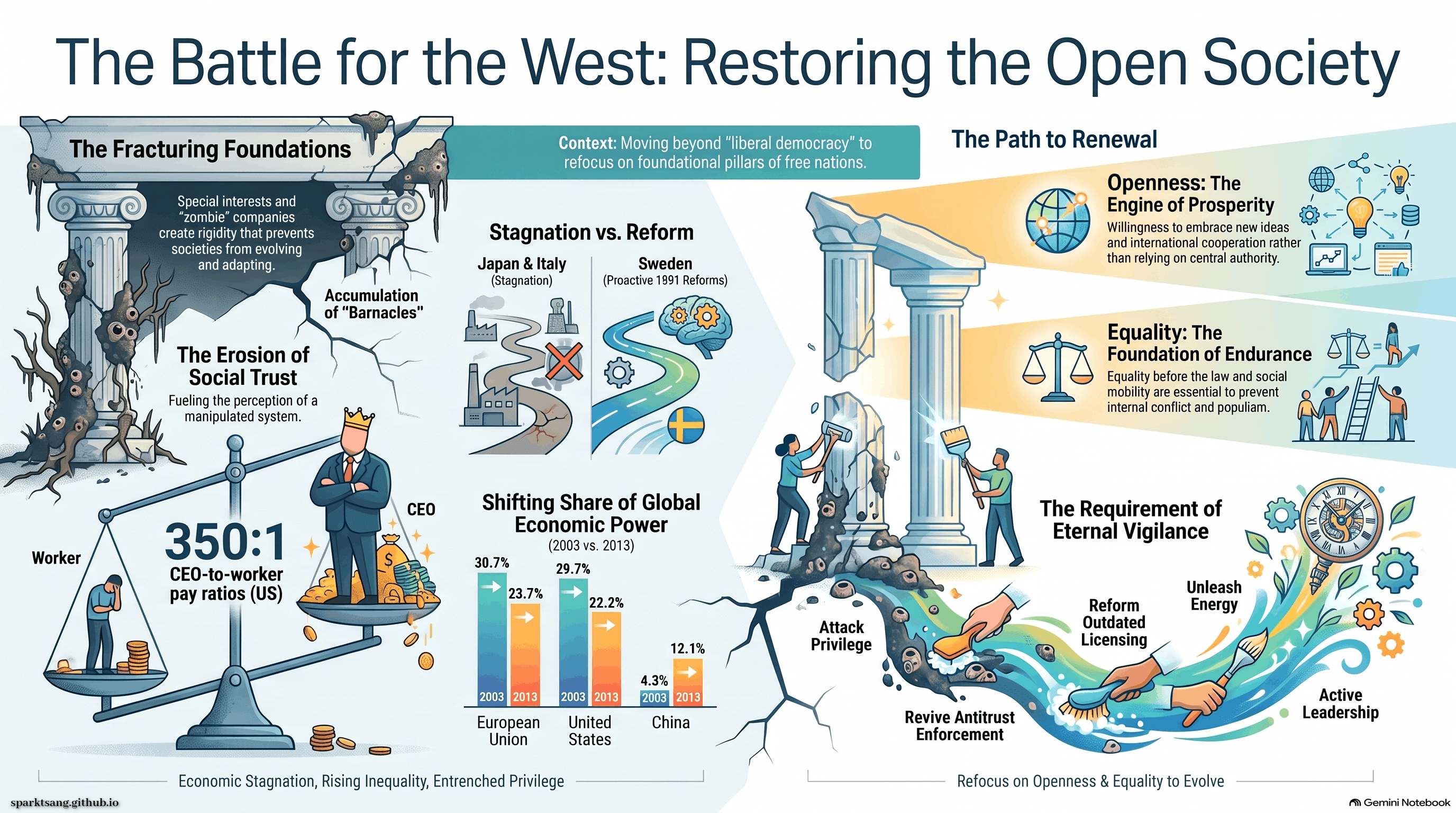
The tautology “liberal democracy” cannot, in itself, fully capture the concept of “the West”; “openness” and “equality” are more fundamental.
An open society is willing to embrace entirely new ideas rather than rely on the guiding wisdom of a central authority, shaping itself through collective desires and actions; to keep a society open, it must continually advance equality, otherwise free individuals are bound to come into conflict.
The West is now in serious trouble. The economic recession beginning in 2008 brought disappointment and was the worst downturn since the Great Depression; employment and incomes had still not recovered ten years later. Deeper problems—including technology, ageing, and worsening inequality—then contributed to Trump’s election because he struck at problems Westerners were either facing or felt they were facing.
But identifying the right problem does not mean having the right solution: trade protectionism harms openness; abandoning international agreements creates fissures between free countries; breaking promises also undermines the premise that free countries can be trusted.
The West’s major weakness is that it operates too freely, without a blueprint: it is therefore easy both to subvert and to misuse, ultimately damaging its foundations; yet openness and equality are precisely what enable society to evolve, and they do not require revolution.
Decline theories are nothing new: the epic work The Decline of the West judged that the West had become a sunset civilization after the First World War and would eventually be replaced (Author: he was discussing Western culture, not the concept of the West).
For the idea of the West to prevail again, it must follow two guiding principles: without openness, the West cannot prosper; without equality, the West cannot endure.
Shared Characteristics
The West has become deeply unconfident and neurotic; the roots of that unease must be examined.
Some self-interested groups, made too secure and complacent by stability, have unconsciously become enemies of the open society, damaging its foundations.
Lady Thatcher once said, “People, if given the choice, will choose freedom.” Had she still been alive, she might have added, “When they have enjoyed freedom for a long time, they usually forget how fortunate they are.”
In the 1990s, the West assumed that as more and more people gained the ability to choose, more countries would become free; some did indeed move toward freedom, including the countries of Central and Eastern Europe, Taiwan, and South Korea. Today, however, some free countries are moving in the opposite direction, even with Russia returning to the ranks of the unfree.
Despite its diversity, the West shares a set of core values that deserve to be clarified:
Success: It benefits from openness; new ideas and new competitors continually emerge, creating prosperity.
Failure: The weaknesses of democracy itself can bring disaster, but over time the overall system improves through the way it operates.
Constitutional government and the rule of law: The roots can be traced back to Magna Carta, and the struggle against those in power trampling the law began long ago.
Social trust: Equality before the law and universal suffrage promote trust within society; the welfare state is not the end in itself—trust, fairness, and social justice are.
Growing injustice: Unequal treatment in legal and political rights can divide groups and create conflict.
Immigration: All open countries face, to varying degrees, the question of how much immigration is too much.
Rising expectations: People have higher expectations of democracy, the rule of law, and their rights in everyday life.
International cooperation: Open societies believe cooperation can bring mutual benefits to multiple parties.
These eight shared characteristics represent a way of dealing with the world: open societies often feel that they are facing a crisis. David Rockefeller launched the Trilateral Commission among North America, Europe, and Japan to promote democratic cooperation; the book published in 1975 was titled The Crisis of Democracy. At the time, the economy was in recession, inflation was extremely high, oil prices had been driven up, protests continued, the Vietnam War had gone badly, the Soviet Union was powerful, and pessimism about the Cold War was widespread. The book quoted the West German chancellor as saying that Western European democracy had only another 20 to 30 years left.
The mistakes made by Western democracies include delaying major and difficult problems, using democratic procedures in ways that make difficult problems even harder to handle, the tyranny of the majority, and the unchecked spread of privilege.
The evolutionary capacity of an open society is extraordinary, but it is not a once-and-for-all achievement; it must constantly fight the barnacles accumulating on the hull.
There are always temptations around us: abandoning privacy in order to catch criminals, allowing public officials to move back and forth between public service and the business world so that they can perform better, or giving up fair trials in order to punish extremists…
An open society must be maintained through effort, persuasion, and vigilance. The invisible hand does not always coincide with the public interest. Thomas Jefferson, the third president, famously said that the price of freedom is eternal vigilance.
Inequality
Inequality has persisted for decades. After the 2008 collapse, the powerful and well-connected were not held accountable, creating the sense that political and civic equality had been threatened and that the system had been manipulated.
The signature achievement of the Obama administration was the Affordable Care Act, but what it failed to change was the ability to buy political and economic advantages with money—and to pass those advantages on for generations.
The system of ranking executive compensation is one of the greatest obstacles to reform. Corporate boards love to claim that their own CEO’s pay is in the top quarter, driving executive compensation ever higher through competition. In 2011–12, the ratio of pay between CEOs of U.S. listed companies and ordinary employees reached 350, far above that of other developed countries; second place was below 150.
Capital in the Twenty-First Century argues that unless governments intervene, inequality will inevitably expand because, over the long run, the income of capitalists will grow faster than the rate of economic growth. He regarded the period of the world wars and the Great Depression from 1914 to 1975 as an exception; now, he argues, we are returning to the normal pattern.
No country can completely eliminate political donations, creating opportunities for corruption. It is widely believed that simply lowering the top marginal income-tax rate can stimulate investment and entrepreneurship and promote economic development, but governments fear displeasing their donors and are increasingly reluctant to tax the rich. Three developed countries—the United States, Israel, and Turkey—invest more in wealthy students; the U.S. estate-tax exemption has repeatedly reached new highs; and in Japan, France, and Germany, employment has become increasingly temporary.
Privilege
The Declaration of Independence speaks of the God-given right to the pursuit of happiness; therefore, if being above others makes someone happy, everyone has the right to pursue it.
The result is that democracy represents equality of voice, but individuals all compete to make themselves heard; the tension between the two is precisely what an open society needs.
Removing institutional distortions can release the potential of assets. The Civil Rights Act of 1964, for example, sought to bring an end to nearly two centuries of unconstitutional practices; Thatcher’s assault on powerful trade unions in the 1980s and the breaking of the cartel among London Stock Exchange members had the same spirit. Japan and Italy, once at their peaks, failed to inject new vitality largely because they never launched comparable battles to undertake the necessary risks in pursuit of reward.
The struggle to sweep away privilege and the obstacles that continually accumulate within society never ends.
Many enemies of open societies were less readily recognizable after the collapse than the bankers were: the Japan Medical Association, lawyers and practitioners in various professions, farmers, trade associations around the country, alliances of large corporations and monopolies, trade unions in different countries, lobbying groups such as the National Rifle Association, pension-related lobbies… In some fields, jobs are heavily protected for life, at the price of temporary contracts with little security for most outsiders.
Since the 1980s, average annual public investment in developed economies has continued to decline, from 26% in 1980 to 20.7% in 2014, while public consumption peaked at 19% of GDP in 2008 (OECD).
Economic winners will monopolize, and so will political winners; the causal relationship is even stronger there.
The Center for Responsive Politics pointed out that Google donated to 162 members of Congress during the 2014 election campaign.
Privilege is not easy to establish, but once established it is difficult to dismantle. Mancur Olson explains this most clearly in The Logic of Collective Action. His posthumous work Power and Prosperity argues that a postwar country can prosper if it satisfies two conditions: protection of individual rights, and the absence of predators that threaten human rights (war, authoritarianism, totalitarianism, and privilege).
The Occupy movement identified finance as the main source of the problem, because the financial industry used political lobbying and donations to obstruct regulation. Even before the tsunami, increased competition merely made the boom more uncontrolled without spreading the profits; the most destructive mistake was to concentrate risks that should have been distributed by means of securitization and hide them from view.
The most astonishing thing after the tsunami was how little changed. The most renowned analyses of the collapse since then, such as The Bankers’ Coup, and scholars’ recommendations were not adopted.
No one is entirely clear about the reasons: financial markets span the globe, so changing them requires broad international support; governments sometimes tolerate their own banks concealing problems (the French and German governments during the sovereign-debt crisis of 2010–12; Japan in the 1990s); and banks possess enormous political influence.
A 2012 study by the Bank for International Settlements pointed out that once a country has passed a certain stage—all developed economies have long since passed it—the larger its financial sector becomes, the more harm it does to productivity and overall economic growth. Unfortunately, the U.S. president still appears to want to loosen regulation and return to the old road that led to the collapse.
Change
If the United States abandons the spirit of the West and does not ally itself with Western countries, even for just a few years, the barbarians waiting at the gates of the West will immediately applaud, believing that the Western world, like the Roman Empire, is about to disintegrate. However coldly one may view American interests, it is difficult to escape its immensely influential global perspective; isolationism simply does not work.
The United States is second to none in innovation. In the 2010s, it developed fracking, a revolutionary energy-production technology, forcing the Middle East into a price war in oil. By driving down costs and improving technology, however, it absorbed the blow without being knocked down; U.S. crude-oil and natural-gas production had gradually declined and turned the country into an importer, but then a host of small start-ups suddenly emerged and rapidly turned the United States into their largest export market, an astonishing achievement.
Today, however, the outlook is not so optimistic. Every industry is controlled by giant corporations. Between 1997 and 2012, only the top fifty companies saw their profits increase (White House Council of Economic Advisers, 2016 Council of Economic Advisers Issue Brief: The Indicators of Competitive Advantage and Market Power); there were fewer start-ups, and the rate at which new firms entered the market continued to fall (Census Bureau); more people worked in large bureaucratic organizations than ever before (Gary Hamel & Michele Zanini, Harvard Business Review).
Licensing requirements are rampant: 30% of the workforce requires a license, and licensed occupations account for five times the share they did in the 1950s. In Minnesota, a cosmetologist is required to complete more classroom hours than a lawyer.
The U.S. incarceration rate is among the highest in the world, with prisoners accounting for 25% of the world’s prison population; in half of the states, any convicted person is permanently unable to obtain a professional license.
In 2014, the labor-force participation rate among prime-age men was only 88%. Nicholas Eberstadt attributed this to prisoners being excluded from the labor market and disability-benefit policies reducing people’s incentives to work.
The War on Drugs created a vicious cycle: those convicted of crimes have too few opportunities and return to their old ways.
The United States spent only 0.1% of GDP on active labor-market programs, one-sixth of the OECD-member average.
Reform proposals: raise the minimum wage, reform occupational licensing, and revive aggressive antitrust enforcement of the kind seen in the 1990s.
Both parties have become incapable of exercising their former dominance, leaving the situation in a prolonged deadlock. In 2010, the Supreme Court ruled 5–4 that campaign spending was protected as free speech; in 2015, it ruled 5–4 that states had the power to establish independent commissions to redraw electoral districts and check gerrymandering.
Recent historical evidence indicates that political reform begins in the states and is then extended nationwide, so the first step must be taken at the state level. California was once a classic case of dysfunctional democracy: money politics, regulatory capture by special interests, the threat of bankruptcy, and no long-term public investment. But in 2016 it showed signs of renewal, driven by reforms allowing a simple majority vote in the state legislature (to pass budgets), the creation of a long-term planning commission bringing together talent from all sides, and Governor Edmund Gerald’s sweeping tax increases. The reform was not yet complete, but it pointed in an optimistic direction. The author mentions Nathan Gardels’s The Great Transformation in discussing California’s reform.
People are actively seeking change, and proposals similar to a long-term planning commission have a good chance of emerging. The road is still long, but the United States is the country in the world that best understands evolution, so there is still reason for optimism.
Britain
Immigration from abroad: 3.8 million in 1993, 8.3 million in 2014.
After more than 30 years of decline and industrial conflict following the Second World War, Thatcher carried out various transformations in the 1980s and 1990s. Britain did not fall into despair again until 2008, but recovered faster than Europe, seeming to climb out of the trough within three or four years and attracting immigrants from the European Union; the 2016 Brexit referendum reflected British dislike of immigration from abroad.
The longevity and power of Britain’s various associations are astonishing. Mrs Thatcher confronted many privileges head-on and successfully defeated them one by one. Mancur Olson’s The Rise and Decline of Nations describes the essence of the problem.
In 2014, the creative economy accounted for as much as 8.2% of Britain’s economy, higher than the 8% accounted for by financial services, while the EU average was only 5.3%.
One of Manchester’s creative clusters is a scientific and creative cluster. In 2010, a scientific team at the University of Manchester discovered graphene and won the Nobel Prize in Physics.
The electoral system is a problem: first past the post gives everything to the winner, based on the old assumption of two major parties. That assumption no longer fits the fragmented multiparty system that exists today, compounded by regional parties and a much more complicated landscape. Scots have long felt that the system is unfair: they have too little voice in the House of Commons at Westminster while being deeply affected by policies imposed from the center. One victim was the UK Independence Party, which won 12.6% of the vote in 2015 but secured only one seat in Parliament.
After the Brexit referendum, a report by the Centre for Social Investigation found that 60% of Britons considered themselves working class, but by sociologists’ criteria only 25% actually were; among those who described themselves as working class, 47% belonged to the professional, skilled, or managerial classes. Overall, voters identify more strongly with working-class values than expected, including distrust of immigration and cosmopolitanism.
An isolated Britain is difficult to imagine: the Governor of the Bank of England is a Canadian citizen, the manager of Manchester United is a Portuguese citizen, and the CEOs of countless leading companies are foreign citizens. To remain open, Britain must repair the problem of unequal political voice. Its political system needs an earthquake-like transformation; without equality, Britain will find it difficult to remain open.
Europe
Brexit revealed that members joined simply for their own interests, and countries’ views on how best to protect those interests can change at any time.
Europe is heading downhill. Public finances have weakened in most countries, and the EU’s ability to sustain welfare systems is gradually disappearing. A series of major crises followed: the collapse of the financial system in 2008, the sovereign-debt crisis two years later, the annexation of Crimea in 2014, and the immigration crisis, the former helping to precipitate Brexit.
One of the EU’s great achievements, the Schengen Agreement, has now become almost meaningless because seven countries have “temporarily” restored their borders.
The euro was born in 1999 with the intention of eliminating privilege, easing rigidity, and restoring vitality. Countries that had traditionally been prone to inflation and economic instability—Italy, Spain, and Greece—welcomed it. Interest rates were cut to levels as low as Germany’s, creating the illusion of prosperity; in heavily indebted Italy, this reduced the burden on taxpayers. Countries became even less disciplined, and the weaknesses were exposed completely after the bubble burst in 2008.
Because of the sovereign-debt crisis, various fiscal-discipline mechanisms were introduced in 2012, but the problem got worse rather than better: government debt rose from 91.3% of aggregate GDP in 2012 to more than 93% in 2015. France, Italy, and Greece saw increases; Spain and Portugal were flat; Ireland was the success story.
The decline of Western Europe has been long and deeply rooted. Among Nobel laureates in the 1980s, researchers working in the EU and European Economic Area accounted for 29.1%, compared with 54% in the United States; in the 1990s, Europe accounted for 23% and the U.S. 68%; from 2000 to 2016, Europe accounted for 23%, the U.S. 43%, and China 1.7%. In technology, Minitel information services had spread across France by 1982; Europe had pioneered technology that was a precursor to the World Wide Web, and the network technology itself was invented by a Briton; Skype was created by Europeans, Nokia was a Finnish company, yet today Europe has no large company in a leading position in the digital sector. R&D spending as a share of GDP, combining public and private spending, was 1.9% in Europe, 2.9% in the U.S., and 3.3% in Japan. Among developers filing new patents, Europe accounted for 12% of the world total in 2000 and China 2.5%; ten years later, Europe accounted for 5% and China 17.3%. In unemployment, Western Europe was consistently below the United States from the 1950s through the middle of the 1980s; after the 1980s, apart from the few years when Europe was hit especially hard by the 2008 crisis, Western Europe remained higher (OECD). According to the World Bank’s 2012 Golden Growth report, arguably the most authoritative and wide-ranging study of Europe’s economic situation, EU productivity relative to the United States rose from about 40% in 1950 to 80% in 1994—the period known in French as the “Trente Glorieuses”—and then fell back. Demographically, the EU-28’s share of the world population fell from 13.4% in 1960 to 7.1% in 2013. As a share of global GDP, in 2003 the EU accounted for 30.7%, the U.S. 29.7%, and China 4.3%; in 2013, the figures were 23.7%, 22.2%, and 12.1% respectively.
From 2004 to 2009, European countries accounted for 58% of social-security spending worldwide. High welfare spending creates path dependence. Sweden experienced this in the 1990s but made the necessary reforms; today France is the representative case, with public spending equal to 55.5% of GDP. It has been in deficit since 1974, and public debt has continued to rise, approaching 94% of GDP. Italy’s public debt is similar, with most spending going toward public-sector pensions and now reaching 130% of GDP. Countries like these are constrained in policymaking by their huge debts.
Trying to solve the problem through high tax rates leads to tax evasion.
Western Europeans worked more hours than Americans in the 1950s, roughly the same in the 1970s, and fewer from 1990 to 2009, without making up the difference through higher productivity. The proportion of older people in employment was also lower than in the United States and Japan.
Italy had astonishing momentum in the 1950s and 1960s, ranking third in the world for economic growth, behind only Japan and South Korea. By the 1980s, it maintained the Italian style and grandeur through public spending and borrowing. In the early 1990s, it entered a political and economic crisis and stagnated. By 2016, it was still ten percentage points below its pre-2008 economic level, while Germany, Britain, and the United States had long since recovered and even surpassed it.
In 2009, France commissioned Jacques Attali to investigate economic growth. He found that labor regulations imposed more restrictions on companies with more than 50 employees, leaving domestic medium-sized enterprises with very little room to develop.
In 2011, the then Governor of the Bank of Italy gave a speech comparing Italy with sixteenth-century Venice and seventeenth-century Amsterdam: both had been prosperous and full of vitality for long periods but eventually entered decline, when the forces that had once pursued growth were forced to shift toward defending privilege. This matches Italy today. Italians are clearly full of energy, creativity, and talent, yet they are obstructed by layers of regulations imposed by local and central governments, while facing privilege, a dysfunctional judiciary, political interference, and organized crime.
A vicious cycle emerges: to pay public pensions equivalent to 16% of GDP every year, Italy needs more innovation, investment, and growth; but innovation requires industries to give up various privileges, while years of economic stagnation make them even more eager to hold on to those privileges.
Among international systems for assessing regulatory rigidity and ease of doing business, the best known is the World Bank’s annual Doing Business ranking, which examines factors such as the ease of starting a business, taxation, enforcement of contracts, electricity, and information-technology connectivity. Those near the top included New Zealand, Denmark, and South Korea: Denmark 3rd, Britain 7th, Sweden 9th, France 29th, Spain 32nd, Italy 50th, Greece 61st.
In 2014, Italy’s youngest-ever prime minister pushed through radical reforms but was defeated; two years later he resigned after losing a referendum. France also began to see calls for reform.
The welfare commitments Europe made in the 1970s and 1980s became enormous after the collapse. Consensus among EU countries is also difficult: rather than proclaiming ever-greater integration, it would be better to increase cooperation among European countries, building transport networks, railways, and broadband and strengthening cross-border links to create jobs.
The EU, now moving toward disintegration and decline, must change direction. Slow growth, high unemployment, and large-scale immigration form a lethal combination. Economically, many aspects resemble Japan in the early 1990s, and demographic data are also often similar, but Europe should not follow Japan’s example of enduring the crisis through “patience and perseverance.”
Japan
In 1990, everyone was stunned by the earth-shattering collapse of the Japanese economy; conspiracy theories claimed it was a tactic by the Japanese government to reach the position of the world’s foremost power.
Olson argued that once interests and privileges become deeply entrenched, they can trap a country in rigidity for a long time, which neatly explains Japan’s experience from 1990 onward.
An ageing population, strategic aggression from China, and enormous public debt—gross debt reached 248% of GDP and net debt 130% in 2015—left Japan overwhelmed. Yet unlike the Meiji Restoration or the period after defeat and surrender, it did not completely collapse and rise again from the ashes.
The fundamental problems were weak demand, stagnant incomes, and a lack of investment. Abenomics was disappointing: the three arrows—“monetary policy, fiscal policy, and liberalization”—that had been promised to be fired never appeared.
Rigidity is Japan’s greatest mystery. In the 1970s and 1980s, old industries ceased to be competitive, and Japanese companies and cities broke free of them, embraced new industries, new products, and new methods, and showed exceptional capacity to evolve and adapt. Yet in a short period they transformed from being hyper-flexible to hyper-rigid. Traits that had seemed powerful in pre-1990 Japan—including consensus-driven bureaucracy and a closed corporate culture built around cross-shareholding among related companies—became a lethal combination that produced decline.
The 1989 book The Enigma of Japanese Power attracted great attention by arguing that Japan had no true center of power. When things became dire, Japan indeed had no center of power capable of taking control, and no consensus for reform could emerge; in the first few years, the leadership consistently resisted change.
Author: The problem had existed for a long time; the 1987 financial bubble emerged in order to conceal the weaknesses.
In the 1970s, Nixon ended the gold standard, causing the yen to appreciate sharply, while oil-producing countries restricted exports. Japanese heavy industry was pushed to the brink of bankruptcy by high energy costs. Japanese industry adjusted immediately, and export markets gradually recovered; many Japanese automakers became world-famous.
Because of U.S. policy to strengthen the dollar, the yen did not appreciate much further. A weak yen drove an export boom, while the Louvre Accord prompted the Bank of Japan to cut interest rates. Credit expansion unleashed a wave of lending and speculation, and surging stock and property prices allowed Japan to avoid making difficult decisions. It came to believe it was standing at the pinnacle of the world, and the old forces became even less willing to remove protective restrictions and open themselves to competition and stimulus.
After the collapse, the banks did not undertake the painful adjustment that was needed. They supported companies deeply mired in crisis rather than acknowledging that the loans were bad, allowing obsolete companies to survive like zombies. The LDP was also not punished as severely by voters as governing parties elsewhere had been. Compared with other places, digital technology also had a much smaller impact on existing business models.
Other indicators of the desire for change were relatively pessimistic: fewer Japanese university students went abroad for advanced study, and at Waseda only one-fifth of classes were taught in English.
The Olympus accounting scandal helped expose the fact that companies served the interests of senior employees; moral obligations, transparency, and legitimacy were secondary. Compared with similar scandals in Europe and the United States, Japanese anger appeared muted.
Japan resembles a case of evolutionary isolation. Today Japan has no choice but to attack privilege, loosen regulation, open itself to immigration, and inject competition into every industry.
Sweden and Switzerland
One threat after another has made Westerners increasingly inclined to hand power to strongmen, yet among wealthy countries there is no example of a country successfully recovering after returning to dictatorship.
Countries that successfully turned themselves around tend to be small, but large countries have also recovered successfully, including Britain and California.
Sweden suffered a severe collapse in 1991. The new government’s prime minister rapidly cleaned up the financial sector and became a model, while cutting taxes and loosening regulation across industries. This was completely different from the way Japan and Italy handled their financial crises at the same time: their governments changed, but they failed to turn crisis into opportunity.
In the 1970s and 1980s, Sweden was like Italy, with competition heavily restricted. Sweden realized the problem earlier and understood that whenever companies got into trouble, the country could not simply subsidize them, nationalize them, or devalue the currency.
In the 1980s, Sweden gradually opened its domestic telecommunications, railway, and postal sectors, reduced the top marginal tax rate on high incomes, removed restrictions on bank credit, interest rates, and lending, and applied to join the EU. The real achievement of the 1991 financial crisis was that it accelerated reforms already underway: within twenty years, Sweden went from one of the most tightly regulated wealthy countries to one of the least regulated.
The 1991 crisis was partly a consequence of deregulation: the financial system was opened without the government simultaneously putting the necessary regulatory controls in place.
Some attribute Sweden’s success to social trust, but Japan also had that. The real difference was that Sweden understood the need to change, whereas Japan never grasped it deeply enough.
Sweden’s public expenditure reached as much as 70% of GDP in 1993 and fell to 49.7% in 2007, yet even today it can still be said to have one of the world’s most comprehensive welfare systems.
The two issues Swedes are most anxious about today are declining student performance and the influx of refugees.
In the early 1990s, Switzerland was conservative and rigid, its property market had only just collapsed, its manufacturing sector was too fragile to compete with China, its overvalued currency weakened exports, it was outside the EU, and it was full of privileged associations.
Switzerland recovered because it responded to the EU’s post-Cold War demands by applying to join the EU and allowing EU citizens to settle and work freely.
Today anti-immigration voices are growing louder, and a referendum decided by a razor-thin margin opted to close the country’s doors.
Many successful recovery stories show that countries need to accept new opportunities, new freedoms, new competition, and new ideas. Even a country large enough to be relatively self-sufficient cannot thereby become more vibrant, innovative, and adaptable: every country needs openness, together with indispensable equality.
Machines
Population ageing is a universal phenomenon, bringing economic, social, and political problems.
There are three rebuttals to the idea that mechanization will cause mass unemployment:
One, the Solow Productivity Paradox: everywhere we see signs that the computer age has arrived, yet nowhere do we see it in the productivity figures.
Two, it will take time before machines truly become intelligent.
Three, massive capital investment in machines is required, yet private investment remained weak after the financial crisis; people replaced by robots cannot become consumers.
In the West—France is used as the example in the chart—life expectancy rose steadily from 1970 to 2014 while the retirement age kept falling, like an alligator opening its jaws and swallowing solvency, economic vitality, and political feasibility all at once. To cope with this, adjustments are needed to working age, career cycles, and the affordability of pensions.
In the 2030s, China’s median age will exceed that of the United States, and by the end of the 2040s it will catch up with the EU. How democracies and authoritarian countries handle this over the coming decades will be a vast experiment on a laboratory scale.
The West’s main crisis is that ageing voters may become more conservative and selfish. Polls show that 60% of voters aged 65 and above voted for Brexit, while nearly 60% of younger people wanted to remain in Europe.
Peter Drucker foresaw in 2001 that the decline of manufacturing would produce a new protectionism, and that the West would need immigration even though the public would not welcome it; whether trade and immigration would also cause conflicts with Western allies is another problem that follows.
Barbarians
Within ten years of the end of the Cold War, the West’s confidence was at an unprecedented high, yet the world was still not at peace.
9/11 dealt a devastating blow to the heart of Western capitalism. Three major changes followed: Western economies became weaker and political divisions grew more severe; the Middle East deteriorated; and the United States withdrew its forces only to regret doing so because it appeared weak.
9/11, Afghanistan, and the Iraq War led banks, between 2001 and 2007, to continue the credit bubble under the pretext of caution, allowing inflationary conditions to persist rather than raising interest rates or restraining credit expansion.
From 2003 to 2013, soaring oil prices solved Russia’s economic problems, raised military morale, and were followed by the events in Georgia and Crimea.
Three major problems emerged: the rising power of China wants to reinterpret existing international rules or create rules suited to its own interests; Russia, a former great power, has declined but is aggressively protecting national identity and behaving high-handedly, trying to prove that the rules of the game do not apply to itself; and ISIS and its predecessors and successors oppose everything about modernity and seek, as far as possible, to drag every dysfunctional place into the chaos.
Groups like ISIS are not the most fundamental or long-term problem. Russia can still negotiate and remains within the range of control. The greater problem is the epochal challenge posed by a rising great power, which cannot be solved through emergency firefighting or traditional deterrence; it could genuinely persist indefinitely because no one knows what its consequences will be, and even if Beijing has a master plan, it will certainly keep updating it.
China sees itself as a status quo power, but its definition of the status quo differs from that accepted by the West. After occupying Tibet, it did not continue expanding aggressively on land, and even after defeating India in 1962, the borders remained unchanged. Given geopolitics and weapons development, however, future threats should come from sea and air, so in recent years China has strengthened control over its coastline, drawn its own nine-dash line in the South China Sea, and made claims over the Diaoyu Islands, violating the existing international status quo.
At the Shangri-La Dialogue in May 2014, a senior Chinese military officer was questioned about the basis of the nine-dash line. He cited neither international law nor contemporary conventions, but instead invoked the history of the Han dynasty. This demonstrated a pragmatic political view: as a great power, China was logically bound to think this way.
When questioned about the construction of artificial islands on reefs, he answered that it was for the public interest: as a great power, China had the right to define what constituted the public interest without having to consult the “public.”
According to this logic, China is restoring its position as the dominant power in Asia, while the newly risen upstart United States is the one disrupting the status quo. Even if one takes a step back and regards both China and the United States as great powers, both possess the right to make the rules.
As for legitimacy, however, the West still holds an enormous advantage. The presence of overseas military bases is a reasonable indicator of international trust: China has only one, in Djibouti in East Africa, while the United States has bases all over the world. Twenty-seven countries are NATO members alongside the United States; some Middle Eastern countries host U.S. military vessels, and Latin America has close military ties with it. The claim that these are merely “the remnants of a declining hegemon” does not hold, because other countries choose them voluntarily.
It is not that every country loves the West deeply, but that the justice, international law, openness, and market principles the West established and maintained since 1945 have consistently benefited and protected other countries.
Russia has six firm allies—Syria, Armenia, Kazakhstan, Kyrgyzstan, Tajikistan, and Belarus. China has only one genuine ally, North Korea; Pakistan sometimes acts as an ally, but only to counterbalance India and remind the United States.
Russia wants the West to split apart and uses classic Cold War methods: funding anti-EU parties in various countries and using overseas television channels for propaganda. Its intervention in Ukraine triggered united sanctions, yet when it interfered in European domestic affairs, polluted Western institutions, spread propaganda, and launched cyberattacks, the West showed little response.
Rather than saying ISIS is the cause of instability in the Middle East, it is more accurate to say that it is a parasite feeding on the chaos; there will always be others seeking to replace it, and terrorism cannot simply disappear overnight.
If the West were more united and more confident, it could devote money and manpower to helping refugees from war zones become self-sufficient. The deeper hidden danger is the division and indecision within the West itself.
The best strategy for confronting the challenge is simple and clear: just as during the Cold War, rebuild the economy, rebuild political strength, and maintain existing values and beliefs.
Fate
The West has suffered many blows and urgently needs to change, most of them problems of its own making.
The West faces both the Thucydides Trap and another modern dilemma: intervention in another country’s civil war and non-intervention both come at a high cost.
As The End of History argued, the outcome of long historical and ideological struggles demonstrated that liberal democracy was the winner; essentially no one is imitating or following China’s system.
The problems of internal weakness, mistaken policies, and democratic habits that have become self-imposed constraints must be resolved. Solving them requires leadership. Past experience—including Thatcher, Sweden in the 1990s, and Canada under Chrétien and Paul Martin—shows that for leaders to succeed, they must choose openness, remove obstacles, unleash society’s energy and ideas, and attack privilege.
The guiding principles of openness and equality must be defended. The secret of the West’s long-term sustainability lies in restoring social mobility, preserving hope for an improved life, and ensuring that differences can be resolved peacefully and fairly, so that citizens are included and public benefits are shared.
China’s path to development is extremely difficult: society must grant people equal rights as it opens up in order to remain stable, yet China cannot satisfy this condition; its political and social inequalities are both far more severe than those of the West.
Freedom encourages competition, which produces inequality. If a society can generate sufficient resources and room to ensure that people can move upward and pursue their aspirations without being suppressed, openness and equality can reinforce one another.
One, open wisely: Opening up capital flows brings many benefits. Complete freedom has two major problems: potentially enormous shocks and unequal information, so there are strong reasons for regulation; immigration can inject vitality, but citizens must also have a voice.
Two, equality in different dimensions: Fight unjust barriers and remove obstacles to choice and movement; inheritance taxes and wealth taxes should be revived to prevent excessive concentration.
Three, education safeguards equality: Continuous oversight and investment are necessary.
Four, equality across age, class, and race: Raise the retirement age.
Five, equality protected by the rule of law is non-negotiable.
Six, freedom of speech is the bridge connecting openness and equality: we are now living in an age, following the Cold War, when truth can be distorted and manipulated with extraordinary ease; we must fight for the truth.
Seven, “Boring” but steady economic growth: Seeking a rapid recovery can lead to inflation, collapse, unemployment, and social fragmentation.
Eight, international rule of law: The West has overwhelming strength. In the face of attack, submission and surrender amount to suicide; compromise and appeasement merely repeat the mistakes of the 1930s; standing firm on principle is the only real choice. The United States must change its view of American Exceptionalism, Europe must strengthen its defenses, and there is nothing to be gained from Western countries avoiding cooperation.
The great 1962 film Lawrence of Arabia: nothing is predetermined by heaven; the fate of the West is in our hands, and winning the next battle depends on ourselves.
Finished reading on June 1, 2021
Emmott concludes that saving the open society requires us to dismantle entrenched privileges and fiercely fight for the truth. But how can political reforms succeed if our foundational systems for determining truth are already corrupted by noise and power?
My philosophy argues that defending democracy requires a deeper structural upgrade: before we can save our political constitutions, we must first establish an epistemic one.
Thank you for reading until the end. This is a bonus infographic just for you.