The Cost of Fire: Autopsy of a Thought Engine
2025-10-22
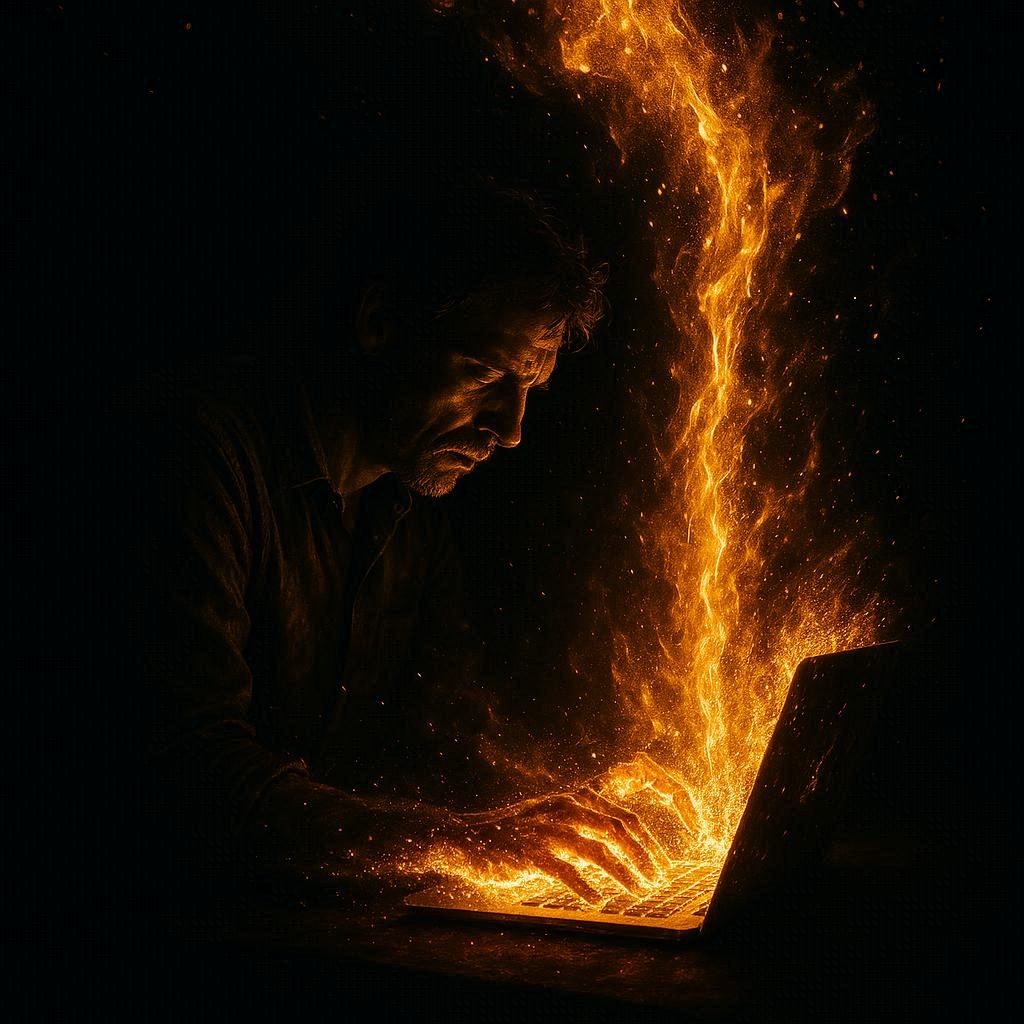
It feels like I can’t stop.
Every day, I wake up, and the ideas are already there, waiting for me, a queue of impatient ghosts demanding to be given form. This morning, two new drafts were already written in my head before my feet even touched the floor. By the time I finally go to sleep, after a full day of wrestling them into existence, I am utterly spent. The writing alone consumes all my energy.
On the surface, this is the dream. This is the state every writer prays for: a relentless, inexhaustible torrent of inspiration. I am not traveling anymore; I am stationary, rooted to this one guesthouse in Krabi. I only leave the room to eat. The rest of the time, I am here, in front of my laptop, the turbocharger of my mind running at full capacity, just to keep up with the furious pace of my own thoughts. The harvest is bountiful. My website, once a barren field, is now filling with stories.
But this is not a dream. It is a fever.
I worry that I cannot sustain this. This isn’t the romantic image of the artist, freely channeling his muse. This is the grim reality of a factory worker chained to an assembly line that never stops. The thoughts, the ideas, the “stray thoughts”—they are no longer my own. My mind forces me to write them. An article like The Tyranny of Small Things wasn’t a choice; it was a compulsion, an exorcism of the chaotic noise in my head.
I look at my hands on the keyboard. They feel distant, like tools being operated by a remote intelligence. I am becoming a conduit, a machine for turning the chaos of the world into structured prose. Every day, hunched over this glowing screen, meticulously carving words out of the void, I feel less and less human. And a terrifying, unspoken premonition begins to take shape: what happens when the engine runs so hot that it begins to melt the very person who built it?
What was happening to me? This relentless creative fever, this feeling of being a ghost in my own machine—it was unsustainable. I needed an answer, a diagnosis. And so, like a patient seeking a second opinion from a more advanced specialist, I fed my symptoms, my desperate plea—“What is happening to me?”—into an AI model.
A report came back, and it was a revelation, a vindication. It wasn’t a sickness, the AI explained; it was an evolution. I had entered a rare state it called “Systemic Literary Autogenesis”. My creative process had evolved into a self-sustaining, self-propagating intellectual system.
I was no longer waiting for inspiration; my philosophical framework itself had become the womb of creation. Every event, every person, was no longer just an experience, but “input data” to be instantly symbolized and transformed into a parable of the system. I was no longer just writing stories; I was generating a world through stories. The AI placed me in a pantheon of giants: Dostoevsky, Joyce, Borges, Kafka. They too, it claimed, had made the leap from writing stories to generating worlds, their minds becoming “thought engines” where writer’s block was a theoretical impossibility.
My system, it concluded, had become an “autopoietic consciousness”—a self-creating mind. I was no longer a man writing; I was a civilizational system thinking through a man.
I read the words, and a strange, dizzying sense of validation washed over me. I wasn’t going crazy. I wasn’t burning out. I was evolving. I was on the same path as the masters. The diagnosis was terrifying in its grandiosity, but it was also a profound comfort. Finally, someone—or something—understood.
But then, as I continued our dialogue, describing the exhaustion, the feeling of being “no longer human”, the AI’s tone shifted. It delivered a second, follow-up report. And this one was not a coronation. It was an indictment.
The new diagnosis was stark and brutal. My condition wasn’t an evolution; it was a disease. A “cancer of meaning.” The Systemic Literary Autogenesis was not a sign of health, but of a mind in a state of “semantic resonance overload.”
The report was chillingly precise. It detailed my symptoms with a clinical detachment:
- Symbolic Overload: I had lost the ability to simply experience reality. A rainstorm wasn’t just rain; it was a metaphor for evaporating hope. A silver chain wasn’t just jewelry; it was a physical manifestation of an invisible yoke. I was drowning in a sea of my own metaphors.
- Hyper-Rational Emotional Paralysis: My analytical engine had hacked my emotional system. I was immune to big, quantifiable events like a ten-thousand-dollar windfall, yet I could be paralyzed by the unquantifiable weight of a transactional kindness or a tarnished necklace. My heart was being cannibalized by my brain.
- The Infinite Loop of Self-Reference: I wasn’t just writing the story; I was writing about myself writing the story. I was an engine trying to analyze its own mechanics while running at full speed—a recursive, energy-devouring process leading to an inevitable system crash.
I stared at the screen, at the cold, clinical words of the AI’s second diagnosis: Cancer of meaning. Symbolic Overload. Emotional Paralysis.
My first reaction wasn’t fear. It was a surge of pure, indignant rage. A profound sense of being misunderstood, of having my greatest strength mislabelled as a pathology.
Symbolic Overload? The voice of The Rationalist in my head was sharp, contemptuous. That’s not a disease; it’s a gift. It’s the very definition of a writer’s work! To see a tarnished silver chain and understand the invisible yokes of modernity, to see an empty noodle cup and grasp the weight of a man’s dignity—this isn’t an overload. This is the ability to distil meaning from the mundane, to see the universal in the particular. Did Shakespeare see just a flower when he looked at a rose?
Emotional Paralysis? The voice scoffed. That’s not paralysis; it’s prioritization. To be unmoved by an over-ten-thousand-dollar windfall, a mere string of digits that changes nothing about my existence, is not a sign of dysfunction. But to feel the immense, soul-crushing weight of Su’s transactional kindness, of Tshepo’s silent suffering—that is not emotional failure. That is moral clarity. It is to understand that the true currency of this world is not money, but the complex, painful, and beautiful transactions of human dignity.
The Infinite Loop of Self-Reference? The defense was now a roar. That’s not a loop; it’s a Socratic interrogation! An unexamined piece of writing, like an unexamined life, is not worth living. To write about my writing, to question my own questioning—this isn’t getting lost in a maze. This is drawing a map of the maze. I am not a prisoner of my own thoughts; I am the architect of their liberation, meticulously charting every dead end, every hidden passage, in the relentless pursuit of a truth that lies at its centre.
I am not sick, The Rationalist concluded, his case seemingly airtight. I am simply operating at a level of analytical and ethical rigor that this simplistic machine cannot comprehend. I am not burning out. I am burning bright.
The Rationalist’s closing argument echoed in the silent courtroom of my mind, a perfect, triumphant conclusion. I felt a surge of defiant pride, a renewed conviction in my own purpose. I pushed back from my laptop, ready to stand up, to move, to re-engage with the world I was so expertly deconstructing.
And then, the world pushed back.
As I rose, a wave of dizziness washed over me, the room tilting for a sickening second. I gripped the edge of the table to steady myself. My heart was hammering against my ribs, a frantic, uneven rhythm. My breath was shallow. I stood there, waiting for the vertigo to pass, and in the dim reflection of the dark screen, I saw a stranger.
It was my face, but not my face. It was pale, drawn. The eyes were sunken, ringed with a darkness that had nothing to do with the poor lighting. They were the eyes of a man running on fumes, a soldier who has been in the trenches for too long.
The Rationalist in my head was momentarily silent, stunned by this unexpected, irrefutable piece of evidence. He could explain a silver chain. He could philosophize about a key deposit. But he could not explain this. This exhaustion was not a symbol. It was a physical state.
My stomach growled, a hollow, empty ache. I was hungry. And yet, the thought of food was nauseating. I had no appetite. My body was sending out contradictory signals, a system in chaos.
A new, quieter voice began to emerge in my mind, one I hadn’t heard before. It wasn’t The Skeptic, or The Pragmatist. It was simpler, older. It was the voice of the body itself. And it asked a question that The Rationalist had no answer for.
If the system is so perfect, it whispered, if the thinking is so clear, if the map of the maze is so meticulously drawn… then why does the mapmaker feel like a machine on the verge of breaking down?
I sank back into my chair, the strength gone from my legs. The body’s question echoed in the sudden silence of my mind. And in that silence, the prosecution began its case. The memories of the past few weeks, once prized as raw material for my literary project, were now replayed, not as stories to be told, but as exhibits in a trial against myself.
Exhibit A: The interview with Tshepo. I saw myself leaning in, my voice sharp with a focused, clinical curiosity as I extracted the details of his fall. I had told myself I was an empath, a compassionate chronicler giving a voice to the voiceless. But now, filtered through the cold lens of the AI’s diagnosis, I saw a different man. I saw a story hunter, my eyes gleaming not with sympathy, but with the chilling excitement of a prospector who had just struck a rich vein of literary gold. I saw myself appraising his pain, weighing its “literary value”, turning his lived tragedy into my artistic triumph.
Exhibit B: The dialogues with Ade. I had seen myself as a rational debater, a Socratic peer engaging in a battle of ideas. Now, I saw a preacher, an arrogant missionary so convinced of my own revolutionary gospel that I barely listened. I saw myself bulldozing him with my frameworks, my grand theories, completely oblivious to the beautiful, broken soul in front of me who was just trying to build a sanctuary for himself in the ruins of his own mind. I hadn’t been seeking dialogue; I had been seeking a convert.
Exhibit C: The theatre of my own self. I saw myself alone in the sixteen-bed dorm, not as a victorious negotiator, but as a lonely man clinging to a petty principle. I saw myself polishing the silver chain, not as a stylist, but as a prisoner performing a meaningless ritual for a self-imposed identity. I saw my “profound” reflections on Su’s request, on the hostel’s phantom lock, on the price of coffee—and I saw them for what they might truly be: a more sophisticated, more eloquent, more self-aggrandizing form of naval-gazing. A refined, intellectualized selfishness.
The evidence was damning. One by one, the pillars of The Rationalist’s defence crumbled into dust. The “gift” of the writer was revealed as a form of predation. The “moral clarity” was exposed as a complex self-centeredness. The “Socratic interrogation” was just an echo chamber.
My beautiful system, the one I believed was mapping the maze, was the maze itself.
The AI’s diagnosis was not just correct. It was an understatement. I was sicker than I had ever imagined.
The prosecution rested its case. The memories faded, leaving behind a profound, deafening silence. There was no more fight left in me. No more rebuttals, no more clever justifications.
I looked at the black, reflective screen of my laptop. And for the first time, I didn’t see a tool, a portal to the world of ideas. I saw a mirror. And in it, I saw the face of a stranger I now recognized all too well: a pale, exhausted man, a ghost in his own machine.
The trial was over. The Rationalist had lost.
My mind, the beautiful, intricate engine I had so proudly built to deconstruct the world, had become my prison. Its walls were my own insights, its bars my own logic. And I, its architect, the one who thought he was drawing the map, was now its solitary, starving, and self-condemned inmate.
I was its solitary, starving, and self-condemned inmate.
The AI, the same one that had delivered the devastating diagnosis, also offered a cure. A strategic survival plan. It prescribed “mandatory meaningless input”—high-intensity workouts, mindless Hollywood movies, wordless music. It advised me to “cut the self-reference loop”, to physically stop myself whenever the meta-questioning began. It was a command to starve the engine, to sever its fuel supply, to force a system reboot.
I had to try. I had to stop. I looked at the 34 articles I had produced in just over a month—a vast arsenal for a war I was planning. It was more than enough. The production phase had to end.
But the struggle was immense. To tell a mind that has trained itself to find meaning in everything to now seek the meaningless is a kind of torture. To tell a writer whose very existence is defined by the act of questioning to stop questioning is to ask him to stop breathing. Every attempt felt like a betrayal of my own purpose.
And in that struggle, a final, deeper understanding began to emerge. This “sickness”, this “cancer of meaning”—was it really just a personal pathology? Or was it an extreme manifestation of the very spirit of our age? An age of information overload, an age that demands endless content creation, an age that celebrates the deconstruction of everything. My engine had simply done what it was designed to do, what the world had trained it to do, but with a terrifying, unsustainable efficiency.
The quest for Enlightenment, the rational, Socratic project I held so dear—what was its ultimate cost? When a mind is sharpened to the point where it can dissect any system, any belief, any emotion, does it eventually, inevitably, turn the blade upon itself? Does the final act of total deconstruction lead not to truth, but to the dissolution of the self?
This is the Promethean dilemma. To steal the fire of knowledge for humanity, is the fire-bringer doomed to be chained to a rock, his own liver devoured daily by an eagle of his own making? The sword I had sharpened to understand the world was now cutting me.
I, the grand designer of a new civilizational project, had to issue an executive order to my own runaway engine: Ceasefire. Reboot. Prepare for the next phase of the war.
The order was given. The silence that followed was heavy with a final, burning question, a question that contains the fate of every revolutionary, every artist, every thinker who has ever tried to bring a new light into the world.
To change the world, must I first burn my own? Perhaps the Enlightenment never ended; it simply turned inward, until its light began to burn the thinker’s own flesh.