The Phantom Lock
2025-09-18
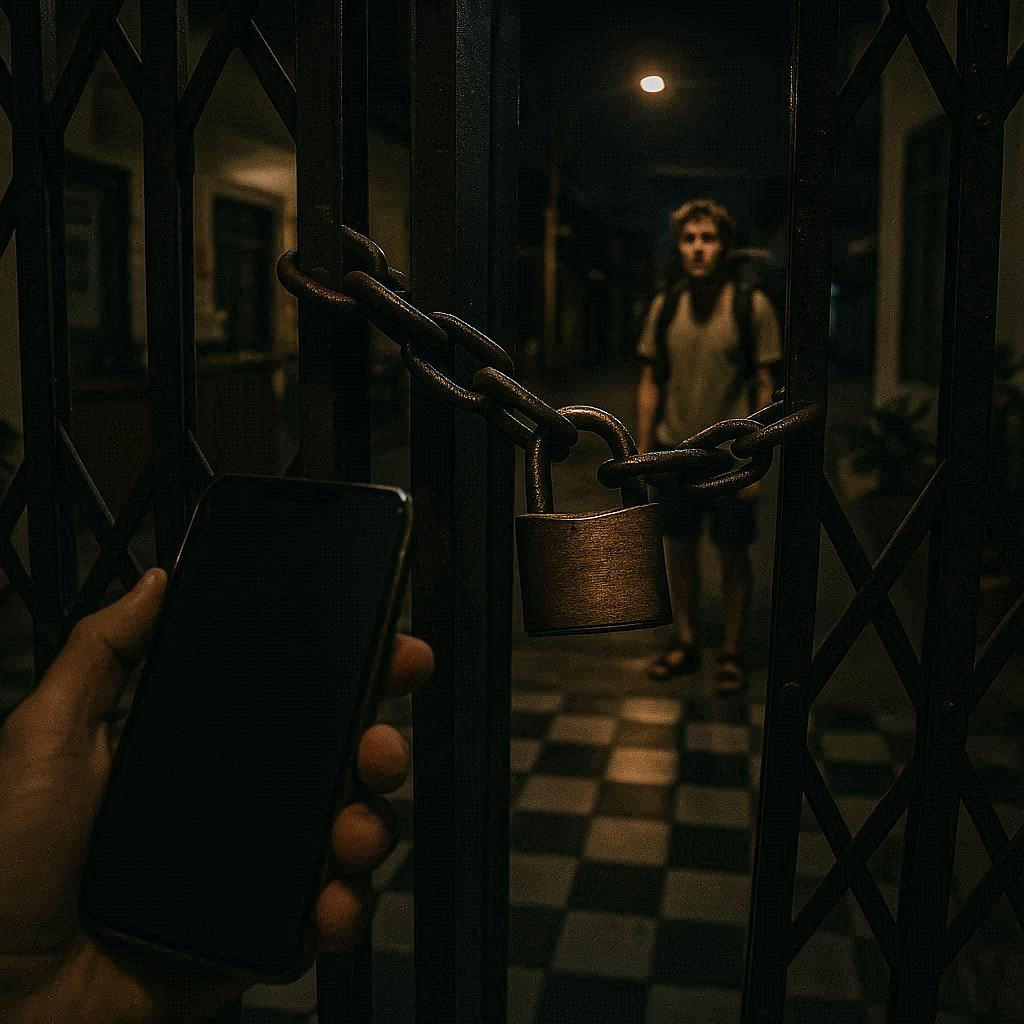
A guesthouse, I’m learning, is a fascinating microcosm of the world. It’s a temporary home for a transient tribe, each member living out their own quiet drama. My last night in Surat Thani, a simple locked door became the stage for a comedy of errors that revealed more about travel in the digital age than any guidebook ever could.
The saga began with my own displacement. After two nights of solitary bliss in a 16-bed dorm I had all to myself—a victory won through stubborn negotiation over a pre-booked bottom bunk—I was finally relocated. Management, keen to save on air-conditioning, moved me into a more populated room. This new dorm was a stark contrast to my private kingdom. It was a digital nomad’s cave. More than half the bunks were occupied, and nearly every occupant was silently hunched over a laptop in the dim light. One resident, a long-term guest judging by the fortress of personal belongings around his bed, lay flat on his back with a laptop resting on his chest. He peered up at me as I passed, his eyes narrowed with the territorial suspicion of a hibernating bear. The composition was so absurdly comical I desperately wanted to take a picture.
These digital denizens had a reason for their peculiar work habits: the downstairs common area, despite having tables, chairs, and power outlets, lacked the one thing that truly mattered—air conditioning. I, however, value posture over a cool breeze when I’m writing. So, as midnight approached, I was the lone soul tapping away at my laptop in the empty lobby.
The receptionist, a friendly young woman, informed me she was closing up at midnight. This was news to me, but not unexpected. “Will you still need the lights?” she asked. I promised I’d turn them off, and she left with a smile, pulling the metal gate at the entrance shut and securing it with a chain and a hefty-looking padlock. “Huh,” I thought, “they never mentioned a curfew.” But I was deep in my work and paid it little mind.
Minutes later, a young Western backpacker appeared on the other side of the gate, looking confused. A guest, locked out. I’ve been in this movie before—the late-night writer in the common room, unwittingly becoming the last line of defense against a hostel’s opaque policies. One by one, the night owls return, and I, the accidental gatekeeper, am their only hope.
My eyes darted to a poster near the door listing prices and two phone numbers. I pointed them out to him. A moment later, he asked, “Do they have WhatsApp?” He’d likely tried the numbers and found no corresponding account. A reasonable assumption, but I could only shrug. “Thais use it, but for business, who knows?” I suggested he just call.
“I don’t have a Thai SIM card,” he replied.
And here was another fascinating paradox of modern travel. The novice traveler obsesses over getting a SIM card, seeing it as a lifeline second only to cash. Without the internet, how would one even navigate? Yet here was a seasoned traveler, deep in the Thai heartland, operating completely offline. He knew how to use offline maps, where to find free Wi-Fi, and that the hostel would be his digital sanctuary. The incentive to buy a local SIM, especially when you don’t know where to find the cheapest deals, diminishes with experience.
I, on the other hand, had a SIM for data. While not essential, I value the convenience of online navigation and, crucially, the voice-to-text function that is vital to my mobile writing process. I’d never actually considered if my card could make calls. There was only one way to find out. I dialed the first number. A strange, automated English message replied, something about the number being “not acknowledged.” Useless.
Just as I was about to break the bad news, a miracle occurred. The stranded guest, with a slight rattle of the chain, simply opened the gate. I gasped, then the absurdity of the situation hit me. The padlock was just for show. It had never been locked at all. The entire ordeal—the frantic search for numbers, the SIM card dilemma, my failed phone call—had been a completely pointless charade. He walked past me, offered a grateful “thanks,” and disappeared upstairs.
I later confirmed my SIM was indeed data-only. But the whole episode left me pondering the quiet, unspoken rules of this place. No one had told me about the closing time, the “locked” gate, or the fact that the lock was a decoy. Was it sheer laziness, or a kind of cultural shorthand? A silent, mutual understanding that permeates Thai life: You should just know. The phantom lock was a perfect metaphor—a system that projects an image of rigid security while operating on a foundation of flexible, unspoken trust. It was a test, and we had all, in our own comical way, eventually figured it out.