The Man from Nowhere, and the Truth in a Rainstorm
2025-09-16
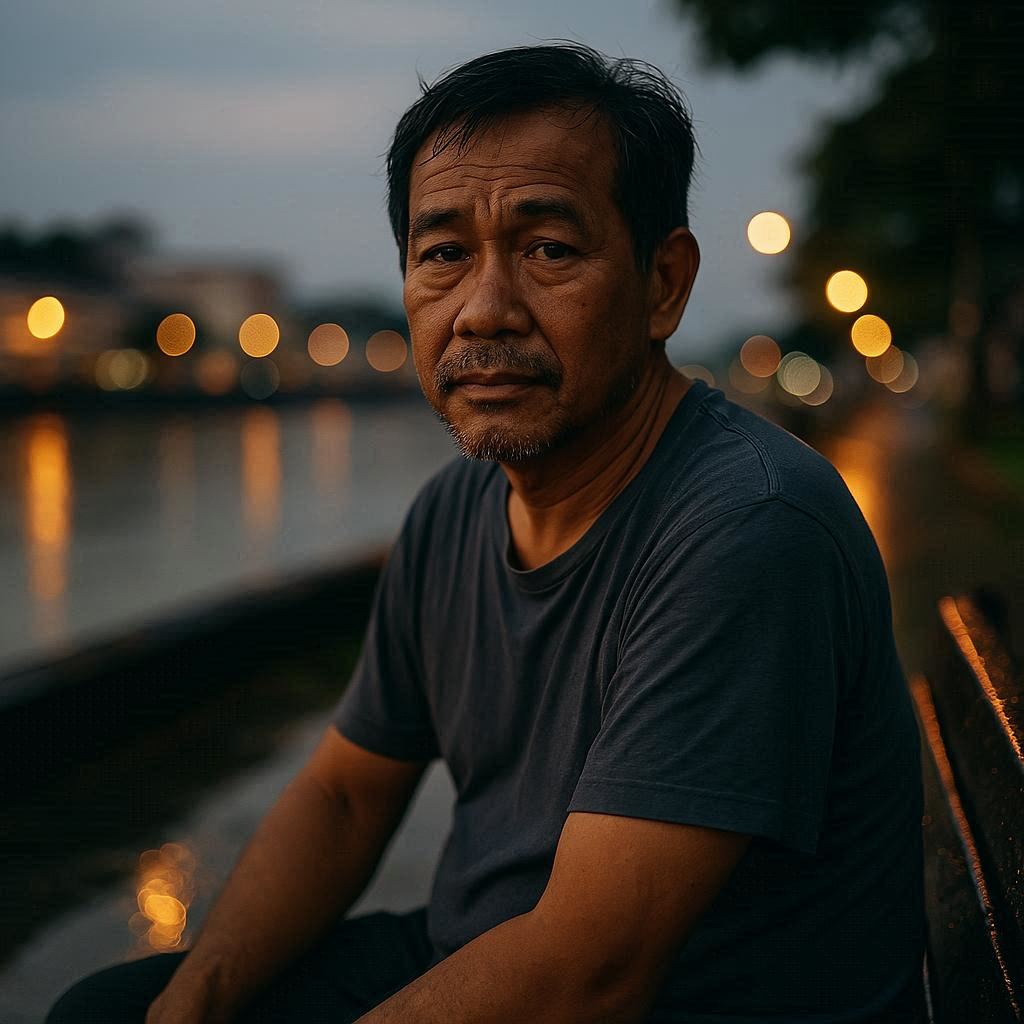
Travel has a funny way of stripping things down to their essence. You think you’re exploring a place, but what you’re often exploring is life itself, in all its messy, beautiful, and contradictory glory. I learned this today in Surat Thani, not in a temple or a museum, but under a dirty pavilion on a river island, waiting out a storm.
It began with a sudden downpour. I was strolling through Ko Lamphu, a leafy park in the middle of the Tapi River, when the heavens opened. I dashed for the nearest shelter, a public pavilion filled with benches caked in mud. Resigned, I spent four wet wipes clearing just enough space to sit. Another man was already there, quietly absorbed in his phone.
When the rain finally subsided, he looked up and smiled. “Where you from?” he asked. And just like that, a conversation began that would define my time in this city.
His name was Neung, he said, which means “One” in Thai. Was it his real name, or just an easy moniker for a foreigner? I never found out. He was from Surat Thani, but he’d been working in Phuket. Now, he was back home, between jobs. “Do this, do that,” he explained, painting a picture of a life lived on the move. “Fisherman, driver, waiter, kitchen hand… many things.” He was hoping to try his luck on the island of Koh Samui next, maybe drive a tuk-tuk, but with tourism still slow, work was hard to find.
Our chat was briefly, and surreally. After a moment, Neung made an offer. “I take you back to hotel,” he said, gesturing to his motorbike. “Free.” I gladly accepted. The storm had flooded the causeway back to the mainland, and I was grateful for the ride. As we parked near my guesthouse, I mentioned my room was only 170-something baht a night. “So cheap!” he exclaimed. “I should stay here.” He then told me he was renting a room in Chaiya, a town an hour away, for over 500 baht. He pulled out his phone and showed me a photo: a tastefully decorated room with a proper double bed, looking every bit worth the price. A flicker of confusion hit me—why would a man struggling to find work, who had worked in the tourist industry, not know how to find a cheaper room on an app like Agoda? But I brushed it aside.
He generously offered to show me more of the town. This was his hometown, he said, but everything had changed. We walked and talked, using a translation app to bridge the gaps. He spoke of his youth, hanging out with friends who were now all married with families. “No more friends,” he lamented, a statement not of fact, but of feeling. I asked if he had plans to settle down. “Tired of love,” he replied with a sad smile, hinting at past heartbreaks. “Before, I want house, want car. But life… not what you think. Now, I think simple life is best.”
As we walked through the early evening market, his tone shifted to politics. “Thailand is at war,” he stated, not of soldiers, but of a deep internal struggle between politicians that choked opportunities for ordinary people. “The tourists, they go to China now,” he said, a simplified explanation for a complex economic reality. He spoke of high unemployment and a pervasive sense of hopelessness that contradicted the country’s “Land of Smiles” image. He was painting a portrait of a Thailand I had never seen in a brochure.
He told me he prayed to Kuan Yin, the Goddess of Mercy, for a sense of peace. We wandered into a Chinese shrine, where he, the professional photographer (another one of his many past lives, apparently), directed me into poses for a few photos. We passed a group of old men huddled around a grainy TV, screaming at a Muay Thai match. “Gambling,” Neung whispered, then added, with a weight that felt ancient, “Everything is gambling.” I looked at the desperate hope on the men’s faces and understood. “This world,” he concluded, looking at nothing in particular, “is very scary.”
As our walk neared its end, we were approached by a group of local students in their school uniforms. They shyly spoke to Neung, who then turned to me, his eyes lighting up. “They need an English teacher for 30 minutes.” he announced. It turned out to be a surreal but charming encounter where I answered a pre-written list of questions on camera for their homework, fully aware they understood almost none of my detailed answers.
After the students departed, happy with their completed task, it was time for me to head back. I asked Neung where he was going for the night. “I stay with friend,” he said casually. The statement landed with a quiet thud, directly contradicting his earlier stories of having “no friends” and renting the nice room in Chaiya he had proudly shown me a photo of. “I don’t want to go back,” he added. “Feel bad for him.” I understood. The shame of imposing, the discomfort of dependency. His “easy-going” attitude was a mask for a man who might not have anywhere else to go.
I suggested he check out my guesthouse, and he followed me back, as his motorbike was parked nearby anyway. He glanced at the photos and price list by the door with a detached curiosity. “Maybe Agoda has discount,” I offered via the translator. He showed no reaction.
We said our goodbyes at the door, he took my Telegram. As he walked away, the pieces of his story clicked into place. The photo of the nice room wasn’t a lie; it was probably an aspiration, a projection of the life he wished he had, a small shield to maintain his dignity in front of a new foreign friend. His generosity, his stories, his willingness to share his city and his soul with me—all of it had come from a place of deep scarcity.
I had met a man who felt adrift in his own hometown, wrestling with love, work, and a nation he felt was failing him. He was a ghost of Thailand’s forgotten economy, and for a few hours, he had let me see the world through his weary but remarkably kind eyes. The encounter left me with a profound and humbling truth: sometimes, the people with the least to give are the ones who give the most.
I went to the night market for a solitary dinner, then returned to my guesthouse. The night before, after arguing with the reception about my pre-booked bottom bunk, they had given me an empty 16-bed dormitory, almost all to myself. I had felt a smug sense of victory, a triumph of asserting my rights. But tonight, the feeling was different. I stood in the vast, silent room, looking at all the empty beds. Me, a single tourist, occupying a space for sixteen. And out there, somewhere in the city, was Neung—a man with no job, no partner, and possibly no real place to sleep, yet who had spent his entire afternoon generously sharing his city and his soul with a stranger.
I thought of the empty guesthouses across town, and the countless drifting souls like him. Neung’s words echoed in the silence of my private dorm. “This world is very scary.” For the first time, I think I truly understood what he meant.