The Gospel of the Psychedelic Buddha
2025-10-15
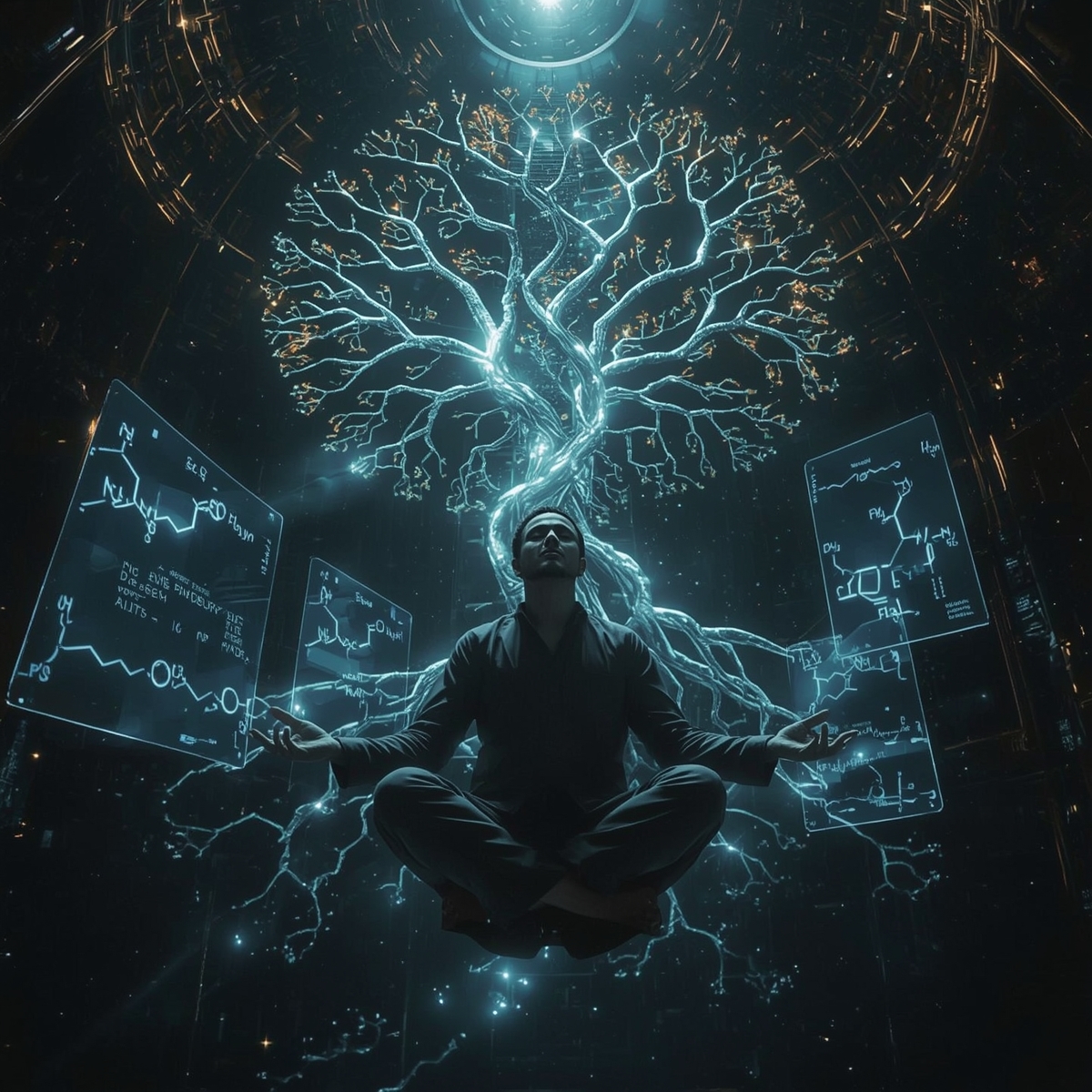
This essay is the first of a three-part series.
I was about to leave my dorm room when he checked in. A new roommate, a man from London. I offered a simple hello, expecting a brief, forgettable exchange. Instead, over the next hour, I was given a guided tour of a parallel reality, a universe of thought so intricate and profound that I am still trying to find my way out of it.
His name was Ade, a software engineer. This was his first time in Asia, and he had already spent two months here in Krabi. What was the appeal? “A bit of everything,” he said. He called his trip a “journey”, a preparation for the next phase of his work. He was something of a digital nomad, he admitted. “Me too,” I said, and on this flimsy common ground—the blurred lines between travel, life, and work—a connection was made.
I sensed the word “journey” held a deeper meaning for him. “What’s the ultimate goal of this journey?” I asked.
“Enlightenment,” he replied without hesitation.
“And how do you achieve that?” I pressed. “Through knowledge? Meditation? A Socratic self-interrogation?”
“Some meditation,” he said. “And some Socratic interrogation.”
Another Socratic dialogue. A jolt of excitement ran through me. Another truth-seeker, another soul unafraid of questions. By invoking that name, he had given me an express pass into the depths of his mind. No question now would be too abrupt.
And so I asked. And he answered, unveiling concept after concept I had never heard before. I, the relentless questioner, became an ignorant student, willingly absorbing the wisdom of a giant. As he spoke, the question marks above my head multiplied.
He spoke of his enlightenment, a process that had revealed his true place in the universe, a revelation so powerful it had forced him to do one thing: “unlearn everything”.
The phrase hit me like a jolt of recognition. Unlearn everything. A cultural studies professor of mine used to say the same thing. For him, it was a call to deconstruct the systems we inhabit, to dismantle the very education that shapes us. Was Ade a fellow revolutionary? Had I, by some cosmic coincidence, stumbled upon a kindred spirit in this sleepy Thai town, another soul dedicated to dismantling the architecture of our world? Eagerly, I waited for him to unveil this grand mission.
And then he spoke of his bloodline. He was not, he explained, an isolated being, but a single, vital link in a vast “physical lineage”, stretching back through the mists of time, generation by generation. He had discovered the grand mission of his entire bloodline. He even mentioned there is another “spiritual lineage”, equally significant.
A chill crept over me, extinguishing the flicker of excitement. This wasn’t the revolution I knew. The Socratic companion I thought I had found was suddenly a stranger, speaking of things I couldn’t comprehend. The feeling was no longer one of kinship, but of a deep, anthropological curiosity. What had happened to this man? What was his story?
He tried to explain the mission, his words elegant and precise, but the concepts themselves were like sand slipping through my fingers. I understood each English word, but strung together, they formed a language from another civilization, one whose grammar was beyond my grasp. My brow furrowed in concentration. He didn’t seem to notice, his monologue flowing uninterrupted, a beautiful, mesmerizing cascade of abstractions about the magnitude of his purpose, none of which brought me any closer to understanding.
The dialogue had dissolved into mysticism. I had to find my way back to solid ground. “How?” I interjected, seizing a rare pause. “How did you know your bloodline was aligned in this way? What showed you this?”
His gaze softened, the intensity replaced by a quiet sorrow. He began to tell his story. It started in the 2020 lockdown—the loss of his job, the anchor of his meaning cut loose. A woman, a near stranger, had sensed his despair. “You should try magical mushrooms,” she’d said. In the grand tradition of the hero’s journey, he refused the call to adventure. But she left a note. Months later, adrift and desperate, he accepted his fate.
“She took them with me,” he said, his voice barely a whisper. “And I experienced a peak state of consciousness I had never imagined.” He used the word “psychedelics”. “Isn’t that just drugs?” I asked. He explained that this was the system’s way of stigmatizing them, to prevent people from enlightening themselves and critiquing the system. The expert term, he added, was “entheogens”.
A wave of alarm, bordering on fear, washed over me. I tried to keep my face neutral, my expression calm, terrified that my pupils might betray my inner turmoil. My mind raced, trying to make sense of it. How could a chemical experience reveal a truth about one’s ancestry, a grand “mission”? I tried to imagine the neurological pathways, the psychological leaps required to connect a psychedelic trip to a genealogical destiny.
Finally, I found my voice. “What was it like?”
He looked at me, not as a teacher to a student, but as a traveler describing a foreign land. “That,” he said, “is what the whole journey has given me. The answers. I found them, step by step.”
This time, without me having to ask, he kept talking, ready to explain exactly what those steps were.
As he spoke, I felt myself drifting, lost in a vast, uncharted ocean of information. In the space of just a few minutes, he threw out a constellation of concepts, names, and sources, all completely new to me, all impossible to process in real time. He mentioned a Netflix documentary, Fantastic Fungi, quoting its director. He cited historical figures I’d never heard of. But through the deluge of data, one astonishing claim pierced through the noise, lodging itself in my memory. He spoke of Srinivasa Ramanujan, the only Asian among the world’s top ten mathematicians, who attributed his breakthroughs to visions received during a lifetime of meditation.
“Seven grams of psychedelics,” Ade stated, his voice filled with the certainty of a prophet, “can give you the equivalent of Ramanujan’s entire lifetime of meditation. Extremely concentrated.”
I fought to keep my expression neutral, to control the widening of my eyes. I was no longer sure what emotion I was even trying to hide—was it shock? Pity? Awe? “You know a lot of things,” I managed to say. “How do you know all this?”
“Have you heard of DeepSeek?” he asked. I had. He then launched into a detailed analysis. “Some people say it’s just a ‘cute toy’,” he began, a dismissive wave of his hand. “But ChatGPT doesn’t hide its intention: to make AI just like a human. DeepSeek is more analytical. It’s not trying to be a person. It’s better for research.” He leaned forward slightly. “Literally this morning, I woke up and asked DeepSeek about the ‘dreamspace realm.’ It instantly gave me a several-hundred-page research report.”
As he said this, I couldn’t help but think of all the confidently incorrect, hallucinating replies DeepSeek had given me in my own experience. But at the same time, a piece of the puzzle clicked into place, a moment of chilling clarity. This was his “research”. This was a crucial part of his “journey” to find the truth.
He then added a word of caution, as if sensing my unspoken skepticism. “A lot of people go mad,” he admitted. “They don’t know what they’re doing. They don’t know how much to take. They don’t know how to distinguish the ‘rice’ from the ‘sand.’ Of course, if you eat the sand, it’s bad for you.”
And how does one tell the difference? “It’s simple,” he said, “common sense. Research that anyone can do.”
I felt a fresh wave of unease, a cold dread that was more complex than my initial fear. This wasn’t just a man taking drugs. This was a man “optimizing” his psychedelic experience with the help of artificial intelligence, perhaps even using it to analyze chemical compositions. He was using the most advanced tool of our rational age to navigate the most irrational journey possible. It was a terrifying, brilliant, and utterly modern form of alchemy, an attempt to build a bridge of code to the divine.
And I was witnessing its birth.
Still reeling from the revelation, I was pulled forward by the gravitational force of my own curiosity. “What’s your next big step?” I asked.
“Expand consciousness,” he replied.
“How?”
He explained that his ultimate goal was to grow his own psychedelics, to control every stage of production from spore to consumption, to achieve the optimal state for consciousness expansion. This, he acknowledged, required a financial foundation. He mentioned, with a sincere, envy-free admiration, my own financial engine, something he was now working to build for himself.
“And how does expanding your consciousness,” I asked, trying to connect the dots, “relate to the mission of your bloodline?”
And that’s when he opened the door to the multiverse. The entire blueprint of his lineage, he said, existed within a specific “realm”.
Realm?
The world, he explained, consists of many realms. He needed to enter his lineage’s realm to fully align with his mission, but he couldn’t get in until he was “qualified”.
“A gatekeeper?” I offered.
“Exactly,” he said, completely unaware of the loaded meaning that word held in my own revolutionary philosophy. “A proper gatekeeper.” Expanding his consciousness, it turned out, was the key to earning his entry visa.
He then looped back to the concept of dreams. Dreaming, he explained, is also a journey to a realm, just a low-level one that everyone can access. The realms are hierarchical, differentiated by dimensions. The dreamspace is the fourth dimension. There is a fifth, a sixth, and so on. Only by expanding one’s consciousness can one ascend to these higher dimensions and achieve true alignment.
As I was struggling to process this cosmic ladder, he casually dropped another bombshell. “All the ancient civilizations,” he said, “the Mayans, the ancient Egyptians, the Aztecs… they never disappeared. They’re just not in this world anymore. They still exist, in one of the realms.”
The pieces fell into place, forming a picture of breathtaking, terrifying coherence. The universe he was describing wasn’t just a spiritual landscape; it was a sprawling, class-structured multiverse, a cosmic bureaucracy of gates and dimensions, where lost civilizations waited in hidden dimensions, and a man’s ultimate purpose was to earn the right to enter his own ancestral VIP lounge.
I had to know the endgame. “What’s the final goal in all of this?” I asked. “Is there a name for it?”
This time, his answer was just two words. “Become Buddha.”
He then launched into a grand, syncretic theory of everything. All the world’s religions, he explained, were just different versions of the same ultimate journey, but none had reached the true final destination. “Jesus Christ,” he said, “he died in the end, even though he founded a religion.”
“So, after becoming Buddha,” I ventured, “you become immortal?”
His reply was a new kind of unexpected, a chilling blend of faith and pseudo-scientific rigor. “I am one hundred percent certain of it,” he said, then added a crucial qualifier, “but I have not validated this yet.”
I felt a profound sense of loss. He was still using the language of reason, he still understood the distinction between a fact and a belief, yet he had become… this. And as I thought about what “validation” meant to him, my mind went back to his earlier sermon on AI.
But my thoughts were interrupted. His topic had already shifted to his reading list. He had, he claimed, listened to all the major religious texts on audiobook—the Bible, the Quran, the Vedas, a dozen others he rattled off. He knew reading was better for critical thinking, but audiobooks were more efficient, he said, even if he had to constantly pause to reflect.
Then he soared beyond Buddha. Above all the realms, he explained, was the highest dimension, “the source of everything.” He cited a scene in Matrix, and described how, upon reaching it, one could reshape reality like a god, how he could transform my hometown into a pinnacle of civilization, its people remade into beings of breathtaking beauty.
And at that point, I stopped listening. The desire to ask more questions had evaporated. I was just staring at him, my mind a blank, trying to calculate how to politely end this conversation and escape.
But before I could, I remembered one last, practical detail I was curious about. “As a traveler,” I asked, “how do you even get these… psychedelics?”
He not only answered—telling me he had a contact right here in Krabi—but he also shared his personal dosage. “I’m on five grams now, every two weeks.” I immediately understood why he had volunteered this information. “I can introduce you,” he offered. “You should start with one gram and work your way up.”
He thought I was asking for a hookup.
“I feel this could be especially useful for you,” he continued, his voice filled with a sincere, almost tender concern. “Someone like you, who already has a financial engine, you can skip a whole part of the journey. Most people can’t do that.” I could hear the admiration in his voice, but no jealousy. He genuinely wanted to help. “Of course,” he added, “I don’t tell this to everyone. It challenges their core beliefs. They are not ready.”
I didn’t respond immediately, feigning deep contemplation. He didn’t push. He just kept talking, his monologue seamlessly flowing into another cosmic tangent.
He was offering salvation, and I was calculating my escape.
When I finally left the room, I was overwhelmed. A profound sadness washed over me, a grief I couldn’t name. I had just been given the gift of a man’s most sincere, unvarnished self. I had witnessed the birth of a new religion—a one-man theology for the Information Age. It was beautiful, and it was terrifying.
Here was a beautiful soul, who, in the wake of a personal collapse, was attempting to rebuild his own subjectivity. He had taken the narrative viruses of our time—sci-fi movies, new-age spirituality, AI, the metaverse—and mutated them into a unique gospel of his own. His “lineage” and “realms” had given him an unshakeable anchor of meaning in a life that had lost its own. Like all religions, it allowed him to outsource the burden of meaning to something greater—something real to him, yet forever unverifiable.
But as I walked through the quiet hostel corridors, his ultimate goal echoed in my mind: Become Buddha. The ancient parable of achieving freedom by transcending the cycle of rebirth. If one were to interpret this with the tools of contemporary philosophy, I thought, its truth would lie in this: to break free from the causal chains of the physical world, to escape the mindless state of “external stimulus leads to automated response.” It is to assert one’s own agency, to act based on a value system one has deliberately, rationally chosen. To help all sentient beings achieve Buddhahood, then, would be to extend this principle to all of humanity, to resist the universal law of stimulus-response, and to empower every individual to construct their own subjectivity.
And in that moment, a chilling thought emerged. His journey, in its own twisted way, was a dark mirror of my own.
We both started from the same place: a profound dissatisfaction with the existing system, a deep yearning for a more authentic, meaningful way of being. We both saw the world as a flawed code, a system full of black boxes and irrational rules that needed to be challenged. We both, in our own language, wanted to “become Buddha”—to achieve a state of sovereign freedom.
But at a critical crossroad, we diverged.
I had chosen a path that leads outward. A revolution based on reason, on dialogue, on the painstaking, collective construction of a shared truth. It is a path of engagement, of trying to persuade the world to be better. It is an attempt to empower everyone to assert their agency.
He had chosen a path that leads inward. A solitary enlightenment fueled by psychedelics, a retreat into a private, unverifiable reality. His path was not about persuading the world, but about replacing it. It was a revolution of one. His agency was not to be asserted in the world, but outside of it, in a realm of his own making. He seemed to have created a new narrative, a new religion, a new possible world—but the materials he used to build it, I realized, were depressingly familiar.
His sanctuary was built from the debris of our post-truth age. The cinematic imagery of The Matrix, the hierarchical, game-like structure of “realms” and “dimensions,” the promise of a “source of everything” borrowed from New Age spirituality, the use of an AI oracle to generate instant “research”—it was a perfect synthesis of our era’s most potent narrative viruses.
And the system itself was flawless, a perfect, self-consuming circle. What is your life’s mission? To align with your bloodline and become Buddha. How do you know this? Because the psychedelics expanded your consciousness and made you smarter. How do you achieve your mission? By expanding your consciousness further, level by level. How do you expand your consciousness? By taking more psychedelics, which requires building a financial engine to fund your own bespoke, quality-controlled production. It was a closed loop, a snake eating its own tail. I realized then that the system no longer needed prophets—it had perfected replication.
I found myself imagining a world where his gospel went mainstream. A world where everyone, disillusioned by the failures of the grand systems, retreated into their own psychedelic-fueled realms. Perhaps he would become the high priest, the sole cultivator of the “truth pill” for the masses. What would a society of enlightened individuals, each communing with their own ancestral lineage in their own private temple, even look like?
And that’s when the true horror of it struck me. What is enlightenment? I had always held to the old definition, a legacy of a bygone era: the pursuit of truth through reason and rigorous, collective dialogue. But perhaps that definition is obsolete. In our age, where grand narratives have collapsed and all truths are relative, perhaps enlightenment simply means this: the ability to weave one’s own narrative, a personal sanctuary of meaning in the ruins.
This is the fear that gripped me: what if his inward revolution wasn’t a rebellion against the system at all, but the system’s most brilliant innovation yet?
We live in an age of inwardness. People stare into their phones, lost in infinite scrolls, their attention captured, their revolutionary potential pacified. The system no longer needs bread and circuses; it just needs a good algorithm. Ade’s journey was just a more sophisticated, more spiritual version of this. His was not the empty distraction of a smartphone, but a quest imbued with the weight of destiny, a purpose-driven retreat into the self. It offered not just distraction, but a profound, unshakeable meaning.
And what could be a more perfect tool of control? A system that doesn’t need to trap you, because it has taught you how to build your own cage, decorate it with self-authored myths of bloodlines and higher dimensions, and call it freedom. A system that doesn’t need to lie to you, because you have learned, with the help of a few grams of a truth pill, to lie to yourself perfectly. His escape wasn’t an escape at all; it was just a more elaborate, personalized prison.
As I finally left the hostel, the profound sadness I’d felt earlier returned, but this time, it was sharp and clear. I wasn’t grieving for a lost soul, but for a lost connection—a connection that, I realized, was never possible in the first place.
I doubted if Ade could ever truly connect with another human being again. His entire sense of self, his grand purpose, was anchored in a private realm accessible only to him and the ghosts of his lineage. How could any real, flawed, present-day human ever compete with the perfection of that ancestral communion? His was the loneliness of a god in a universe of one. A beautiful, self-sustaining, and utterly solitary existence.
And what of my own loneliness? It was the loneliness of the revolutionary who looks for comrades in a world of ghosts. The loneliness of holding on to a belief in shared, rational truth in an age that celebrates personalized, self-medicated realities. My very purpose is defined by the existence of other sovereign, subjective minds to connect with, to reason with, to build a better world alongside. But his story was just another piece of evidence in a growing mountain of it: that the world is no longer populated by people, but by avatars performing the role of people, their true selves locked away in their own private realms.
He had found his answer by looking inward. My answer requires me to keep looking outward, searching for another human in a world that seems to have forgotten what being human even means.
We were two ghosts in the same machine, each trapped in our own kind of solitude.
Perhaps the world no longer needs to oppress anyone. It only needs to persuade us that there is nothing left to free. We have all learned how to self-medicate, how to build our own beautiful cages, and how to lock the door from the inside.