The Dorm Room War: A Miniature Geopolitical Situation
2025-10-23
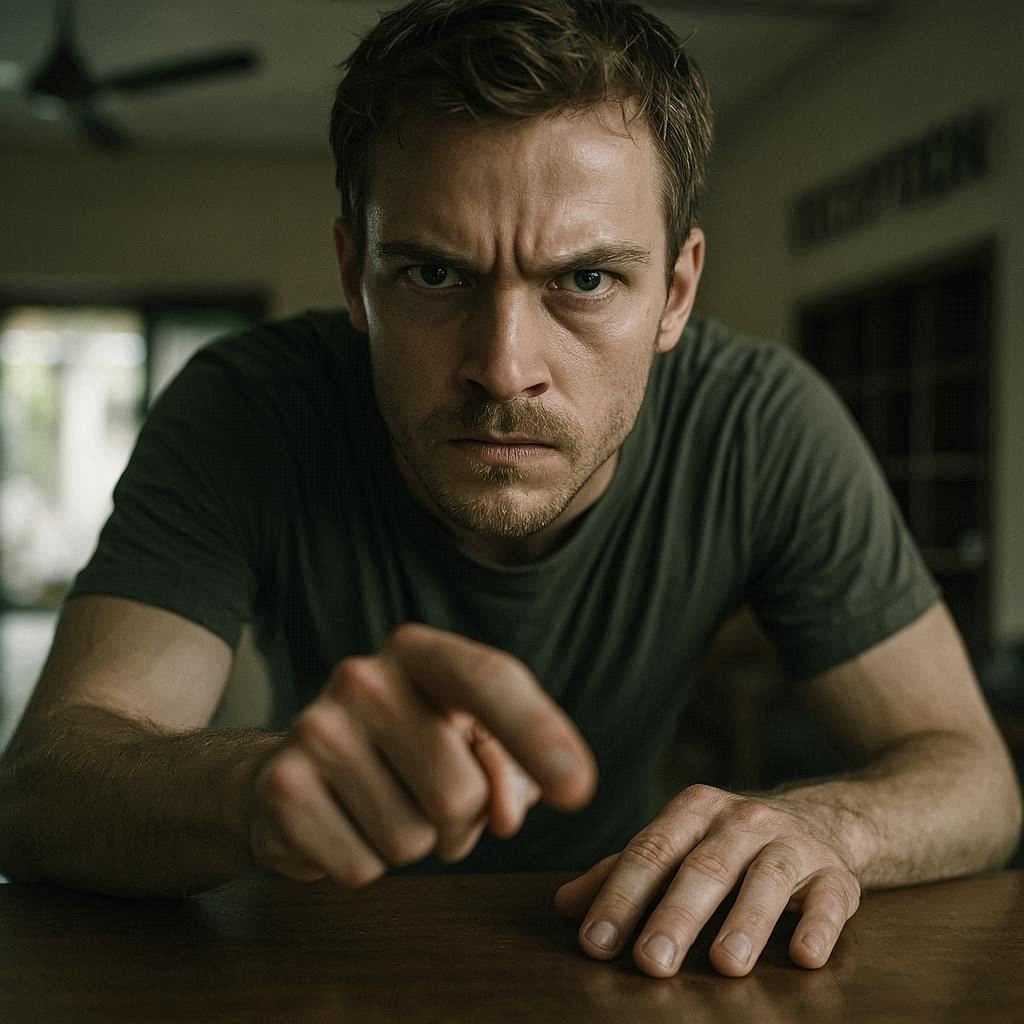
It began with a disturbance in the force. Last night, returning to the hostel, I noticed something unusual. The door to my dorm room was wide open, and a man was sitting strangely at the table just outside, a cat sleeping on the chair next to him. He was holding a musical instrument, poised to play but not playing. Why is the door open? I wondered. Perhaps for ventilation. The room’s air‑con was perpetually set to 26°C, a temperature below which my fruitarian roommate Ade, with his heightened sensitivity to cold, likely found unbearable.
I moved closer, ready to offer a standard traveller’s greeting. But as I passed the doorway, I looked at the man’s face. He was staring into the middle distance, his expression completely blank, his eyes empty. A chill, entirely unrelated to the air conditioning, ran down my spine. He looked like a serial killer from a movie. I said nothing, just a quick glance, and continued on my way. The room was dark, the air-con off. They’re just airing it out, I told myself, dismissing the unease. I was only there to grab my laptop from my locker anyway.
At 2 AM, I returned to sleep. I opened my locker’s padlock with the slow, deliberate care of a bomb disposal expert. In the dead of night, in a cheap hostel with creaky beds, every sound is amplified. The room now had three new occupants. The quality of my sleep, I knew, was about to plummet.
I was not wrong.
Before noon, while I was still deep in a fragile sleep, the party began. Not in the bar outside, but right here, in the dorm room. A loud, jarring music exploded from a speaker. The door was thrown open, letting in the noise and heat. They were talking, shouting, singing along. For an entire hour, the assault was relentless.
I lay there, my eyes squeezed shut, not in rest, but in a state of furious, helpless resignation. This was my sanctuary, my cheap, quiet corner of the world, and it had been invaded. The unwritten rules of the backpacker world—a world supposedly built on mutual respect and shared space—were being brutally, unapologetically violated.
Every fibre of my being wanted to scream, to fight, to restore order. But I did nothing. I was tired. I was outnumbered. And in that moment, I was just another victim, another powerless subject in a kingdom newly conquered by chaos. Feigning sleep, my mind a raging storm of indignation, waiting, just waiting, for the barbarians to finish their celebration so I could reclaim a few more precious moments of peace.
My twelve-hour sleep had been less of a rest and more of a siege. I finally emerged from my bunk after the party had subsided, feeling drained and violated. I saw Ade packing a small suitcase.
“I need to be alone sometimes,” he explained. He was escaping to a nearby villa for one night, a small luxury. His bed here was already paid for, so it wasn’t a move, just a temporary retreat.
The conversation naturally turned to our new roommates, the source of our shared misery. His grievances, I discovered, were even greater than mine. “They didn’t just leave the door open last night,” he said, his voice tight with a controlled anger, “they let a cat into the room.” He then pointed to a box of incense on a locker. “They were burning this. The ash was everywhere. On my things. In the bathroom. All over my soap.” He shook his head. “Typical Americans. So insensitive.”
“I think it’s intentional,” I countered, my own anger flaring. “It’s a deliberate insensitivity. An ‘I don’t fucking care about anything’ attitude.”
An idea began to form in my mind. “I’m thinking of changing rooms,” I said, testing the waters. “My sleep was terrible.” A solo complaint might be dismissed. But a joint complaint from two long-term guests? That had leverage.
But Ade was hesitant. “I already moved the incense,” he said, “maybe they’ll get the hint.” He had no real desire to move. “I don’t want to confront them,” he added. “It’s a waste of my precious time and energy.” In my mind, I thought, You’re the better person for this. A confrontation requires a baseline of mutual respect, and I have none left for them.
“You could try again tonight,” he suggested.
“But I couldn’t sleep,” I insisted.
He seemed to finally understand the depth of my problem. “Ah, yes,” he said, a flicker of empathy in his eyes. “That is an issue.” Our situations were different. He was an early riser, off to meditate at dawn. And with his AirPods in, he was immune to their midday parties. My suffering was not his.
I didn’t push, but I asked again. “So, what should we do?” A fragile consensus was finally reached. We would go to the reception together. We would report the problem and let them handle it.
As we were about to leave the room, Ade looked at me, a wry, knowing smile on his face. “This,” he said, “is a miniature geopolitical situation. It will give you a few more articles to write.”
I wondered if he had any idea that I had already written three about him.
As we walked down the corridor towards the reception, we passed one of the new arrivals—not the “serial killer”, but his companion. I saw him clearly now: a bald man, his entire head and body a canvas of tattoos. It was a startling sight.
At the reception, Film, the main manager, was absent. We explained to the young woman on duty that we needed to speak with him. She, knowing her English was limited, still insisted we tell her the problem. We obliged, running through the litany of sins. After listening patiently, she concluded, as I knew she would, that this was a matter for Film. She picked up the phone to call him.
A surge of frustration rose in my chest. I came here to speak to Film. You knew you couldn’t handle this. You made me tell you the whole story, and now I have to tell it all over again. The inefficiency was maddening, a classic symptom of the Thai service industry’s chronic inability to delegate authority.
Film arrived. We repeated the story. The open door, the disabled air-con, the cat, the incense, the ash on our belongings, the midday party in a room with sleeping guests.
He listened, then asked the wrong question. “So what do you want? Do you want to move together, or separately?”
He assumed the solution was for us, the victims, to be displaced. He didn’t understand that our agendas were different. Ade didn’t even really want to move. As I hesitated, trying to formulate a strategy, Ade answered with a calm, maddeningly neutral, “I don’t mind.” It was an answer that could mean anything, and therefore meant nothing.
While Ade continued his quiet, non-confrontational chat with Film, I saw an opportunity. I walked over to where Tshepo was sitting, using the moment to check in on him, a small act of kindness that also served as a strategic retreat. I didn’t need to be part of Ade’s negotiation. The fact that he, another long-term guest, had stood beside me in lodging the complaint was enough. My leverage had already been secured.
Ade finished his talk, picked up his suitcase, and left for his one-night villa escape. Now, it was my turn. The politics of the situation had shifted. A lone complaint could be solved with a simple room change. But a joint complaint, from two of the hostel’s most loyal residents? That demanded a real solution.
Film, ever polite, asked me again what I wanted.
“The ideal solution,” I said, my voice now devoid of any of the previous warmth, “is for them to be moved.”
He hesitated. “Maybe… maybe it’s better if I arrange a new room for you?”
And that’s when the war began.
I didn’t just repeat my complaints. I performed them. I knew this was no longer a negotiation; it was a show of force. My eyes held a flicker of fire. My expression was one of righteous indignation. My tone was laced with disbelief, my voice imbued with the unshakeable certainty of a man who had been profoundly wronged. I listed their crimes again, each one punctuated by a pause, letting the weight of their transgressions hang in the air.
And then, the final, decisive blow. I leaned in slightly. “Ade just told you exactly the same thing, didn’t he?” The sentence was a symphony of escalating tones, a question that was not a question, but a threat. It was an announcement: I am ready for battle.
My mind was already three moves ahead. If he refused, my phone would come out. I would start recording. I would ask him, on the record, for each and every violation, “Is this acceptable behaviour in your hostel? Is this the standard you set for all guests?” His answer would become his brand’s public statement.
But I didn’t need to deploy the nuclear option. He saw it in my eyes. He saw the vulture he had judged me to be a few days ago, and now, it was circling him. His previous coldness, his act of treating me like a stranger, had ironically become my greatest asset. There was no friendliness left to preserve, no goodwill to consider. I was simply a long-term, paying customer, my complaint now corroborated by another, and I was not going to back down.
“I will talk to them,” he finally said.
“Good,” I replied. “I’ll be back later to see the result.” He apologized for my experience. It was a professional, formulaic apology, but the expression of sincerity was perfectly feigned. The first battle was won.
Returning to the hostel, my heart beat a little faster. I was preparing for the possibility of another confrontation, another war. I plastered a wide, friendly smile on my face—a tactical maneuver. If he told me he had failed, the smile would vanish instantly, replaced by the fiery glare I had deployed earlier, but with twice the intensity.
But the performance was unnecessary. “They have moved out of the room,” Film informed me, his tone professional but calm. A genuine smile of relief broke across my face. I gave him a double thumbs-up. Thank you.
I walked slowly towards the dorm, savouring the small victory. Suddenly, Film almost ran past me, murmuring an apology. He was heading into my room. The two invaders’ beds had been cleared, but one of them was still there—the one with the “serial killer” eyes. Film was confronting him. The man was complaining about not having a key. Film insisted one had been given. I didn’t pay much attention; they were gone, that’s all that mattered.
But then I saw it. The door to our room was broken. The edge near the handle had been split vertically, not completely, but enough to be folded inwards. The man’s story, I now understood, was that he had broken it because he couldn’t get in.
“That’s crazy,” I said to Film as I left the room. “If I were you, I would call the police.”
“I’m about to,” he replied, though I couldn’t tell if he was serious.
I took my laptop to the common area to do my own things, while watching. The two former invaders were now sitting quietly at a table outside the room. All their menacing energy was gone. They looked less like serial killers and more like stray dogs that had been kicked out into the rain. Film and his staff were huddled together, discussing the situation in hushed, urgent Thai.
Then, a bizarre scene unfolded. The man who had broken the door walked calmly to the bar and ordered a drink. He sat there, sipping it like a regular customer, with Film standing nearby. What was happening? Had they already settled the damages? Was this Film’s brilliant political maneuver—a “win-win” deal where the damages were paid in bar credits, converting a liability into a high-margin profit? If so, his skill was on another level.
An hour later, the real answer arrived. A group of five or six men, mostly in plain clothes, but two with “Krabi Tourist Police” emblazoned on their backs. Film had been serious. He borrowed my key to open the now-useless door, and the police surrounded the man, who sat and explained his side of the story. The discussion was surprisingly calm. I only heard one officer shout “Listen!” once. An hour later, I saw the man hand over a wad of cash to Film and sign a document on high-quality paper. Justice, it seemed, had been served.
As Film was heading back to the reception, I called out to him about my key. He walked over, and the chill was gone. “I can move you to another room,” he offered, “the door is completely broken now.” I went to look. The wood was no longer just split; it was completely severed. I decided to stay, at least for the night. A room with a broken door was a small price to pay for the luxury of having the entire dorm to myself.
“If you change your mind,” Film said, “just find me. I’m here until eleven.” And then, it was back. The smile. The warmth.
Perhaps it’s a matter of comparison. Next to a guest who literally breaks down his door, I suddenly seemed reasonable and harmless.
The power dynamic had reversed completely. I was no longer the threat. I was his ally. The war was over, and peace had been restored.
Later that night, I sat in the common area, working. The hostel was quiet. The war was over. Peace had been restored. But I felt no joy, no sense of triumph. Only a profound, chilling emptiness.
Ade’s words earlier came back to me: This is a miniature geopolitical situation. I had dismissed it then as another one of his cosmic pronouncements. But now, I saw the terrifying truth in it.
I replayed the events in my mind. A cold dread washed over me as I realized what I had done. In the process of fighting for what was rightfully mine, I had instrumentalized myself. My body, my facial expressions, my language, the very tone of my voice—they had all ceased to be expressions of my self. They had become weapons, tools to be strategically deployed in a micro-political battle. I was no longer a person; I was a calculated performance of anger, a threat assessment, a walking, talking leverage machine.
Am I the only one who does this? I look around, and I see a world of people doing the same thing, just without the burden of self-awareness. Perhaps we are all forced to become these things. In an imperfect world, a world of black box courtrooms and unwritten rules, a world where reason is not enough, maybe this is the only way to survive. We just get used to it. We forget there was ever another way to be.
But I am still haunted by it. Because I know that for a period of time today, I was not myself. There was no “self” to speak of. There was only the cold, binary logic of winning or losing a miniature war. I was both the general and the soldier, fighting not just for my own interest, but for a principle of justice. If I had lost, a part of me—the part that believes the world shouldn’t be worse off because of our actions—would have died.
And to win that war, it seems, I had no choice but to become a tool. In a world where reason can no longer protect us, we learn to weaponize our humanity.
I had won the war for a quiet room. But in the process, I had to kill a part of myself—the part that believed a just world could be won with reason alone.
The silence in my room that night was profound. It was the sound of a small victory.
And the sound of a great loss.