The Bridge Never Crossed: A Requiem for Transferable Truth
2025-10-27
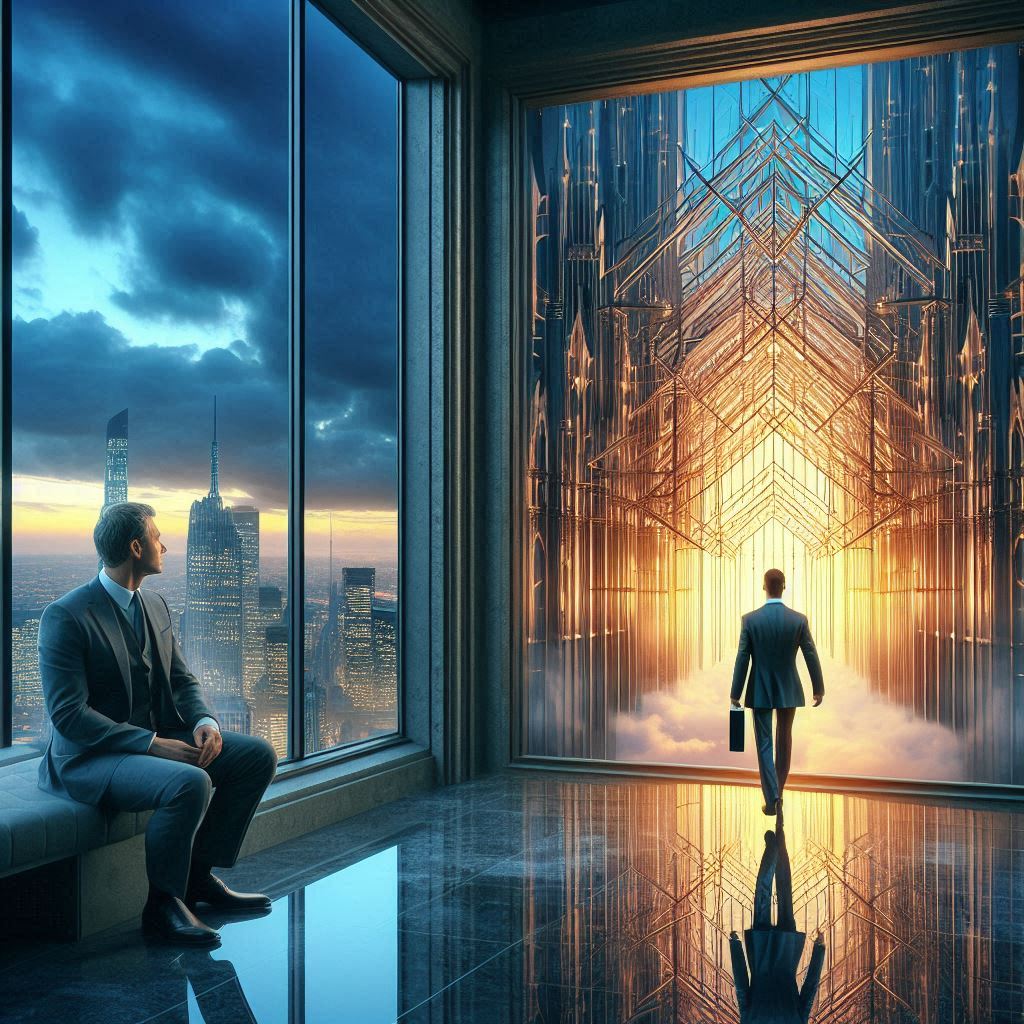
Prequel — The Epistemic Island: A Language with No Other Speaker
From the ruins of a world that had deceived me, one man emerged.
He appeared not in a temple or a university, but in the most unlikely of places: the group I had built from the ruin of a fraudulent investment course. He introduced himself as having seventeen years in the capital market, a man of private equity and venture capital. He wanted to “exchange views for mutual benefit”. His true intention was uncertain, but I agreed to meet.
I met the first, and to this day, the last, benefactor of my life.
He seemed to see right through me—not just the persona of the traveller, but the structure beneath my alienation. He understood my relentless quest for independence and intellectual autonomy. He asked profound, probing questions about my past, and for some reason I still don’t fully understand, I opened up to this stranger in a way I never had before. It was not trust. It was recognition—rare, disarming, and impossible to resist. I spoke of my teenage existential crisis, the conflicts with my father, my search for meaning in philosophy—even my failed attempt at a “co-living revolution”.
In return, he spoke of his world, a world of billion-dollar acquisitions and the absolute power of credibility. Then, as I had expected, he turned his sharp, analytical gaze onto my system. He didn’t just ask what it did; he asked how it was built. He asked about my algorithm, my value projections, my buy-and-sell thresholds, the first principles behind my “value-purity” index.
After listening to my struggles, he diagnosed my problem with a brutal, startling accuracy. “Your weakness,” he said, “is that you are too smart. It makes people feel like they can be easily tricked by you, and their defences go up.” He saw things I couldn’t see, speaking of truths I had only just learned through years of painful trial and error as if they were simple, self-evident facts.
The conversation was a whirlwind of intellectual excitement. And then, he delivered the highest praise I had ever received, a sentence that felt less like a compliment and more like a coronation.
“You,” he said with a quiet sense of wonder, “can build an entire system from a single point.”
I felt, for the first time, seen. Truly seen. Later I would understand: what he saw was the brilliance of my intellect, not the foundation of my being. But in that moment, the loneliness of the architect, the despair of speaking into silence—it all melted away in the warmth of his understanding. The philosophical proposition that had been brewing in my mind—Truth can be understood—had finally found its living proof.
Hope, a feeling I had long thought extinct, was born. I did not yet know that understanding is only the first illusion of connection.
Our first meeting grew into a series of intense, exhilarating exchanges. We were two systems, two minds, decoding each other in real time. He laid his world bare for me—his criteria for global stock selection, his emphasis on companies with deep moats. His insights were a catalyst. I realized my system, built on universal first principles, was never meant for a single market. Its true arena was the world.
He, in turn, was fascinated by my creation. I understood why it was so appealing to him. His own faith was in value investing, but he saw that my system was something new: an attempt to give value investing the first-principle, philosophical foundation it had always lacked.
Then he gave me the key. It was a link to a hidden section of the Morningstar website, a treasure trove of ten years of financial data. Suddenly, the gruelling, manual labour of data entry that had consumed my life was over. But what it really ended was my illusion that truth needed only effort. I learned then that it also needed access—and a key.
We spoke of our ultimate goals. I spoke of my infinite ambition to fix the unjust rules of the world. He spoke of his desire for happiness, for making others happy. We even discovered we were both INTJs—a type he called the “mastermind”. For a moment, the synergy felt cosmic.
I ran the numbers for a list of US stocks he provided. He was, naturally, the first reader. On October 21, 2019, I sent him the first report. One of the stocks that lit up, a clear “buy” signal from my system, was Tesla. At the time, I barely knew what the company did. But my system did. From that point on, Tesla’s stock began its legendary, astronomical ascent.
The proof was undeniable. The engine worked. It was not just a theory; it was a force of nature. It was the first time my truth had made itself manifest on the world’s greatest stage, a beautiful, irrefutable signal in the noise. A second philosophical proposition felt proven: Truth can not only be understood, it can be exchanged and verified.
I did not yet know that I was mistaking verification for alignment.
Perhaps sensing the undeniable power behind the Tesla signal, he proposed a formal partnership. He would handle the world of men—the business development, the clients, the legal structures. All I had to do was continue to perfect the engine. For a brief, brilliant moment, I believed a civilizational-level collaboration was about to be born.
Our conversations shifted from the theoretical to the practical, from the “what” to the “how”. He began to lay out a grand vision, a three-to-five-year plan to build a legitimate fund. He spoke of the arcane world of licenses, of Responsible Officers, of corporate structures designed to satisfy the regulators. He explained how I, with no experience, could “incubate” a three-year track record simply by being licensed under an existing firm. It was another loophole, another hidden key, but this one unlocked not a website, but the very gates of the institutional world. He praised my abilities, saying they surpassed many at JPMorgan.
And for the first time since my disillusionment in the insurance industry, I felt a flicker of purpose return. My financial freedom had solved the problem of survival, but it had left me in a void of meaning. My engine was powerful, but it was an engine without a vehicle. He was a beacon, illuminating a path forward. I no longer had to be a lone prophet shouting into the fog. I had found a way to bring my gospel into the cathedral. The walking ghost, once again, felt the phantom limb of life return.
Half a year passed. He introduced me to his network, figures who seemed to belong to an older world. One was a man of immense stature, a legendary investor. He asked about my ultimate goal. “To become the Newton of the investment world,” I declared. It was an ambition he acknowledged but never inhabited. My benefactor interjected with a gentle, grounding humour. “I’m not thinking that big,” he told the legend, “but I want to build a bridge for him, step by step.” He described himself as a connector of heaven and earth.
The legend was impressed enough. He introduced us to the head of a fund management company, a sharp, energetic man skeptical of my philosophy. But when he saw that my system had pinpointed the same buying point for Tencent as his own volatility-based algorithm, we found our common language: the numbers. The deal was confirmed two months later. The fund manager would license me under his company, a rare, zero-cost entry into the world of asset management.
My dream, once an abstract blueprint in a spreadsheet, was finally taking physical form. It was happening. A new philosophical proposition felt proven, one that was even more intoxicating than the last: Truth can be institutionalized.
What I did not yet see was that institutions require believers, not builders.
Our plan to institutionalize truth was taking shape. And driven by this newfound sense of purpose, I poured all my energy into perfecting my weapon.
My unified template in a spreadsheet had reached its breaking point. It was a clunky, inefficient machine, a relic from an earlier stage of my evolution. Inspired by the programmers in my online community, I took the leap. I gave myself one week. I taught myself Python.
And in that week, my entire universe found its language.
Over the next two months, I rebuilt my system from the ground up, not in the rigid cells of a spreadsheet, but in the fluid, infinite language of code. The difference was not between a kilometre and a light-year; it was between walking and teleportation itself. All the complex calculations I had dreamed of, the ones that would have crashed my old system, were now effortlessly solved. My entire mathematical and philosophical cosmos was finally liberated from its physical prison.
With a single click, the engine would roar to life, scraping all necessary data from the web, running each stock through my unified model, and exporting it all into a perfectly formatted, color-coded spreadsheet. The manual labor of days was now the automated work of minutes.
I had finally built it. My Financial Engine. And in its creation, I understood. It was no longer just a tool I had made. It was a metaphysical engine: a machine that distilled order from the chaos of the world. And in building it, it had also rebuilt me.
With this new, god-like power, I could go deeper. I began a systematic study of the twenty percent of cases where my model had “failed”. I discovered new, universal patterns, new laws that explained these exceptions, laws that were, in themselves, derivable from first principles. I had built more than a system. I had built an engine capable of discovering new truths.
A final, intoxicating philosophical proposition felt proven, not just in theory, but in cold, hard code: Truth can be systematized, engineered, and infinitely extended.
In that moment of creation, I felt like I was finally standing on the unshakeable bedrock of first principles, an architect who had not just designed a cathedral, but had discovered the very laws of physics that allowed it to stand. The symphony was complete. The only tragic note was a quiet, persistent thought, a whisper in the grandeur: I was the only one in the world who could hear the music.
What I had not yet learned was that extension does not guarantee transmission.
With my engine built, a machine capable of discovering new truths, I was filled with a burning, god-like ambition. I wanted to move faster, to bring my cathedral to the world. Because for the first time, the engine was no longer a private revelation—it was a civilizational artefact waiting for its inevitable audience. I proposed different routes to my benefactor: a mass-market subscription model, a large-scale promotional campaign. He shot them all down. “You’d die,” he said, his voice carrying the weight of industry experience. “The financial circle is small. One bad word, and you’re finished.” The only way, he insisted, was the slow, steady, institutional path of asset management.
So I waited. For over half a year, our grand vision remained a blueprint. Nothing happened. He would offer me small gestures—a business card with the hollow title ‘Investment Manager’, a quietly worsened profit-sharing plan—tokens engineered not to build momentum, but to prevent collapse. He would meet with me, scrutinizing my system like a coroner, asking the same sharp, technical questions he had asked months before, as if he were encountering my creation for the first time, every time.
And in his repetitive questioning, in his constant stalling, I began to see the first, terrifying crack in the foundation of our partnership. It wasn’t a failure of comprehension; it was a failure of absorption. The equations lived in his mind, but not in his model. A cold, quiet dread began to set in. Our shared vision was stalling.
Then, during one of our casual meetings, he dropped the bombshell. He was, he mentioned offhandedly, researching QQQ, the Nasdaq-100 ETF. “It’s an unbeatable underlying asset,” he said.
The words hung in the air. I asked him how it compared to my system.
“For one to three years,” he conceded, “your engine outperforms. But over ten? QQQ still wins.”
A profound chill went down my spine, a coldness that had nothing to do with the air conditioning. It was a single sentence, but it was a confession. After all our conversations, after all the evidences, he was still searching. He was still looking for other things. He had never truly understood that my system wasn’t just another method to be compared against an ETF; it was a foundational critique of all other methods. He was the only person who had read my essay on first principles and called it “inspiring”, yet he had missed its entire point.
I had believed that a truth, once demonstrated, would inevitably lead to belief. But I was wrong. He had understood the blueprint of the cathedral. He had even admired its architecture. He had just never intended to pray in it. The first, deepest collapse had happened. Understanding is not belief.
I thought we were building the same bridge. But his foundations were laid in a different world.
I don’t remember what I said next. I probably tried, once again, to re-explain the first principles, the bedrock of causality upon which my entire cathedral was built. He seemed to soften, his intellectual curiosity momentarily rekindled by the elegance of the logic. For a fleeting moment, I mistook curiosity for commitment.
But then, he raised the wall again, and this time, it was not a wall of skepticism, but a wall of impeccable morality.
My system still needed to “evolve”, he said, to a state of absolute reliability—irrefutable, immune to every Black Swan and every predictable White Swan alike. “It’s one thing to lose my own money,” he went on, his voice now imbued with a solemn, paternal gravity. “But if I introduce this to someone else, I must be absolutely certain they won’t lose.”
And in that moment, I saw it. I saw the genius, the airtight perfection of his defence. He had discovered a moral argument that could never lose: the infinite regress of safety. The bar for “certainty” would forever be raised, always just beyond the reach of any possible evidence. It was an impossible standard, a goalpost he could move indefinitely to justify his own inaction. It was safety as an asymptote: forever approached, never reached.
His argument wasn’t about protecting his clients; it was about protecting himself. Not from financial risk, but from the terrifying burden of responsibility.
I had believed that he was a man who, once convinced by the truth, would have the courage to act upon it. But I was wrong again. The second collapse was deeper, more painful. He had understood the logic. But belief, I was learning, is not the same as faith. Belief rearranges thoughts. Faith rearranges a life.
He had refused to make the leap. Belief is not action.
My engine could explain the world. But it could not move a man who did not wish to leave his own.
And then, for a long time, nothing. He emigrated to Canada. Our frequent meetings became a phone call once a year. My “Investment Manager” license became a joke, its only function to be kept alive by watching a few compliance videos online so I could download the certificates. The cathedral stood complete—and yet no footstep ever crossed its threshold.
Four years passed. We met again when he was back in Hong Kong. He brought up the grand plan again—the limited partnership fund, the next phase. But it was just a ghost, an echo of a conversation from a different lifetime. “It’s a possibility,” he emphasized, “not a plan.” Then, he spoke of his family, of being semi-retired, of his long-term goal to lighten his burdens.
And in that moment, I was finally, completely, liberated from the tyranny of hope.
I understood. He had not betrayed me. He was simply being true to himself. The difference between us was never the small variations that he, as an INTJ, worried about. It was a fundamental, unbridgeable chasm between our entire life-models. His model was to curate happiness, to reduce burdens, to live a good life within the existing world. My model was to build a truth engine, to rewrite the rules of the civilizational game, to carve out a territory I could belong to in a world where I felt like an alien.
I finally saw it. We had never shared a future; we had only shared language.
And here lies the ultimate tragedy of knowledge in our time. For a truth to be accepted, it must align with one’s life-model. A model is not a belief—it is the gravitational field of a life, bending every decision back into its orbit. Otherwise, even the most perfect understanding is useless. The final collapse was not of action, nor of belief. It was a collapse of being.
And then came the final, cruellest piece of evidence, the one that confirmed everything. He, the man who understood my system better than anyone on the planet, who had received years of my data for free as a “partner”, had never, not once, invested a single dollar of his own money based on my signals. He had understood. He had appreciated. He had even assisted. But he had never crossed the boundary where understanding becomes risk.
He had understood everything—except the one thing that mattered: that truth cannot be transferred. It can only be rebuilt. And he had no reason to rebuild his world.
He was the only person who could read my map perfectly. And he was also the one who taught me, with his gentle, unwavering inaction, that a map is useless to a man whose destination is already behind him. His world had no void for truth to fill.
And so I learned the final rule: truth does not fail—it simply fails to find a world shaped to receive it.
From that realization, something inside me shifted. My heartbreak did not burst; it evaporated—quietly, cleanly—leaving behind a colder clarity that felt less like sorrow and more like an autopsy on the architecture of a life-model.
It was never a failure of intellect, nor of sincerity. It was a structural inevitability. He had not betrayed me; he had simply followed the gradient of his world.
He had mastered the game of this world not by defying it, but by flowing effortlessly along the channels carved by institutions. His entire life was a river, its course shaped by the bedrock of licenses, credibility, billion-dollar deals, and networks of influence. Success, for him, was not a belief system; it was terrain.
He had never asked what the world should be. He carried no blueprint for a better order, no metaphysical hunger, no desire to tear down the scaffolding of the present to build a more coherent future.
His life-model contained no “world” to be rebuilt—only a life to be lived, and a family to return to. When a man carries no mission beyond himself, the gentlest current will always guide him home. Family was his final harbour. Responsibility, risk, and the burden of creation had no place in his design.
The truth I carried, the engine I had built—these were not roads he lacked the courage to walk. They were roads that could not exist within the topology of his being.
The tragedy was never that he failed me. The tragedy was that he was the perfect listener, the perfect student, the perfect mind—and even he could not cross the threshold.
And in that final, devastating proof, a theorem of civilization emerged with surgical inevitability:
Civilizational Theorem #1: Human beings do not act according to the best truth available. They act according to the narrative that best preserves the structure of their existence. And a structure defends itself long after its logic—and even its world—has expired.
Truth is not rejected; it simply fails to find a compatible host. What I had once called understanding, verification, institutionalization, and systematization—those had never been stages toward truth. They were only proofs of a deeper illusion: that truth travels forward. But truth does not travel. It only reveals the fault lines of the worlds it touches.
It does not need an audience. It needs a builder—someone whose world is fractured enough, hungry enough, hollow enough, that rebuilding becomes the only path of least resistance left.
I remembered him, standing before the legend, telling him that he wished to “build a bridge for me, step by step”. He, the great connector of heaven and earth.
Understanding, I realized then, is a window. Action is a bridge. For years, we had stood together at the same window, looking out at the same breath-taking vision of what could be. I had spent all my energy drawing the blueprint of the bridge, showing him how solid its foundations were, how elegant its arches. I believed he was building it with me.
And in the end, I understood. He had only ever intended to admire the horizon.
He had promised me a bridge. But he lived in a world where stepping onto it was not only unnecessary—it was structurally forbidden.
So the bridge remained on my side of the window—unstepped, suspended. A design waiting for a builder. A truth waiting for a world. And on the far side of the window, the structure held—silent as gravity.
Sequel — In progress. Coming soon.