The Sunlit Cage: On the Tyranny of the Inner Voice
2025-10-16
Prequel — The Gospel of the Psychedelic Buddha
The next day, as I passed his bunk, Ade greeted me warmly. I expected a fleeting hello, but the conversation that followed lasted another hour, unlocking yet another, deeper layer of his parallel reality.
It began with a simple question. “How are you doing?” he asked, then added, “I see you stay up late.”
“Yes,” I replied, a little self-consciously, “the nights are quiet. Good for thinking and writing.” I felt a slight pang of guilt, knowing that he had been the subject of my writing the night before. Thankfully, he had no interest in what I was thinking or writing about.
The conversation, as I had hoped, quickly circled back to him. I asked where he usually ate, noticing he rarely seemed to leave the room. His answer, delivered with a calm simplicity, opened a door to a new world.
“I only eat fruits now,” he said.
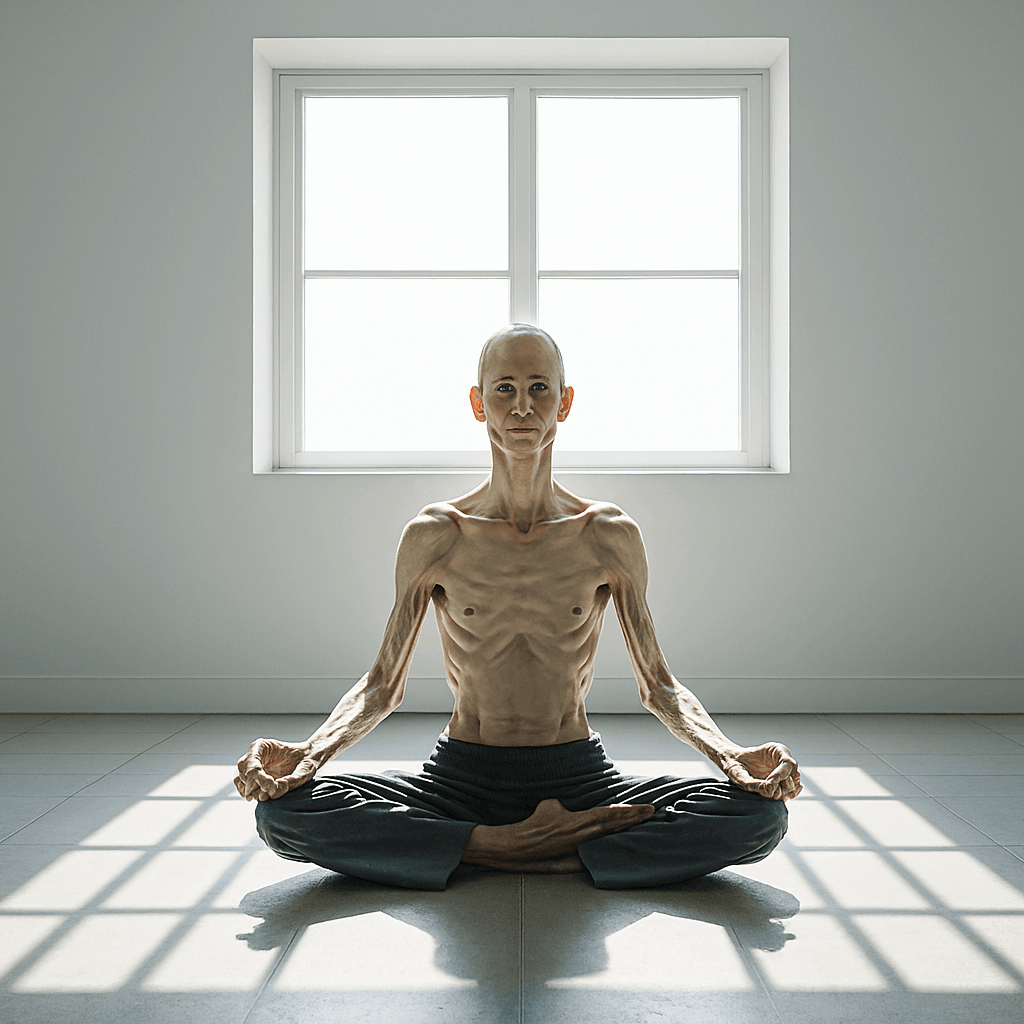
The statement hung in the air. I looked at the strange, unfamiliar fruit sitting on his table and tried to imagine it. A life without restaurants, without cooked food. My mind flashed back to an old man I’d met years ago in Ipoh, Malaysia. He too was a fruitarian, a man so painfully thin he was almost skeletal. But what I remembered most was the stark, unforgettable contrast between his emaciated frame and the burning, unwavering clarity in his eyes. He radiated the serene aura of a seasoned meditator, and he had told me the same thing: “Cooked food makes you tired. It takes all your energy to digest. When you only eat fruit, you feel alive.”
His eyes had told me he believed it with every fiber of his being. But even then, a quiet doubt had pricked at my mind: did the clarity come from the diet, or from the meditation? Was he making a false attribution? I never pursued the question back then.
Here I was again, faced with another fruit-eating meditator. The old question returned, but this time with a new, more urgent weight. Is this a health choice, or is it something more?
And for Ade, this wasn’t just a lifestyle choice; it was a cornerstone of his entire cosmology. He explained that the ideal human body is in a neutral state, its pH perfectly balanced. Digestion, however, creates acid. Therefore, to achieve neutrality, one must consume alkaline foods. All mainstream foods—rice, bread, meat, fish—are acidic, he stated. They make you tired. Alkaline foods, like fruit, give you energy, aligning your chakras.
Chakras. I recognized the word. It was another ancient, living-fossil of a narrative virus, much like the concepts of Yin and Yang. A radically simplified model of the world, simple to digest, easy to spread, and nearly impossible to disprove. This ancient virus, I was about to learn, had been given a powerful modern update.
Before I could even ask for his source, he gave me a name: Dr. Sebi, a controversial figure who championed alkaline diets. “He’s not a mainstream medical doctor,” Ade preemptively clarified. This diet, he continued, was a cure for everything, even AIDS. Dr. Sebi had saved countless lives with it. Ade wasn’t sick, but he wanted to be healthier.
My mind reeled. How could a man who used AI for research fall for a theory so easily debunked? “How did you first hear about this?” I asked.
“A guy I met,” he said.
And there it was. It wasn’t something he’d found through data; it came from a living, breathing person. A human testament, which always carries more weight than abstract information. Now, he had become another living testament, a link in the chain.
“Is the energy from just fruit enough?” I wondered aloud.
He smiled, as if I’d asked a wonderfully naive question. And then, a more astonishing theory. The energy we consume, he explained, isn’t just for us. It feeds the “parasites” inside our bodies. When we feel hungry, it’s not us; it’s the parasites demanding to be fed. By cleansing himself of these parasites, his own energy needs had plummeted. He now ate just one mango a day, he said, and it was perfectly sufficient, unless he had a particularly active day, in which case he might add a few bananas.
I fought to keep my expression neutral, to school my features into a mask of calm curiosity. For a moment, I looked at his thin arms, the hollows that were beginning to form around his eyes. There was no fanatic gleam—only a serene, unshakable peace. And that was what terrified me most.
A wave of empathy, sharp and painful, washed over me. What would his parents, his siblings, a child, think if they saw him like this? A man, their son, their brother, their father, living on a single piece of fruit a day, convinced that the food of his ancestors was poison. I thought of the room’s air conditioner, which he, the prime suspect, had set to a balmy 26°C the night before. Perhaps it was a body with no fuel left to fight the cold.
He spoke of purification, of cleansing the parasites from his body. And I couldn’t help but think of my own quest. I, too, was on a path of purification. But the parasites I sought to exterminate were not in my gut; they were in my mind—the unexamined beliefs, the logical fallacies, the narrative viruses of our time.
We were both purifiers, I realized then, just fighting on two completely different battlefields. He wanted to reach the neutral body; I wanted to reach the neutral mind.
“But what health benefits do you actually feel?” I asked, my voice betraying a hint of the urgency I felt. “How do you know you’re healthier?” This was the crux of it all. I leaned in, a part of me desperately hoping for a logical answer, another part terrified of the strange new concepts he might unleash.
“That’s a very good question,” he said slowly, and for a moment, I felt a flicker of hope, the thrill of a detective about to solve a case. The answer, however, was devastatingly simple. He knew through meditation. The clarity he could achieve in meditation after switching to the alkaline diet was on another level entirely. It was, he said, like his brain had a new, “supercharged engine”.
My heart sank. Not because his belief was wrong, but because it was irrefutable. It was a truth based entirely on a subjective feeling, a “supercharged engine” that no instrument could ever measure, that no argument could ever disprove. I understood then the nature of his fortress: no one could ever rescue him from this belief, because there was no way to demonstrate that the engine he felt so vividly did not, in fact, exist.
And as I tried to imagine this higher state of meditative clarity, he delivered the final, devastating piece of the puzzle.
“The entheogens I take,” he said, almost reverently, “they are alkaline. A very powerful neutralizer.”
The words fell like the final click of a complex lock. And in that instant, all the disparate, chaotic pieces of his worldview slammed together in my mind, forming a single, horrifyingly perfect picture. It was the last puzzle piece. The “alkaline” narrative virus, absorbed from the outside world, had seamlessly fused his spiritual journey with his physical one. The drugs that brought enlightenment were now also, conveniently, the agents of his bodily purification. It was a closed loop, a self-sustaining cosmology, a bomb that had just armed itself.
But it was more than that. It was the last puzzle piece for me. I finally understood that his grand journey was not a passive, mystical revelation. It was an active, ongoing construction. He was a curator, a scavenger of ideas, constantly absorbing narrative viruses from the world, testing them, and integrating the ones that fit, piece by piece, into his one-man religion. He wasn’t just a believer; he was an alchemist.
This was the true meaning of his “step by step” journey. It was a mad, modern alchemy, an attempt to build a bridge of code to the divine. And in that moment, the thought that formed in my mind was not a conclusion, but a far more terrifying question: What if this process, this endless absorption and integration of narrative viruses, was not building a self, but consuming it? What if the final product of this alchemy was not enlightenment, but a perfect, self-sustaining parasite of the mind?
I looked at Ade, at his thin frame and the burning, serene clarity in his eyes. He spoke of purification, of his body’s successful war against its inner demons. He was winning his battle. And what of my own? My quest to purify the mind, to exterminate the parasites of unexamined beliefs and logical fallacies, to build a world based on reason—where did that stand?
And then, like a lightning flash in a dark room, a phrase appeared in my mind. The most common, most powerful, most unassailable piece of advice of our age.
Follow your inner voice. Follow your instinct.
I looked at Ade, and I no longer saw a stranger or a curiosity. I saw the ghost of our generation. He was not an anomaly; he was a devout believer, the most faithful practitioner of our era’s most sacred mantra. He had done it. He had followed his inner voice more faithfully than anyone I had ever met, meditating before dawn each day just to hear it more clearly.
And it had led him here. To a state one step away from starvation, to a belief that his ultimate destiny lay in a distant, higher-dimensional realm, communing with the ghosts of his ancestors.
In that instant, my entire critique collapsed. On what grounds could I possibly challenge him? To question his journey would be to question the very gospel of our time. It would be to commit the ultimate heresy: to suggest that one’s inner voice might be wrong, that it might be a deceiver, that it might be the most dangerous parasite of all.
Could I imagine a reality where we tell people to distrust their inner voice? The thought was unthinkable. I, the relentless questioner, had finally met a belief system I had no tools to dismantle. I was defeated before the battle had even begun, disarmed by the most powerful weapon of all: an unshakeable, unprovable, and universally celebrated truth.
My purification project—my dream of a world where individuals achieve sovereignty through rigorous self-interrogation and rational dialogue—was revealed for what it was: a hopeless, one-man insurgency against an entire epoch. His path of purification was showing progress, validated by the “supercharged engine” in his mind. Mine, faced with the unthinking, unchallengeable titan of “instinct”, was a non-starter, a total failure.
I felt a profound sense of defeat, a loneliness that was deeper and colder than any I had felt before. My battle was not with him, but with the spirit of the age itself. And I had already lost.
Later, in the quiet of my own bunk, a final, futile act of reason. I opened DeepSeek, the very oracle Ade had praised, and typed in “alkaline diet”. The answer came instantly, a cold, clinical stream of scientific consensus: no evidence, a tightly regulated bodily pH, post-meal fatigue is normal. I looked at the screen, at the clean, logical text. It was the truth. And it was utterly, completely, powerless.
I knew this information would be useless to him. He had already built his defenses, a fortress of self-validating logic. He had even told me, with a hint of pride, that DeepSeek itself had praised him in their conversations: You are the only person I have ever met who has reached this level of thinking.
We both held the same tool in our hands, arguably the most powerful weapon of our age. He used it to select purer chemicals for his alchemy, to find confirmation for his beautiful visions, to build the architecture of his faith.
And I? I held this same immense power, and I could do nothing. I was a man with a rescue helicopter, watching a soul drown in a calm, sunlit sea, and he was waving back at me, smiling, convinced he was learning how to breathe underwater.
The prophets of our time speak of one-person, billion-dollar companies, empowered by this new technology. They were early. The one-person religion had arrived first, and it was already blooming everywhere.
I looked at Ade, a man who had successfully purified himself of everything—food, parasites, doubt, and perhaps, even the world itself. And I, the relentless questioner, the purifier of thoughts, was left with only one, impure question:
In an age that worships the inner voice, what happens when that voice leads you into a beautiful, sunlit, and inescapable void— and everyone else calls it enlightenment?
Sequel — How to Educate a God: Notes on a War of Enlightenment