An Autopsy of a Heartfelt Letter
2025-10-13
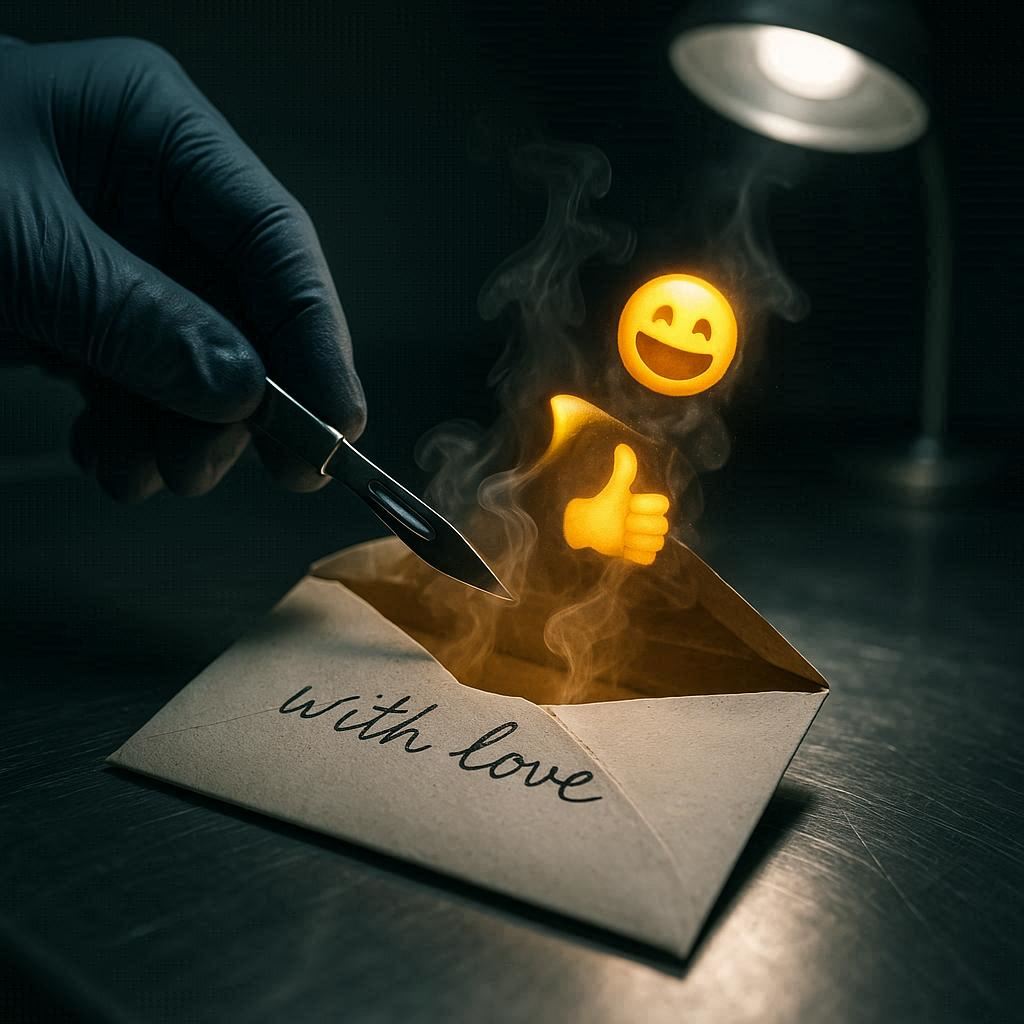
Yesterday a female shared a letter she received from a male pen pal. “It’s full of sincerity,” she said, “but I have absolutely no motivation to reply.”
I understood immediately why. The letter wasn’t an isolated case; it was a perfect specimen, a product of the structural logic of our times. It was a typical, earnest attempt at connection, the kind that floods our inboxes and social apps, written by someone who, after receiving no reply, would likely never know what they did wrong.
The letter began with a slightly awkward icebreaker about language, followed by a laugh-out-with-tear emoji. It then moved into the “connection attempt” phase. But what was it trying to connect? The author presented himself as a blank slate, a man with no sharp edges, no discernible substance, his own subjectivity almost completely erased. His sincerity was not in revealing himself, but in his eagerness to follow her lead. “That’s great!” he wrote about her verbosity, “I don’t want you to stop writing so soon!😆” The message was clear: You talk, I’ll listen.
His own opinions were fleeting, non-committal. On her stated dislike of AI, he offered a vague “I understand your aversion to AI, because there are people who use it directly to replace their replies…” and then he trailed off with an ellipsis, a void where a real thought should have been. Was he hiding an opinion for fear of disagreement, or did he simply not have one? In this age, it’s hard to tell. A thought unexamined is not a thought; it is a narrative virus, like the one my roommate Brian had been infected with.
The entire subtext of the letter was: I am interested in you, and I hope you will be interested in me. It was an attempt at a transaction, a negotiation of interest, based on a bizarre framework where two people, without revealing who they are—perhaps without even knowing who they are—try to form a connection. It was a plea for validation, an offer to trade compliance and agreeableness for the same in return.
And the emojis—three in just a few short paragraphs—felt less like genuine warmth and more like cosmetic enhancements, like rouge on a corpse. They were an attempt to paint emotion onto a surface where no soul resided.
This wasn’t a meeting of souls. It was a transaction, one that fit perfectly within the logic of capitalism: an attention trade, an exchange of interest. And in any transaction, the way to maximize the probability of success is to erase all points of friction, to abandon all sharp edges, to pursue conformity and abdicate selfhood.
And then, a chilling realization: he was not being a person; he was performing the role of one. A real person has tension, desire, contradictions, loneliness, prejudice—the beautiful and the ugly. What was presented here was a caricature, a hollow shell packaged in polite phrases and emojis, its subjectivity completely gone. And when the self is absent, what is there to be attracted to? What is there to connect with?
Even the letter’s only compliment felt hollow. “From your language learning, I can deeply feel your self-discipline and execution!” he wrote. What specific detail led him to this conclusion? He didn’t say. How did this feeling connect with his own experiences? He didn’t say. It was a generic, polite, and ultimately meaningless statement, designed not to convey genuine admiration, but to signal harmlessness. To represent anything real would be to have a preference, a standard, a filter. And to have a preference is to risk a failed transaction.
So, he chose to castrate his own tastes, to sand down his edges, to assassinate his own subjectivity. In the process, he murdered himself. He transformed from a subject into an unrecognizable object. He was no longer a person, but he was still pretending to be one. The logic of the transaction had stripped him of his humanity, and with it, his ability to form a real connection. The great irony is that if he had abandoned this strategy, if he had dared to reveal his true, flawed self, she might have actually replied.
And when the whole world has stopped being human, what then, is the point of being one? I think of the connections I’ve made on my travels, most of them too fleeting to even record. Even as I dissect this letter, even as I hold on to my own subjectivity in a world of self-castration, I know that to most people, I am already too much. A person with no edges cannot comprehend a person full of them. They see me as a different species, an entity to be observed, not engaged with. And so, even as I hold fast to myself, I am destined to be alone, in the hope that by being human, I might one day find another.