The Socratic Backpacker
2025-10-11
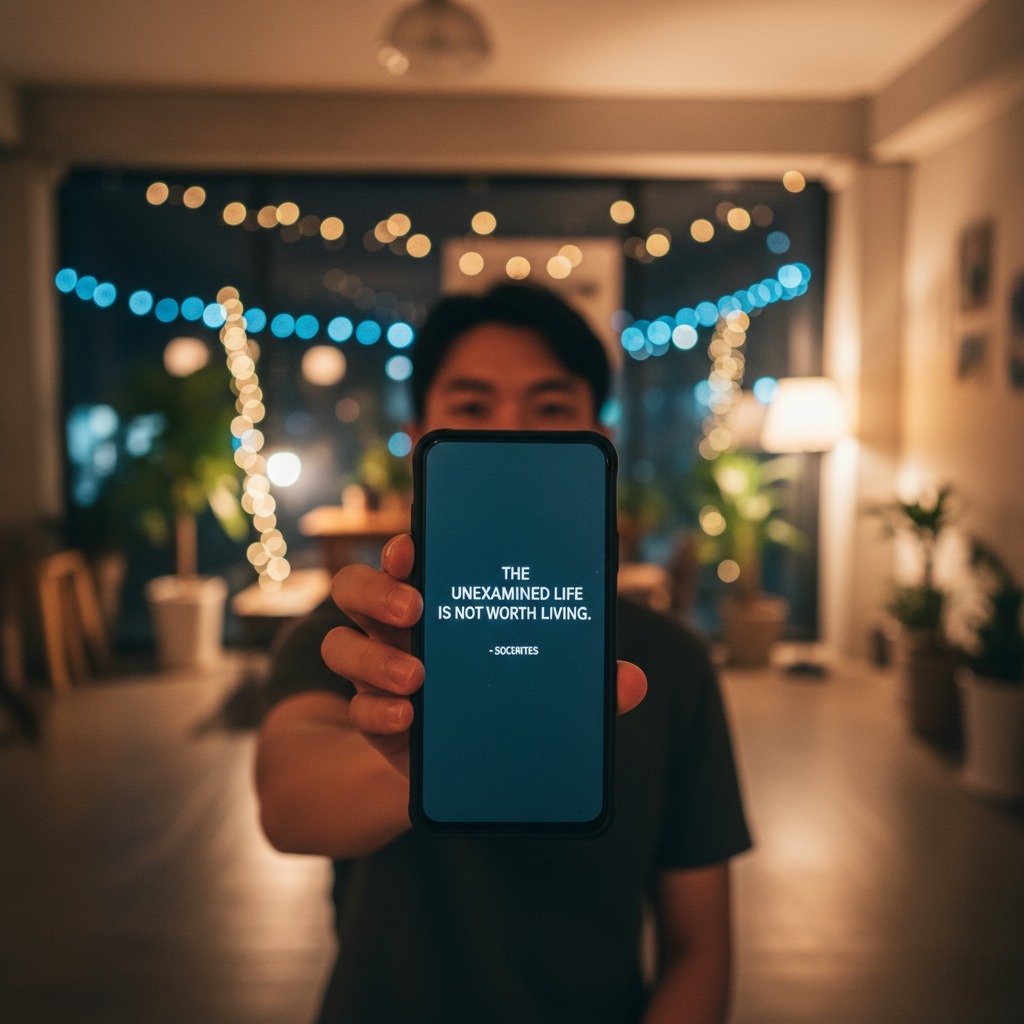
Last night, I was in the common area of a guesthouse in Ao Nang, Krabi, preparing an image for my last article, when a young East Asian man came over and said hello. He was my new roommate, he explained, just checked in two minutes ago. His name was Hao. He was from Singapore. He said our other roommate, Brian, had told him I was a long-term traveler.
There was something immediately different about him. His expressions were animated, his gestures expansive, his speech rapid. His mind seemed to be moving faster than his body could keep up. You got the distinct feeling that this was a person you could say anything to. The unspoken rules of social convention, the carefully curated topics for small talk, simply seemed to evaporate in his presence.
Our conversation began, as it always does, with travel. And for the first time, perhaps, I felt I could be completely honest about my own journey.
“For me, the marginal utility of exploring new places is diminishing,” I said, a statement that would sound pretentious to a more ‘normal’ person. “I’ve been to a lot of places.” He didn’t flinch. He just listened. My honesty had opened a door.
I explained that my journey was no longer about exploring the external world, but the internal one. I was trying to transform the vast, chaotic material in my head into written words, to make sense of the interesting phenomena I constantly witnessed. I told him about my experience unlocking a secret Thai-only menu simply by attempting to speak a single sentence in Thai. “In Hong Kong or Singapore, this kind of price discrimination would be unthinkable,” I explained. “Our business ethics wouldn’t allow it. But here, it’s a different culture, a different way of being. And to discover a new reality like that, it’s fascinating.”
As I spoke about my method—taking a step back, questioning the logic of everything—he held up his phone. On the screen was a quote. The unexamined life is not worth living. Socrates.
“He’s my favorite philosopher,” I said, a grin spreading across my face. We both burst into laughter, two strangers in a Thai guesthouse suddenly united by a 2,400-year-old Greek man. He moved to the chair beside me. The conversation had begun.
I used the story of the schoolgirl in the Chumphon library to illustrate my point. She hogged the only fan to scroll on her phone, I explained, when she could have gone to an air-conditioned 7-Eleven. Why? Because as a local schoolgirl, her presence there would be judged, while I, a foreigner, could sit there all day without issue.
He paused, then asked, his own mind clearly working at high speed, “But how can you be sure of her intention? You could be wrong about what others are thinking.”
“You’re absolutely right,” I conceded. He looked confused, as if I had contradicted myself. I explained that it wasn’t a philosophical proof, but an illustration. The point wasn’t the girl’s actual motive, but the social reality that such biases exist. The proof wasn’t in mind-reading, but in a kind of phenomenological reduction. I just had to ask myself: if I were the 7-Eleven clerk, would I, consciously or unconsciously, judge the loitering schoolgirl differently from the loitering foreigner? The answer, I knew, was yes. The bias exists within me, even when I know it’s irrational.
“There are three layers to the world,” I summarized. “First, the written rules. Second, the unwritten rules, like the two-menu system—a hidden reality you can only unlock if you know how. And the deepest layer is this social judgment, this invisible consensus where everyone is guessing what everyone else is thinking, a logic that is never spoken because it has no rational basis.”
“So what’s your response to all this?” he asked.
“I’m writing,” I said. “I’m writing it all down. And this conversation, right now, is part of it. If I can convince you that the world works this way, and that this way is wrong, then we have already changed the world, just a tiny bit.”
I took a breath and laid out my entire philosophy. My core belief that humans are rational beings, that right and wrong are determined by reason. That any one of us can be wrong. That the only path to truth is a framework that allows all of humanity to present their arguments, a system where the best reason wins, not the loudest voice or the biggest stick.
He listened with a kind of solemn reverence. “I agree,” he said.
“You’re the first person who has truly understood,” I said, a jolt of excitement running through me. I then explained the revolutionary deduction: if this simple principle is true, then the power of our current governments, corporations, and algorithms is illegitimate. They must all cede their authority to such a framework.
“It sounds a bit intangible,” he countered. “We have votes, we have money. Those are concrete. How does your system work?”
“It is,” I agreed. “But we now have the tools. Think of Wikipedia. Before the internet, the idea of a universal encyclopedia written by everyone, not a small group of experts, would have been pure fantasy. The internet provided the physical infrastructure for that idea to become real. My framework is the same. The internet is its physical foundation.” A look of genuine understanding dawned on his face.
“What’s your next big step?” he asked.
I explained that my ideas, as they were, could only reach people like him—those who were already inclined to think deeply. To start a revolution, I needed the masses. “I’m writing an epic,” I said, “a story that is also a blueprint. A sandbox simulation of how this new world could be built, packaged in a narrative that anyone can understand, a spark that can start a fire.”
“And the next small step?”
“A campaign,” I said. “To drive traffic to my website, to create social proof. To show that these ideas have momentum.” He nodded, immediately grasping the concept.
Our conversation then drifted, touching upon the nature of religion, lucid dreaming, the Monty Hall problem. He told me he was flying back to Singapore in ten hours. The most amazing thing about his trip, he said, was the improbable, repeated encounters with unique and interesting people.
“Perhaps,” I suggested, “it’s because you yourself are at that level of thinking. It allows you to meet similar people.”
He smiled, and added the final, perfect grace note. “Like attracts like.”