The Three Walls of Sandeep
2025-09-22
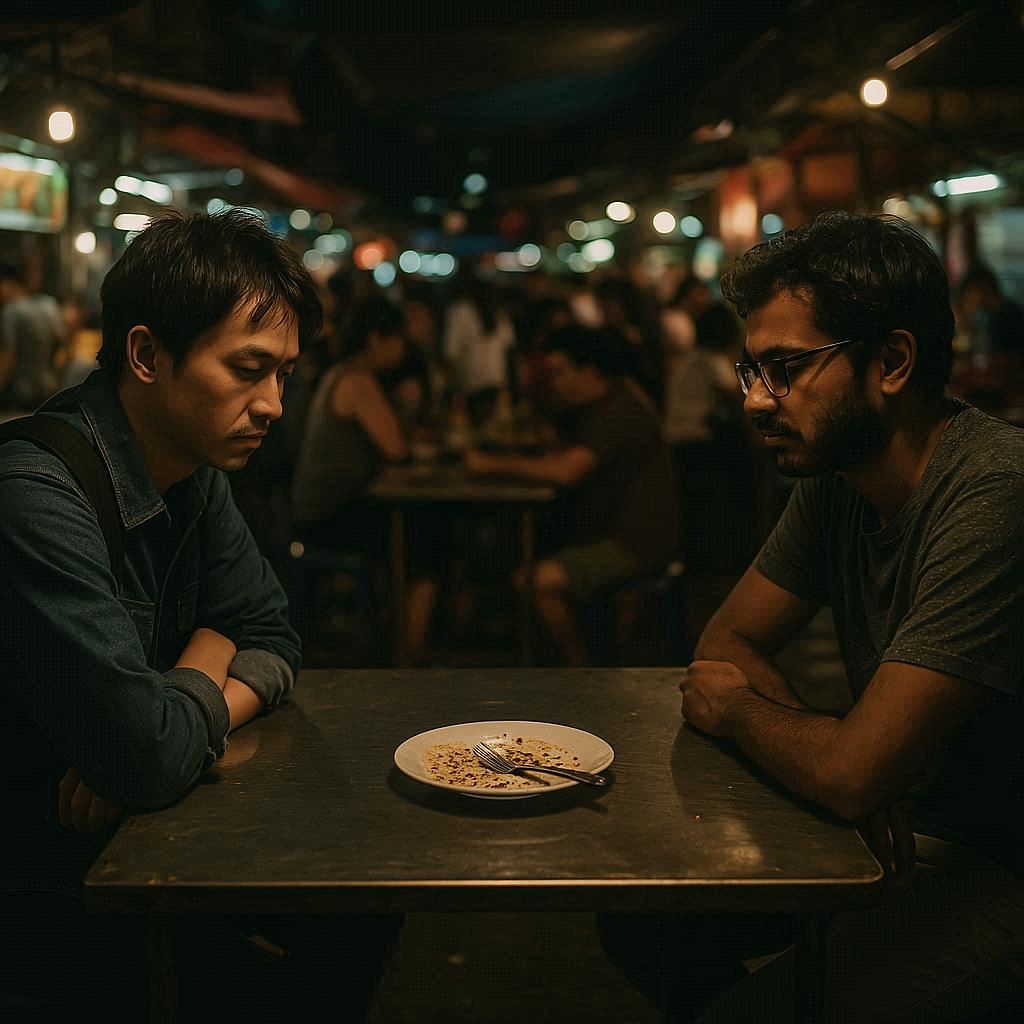
After a chaotic few days on Koh Pha Ngan, I returned to the relative calm of Surat Thani, checking back into the same guesthouse. As I walked up to the third floor, a familiar sight greeted me: in the bottom bunk to my right was the same Indian man I had seen before my island detour. I gave him a nod of recognition. This time, a connection was made.
His name was Sandeep, a programmer. As I settled in, he was sitting outside. He caught my eye. “Excuse me,” he said, and for a tense second, I wasn’t sure what to expect. “Where are you going?” I told him I was headed to the night market. “Can I come?” he asked. And just like that, we became travel companions for the evening.
Our first stop was a Chinese bubble tea chain. He was about to buy a drink when I mentioned its dubious reputation back in Hong Kong—rock-bottom ingredient costs revealed in their financial statements. He shrugged. “It’s worse in India,” he said, before buying his 40-baht milk tea anyway. Perhaps, I thought, every complaint is just a point on a relative scale of despair. I recommended the 7-Eleven’s award-winning self-serve Thai tea; he’d seen it but never tried it. He told me he mostly ate snacks at night and ordered Grab for lunch, despite having stayed here long enough to have tried almost every stall at the night market. He was, he admitted with a laugh, a big eater.
I ordered my seafood fried rice, and as I ate, our conversation deepened. He was a programmer, he said, and I casually replied, “Me too.” He had a stable job that had gone remote during the pandemic. Now, even with management pushing for a return to the office, no one was going back, not even his boss. This had granted him the freedom to travel.
But this freedom, I soon learned, was a fragile, conditional thing, bounded by invisible walls.
The first wall was made of paper and ink. He had only been to four countries, all in Southeast Asia. Why not further? “My Indian passport is too weak,” he explained, “maybe weaker than a Chinese one.” Traveling to developed countries meant a mountain of paperwork: bank statements, employment letters, endless proofs that he was not a threat. Thailand was one of the few places that welcomed him, granting a generous 60-day visa exemption.
I fell silent, thinking of my own passport, a relic of British Hong Kong that allows me to glide through most of the world’s borders. I was born on the right side of a historical anomaly, a winner of the uterine lottery. We were both travellers, but his freedom was a privilege granted, while mine was an assumption. The first wall between us had become visible.
Sensing his frustration, I tried to connect on a higher level, to find a common enemy. “We are not truly free,” I began, launching into my grand theory about the world’s power being concentrated in the hands of a few—governments, corporations, even algorithms. They make decisions in black boxes, I explained, without our consent or even our knowledge. The future, I proposed, could be different. We could have global self-governance, just as Wikipedia proved we don’t need a handful of experts to write an encyclopaedia for us. We could build systems based on reason, not power. He listened, lost in thought, but offered no reply.
As we walked back to the hostel, he asked about my programming work. I told him I used code to automate my investment system, which in turn funded my freedom. I don’t remember his exact response, probably just a polite compliment, but I remember what I felt: a pang of guilt. My earlier, easy “me too” now felt like a deception. We were both men who wrote code, but the chasm between us was immense.
And that’s when I saw the second wall. For him, code was a tool to earn a salary, a way to participate in the existing system to gain a fragile freedom. For me, code was a weapon to hack that very system, to create a more authentic, sovereign freedom. He wrote code as part of the machine; I wrote code to become the ghost in it. The silence between us grew heavy with this unspoken, perhaps even unspeakable, difference.
The next day, as I was checking out, we exchanged Telegram details. “It’s hard with Chinese people,” he remarked. “The apps they use are all blocked in India, and the apps I use are all blocked in China.”
There it was. A final reminder. The third wall. Even as we connected, we were being reminded of the digital partitions that divide the world.
Looking back, I don’t think my grand philosophical critique of the system resonated with him. And perhaps that’s for the best. The walls he faces are already so tall, so concrete. He has the freedom to move, but no freedom from the system. I have more freedom from the system, and yet I spend my time critiquing it. Our relative scales of despair are so different that true resonance might be impossible.
And yet, I also saw something else. The most formidable walls in the world are not made of code, or laws, or borders. They are built from fear, from compliance, from the sheer force of habit. And those are the walls that perhaps no traveller, no matter how free, can ever truly transcend.