The Cursed Comments of a Digital Ghost
2025-09-21
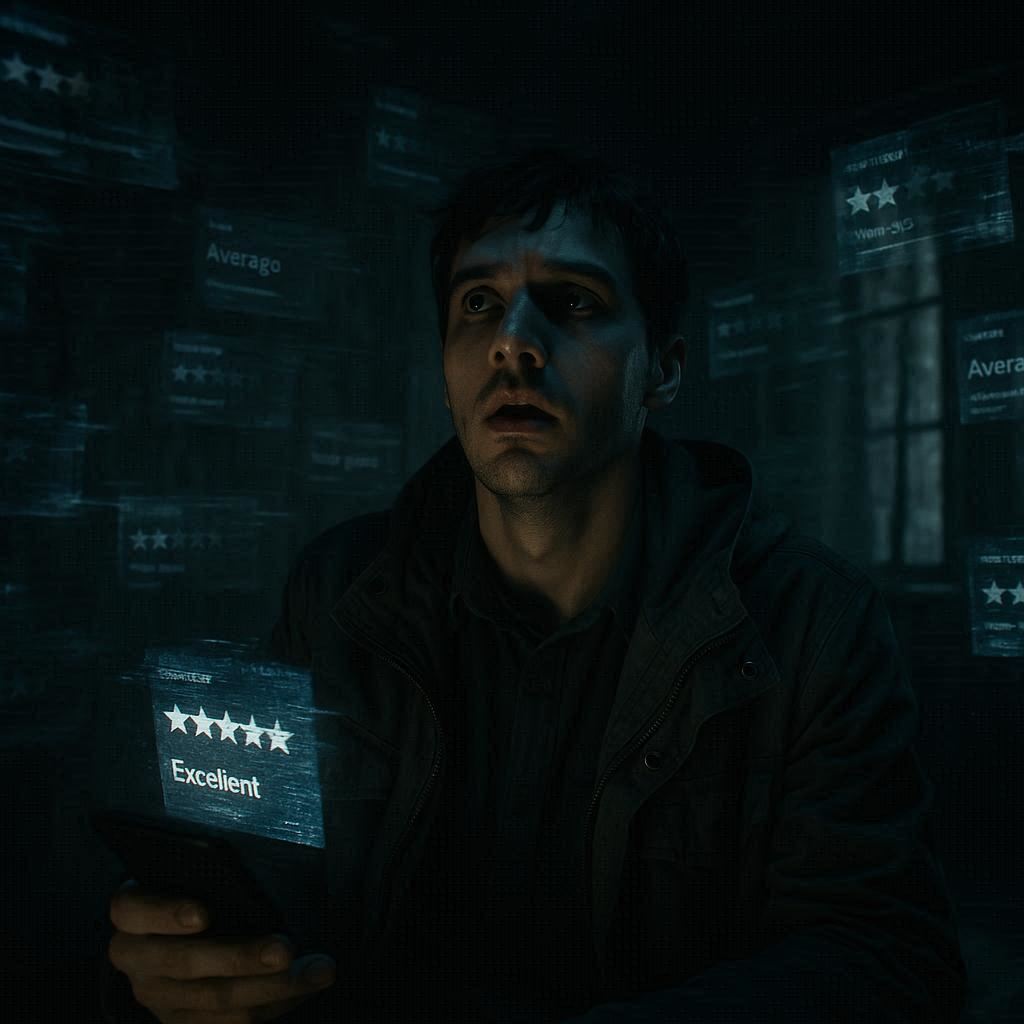
On my last night in Koh Pha Ngan, technology was my saviour. The island’s culinary landscape is a minefield of tourist-priced mediocrity, but the digital oracle of Google Maps, guided by the statistical wisdom of the crowd, led me to a 4.9-star gem hidden in a food court. It was a Ukrainian stall selling something called Chebureks, and their tagline, “criminally delicious,” was an understatement. It was a triumph of data, a testament to the power of technology to elevate our travel experiences. I went to bed that night with a full stomach and a deep sense of gratitude for the digital tools that empower the modern wanderer.
That gratitude, I would soon discover, was profoundly misplaced.
After buying my ferry ticket the next day, I had two hours to complete one final mission: find a truly great, hidden, local lunch spot to bid farewell to the island. My faith in the algorithm was absolute.
The search began under the oppressive midday sun. I selected my first target: “Southern Thai Food Restaurant,” its high rating backed by reviews as recent as a month ago. After a ten-minute, sweat-drenched walk, I found it. The gates were pulled shut, the life within extinguished. No signs, no clues, just a single, unblinking CCTV camera and a Ba Gua mirror warding off evil spirits that had apparently already won. I took a photo, marked the restaurant as “permanently closed” on the map—my small contribution to the digital commons, a warning flare for the next weary traveler.
My second choice was a six-minute walk away. It too was closed, though at least this one offered a minimalist’s note: “OPEN 25/09/68”. I dutifully updated the map again: “temporarily closed.”
My options were dwindling. The only other place within a five-minute radius was a 4.1-star joint I had passed earlier. A 4.1 is a gamble, a game of Russian roulette with your lunch. But drenched in sweat and out of alternatives, I took the plunge.
The restaurant was a strange pocket of warped reality. Several tables of locals were eating, but as I stepped inside, laden with my 10kg pack, I became invisible. No one greeted me, no one gestured to a table. I had entered a parallel dimension. I did a full lap of the dining area, searching for a menu. Nothing. I approached a glass counter displaying photos of food, a dark doorway behind it. Still nothing. The staff flew back and forth through this doorway, moving between the orderly dining room and what I could only describe as a black hole—a dim, chaotic, noisy space beyond.
I was a ghost, a glitch in their matrix. An employee emerged from the black hole, shouting at another staff member, who shouted back. I tried to interject, my voice a pathetic plea: “Do you have a menu?” The words dissolved into the entropy of the room, as if never spoken. The argument escalated, their voices rising in pitch and intensity. I wasn’t just being ignored; my very existence was being denied. With an empty stomach and a heavy heart, I retreated.
Back on the street, I realized the algorithm had failed me. Google Maps, even when you specify an area and filter by criteria, doesn’t show you everything. It shows you what it wants you to see. Is this a bug, or a feature of a system that prioritizes businesses with a registered online presence? Whatever the reason, I had to resort to a more primitive method: manually scanning the map, clicking on every single restaurant icon, and inspecting its data point by point. It was a task that required immense concentration, a costly expenditure of mental energy—the most precious and undervalued asset a human possesses.
Fourteen minutes later, I found it: another 4.9-star eatery. This time, it was open. I was served a plate of Pad kaphrao that was perfectly competent, impossible to complain about, but it wasn’t a hidden gem. It was just… acceptable. A statistically safe but soulless meal.
As I ate, I thought about how technology had both empowered and neutered me. I used to be a directionally-challenged teenager who needed a paper map to leave his own neighbourhood. Now, I can navigate the world. A travel partner once praised my ability to find the best, cheapest food in a city before I’d even arrived. Another partner once commented, “Without your phone, you are nothing.” Both were right. I had gained a superpower, but in the process, I had lost an instinct. The ability to just walk, to look, to feel my way to a good meal was gone.
The least I could do, I thought, was to continue contributing my own data to the system, to help the next traveler make a more informed choice. But even that had become a fraught exercise. For a while now, my long, detailed reviews hadn’t been getting much traction. I thought the advent of AI would help. I could dictate my thoughts, and the AI would translate them into a well-structured, eloquent review. The process was flawless. The reviews looked perfect on my screen. I even shared a link to one with a friend.
His reply sent a chill down my spine: “I can’t see your review.”
I opened an incognito browser tab and navigated to the same page. He was right. It wasn’t there. I checked my other AI-assisted reviews. The same issue. An astonishing, horrifying truth dawned on me: my contributions, my carefully crafted data points, had been ghosted. They existed only for me, in a digital parallel universe where I was a valued contributor. To the rest of the world, I was silent.
I soon discovered the common denominator: every review written with the help of an AI had been shadow-banned. It wasn’t the censorship that terrified me—that’s a debatable policy. It was the deception. The system hadn’t told me. It had built a personalized phantom reality for me, letting me believe my voice mattered, while ensuring it was never actually heard. I wondered how many hundreds, or thousands, of other users were shouting into the same silent, personalized void, completely unaware.
My faith in contributing to the great digital commons was shattered. And yet, here I was, utterly dependent on that very system, that flawed and biased collection of data, just to find a decent lunch. This is the prison of our age: to be trapped in a system you can no longer trust, but cannot afford to leave.