The Accountant's Holiday
2025-09-23
After my encounter with Sandeep, I journeyed north to Chumphon, a sleepy town untouched by the ravenous appetite of mass tourism. It was, I decided, the perfect place to spend my birthday. For years, my travels have been defined by a certain asceticism—staying in dorm rooms, seeking out the cheapest local food. It’s a small rebellion against the sterile, industrialized hospitality complex, a way to find stories and connections.
But for my birthday, I made an exception. I booked a private double room in a three-star hotel for three nights. It wasn’t about comfort for comfort’s sake. It was about solitude, a space to reflect. And I had a mission: for one day only, I was going to fire the accountant in my head.
This internal accountant is the great paradox of my financial freedom. Won through years of disciplined investing, my freedom is paradoxically guarded by a relentless inner voice that treats every expenditure as an investment, demanding a rigorous justification of its return. Today, he was on vacation. My only rule was to spend freely, to seek maximum satisfaction, as long as it wasn’t absurdly ridiculous.
The day began at an empty hotel. When I arrived the day before, the grand lobby was deserted, a note on the reception desk providing only a phone number. My Thai SIM, I discovered with a small miracle, could actually make calls. A man who lived next door soon appeared, flip-flops shuffling, to check me in. He led me to a flawless room with a small balcony overlooking a sea of trees at the edge of town. My grand experiment in luxury had begun.
I found a 5-star rated craft burger joint on the map. The owner greeted me warmly in Thai. I replied with my only Thai greeting, Sawasdee khrap, which was clearly the wrong response. “Sorry,” he laughed, “I thought you were Thai.” It was a rare and beautiful moment. In the tourist ghettos, they can spot a foreigner a mile away. Here, in the real Thailand, for one fleeting second before I opened my mouth, I was just another local.
He was curious about Hong Kong, a city of soaring towers and human tides. I told him a garden restaurant like his would be an impossibility there. “That’s probably why you’re here,” he mused, before lamenting the quiet boredom of country life. We found a common ground in the universal push-and-pull between the city and the countryside. I ordered a double bacon cheeseburger with french fries. It was magnificent, and criminally cheap at 175 baht.
My thirst led me to a Taiwanese bubble tea shop. No pearls, but I took it anyway. It was gone in a few gulps. I ended up where I always do, at a 7-Eleven, for their award-winning, perfectly proportioned 20-baht Thai tea. My stomach was full. My quest to spend money was already hitting a wall.
What next? The town had a single cinema. I found a Japanese film I wanted to see, but the ticketing machine displayed a puzzle. Today’s screening was in Thai; tomorrow’s was in Japanese with English subtitles. A smiling employee came to help. “Today, speak Thai?” I asked. “Tomorrow, speak Japanese, English subtitle?” She confirmed my understanding. But it felt wrong. Why the difference? “Why?” I asked.
In our age, “why” is the hardest question. She couldn’t answer, and scurried off to find help. After a three-minute wait, she returned only to politely ask for another moment. Three more minutes passed. The final verdict, delivered via a translation app on her phone, was two words: “System Error.”
We both laughed. Of course. The information was likely piped in from a Bangkok server, reflecting the capital’s cosmopolitan options, not the reality of a small town where no one needed English subtitles. My vast purchasing power was useless. I could have paid 1,000 baht for that 99-baht ticket, and it wouldn’t have changed the fact that the movie I wanted to see didn’t exist here.
My grand plan was failing spectacularly. For dinner, I threw caution to the wind and went to a 4.9-star local restaurant. The accountant was on leave, so I ordered a 150-baht plate of fried shrimp. It was delicious, but the portion was tiny. I ordered a seafood salad. It was not just spicy; it was a fiery assault on my senses. I had to ask for ice to press against my lips. I thought of the 65-baht three-egg congee I’d eaten last night—a masterpiece of street food perfection. Tonight’s 315-baht meal was self-inflicted torture.
I couldn’t blame the restaurant. It wasn’t bad; it just wasn’t for me. I had forgotten to ask for it “less spicy,” a question they would ask in a tourist area, but not here. My mistake.
I bought a large beer from a supermarket to quell the fire in my mouth—another expense the accountant would never approve of. And then, though my hotel was within walking distance, I hailed a Grab. The driver spoke no English. In my slightly buzzed, relaxed state, I gave him a rambling monologue about my life, knowing he didn’t understand a word.
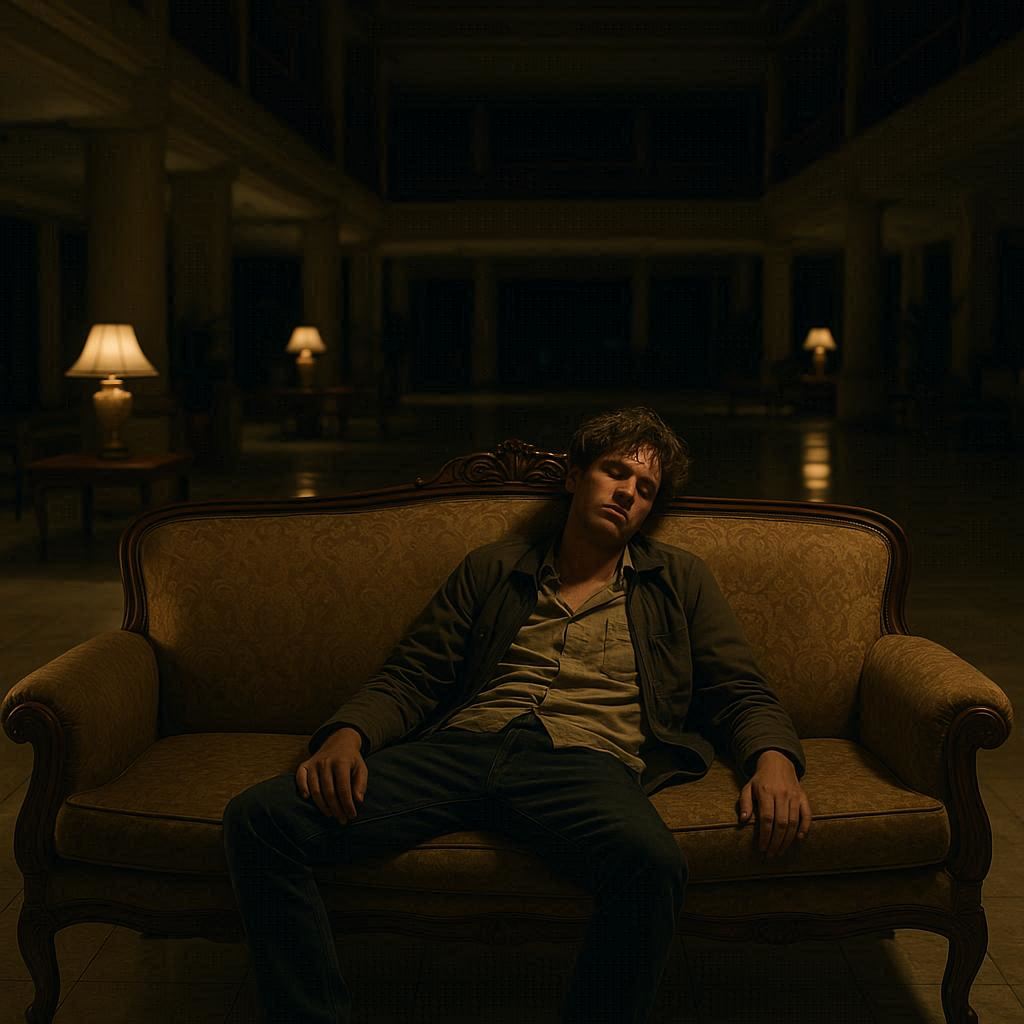
I returned to my hotel, a magnificent, 51-room establishment that could house a hundred souls, to find it completely empty. I was the sole guest, the king of a silent castle. I sat on the lobby sofa, a drunken, lonely monarch, admiring the strange, kissing-couple-shaped lamps. I had spent over a thousand baht, yet I couldn’t find a single person to talk to.
Tomorrow, the accountant would be back at his desk. He would surely laugh at my foolishness. I live in a world that preaches the gospel of free-market capitalism, a world that promises infinite choice. But in reality, I am constantly being deceived by price tags. My experience, interpreted by the ruthless logic of the accountant in my head, leads to one inescapable conclusion: expensive things are rarely good, and the best things are almost always cheap.
I had lost my faith in consumption. I didn’t know where to go next. And when I don’t know where to go, the accountant has a simple, foolproof rule: choose the cheapest.
My desire to spend was extinguished. I decided to return to the place with the cheapest dorm beds in all of Southern Thailand—back to Ao Nang, Krabi, the very place I had started with my friend. It wasn’t a defeat. It was a homecoming, a return from a chaotic experiment in freedom to a world of value that I understood.