The Ghosts of Connection
2025-09-21
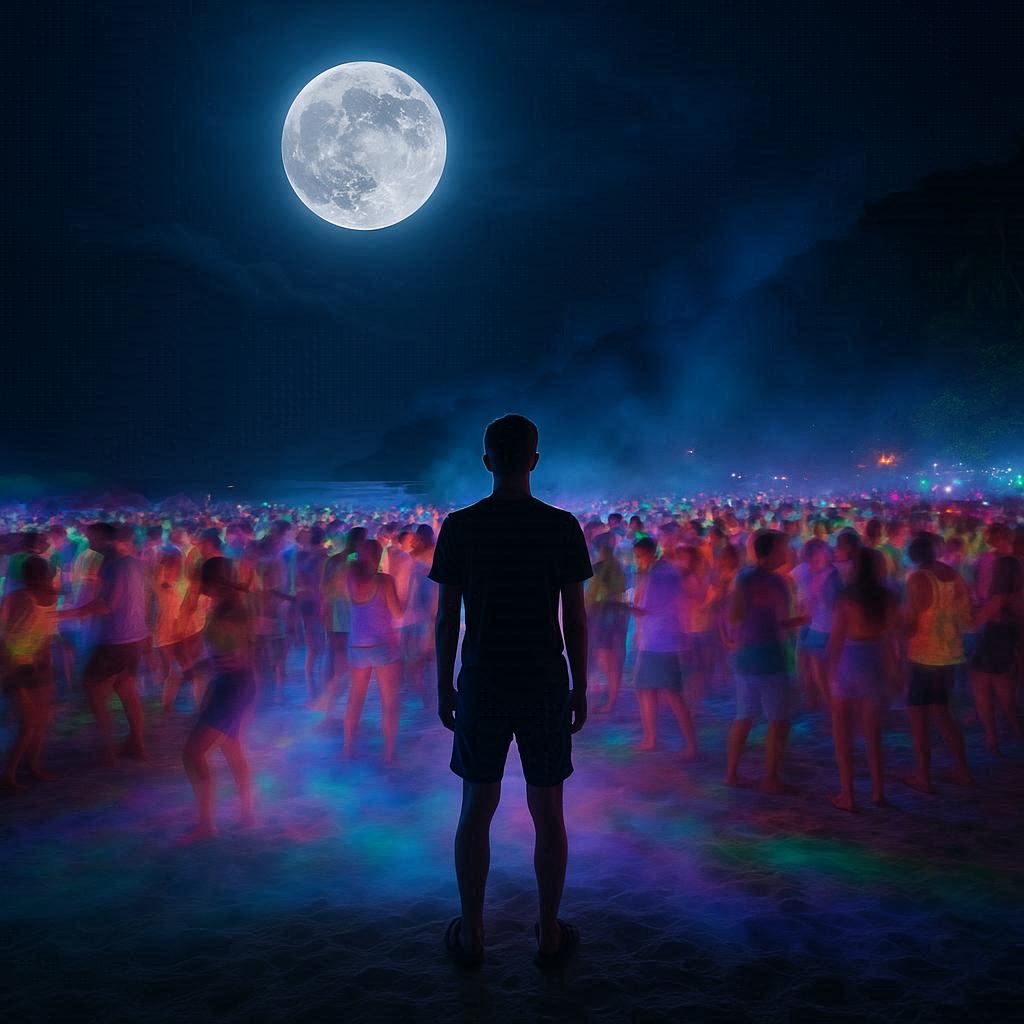
Some places are built on a promise. Koh Pha Ngan sells one: connection—nature, freedom, a thousand strangers dancing under a full moon. But promises are often powerful fictions we agree to live by. But I learned that promises are often just powerful fictions we all agree to believe in. And sometimes, the most profound connections are found in the silences between the noise.
My first night at the new hostel was a lesson in physical reality. The air conditioning unit, positioned directly above my bunk, waged a relentless war against the tropical heat, and I was the collateral damage. I spent the night in a state of shivering hibernation, waking periodically, cocooned in every thin, Uniqlo-style garment I owned. The next day, I requested a new bed, an upper bunk far from the arctic blast. As I moved my things, I asked the guy in the bunk next to me if he’d also found it cold. He was absorbed in his laptop, a digital nomad deep in his own world. “It’s warm now,” he mumbled, not looking up. “I mean last night,” I clarified. “Yeah, it was cold,” he conceded. I asked how he dealt with it. He finally took off his headphones and unleashed a sentence so fast and complex it shot straight past my English comprehension. I understood. The conversation was over. He had no need for my concern.
This island, I realized, was already making me miss the city. The streets were a monotonous parade of businesses that had nothing to do with me: tattoo parlors, barbershops, cannabis dispensaries, and overpriced massage parlors. Even the 7-Eleven, my usual sanctuary of standardized pricing, betrayed me. The self-serve Thai tea that cost 20 baht everywhere else in Thailand was 23 baht here. The local restaurants were scarce, lost in a sea of tourist traps.
Yet, amidst this commercial landscape, there was a strange and undeniable warmth—not from the locals, but from the foreigners. “Everyone is so nice here,” the volunteer at the reception had told me. She was right. In the hostel, strangers said “hi”. On the beach, a woman sunbathing met my gaze and offered a genuine smile. At night, as I sat on a rock by the sea, writing on my phone, a voice from the darkness behind me said, “Hi.” It was a woman, a shadowy figure I couldn’t make out. It was always the women who initiated this. The men were almost universally distant, like my bunkmate, lost in their own worlds.
I began to ponder the nature of this island “niceness”. The women’s “hi”, I deduced, was a social pass, an invitation offered within a framework of unspoken gender inequality. It was a permit for the man to open a conversation, placing the burden of creating a topic squarely on his shoulders. When I simply offered a polite “hi” in return and shouldered none of that responsibility, the interaction would instantly end. It was a game of social scripts, amplified by a context that screamed: beach equals party equals “connection”.
For two days, I ignored the script. I found my own connection on the deserted sands of Thong Sala beach. This was the main town’s beach, the most accessible stretch of nature on the island, yet it was almost always empty. It became my only sanctuary, my only reachable natural escape. The transport mafia held the keys to every other cove and viewpoint, and unless you rode a motorbike, you weren’t getting there without paying their ransom. Here was the island’s great paradox: a place famed for its natural beauty, where nature itself was largely inaccessible.
On my last night, I sat in the hostel’s common area. David, a guy I’d briefly spoken to on my first night, was sprawled on a cushion, scrolling through his phone. “Hey,” he said, his eyes not quite registering who I was. I asked if his video editing was going well. He paused, thinking. “Some of it,” he replied, the memory of our conversation seemingly lost in the digital ether. He had planned to check out today, but he was still here. Connections here were as extendable and forgettable as a booking.
As the night deepened, one of the volunteers dimmed the lights and put on some spiritual, ambient music. A small group of four or five people gathered on the cushions, their conversation drifting in fragments. I listened as they taught each other simple words in Portuguese and English, a fleeting moment of shared learning. They were happy.
The next morning, as I went to return my key, the water cooler was empty. The man who helped me with the bed change was in the middle of a yoga session with his volunteers—the source of the spiritual music, I presumed. He immediately sprang up from his mat to help me. I complimented him on the hostel’s atmosphere, how it brought people together. “Yes,” he agreed. “From time to time, people just keep extending their stay.” He asked if I was leaving. I said yes. He asked if I’d bought my ferry ticket, and when I told him I’d buy it at the pier, he nodded. “Good,” he said. “Only need to book for Full Moon.”
His concern was genuine. It was, I realized, the secret ingredient. The hostel worked not because of the party packages, but because of him. He created a safe, welcoming space where all these fleeting, superficial connections could happen without friction. He tended to his garden of ghosts.
The Full Moon Party, they say, is one of the world’s great raves. But like money, or nations, or corporations, it’s a fiction that only becomes real when enough people agree to believe in it. It’s a powerful tool for mobilizing human action. I didn’t participate. And as I left the island, walking towards the pier with my 200-baht deposit back in my pocket, I felt no regret at all. I had come seeking connection and realized something far more interesting: a thousand beautiful, lonely phantoms, all dancing together in the dark.