Notes on 8 Rules of Love

8 Rules of Love: How to Find It, Keep It, and Let It Go by Jay Shetty
Original notes here.
Read until the end to get a bonus. Enjoy reading.
“What is the difference between love and liking?” “If you like a flower, you will pick it; if you love it, you will water it every day.”
Love is an effort made day after day. This book aims to help you consciously build loving relationships, face all kinds of challenges and imperfections along the journey of love, and create a kind of love that can grow, expand, and transform every day, rather than treating a successful match as the end of the story.
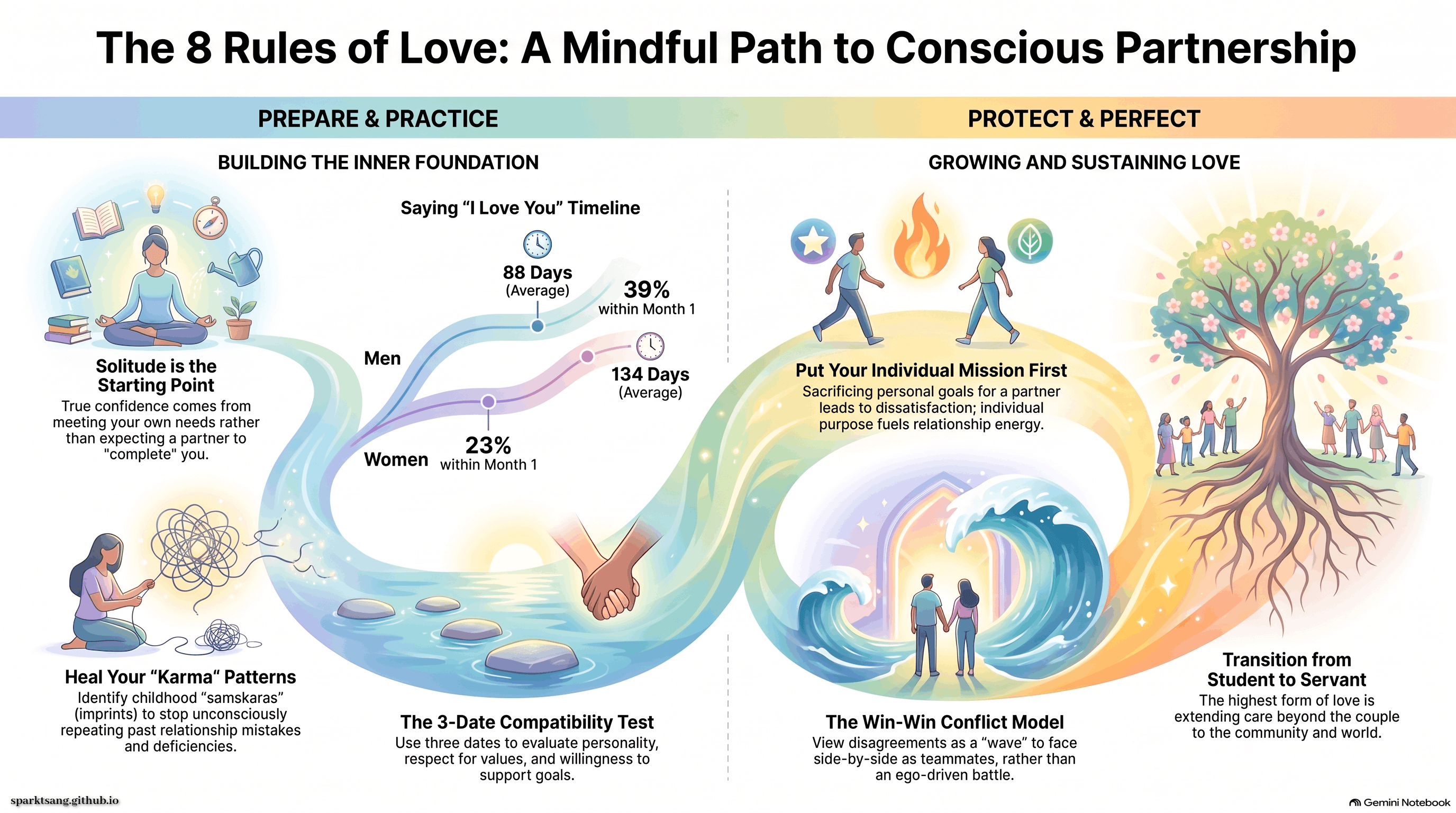
Drawing on the four stages of life described in the Vedas, there are four ashramas for learning the rules of love: Prepare (loving yourself), Practice (loving others), Protect, and Perfect. The book’s eight rules are distributed across these four stages (2, 3, 2, 1), progressing step by step, with each one building on the previous one.
Rule One: Enjoy Your Own Company / Solitude
Research has found that people are more likely to compromise themselves when they are lonely, because fear of loneliness interferes with emotional judgment.
Whether you enter into or maintain a relationship out of insecurity and urgency, or out of fulfillment and joy, leads to very different mindsets.
To improve your experience of solitude: first, examine how you spend time alone—what you do, how you feel, and why; second, choose an activity you have never, or rarely, done alone, and observe your thoughts, including how long it takes before you feel comfortable, whether you are now able to enjoy your own company, and whether you still wish someone were there with you.
Think about how to become more comfortable with solitude: bring a book when eating alone, write a review after seeing a movie by yourself, or treat a solo hike as a treasure hunt or photography outing.
Solitude is the starting point of love. Research has found that when people visit an art museum without talking, they have stronger emotional responses to works of art. Research also shows that children who cannot tolerate being alone struggle to develop creative skills.
The three stages from loneliness to enjoying your own company are: being with yourself, discomfort, and confidence.
Being with yourself
Being comfortable with yourself and having self-awareness means we can overcome weaknesses and make use of our strengths. Start by understanding your own values:
Time: love posting online / love being present; want to see the world / just want to relax; love cooking on dates / love going out; browse around / pick a show; punctual / casual; plan everything / dislike planning
Lifestyle: disciplined / disorganized; active / quiet; health-first / food-first; sleep in / rise early
Money: save / spend; extravagant / frugal; simple / refined; splurge / cautious
Relationships: a crowd / one person; see family often / rarely; talk about everything / get straight to the point
Discomfort
Give yourself small challenges, and use your time alone until it becomes habitual.
Learn a skill that takes weeks or longer to master; travel alone and observe your mood, luggage, itinerary, planning, and habits; do something you have never done before.
Understanding yourself and knowing what you like makes solitude more comfortable.
Confidence
Based on appreciating your own abilities and qualities, confidence means trusting your own feelings.
There are always two choices: change your mindset, or change what you do not like.
The goal is growth, not achievement.
Identify where you most need to grow in five areas: personality, emotions, physical well-being, relationships, and money. Look at yourself from all 360 degrees and ask whether you are satisfied with your current state or want to change it.
For the area that needs the most improvement, use a three-step growth plan: self-study, persistence (action-oriented—for example, “I will continue striving for growth financially” rather than setting “make one million” as the goal), and group support (find a group whose members are going through the same process of change so you can encourage one another).
With confidence in yourself, even when a relationship hits trouble, it does not diminish you, because you do not use the success or failure of your love life as a measure of your self-worth.
The rewards of solitude:
Independent thinking: developing the ability not to be swayed by other people’s opinions, and learning to see and understand yourself through your own eyes
Self-control and patience: mutually reinforcing; without them, we are easily led around by our senses. Solitude gives us the space between being “attracted” and “reacting.”
A complete self: you do not need a partner to make you whole or treat them as a magic cure. Before expecting others to meet your needs, it is better to practice meeting them yourself in solitude. A relationship with another person will not heal your relationship with yourself. Looking for a partner to solve your problems is like finding someone to write your final paper for you.
Rule Two: See Your Karma Clearly / Self-Reflection
Every action has consequences, and every choice determines what we encounter in the future.
From childhood onward, we absorb various imprints, samskaras. As we grow older, we can reexamine, adjust, and change them.
The counterforce of samskaras: a first spouse may have been extremely career-driven but was never around, so you choose a second spouse who is extremely attentive but possessive. This is the lesson of the counterforce.
The way we love others echoes the way we were loved. By tracing the pattern of our samskaras, we can understand the source of cause and effect, or perhaps use wisdom to create new samskaras.
When we focus entirely on what we do not want, we forget to think about what we do want. We should learn from experience to make decisions, rather than being unconsciously led by the past.
Exercise: Visit your younger self
Find your thirteen- or fourteen-year-old self. Identify the desires you could not resolve or fulfill at the time, then give that younger self the words, wisdom, and embrace they needed, and let them respond.
This exercise can help us recognize the gifts and deprivations that have followed us since childhood. (We tend to look for partners to give us the gifts we received as children and fill the deficiencies left by our parents while we were growing up.) It can even uncover deeply buried trauma.
Exercise: Understand the gifts and deprivations inherited from your parents
The forms of love we receive while growing up leave imprints, and it takes time to become conscious of the different forms they take. If our parents constantly argued, or were highly defensive, we may reproduce those patterns; or we may emerge from a dark environment and become good at mediating. We may have a terrible father and repeatedly end up with terrible men, or become aware of the pattern and choose good men instead.
Write down three of your happiest childhood memories and three of your unhappiest. Recall a difficult moment from childhood: did your parents help, and how? What impact did the event have? What did your parents expect of you? Did that create motivation or pressure? Did it affect your relationship with them, and how did it affect your life? In the way your parents modeled relationships for you, what did you like and dislike? What kind of love and support do you wish your parents had given you? What do you think you lacked?
Once you become aware of the gifts and deprivations you bring into a relationship, you can work on the associated samskaras:
First, awareness: when and where does the imprint cause an inappropriate response?
Second, self-reminders: remember the kind of person you want and do not want to become; think of a way to stop the thought in time and avoid acting in ways you do not want; what challenges are you facing? Are you expecting support from a partner who does not actually support you? Do you get jealous when you see your partner interacting passionately with someone else? Are there particular behaviors that trigger your anger?
Third, repetition: turn the self-reminder into a personal maxim and repeat it from time to time, such as “Love is not something to feel guilty about” or “Anger is of no use,” so that the words arise automatically when needed.
Fourth, reduce: when your reactions become less intense and your expectations less demanding, let your partner notice the change.
Fifth, remove: over time, break the habits built around those expectations.
Exercise: Break free from media manipulation
The media, including movies and music, has been feeding us romanticized ideas about love since childhood. This led the author to use an extravagant horse-drawn carriage when proposing, without knowing that the woman involved was sensitive to horses. He now also knows how jewelry merchants have gone to extraordinary lengths to tell men how much they should spend on engagement rings.
Think back to the first movie or love song that shaped or changed the way you saw love. What kind of love did it present? Did you believe love was really like that? Did your past relationships live up to the picture it portrayed?
Five types of attraction
The rebel: always expecting adventure and unpredictability to turn into loyalty and responsibility. You should learn the lesson.
The unattainable: constantly comforting yourself that they will eventually stop and turn their attention to you. Once you fall into this chase, it is no longer about getting to know, evaluating, and growing with each other; it is about wasting your affection.
The rescue case: you find their sense of competence and importance attractive, or they happen to fit your natural tendency to take care of people. But in the long run, you will become exhausted because you are giving far more than the other person.
The sexual: sex interferes with judgment. Oxytocin is the culprit: it helps spark attraction and trust and accelerates emotional bonding. Hormones can temporarily block the influence of negative memories, so an argument before sex can seem to disappear afterward.
The Opulent (conditional): The Bhagavad Gita speaks of six opulences: knowledge, fame, wealth, beauty, power, and renunciation. Such an aura can be enough to make people fall in love, but it does not necessarily reveal what someone is actually like. Under the bias of charisma, we are easily left with a distorted impression. The qualities we seek in a partner become merely a temporary checklist. The Bhagavad Gita says that divine love means knowing their greatness while being drawn to their loveliness. Only by spending time with someone can we discover what is lovable about them.
Exercise: Reflect on past relationships and learn the lessons
If you fail to learn the lessons of past relationships, you will only repeat the same mistakes.
What kind of energy were you in when you chose to be with an ex? Ignorance / Tamas (boredom, loneliness, depression, pain, and stress); Passion / Rajas (wanting to obtain certain conditions; a good outcome requires both people to have a deeper understanding and respect for each other); Goodness / Sattva (feeling that the two of you were emotionally connected and compatible, that you respected each other, and that even after the relationship ended, you still retained respect).
Why did it end? Be as honest as possible.
Learn the lesson: Next time, would you do things differently? Can you enter your next relationship from a place of goodness? Can you put conditions aside and focus on observing the qualities that truly matter?
Using conditions to attract someone means being bound by karma as well: if you attract someone through wealth, you must be prepared to do whatever it takes to remain wealthy; if you attract someone through appearance, then you effectively have to stay ageless; if you attract someone through status, you will be replaced by someone with higher status; if you attract someone through intelligence, you may discover that the two of you are emotionally distant. If you attract someone through sex, it becomes very difficult to maintain the relationship once the passion fades.
Fifty-three percent of dating-profile bios are lies. People either have to keep maintaining the image they present, or eventually have their true selves exposed.
Show your real personality, values, and goals, and people will love us for the values we ourselves consider important.
Exercise: Reflect on the image you present
List the things you like about yourself, such as being kind, caring, hardworking, honest, creative, or grateful. Try not to think in terms of conditions.
Recall each important relationship and list the qualities you believe the other person saw and appreciated in you.
When our partner loves us for exactly the qualities in us that we ourselves love, that is the kind of relationship we want to build.
Exercise: Give to yourself
We expect our partners to fill the emotional deprivation of childhood, but healing is our own responsibility. Give yourself what you want.
“I never felt validated by my parents”: If you want validation, what do you want others to validate about you? What can you do each day to validate yourself?
“I never felt special to my parents”: If you want others to see you as special, what would you want them to see as special about you? What can you do each day to make yourself feel special?
“My parents never respected my feelings or opinions”: If you want to be respected, what do you want others to respect about you? What can you do each day to respect yourself?
Take three minutes at the beginning and end of each day to fill the deprivation: in the morning, spend three minutes choosing one thing you can do to improve the day; in the final three minutes, think about how that action felt and whether it helped, and whether you want to try it again tomorrow.
Exercise: Write yourself a love letter
This helps open a dialogue with yourself, understand your thoughts and feelings, make good decisions, and take the next step in life.
Exercise: Meditation
The focus is on loving yourself and appreciating yourself, nourishing the soil in which love grows.
Place your attention on different parts of the body in turn and appreciate their contribution.
Rule Three: Define Love
Men say “I love you” after an average of 88 days, women after an average of 134 days. Among those who say it within the first month, 39% are men and 23% are women. Different people may mean very different things when they say they are in love.
The four stages of love:
First, attraction
The three drives of love: lust, attraction, and attachment.
Compared with small talk, meaningful deep conversations produce greater happiness. This includes opening up and exposing vulnerability.
Based on the author’s experience counseling others, three dates are enough to determine whether two people are compatible. They do not have to be the first three dates, nor do they have to be consecutive. In sequence, determine whether you like the other person’s personality, respect their values, and are willing to support the goals they pursue.
First date: light questions about tastes and interests: what they love doing, places they love going, books and movies, what occupies their mind, what they want to learn more about, favorite food.
Second date: values and principles, so that both people can understand what the other values, what they find interesting, and how they face challenges and make decisions: Who is the most interesting person you have met? What is the craziest thing you have done? What crazy thing would you like to do? What has been the biggest turning point in your life? If you won the lottery, how would you spend the money? What is the most spontaneous thing you have ever done? Have you ever encountered a particularly difficult challenge? What are you most proud of? If you had enough money that you never had to work again, what would you do?
If the other person hesitates, you can say that you know it is a difficult question and answer it yourself first.
Ask without creating pressure. Do not start by asking about their most painful experience or deepest, darkest secret.
Third date: thoughts about the future and the meaning of life: dreams you hope to fulfill someday, career goals, travel plans, personal achievements, what you would change about your life, people you would like to meet, things that have changed your life, and who your mentors and closest advisers are.
Second, dreams
Build a solid relationship through realistic expectations. Do not assume that your partner wants the same standard of living, friendships, family structure, or attitude toward money as you do. Even the rhythm and pattern of communication need to be discussed. You do not need to guess when they will call, why they are ignoring you, or whether there is someone else.
Set an appropriate frequency for seeing each other. Do not move too quickly or too slowly.
Third, struggle and growth
Two people each have their own beliefs, values, expectations, and dreams, so the relationship cannot possibly always be smooth.
There are three paths: pretend not to hear and make no changes; realize that the other person is not suitable and leave the relationship; or realize that the two of you can solve problems and grow together.
Fourth, trust
Trust is built gradually through behavior, thoughts, and words. It begins with yourself: you must be trustworthy yourself, which means aligning your words and actions, expressing your true thoughts, putting them into practice, and honoring the promises you make to yourself.
It should be considered on three levels:
Physical: the sense of safety and care they provide when they are around; trusting that they are there both physically and emotionally.
Mental: being able to trust their thinking, judgment, and deliberation; trusting that they know what to do.
Emotional: trusting their character and conduct, whether they treat you well and support you, and whether you believe their behavior toward you will remain the same in front of others.
If the other person makes a mistake and challenges your trust, be honest about your concerns and give them an opportunity to repair the damage.
Just as we should show appreciation for their daily efforts, we should make trust and empathy visible in our actions.
Exercise: Build your dreams with your feet on the ground
Once a month, spend an hour identifying what about your partner you are grateful for and what challenges need improvement.
Rule Four: Treat Your Partner as Your Teacher
When the author was a monk, the first thing his teacher did when he saw him was kneel before him, paying respect to the soul within him. They respected and honored one another.
What a guru gives a disciple is nonjudgmental guidance, selfless wisdom, and love without expectations.
A partner should be someone you want to learn with, learn from, and learn through—and the same should be true in reverse. Learning through someone is the hardest of the three.
When the author’s career breakthrough came, his wife was not particularly excited. From this, he realized that she loved him for his intrinsic value.
Self-expansion theory: our partners expand our sense of self, bringing us things we did not possess before.
If you think your partner should do whatever you ask whenever you ask them to do it, that is not a partnership but a subordinate relationship. Love is not obedience or exchange; love is overcoming challenges together.
Exercise: Assess whether the two of you can learn from each other and grow together
-
Is he interested in knowing himself? If he has no interest in learning about himself, he may also have little interest in learning about you.
There are three answers to each question: always, sometimes, never. -
Does he understand his own emotions? Is he good at understanding and expressing them? Do you only discuss everyday trivia, or do you share your genuine inner feelings? When telling a story, does he talk about how he felt?
-
Does he try to understand? Is he curious about you? Self-awareness can make a person curious about others, though it does not necessarily do so. Has he used self-awareness techniques to learn more about you?
-
Can he enjoy his own company? It is easier to learn from someone who knows how to enjoy being alone.
-
Is he willing to seek new solutions with an open mind? When something happens, does he consult you or his friends?
-
Does he support other people’s growth? Does he make an effort to support the people around him? Is helping others part of his life?
-
Does he inspire you to become better? A partner can stimulate your drive to improve, not because you need to prove yourself, but because they believe in your abilities.
The answers to these assessments do not determine the success or failure of a relationship, but “never” and “sometimes” indicate areas that require work.
Becoming a better teacher:
See yourself as a servant rather than a leader: if something would help the student, do not hesitate to lower yourself.
Lead by example: a counterexample would be a man who buys a luxury car while complaining that his wife buys too many shoes.
Support the other person’s goals: a teacher should support the student in following their own path, helping them become the person they want to become and the best version of themselves they envision.
Guide them to learn in their own way: not everyone likes to read books; some prefer listening to programs or watching videos.
Do not criticize or judge: research indicates that negative feedback is one of the most common triggers for falling into a fixed mindset. Instead of saying, “You wrinkle the clothes every time you do the laundry,” try saying, “Thank you for helping. In my experience, clothes get wrinkled if they sit in the dryer too long, so I usually wait until I have finished what I am doing before turning it on. You could try that too. What do you think, or do you have a better idea?”
Stay open, curious, and humble: adopt the mindset of a beginner.
Listen carefully and understand properly: most people listen not with the intention of understanding but with the intention of replying. Rather than immediately responding with your own feelings, you could first say, “It sounds like you are very unhappy. Why do you feel that way?”
Appreciation: it can create a positive feedback loop.
A teacher may have ten points while the student has only one. But if the teacher has only one point, the student needs ten points to learn anything from them. Be the kind of student whose own behavior and qualities bring out the best in the teacher.
Exercise: Help your partner find their goals
Ask your partner three questions: What really matters to you right now? What do you need to do to achieve this goal? Is there anything I can do to help?
Rule Five: Put Your Mission First
One of the author’s clients put herself first. She explained that she did so because she wanted to give her husband and family the best version of herself.
To show up as your best self in a relationship, everyone must pursue their mission or inner calling.
The key is not the activity itself, but why you do it. It is not an accidental interest but the place where your passion lies; it defines who you are.
The Vedas describe four basic pursuits (Purusharthas) that drive life forward: Dharma (Purpose), Artha (Wealth), Kama (Desire/Love), and Moksha (Liberation, transcending the worldly and cultivating the spirit).
With a mission, you know how to use your time, money, and energy, and it gives money meaning.
Without a mission, a person seeks only personal pleasure and will not be considerate or empathetic toward others.
With a mission, we can clarify our values and priorities to one another. We know how to spend the money we earn. When we fall in love, we carry a desire to co-create a meaningful life together. Ultimately, these three pursuits lead to liberation.
The impact of mission on well-being has been supported by research. People with a weak sense of mission see their confidence rise and fall with external approval. A mission insulates us from external influence and reinforces confidence: it allows us to live a life that is lively, passionate, inspiring, and full of energy, a life we want to share with others.
Sacrificing your own goals for your partner is not love. Each person must put their own mission first. If you want to offer real love and the best version of yourself, you must become the best version of yourself.
The root of dissatisfaction in many relationships is simply that one or even both partners have no mission.
A mission is the intersection of passion and strengths. Ask yourself the following questions to uncover your passion: If money were no object, what would you want to do? What hobbies did you love as a child but no longer pursue? What talents do other people not know about? Whose job looks like a dream job? If you were not limited by location or lifestyle, what would you do now? What were you once very good at that you now deeply miss? What talents or skills have you recently been unable to pursue?
Based on the roles you play at home or at work, identify your strengths.
The five stages of finding your mission:
Learning: take classes and read books in areas where your passion and strengths intersect; find relevant groups; set aside weekends to experiment; seek advice from experienced people in the field, ask questions, and organize your key takeaways; organize your free time (your partner can participate, as long as they respect the way you allocate your time).
Experimenting: put it into practice and see whether it works.
Development: establish routines and set measurable goals.
Struggle: it will inevitably appear; use it to learn and grow.
Victory: time in the spotlight accounts for only 0.01%; remember that it is merely a by-product.
Through all five stages above, help the other person put their mission first.
Exercise: Set goals together
What goals do you each want to achieve? What do you want from your partner? How can you help the other person achieve their goals? Do you need emotional support, or help sharing responsibilities? Do you believe in your partner’s goals?
When goals conflict, there are four options:
Temporarily put the goal aside and prioritize making money and spending time with family: for people with financial burdens, this is a healthy starting point.
Prioritize one person’s goal: different people have different timelines for their goals. When one person’s goal requires a large immediate investment of time and energy, or the other person’s goal is not yet clear, this option may work. But remember that even if one person is more successful, their goal is not more important than the other’s.
Take turns prioritizing each person’s goal: when neither person wants to sacrifice their own goal, but there is not enough time or money to accommodate both, this may be the best option.
Both pursue their own goals wholeheartedly: suitable when both people have already accumulated a certain amount of experience and achievement.
Rule Six: Either We Both Win or We Both Lose
Both partners should argue. Arguing more can prevent things from spiraling out of control. The surface appearance of harmony created by hiding feelings often comes at the cost of honesty and understanding.
Approach conflict as teammates: conflict is like waves in the sea; your partner is not the wave. The point of disagreement is the wave. The two of you should face it side by side and resolve it together.
For example: “You never clean up” → “Let’s set some housework rules together”; “You are always late” → “Can we talk about our scheduling?”; “You waste money and then say I shouldn’t” → “Let’s work out a reasonable budget”; “You don’t pay attention to the children” → “Let’s talk about what the children need.”
A report from the American Personality and Social Psychology Association states that when partners express anger in healthy ways, they can develop compassion, empathy, and patience, which helps them understand the crux of a problem.
Distinguish conflict from abuse: the latter involves commands, insults, threats, control, accusations, belittling, and coercion.
The three qualities of energy mentioned in Rule Two—ignorance, impulse, and goodness—can also be applied to arguments: pointless arguments (not knowing what matters, the wrong time and place, simply venting), ego-driven arguments (arguing to win and trying to make the other person admit fault and apologize), and effective arguments (working together to overcome an obstacle, seeing it as a step in the healthy development of the relationship, putting sincerity and love into it, and reaching consensus).
To argue effectively:
Strip away ego: only a win-win outcome counts as a successful argument. Clarify whether the reason for the argument comes from ego, impulse, or goodness: “I think my way is best” (ego); “I want to see the other person change” (impulse); “I want us to feel closer” (goodness). Step away from ego and define a common goal from a team perspective.
Analyze the core issue: one male client was unhappy that his girlfriend was being approached by other men. The real reason was that he felt insecure about the relationship. There are three kinds of conflict: social, interpersonal, and internal. For example, a couple has a limited number of guests they can invite to their wedding, and both mothers want the last remaining places reserved for their own friends. That is a “social conflict” caused by outside factors intruding on the relationship. Then, between the couple, one thinks that whoever contributes more money has the right to decide, while the other thinks that whoever contributes more effort to the planning has that right. That is an “interpersonal conflict.” Finally, both realize that the real problem is that neither wants to disappoint their mother. That is the “internal conflict” within each person. This is the real problem that needs to be solved.
Recognize your arguing style: the venting type (talks continuously and focuses excessively on facts), the avoidant type (shuts down, becomes silent, leaves, and needs time to process), and the explosive type (like a volcano, needing to learn emotional regulation).
Win-win: Five steps to resolve problems peacefully:
Time and place: choose the right moment and make sure both people are calm. Avoid the bedroom, dining table, and other places associated with intimate time together, keeping those spaces pure and warm. Appropriate places for rational discussion include the living room, a discussion room, or outdoors. Such settings help you stay focused, calm, and engaged, evoking a sense of responsibility rather than emotion.
Expression: communicate your feelings calmly, gently, clearly, and specifically. Avoid extremes such as “always” and “never.” Do not complain, blame, or become defensive. Both sides should ask and answer two questions: “What is our problem?” and “What do you need from me right now?” Use “we” more often to establish a shared starting point.
Anger management: if the other person is deeply angry or caught in ego, calmly invite them into a conversation and explain that the aim is not to determine who is right or wrong, but to grow and become happier together.
Commitment: reach an agreement, seek a solution, and make changes. It is not merely about dramatic vows; improving a relationship requires sustained effort.
Growth: take responsibility for the problems you caused, apologize, acknowledge your mistake, and express your determination to change. A genuine apology has three steps: taking responsibility, expressing it, and acting on it.
For arguments that cannot be resolved, it may be better to place them in a neutral zone and agree to respect each other without trying to change one another.
Rule Seven: It Is the Relationship That Breaks, Not You
Abuse: Any attempt to control another person by any means is abuse.
Love and respect are things you deserve; safety is non-negotiable.
Infidelity: the most common reason relationships end.
Only 15.6% of relationships involving cheating are successfully repaired, and only one in ten people who divorce because of an affair eventually marry the affair partner.
Betraying a partner means you have not spent enough time understanding yourself. Jumping into a new relationship in the middle of chaos only plants the seeds of future problems.
Repair requires honesty. Among married couples affected by an affair, when the unfaithful spouse is willing to answer questions honestly, 72% of partners say trust can be rebuilt.
The unfaithful partner can ask themselves: If there had been no affair, would you still be with your partner? If yes, then your attention should be on repairing the existing relationship. A new relationship is full of magic, but if cracks appear with the new partner, are you prepared to repair them? You left your old love for the new one; the new one may do the same to you.
Loss of interest
If you want to avoid them, you must ask yourself why.
Another sign is that you no longer want to share good or bad news with them first. This means you no longer feel emotionally connected.
Another sign is that you no longer feel able to learn from each other.
When you no longer want to work for the relationship, it means you are no longer in love. The question then becomes how to part well.
Fading feelings
“The great talk about ideas, ordinary people talk about things, petty people talk about other people”: examine what the two of you talk about. High-level interaction means exploring shared interests and ideas; medium-level interaction means discussing to-do lists and practical matters; low-level interaction means talking about who is right and wrong.
If you do not spend time improving yourself, you will naturally have nothing new to bring into the relationship.
There are many ways to increase intimacy:
Even if you watch television together, simply put away your phones and watch attentively together.
Experiencing something new does not have to mean going somewhere far away, spending a lot of money, or doing something crazy.
Eighty-six percent of couples who travel together say they still have chemistry.
Serving or volunteering together increases oxytocin, and surveys show that couples who continue doing so together are more likely to stay together.
The “Suspension Bridge Effect” (research found that when male participants were on a swaying suspension bridge, they rated the female interviewer as more attractive) reflects how stimulating, adventurous activities can bring a relationship closer.
Studying together is a good way to support each other’s growth.
Expressing appreciation creates a positive feedback loop in which both people feel loved.
Improve or separate
If, after trying harder, one of the four major problems above still remains, there are only two choices.
Accepting the current state can also be growth, especially when the problem comes from overly high expectations or comparison with an ideal.
Organize your support systems and know whom to turn to for help.
The growth process is: cannot tolerate → can tolerate → understand → accept → appreciate.
Ask yourself: Do you love them enough to be willing to deal with the unpleasant parts? Can you acknowledge that there may be a solution? Can you communicate and seek mutual understanding over your differences? Can you accept each other’s differences? Can you learn to appreciate those differences in a different way?
Example: A wife who did not understand why her husband insisted on paying for an expensive car came to understand after talking with him that his behavior stemmed from childhood deprivation and the trauma it caused. She became able to understand him, and they ultimately agreed to review the matter together when the lease expired. Another man was addicted to pornography but was willing to be honest, accept follow-up support, and work hard to change, and his girlfriend was able to empathize with him.
Sometimes the very problem in a partner may be the quality that attracted you in the first place. For example, a man who is overly accommodating toward his mother may also be very accommodating toward his partner.
Parting well
After waiting a long time or trying many times, you must recognize that the other person may never change.
Your soul existed before this relationship and will not be extinguished.
Initiating a breakup: better to end the pain sooner than prolong it. Honesty is best. You can begin the conversation with the three elements that brought you together: liking the other person’s personality, respecting their values, and wanting to help them achieve their goals. Use these to explain the differences between you. Say everything clearly within a day. Do not waver or soften. If you genuinely want to remain friends, it is recommended that you first cut things off cleanly. If you have children, do not sacrifice yourself for the sake of the children.
Accepting a breakup: the person who broke your heart cannot be the person who heals it. Happiness has always been your own responsibility. Research has found that people who construct meaningful stories about the relationship after a breakup experience less psychological stress later on.
Exercise: Reflect on what you learned from the relationship
Reflect on what you gained, what you lost, what you were lacking, and what you learned about yourself.
Loneliness exists only because our minds trouble us, making us mistakenly believe we have value only if someone wants us. In reality, we naturally have different value in the eyes of different people.
When intrusive thoughts arise, such as wanting to stand watch outside the other person’s home, question yourself about the meaning of the impulse and try to shift your thinking.
Invest seriously in getting to know yourself, discover the pleasures of solitude, cultivate trust in love, improve your capacity to love, and you will be better prepared for your next relationship.
Rule Eight: Love Again and Again
From being a student of love to becoming a servant of love: all living beings are interconnected. Serving others is serving yourself. Improving the world also benefits future generations. Helping others is a basic human need and can make us happier.
Focus on giving love, and you can experience more love. Selfishly receiving love limits what you gain.
Remove ego, greed, anger, delusion, and other impurities, and return to the essence of love.
Be careful that the desire to help others does not turn into people-pleasing for the sake of satisfying yourself.
The essentials of loving the people around you: understanding, trust, acceptance, and gratitude.
Fill yourself with love for your own sake, just as you clean your home regularly because you want it to be clean.
For difficult people in your life: find other sources of love for them.
Decide how much time to invest in each person according to the closeness and importance of the relationship.
Bring love into the workplace as well, without seeking anything in return; participate more in the community; inspire strangers; extend love to institutions, organizations, and ultimately to the Earth.
Finished reading on Oct 10, 2024
Thank you for reading until the end. This is a bonus infographic just for you.