The Utopia of the Unruly
2025-10-12
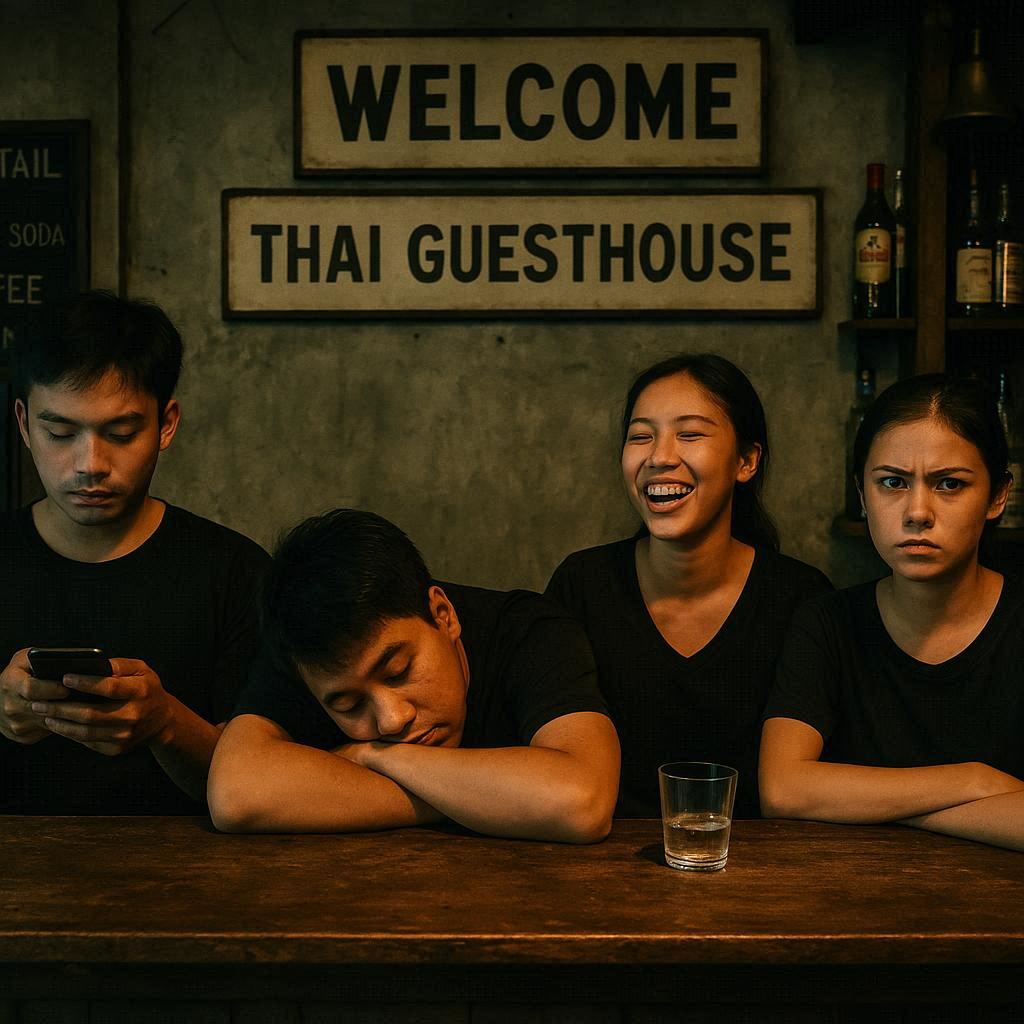
The Slumber Party Hostel in Ao Nang, Krabi, was an anomaly. In a tourist town, the cheapest places are usually the most crowded. But this one, despite its rock-bottom prices, was strangely quiet. A slightly subpar 7.5 rating on Agoda was the likely culprit. I had scouted it twice before booking; it seemed fine. The location suited me, far from the tourist chaos but close to the local eateries I preferred.
Some things, however, you only learn by living them. And some things, once learned, have the power to shatter your entire worldview.
My check-in began with a reasonable contract. Hot water was essential for my morning coffee. The woman at the reception—likely the owner, I surmised—agreed that the bar staff would provide it. I asked for an extra pillow. She hesitated, then agreed on one small condition: a good review. A fair trade. A clear, transactional understanding.
The first night was pleasant. I met a couple of new roommates; the vibe was good. The next morning, I went to the bar for my hot water. The staff—a group of young Thais who, in this perpetual low season, seemed to have very little to do besides chat amongst themselves—responded in unison: “No, no, no. No have.”
My heart sank. Another wall. Another gatekeeper. Another battle to be fought. I explained that the reception had already approved my request. They ignored me, chattering away in Thai. Were they dealing with it, or dismissing me? Finally, one of them held out a phone with a translated message: The kettle broke yesterday.
Was it true? Impossible to know. I typed my reply: Can I borrow a pan to boil it myself? More chattering. More waiting. Finally, a different staff member, with a barely contained aura of exasperation, took a pan, filled it with a shallow layer of water, and put it on the stove. The entire action took five seconds.
They hadn’t asked how much I needed. When I requested more, they added a little more, begrudgingly. The girl then slammed the wide-mouthed pan on the table for me to use. Pouring boiling water from a wide pan into a narrow-mouthed thermos is not a skill I possess. The table became a mess. They watched, offering no assistance.
The next morning, I returned for round two. This time, after my request, a different excuse. One of them pointed to the gas canister. “No have, no have.”
Yesterday, a broken kettle. Today, no gas. The probability that they were just messing with me now exceeded 50%. I abandoned the futile negotiation and went to the reception. The owner was there. I explained the situation, and she walked with me to the bar, a silent commander coming to restore order. I followed close behind, ready for a small taste of justice.
What happened next completely upended my understanding of the world. As the owner approached the bar, not a single employee reacted. They looked through her as if she were a ghost. She spoke to me in a low voice, “I’ll get you a kettle.” In front of her staff, I seized the opportunity. “That would be best,” I said, my voice louder than hers. “I don’t want to feel like I’m begging for hot water every day.”
At this, the staff member who had just declared “no gas” finally spoke, in slow, broken English, her words dripping with accusation: “Yesterday. You. A lot. A lot!”
A lot of water? So what? The hostel had promised me hot water. Or perhaps she meant a lot of mess. But how was I supposed to pour from a giant pan without spilling? The accusation was as absurd as it was audacious. An employee, in front of her boss, was reprimanding a guest for exercising a right that had been explicitly granted. More surreal still, the boss remained completely silent, a passive observer in her own establishment. She seemed to have quietly accepted her own irrelevance.
This was a world turned upside down. In this bizarre food chain, the customer was at the bottom, prey to the whims of the staff. The owner was a ghost. The employees were the apex predators.
The owner slipped away and returned with a kettle, which she quietly filled and plugged in for me at the bar. The problem was solved, for now. But when I returned that evening, the kettle was gone. The owner had gone home.
I spent the rest of my stay wrestling with this ethical black hole. I thought of the infamous rudeness of Hong Kong’s restaurant industry, a phenomenon born from a structural power imbalance. In a city with a massive labor shortage, owners can’t afford to fire even the worst employees. The power shifts from the boss to the worker. A customer’s complaint becomes meaningless. Was the same dynamic at play here?
The textbook logic of the service industry, the neat theories I held about how the world should work, had completely failed. We assume that a job in the tourism sector is a golden opportunity, a chance to practice English, to climb the ladder. We assume employees would be motivated to provide good service. But here, in this small, cheap guesthouse, all assumptions were void. The employees had no incentive to be helpful. The owner had lost her power to manage them. My presence was not an opportunity; it was a chore. Why keep a guest happy? It was easier to get rid of him.
And then, I finally understood. I had been looking at it all wrong. This wasn’t a system that was broken. This was a system that was working perfectly, just not according to my rulebook.
Could it be that they had created something else here, a new moral universe that I, as an outsider, simply couldn’t comprehend? A universe where showing up to work is the only duty, where the customer is a toy, and the boss is an ATM. A universe where the workers are the rule-makers, free to invent standards and levy accusations at will, answerable to no one.
Was this not, in its own twisted way, the worker’s utopia that millions dream of? A place where the tyranny of the customer and the authority of the owner have been utterly vanquished. A small, unassuming guesthouse in Krabi, the site of a quiet, successful revolution.
It is a miracle of humanity. And once you know it exists, you realize it can exist anywhere. Miracles are all around us, just waiting to be discovered.
See also: The Tyranny of Small Things