The Gospel of the 800-Baht Shrimp
2025-10-12
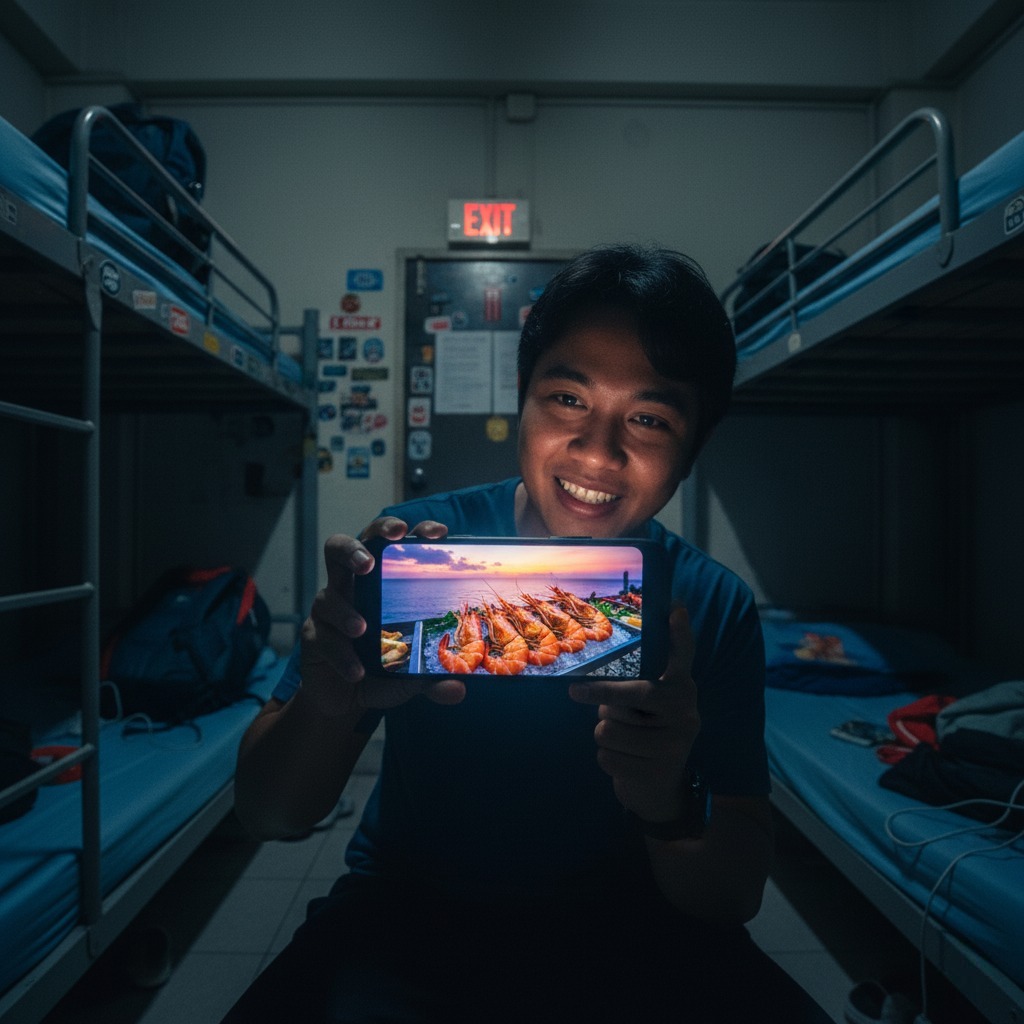
His name was Brian. He was my roommate at Slumber Party Hostel in Ao Nang, a Filipino who had spent the last two years managing a call center in Kuala Lumpur. He’d just checked in. Our first conversation was a study in contrasts.
He complained about the hostel. It was a twenty-minute walk from the beach, too far from the action. It was too quiet, lacking the party atmosphere he craved. He had booked it, I surmised, based on its name—a “party hostel”—without researching its more secluded location.
For me, the place was perfect. The quiet was a blessing, and its distance from the tourist chaos meant it was closer to the cheap, local restaurants I preferred. I had scouted the place twice before booking. It was another small tragedy of the information age: a mismatch of supply and demand born from imperfect data. I possessed the local knowledge that could have guided him to a better experience, but in the vast, illusory ocean of the internet, how could my signal ever have reached him before he clicked “book”?
The next night, I found him on his bunk. We exchanged the traveler’s daily catechism: “Where did you go today?”
“The Hilltop,” he said.
I knew the place. A restaurant with a stunning viewpoint. “It cost… I don’t know how much,” he said, scrolling through his phone. “Maybe 800, 1000 baht.” He showed me the evidence: a photo of a few enormous, almost surreal-looking prawns arranged next to a hollowed-out coconut. It was beautifully composed. For half that price, I thought, he could have feasted at a solid, all-you-can-eat seafood buffet in town. But that wouldn’t have been the point.
“I went to the viewpoint just outside,” I offered. “Same view, but for free.”
Then he showed me what he had truly purchased. It wasn’t the photo; it was a video. It began with a slow, cinematic pan across the restaurant’s name, elegantly inscribed on a lawn. It then swept across the chic, open-air dining space. The spectacular natural landscape was there, but only as a backdrop, a supporting actor to the main star: the restaurant itself.
I murmured an appreciative “nice”, but in my mind, the entire logic of the transaction laid itself bare. He hadn’t bought food. He had bought a narrative. A perfectly packaged, easily shareable story: I had a beautiful, exquisite meal at this stunning location. A buffet, with its chaotic mounds of food, could never offer such a clean, elegant narrative. The restaurant wasn’t selling shrimp; it was selling a stage, and the feeling of grandeur that came with being on it.
And he, in turn, had become its unwitting brand ambassador. He was showing the video to me now, and would surely post it to his social media, broadcasting the unspoken subtext: I had this refined experience, and I possess the means to acquire it.
The experience was a virus. He had likely been infected by a similar post, and now, he had become a vector, ready to infect others.
After my “nice”, I offered a counternarrative. “I could never pay that,” I said. “Every time I think of spending that much, I remember a 65-baht meal I had that was pure culinary bliss. This 800-baht experience couldn’t possibly compare, so the spending feels unjustified.”
He looked at me, a little coolly. “You always compare,” he said. His tone wasn’t hostile, just tired—like a man defending the right not to think.
The words stung. Shouldn’t I? I thought. Isn’t comparison the very foundation of reflection, of a life examined? If we don’t compare, how do we know if a system is worth participating in? More than that, it felt like a matter of justice. If a small vendor provides a sublime experience for 65 baht, and another provides a mediocre one for 800, doesn’t the small vendor deserve my money more? By not comparing, we reward the marketer, not the craftsman.
Of course, I said none of this. It was too much for a casual dorm room chat. I just mentioned that it felt unfair.
He gave a noncommittal “yes, that’s right,” his attention already back on his phone, probably curating his viral video for distribution. All of this, happening on a bunk bed in a 110-baht-a-night dorm room, a detail that would be conveniently absent from the story his friends would see.
The conversation died. I was left with the sting of his words. You always compare. Perhaps he was right. But I feared a world where no one compares. A world where a price tag replaces quality, where a slick, viral narrative replaces the messy, complex discussion of value and fairness. In that world, consumers themselves are enlisted as co-conspirators in their own deception. They have a vested interest in promoting the beautiful story, because the story becomes their capital—proof of their good taste, their status. To admit the food was average would be to devalue their own investment.
And so the system self-replicates, auto-generates, and endlessly reinforces itself. Truth, fairness, quality, dignity—they become secondary, perhaps even irrelevant.
Just like this essay, I thought. It will never go viral. It has no beautiful images to share. It will stand, instead, in some quiet, eternal archive, a silent witness to the world as it is. And maybe that’s why I still write—to leave behind proofs that someone, somewhere, still compared.