The Library of Unwritten Rules
2025-09-23
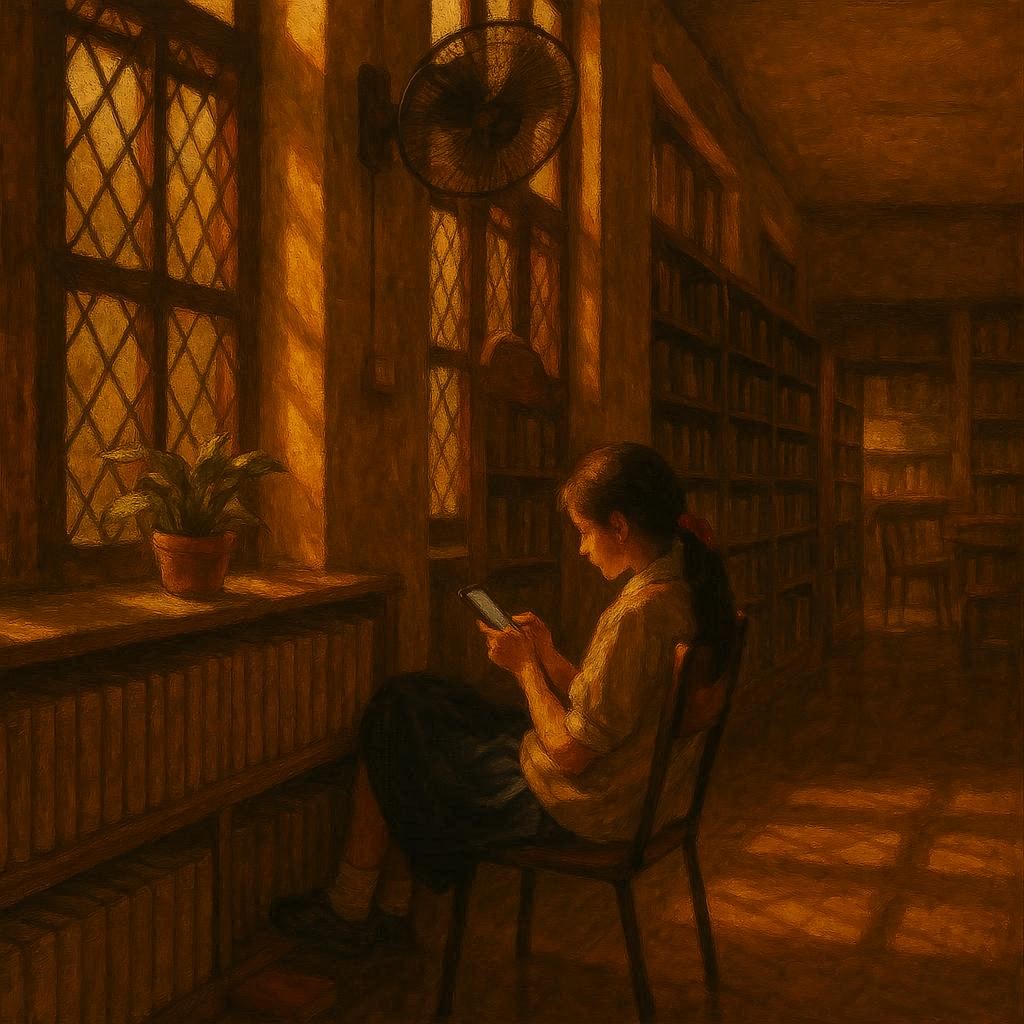
On my birthday, after a celebratory Thai tea from 7-Eleven, a question surfaced: if I could go anywhere in this town, where would I truly want to be? I felt no desire for grand landscapes or curated attractions. I didn’t want to see what people wanted to show me; I wanted to see something with a story.
My mind drifted back to my life in Hong Kong, to what I do when I have nowhere else to be: I go to a bookstore. For two weeks, I hadn’t touched a physical book. A quick search on the map revealed the provincial library was just a short walk away.
The library was a beautiful, airy space with dark wood floors. A disproportionately large portrait of the Queen presided over the room, bearing the grand mission statement: “Let’s join in to make a literate world.” But the books themselves told a different story. The shelves were filled primarily with young adult fiction. It felt less like a provincial library and more like a school library. My brief tour unearthed a collection of relics: a row of dusty computer manuals for Windows XP, Flash, and FoxPro 2.5. And then I saw them, given a place of honour—the only English books in sight. Three full sets of encyclopaedias.
One was the Encyclopedia Americana. With a sense of reverence, I pulled out Volume 1. It was the 2006 edition—the final print edition ever published before it, too, surrendered to the digital dominance of Wikipedia and faded into history. With the feeling of having discovered a legendary grimoire, I sat down to read. The spot was stuffy, just beyond the reach of the room’s single, oscillating fan on the wall.
I looked over at the fan. It wasn’t oscillating. Its angle had been fixed, aimed directly at a single schoolgirl sitting at a peculiar angle, facing a bookshelf. She wasn’t reading. She was scrolling through her phone. And then it hit me, a sudden, sharp realization: this brilliant girl hadn’t come to the library to read; she had come to claim its most precious resource—the fan.
But why not go to a 7-Eleven? I had just passed one with a small café-like seating area. She could sit there for hours in the air conditioning. I could. This fact, I knew with an uncomfortable certainty, was a privilege. I, a decently dressed traveller in a town with few tourists, could sit in a 7-Eleven all day without buying a thing, and no one would bat an eye. But a local girl in a school uniform, endlessly scrolling on her phone? The judgment, though unspoken, would be immediate and unkind. The staff might not kick her out, but the silent, collective gaze of society would. She knew it. And that is why she was here, in the library, with the fan.
The two-menu system at the restaurant was an unwritten rule, but it was still a rule. What this girl faced was something far more insidious. It was a rule that existed only in the air, a form of social policing enforced by the shared knowledge of what everyone else might be thinking.
And that same logic meant that I now sat in a stuffy corner, without a breeze. I had no right to complain. In the information age, no one could judge her for using her phone; she could be researching, reading, doing homework. She had found the perfect sanctuary, a space where her actions were immune to the very judgment that had driven her here.
I lost myself in the “A” volume of the Americana, and found a fascinating entry on “Acting”. It traced the art’s evolution, from an early focus on external techniques—the physical craft of manipulating one’s body—to the later development of internal, psychological methods.
A strange parallel clicked in my mind. The systems that govern us have evolved in the same way. The old way was an external technique: a sign that says “Customers Only”, a security guard to throw you out. The new way is an internal technique: you don’t need a sign, because you already know you don’t belong. You become your own guard.
As this thought settled, three junior high school boys with phones and tablets sat down near the Queen’s portrait and started a boisterous mobile game. This was, after all, just a small-town library, loosely managed. As long as they weren’t unacceptably loud, another unwritten rule dictated that no one would bother them.
Here it was: a library that housed the last printed edition of a great encyclopaedia, yet no one, save for a passing traveller, was reading. The grand mission on the wall and the reality on the floor were worlds apart. Perhaps the library’s function had changed. It was no longer a temple of knowledge, but a haven decorated with books, a quiet, judgment-free space where the town’s youth could escape the heat, the social pressures, and just be themselves. It was a sanctuary, yes—but sanctuaries are born when the world outside becomes unliveable. And in that, I thought, it was performing its new function perfectly.