The Unwritten Menu
2025-10-05
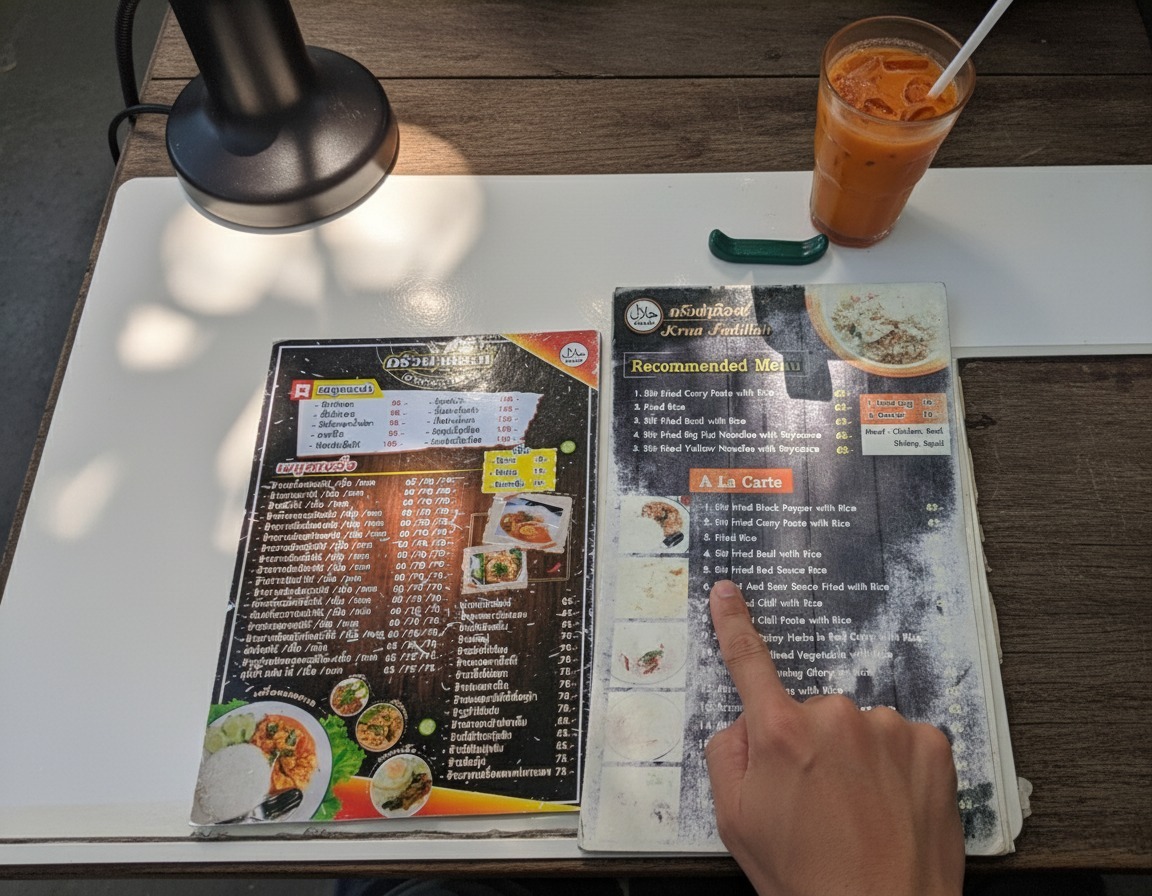
In the gray zone between a tourist trap and a truly local experience, there exists a fascinating ecosystem. These are the restaurants that have, over time, learned to cater to foreigners but have not yet lost their local soul. Here, in this liminal space, the rules are unwritten, and reality is a matter of perspective.
My first encounter with this world was at a restaurant a 40-minute walk from Ao Nang Beach. It was a 4.9-star haven of local prices in a sea of tourist inflation. I was handed an English-only menu. Something felt off. In Thailand, menus are usually detailed. Chicken is cheapest, seafood is priciest. But here, all fried rice dishes were listed at a flat 65 baht. Could chicken, pork, and shrimp all cost the same?
A sliver of suspicion crept in. I politely asked for the Thai menu, using my go-to excuse: “I’m learning Thai.” What I expected to find was a set of uniformly lower prices. What I found was a fog of confusion. Chicken fried rice was 60 baht, but beef and seafood were 70. This meant that if I ordered the seafood fried rice from the English menu, I’d actually be paying less.
My mind raced. A foreigner getting a better price than the menu dictates? Impossible. The only logical explanation was that the English menu was a simplification, and the portion size would inevitably be adjusted to match the price. A smaller, “international version”.
With both menus now in my possession, I asked the owner directly if the portion would be smaller. Perhaps sensing that his system had been decoded, he became incredibly friendly. With a warm smile, he assured me that for 65 baht, the portion would be just fine, not much different. His sincerity disarmed me. I relaxed and ordered the 65-baht seafood fried rice. It was delicious, and the portion was, indeed, generous.
Tonight, I was haunted by the memory of an even better meal: a pineapple seafood fried rice from another nearby restaurant four days ago. The first time I’d eaten there, it had been the best I’d had in Krabi. The menu, a bilingual one, had listed it at 80 baht. But when I paid with a 100-baht note, I received 30 baht in change. I was puzzled but didn’t question it.
Now, returning to that same restaurant, the truth revealed itself the moment I sat down. The little girl who had served me before, perhaps only six years old, brought me a different menu this time. It was a simple Thai-language menu, accompanied by a small notepad and a pen for me to write down my order—the authentic local way. I flipped it open. Just as I suspected. The pineapple seafood fried rice was 70 baht. The non-seafood versions were only 60.
It all clicked. I had been given this “local” menu because of one small detail from my first visit. I had ordered in my clumsy, yet practiced, Thai: Ao khao phat sapparot thale, khrap. I’d been practicing my food vocabulary, and for that one sentence, I could almost pass as someone who knew what they were doing.
This wasn’t my first time receiving better treatment for attempting the local language. Often, it’s a slightly larger portion, a small, unquantifiable bonus you’d never know you received unless you were with a foreign friend who got the standard size.
The first time I’d encountered this kind of price discrimination, years ago in a restaurant in Vietnam, I was furious. I had just learned enough Vietnamese to recognize the discrepancy between the English menu and the prices on the wall. It felt unfair, unjust. I was ready for a fight. The owner, unperturbed, simply charged me the local price, and my righteous anger dissipated, leaving me with nothing to protest.
Now, years later, the same situation unfolded not as a confrontation, but as a reward, a special privilege. It disarmed my will to resist. Even if I had wanted to protest, on what grounds? There was no price on the wall. The unfairness was hidden, administered through the simple act of handing you one menu instead of another. Unless you reached a certain, unspoken threshold, you would never even know the other menu—the other reality—existed.
I looked over at a Western man at the next table, contentedly eating his meal, completely oblivious to the truth I had just unlocked. A strange conflict brewed within me. Should I feel grateful for this special treatment, or should I continue to speak out against the inherent unfairness of the system? I wasn’t even sure it was unfair anymore. This was a privilege I had, in a small way, earned.
Anyone can learn a few words of the local language; they just choose not to. They choose to remain a tourist. But do we want to live in a world full of invisible barriers and hidden thresholds? A world where the rules are unwritten, the gates are unmarked, and you never even know what it takes to be let inside? Is such a world, I wondered, truly a model of civilization?