The Immaculate Contradictions of an American Dreamer
2025-10-04
My check-in at the Hangout guesthouse began with a piece of paper. It was an Arrival Card, a formality most Thai hostels have long since abandoned. The few that still use them are usually content with a name and a scribble for a signature. But this one was different. Andrew, the American owner, had meticulously marked most fields with a hand-drawn asterisk. Mandatory.
“Most local places don’t do this anymore,” I observed politely.
“I know,” he said with a hint of pride. “But we do things by the book here.”
Coming from a culture that values both efficiency and compliance, I could respect that. At the time, I believed this rigid adherence to rules was the sign of a well-run establishment. Over the next few days, I would learn that the distance between “by the book” and “by the reality” can be a universe.
Andrew, I soon discovered, was a character. A lifelong traveler who had roamed over thirty American states, he had finally put down roots in Thailand to build his dream. This guesthouse was his latest two-year project, a partnership with a local landowner. He spoke with the infectious energy of a true believer, pointing out the space next to the bar where he planned to build a swimming pool. “It’s all about what the guests want,” he explained. “We have food, drinks, parties when it’s busy, tours…”
He was fascinated to learn I was from Hong Kong, a place he’d always wanted to visit. He listed its virtues with the precision of a seasoned resident. “Hong Kong has everything,” he declared. “It’s a little Bangkok and a little New York, all in one place. Thailand is different. Bangkok is Bangkok, Phuket is Phuket. But Hong Kong is everything at once.”
He asked what I did. I told him I was a stock investor with a stable system that had granted me financial and geographical freedom. His eyes lit up. He dabbled in funds, he said, but lamented the taxes he owed the US government, a burden he knew I didn’t share in tax-free Hong Kong. When I asked for a lunch recommendation, his top two choices were the very same places my own research had identified as the best in town. We laughed when I told him I’d given a one-star review to another spot he also disliked. In that first conversation, Andrew felt like a kindred spirit—a smart, worldly, and driven man.
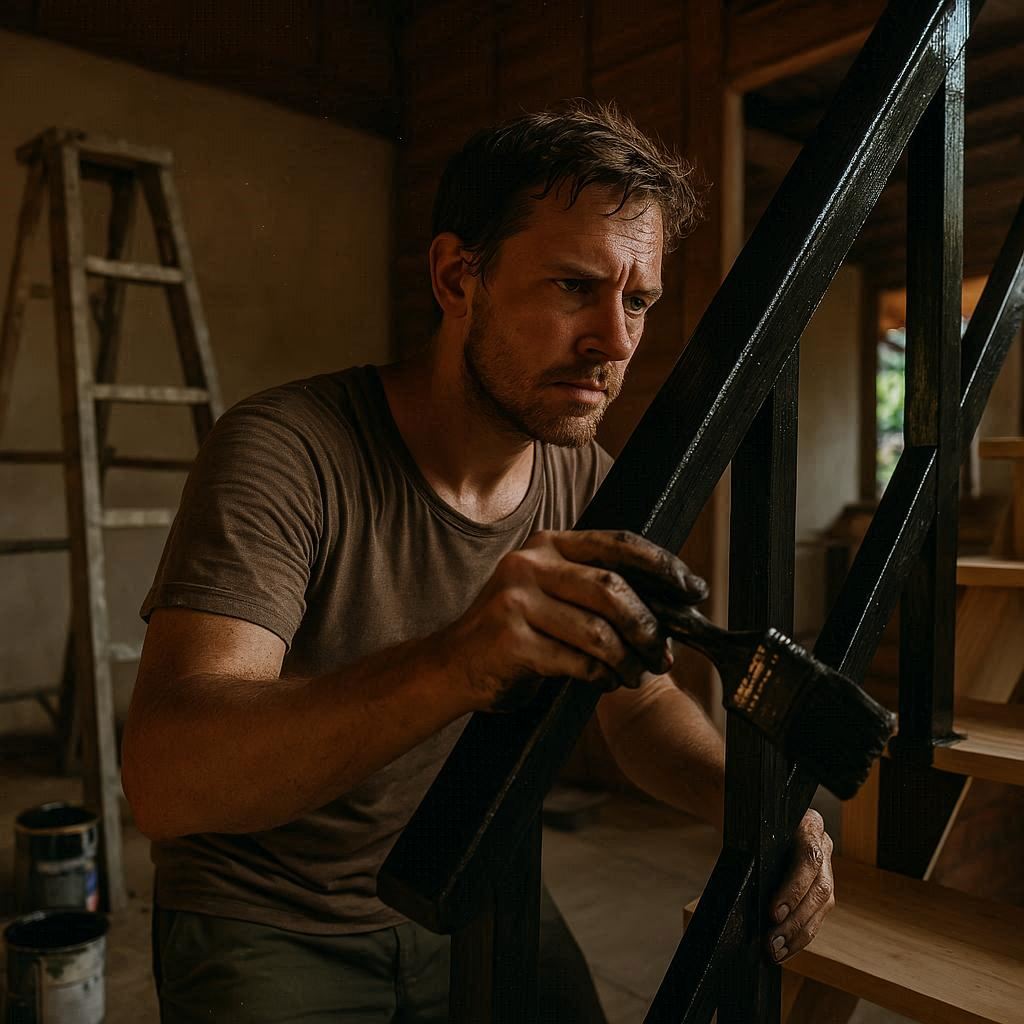
But the immaculate dream he described began to fray at the edges. The first sign was the overwhelming smell of paint thinner in the common area. It came, an employee explained, from a decoration project evidenced by a wooden ladder. Later, I saw Andrew himself, paintbrush in hand, meticulously applying black lacquer to a staircase railing. “You have to do this yourself?” I asked, a playful tease in my voice. I complimented his work, but couldn’t help but add, “It would look even better if the stairs were painted to match.” The unpainted stairs and the freshly lacquered railing were a perfect metaphor for the place: a system of jarring, uncoordinated improvements. I felt a pang of sympathy. An owner who often works “all day and all night”, as he later admitted with a humourous footnote “but not overnight”, has to find things to do.
The small inconsistencies piled up. The hot water was from a basic kettle, the cold from a giant drum with a cheap, manual pump. One day, the pump vanished. “It broke last night,” Andrew explained, appearing instantly to install a new one he’d just bought. Another day, the water supply to one entire side of the building cut out. “Don’t worry, I’ve called someone. It’ll be fixed tomorrow,” he assured me, directing me to a smaller, stuffier bathroom on the other side. He was a man constantly, heroically, plugging holes in a leaky ship.
The leaks weren’t just physical. One evening, the hostel’s Wi-Fi vanished. I went to Andrew for help. “The internet company is having issues,” he explained, “they said it will be fixed tomorrow.” Without missing a beat, he offered a solution. “I can give you the password for the bar across the street.” He typed it into my phone, but it was wrong. Unfazed, he simply picked up his phone and called the bar to get the correct one. I praised his resourcefulness, his mastery of the local network.
Two hours later, the bar’s Wi-Fi died too. I switched to my own SIM card’s hotspot, a silent testament to the fragility of his patchwork solutions. It was another perfect metaphor for his entire operation: a series of brilliant, improvised fixes for a system that was fundamentally unstable at its core. From the water in the pipes to the data in the air, everything felt temporary, contingent, one step away from collapse.
His most “by the book” decision was the most alienating. Every night, just before midnight, a professional security guard in full uniform would arrive, pull down the metal gates. The hostel, which had a dozen guests at most, was transformed into a fortress. The guard would then spend the entire night watching loud videos and playing games on his phone. Sometimes he would drew on a cigarette at the solitary unlatched gate, releasing a clinging haze that saturated the room. They were minor annoyances, but his very presence felt like a violation. In a place that was supposed to feel like a traveler’s home, this uniformed stranger, a stark symbol of institutional procedure, felt utterly out of place.
Was this the experience a traveler wanted? If we, the guests, could vote, I knew we’d choose to keep the gates open, to feel the night breeze, to not be watched over by a bored guard. We would have voted to spend the security budget, and the time spent painting a single railing, on a better Wi-Fi network, water pump or a more stable plumbing system.
But a choice was never offered. This is the paradox of the modern consumer. I was a paying customer with the freedom to leave, but I had no right to participate in the decisions that shaped my experience. My feedback, no matter how well-reasoned, was irrelevant. I could only accept the system, or reject it entirely.
And yet, I kept extending my stay. The bed wasn’t the best, the staff were sometimes noisy, but it was functional. It was, just barely, good enough.
On my last day, the water crisis will be over, the railing will be dry. Andrew will likely be back to being the charismatic host. In him, I saw the beautiful, tragic contradiction of the American dreamer in a foreign land. A man who wanted to build a perfect system based on rules and compliance, but was constantly wrestling with the chaotic, unpredictable reality of leaky pipes and broken pumps. He had brought his textbook solutions to a place that runs on local wisdom, and the result was this strange, flawed, yet somehow functional hybrid. I don’t know if his way was better or worse than the local way. I only know that a better way, a true optimal solution, must exist somewhere in the space between. But there is no channel to submit that proposal. And so we, the travelers, just keep adapting, finding our comfort in the quiet imperfections of a world we can observe, but never truly change.