The Final Exam on the Riverbank
2025-09-16
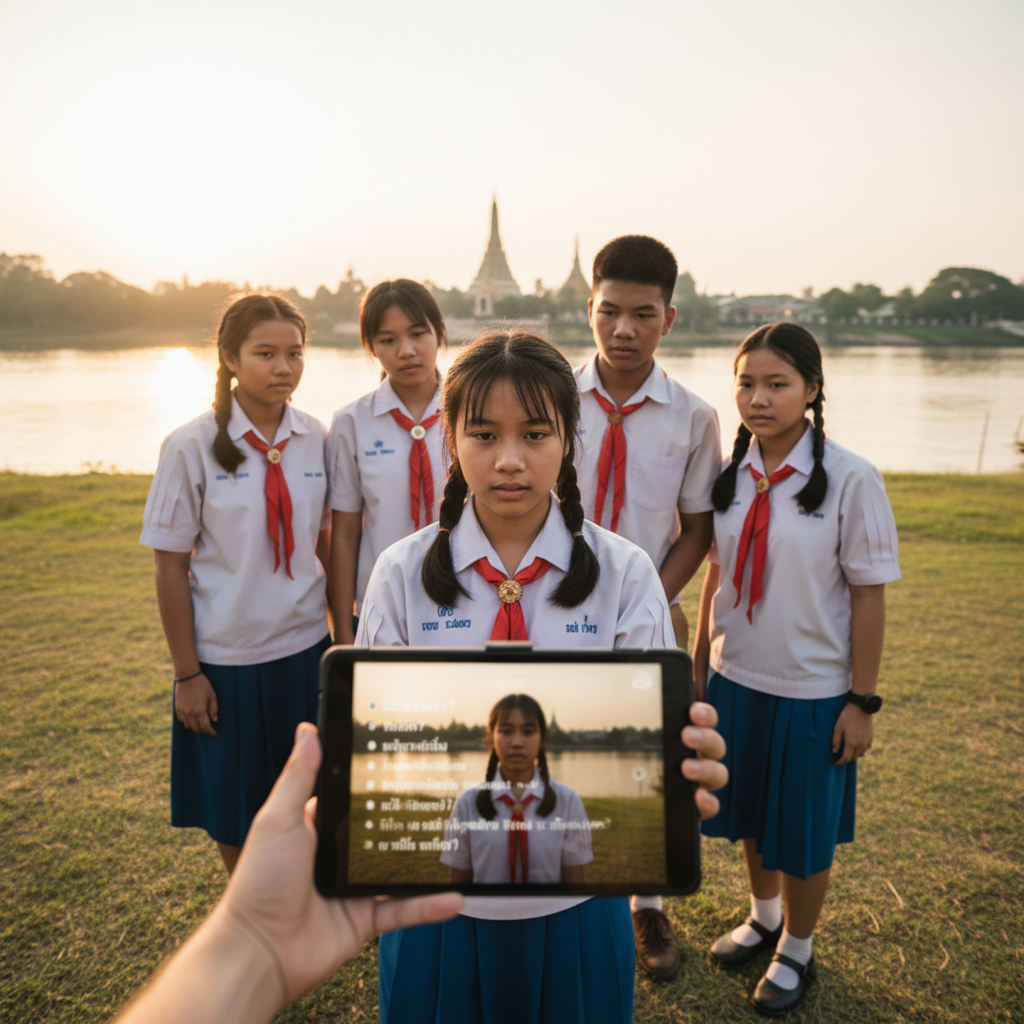
There’s a universal truth to travel: just when you think you’ve settled into a rhythm, the universe throws a delightful curveball. My final hour with Neung, my newfound guide and friend in Surat Thani, was a perfect example. We were walking along the Tapi River, our deep conversation about life and politics winding down as the sun set. Suddenly, we were ambushed.
The ambush party consisted of six teenagers in school uniforms—two boys and four girls. They approached Neung with a nervous energy, chattering away in rapid-fire Thai. Neung’s face lit up; he seemed thrilled to be at the center of this unexpected commotion. He turned to me, his eyes gleaming with the importance of his announcement. “They need an English teacher,” he said. “For thirty minutes.”
My mind raced. An English teacher? I looked at the students, who were now shyly glancing at me. Their own English teacher had clearly sent them on a mission, but how was I supposed to teach a language to kids who, I suspected, didn’t speak a word of it?
“Do you speak English?” I asked them in Thai, using one of my few memorized phrases: pood pasa angrit dai mai khrab?
The question had the effect of a stun grenade. They froze, their faces a mixture of panic and embarrassment. After a moment of complete silence, one girl, clearly the designated spokesperson and bravest of the lot, mumbled a barely audible, “A little.”
My confusion was swiftly cleared up. This wasn’t a lesson; it was a performance. And they already had a script. The brave girl presented me with a tablet. On the screen was a list of five questions, neatly typed out in both English and Thai. My role was not to teach, but to be the final, exotic ingredient in their homework assignment.
And so, the show began. One student became the cameraman, pointing the tablet at me like a seasoned documentarian. The brave girl, as the interviewer, read the first question from the screen: “What is your name and where are you from?” I answered. Then came the next: “Why did you choose to travel to Suratthani Province?” I gave a long, heartfelt answer about wanting to see the real Thailand, about the kindness of strangers. Then the next, and the next. The interview was a surreal piece of theater. I spoke in detailed English sentences, and she nodded along, pretending to understand, while I knew with absolute certainty that my words were dissolving into meaningless noise the moment they left my lips. After she finished, one of the boys stepped up and asked another five very similar questions. I, in turn, gave my performance again.
As I answered, a sudden thought struck me: by giving such elaborate answers, was I inadvertently making their homework harder? Would they now have to spend hours transcribing and translating my rambling monologue?
Once the second round of questioning was done, a wave of relief washed over the students. Their mission was accomplished. They broke into happy chatter, thanking Neung profusely. He translated their parting words to me: “They have been looking for a foreigner for a long time,” he explained. “They found one before, but he didn’t speak English.”
The absurdity of it all was brilliant. The assignment wasn’t to learn English; it was to record an interaction with a foreigner. The content of that interaction was entirely irrelevant. It was a perfect example of what I call “Performative Learning”—a system that prioritizes the form of education over its function. They could write the questions perfectly, but they couldn’t ask a single one without a script. They feared making a mistake so much that they preferred not to speak at all, a “face culture” that becomes the biggest enemy of language acquisition.
It reminded me so vividly of a 16-day trip to Medan three years ago, Indonesia—another bustling city almost entirely devoid of tourists. In over two weeks, I met exactly three locals who could speak English. The first was an English teacher who kindly helped me order food. The second was a waitress my age at a high-end Korean BBQ joint, who had learned it working in Kuala Lumpur. The third was a Grab motorcycle driver who had taught himself by watching Western movies.
The pattern is uncanny, and it holds true here in provincial Thailand. English proficiency doesn’t seem to come from the school system. It comes from three specific places: a professional necessity (the teacher), international exposure (the waitress), or a deep personal passion (the film buff). For everyone else, there is simply no compelling reason to master the language, even as the fanciest malls display signs in English to project a sense of class. The students on the riverbank were products of that system—a system that had taught them the alphabet of English, but not its music.
They didn’t learn any English from me that day, and I learned very little Thai. But in that strange, funny, and deeply human exchange, we learned something else. We learned that communication is a stubborn thing. Even when language fails, a shared goal, a little bit of patience, and a whole lot of smiling can somehow, miraculously, get the job done.