Notes on Story: Substance, Structure, Style and the Principles of Screenwriting
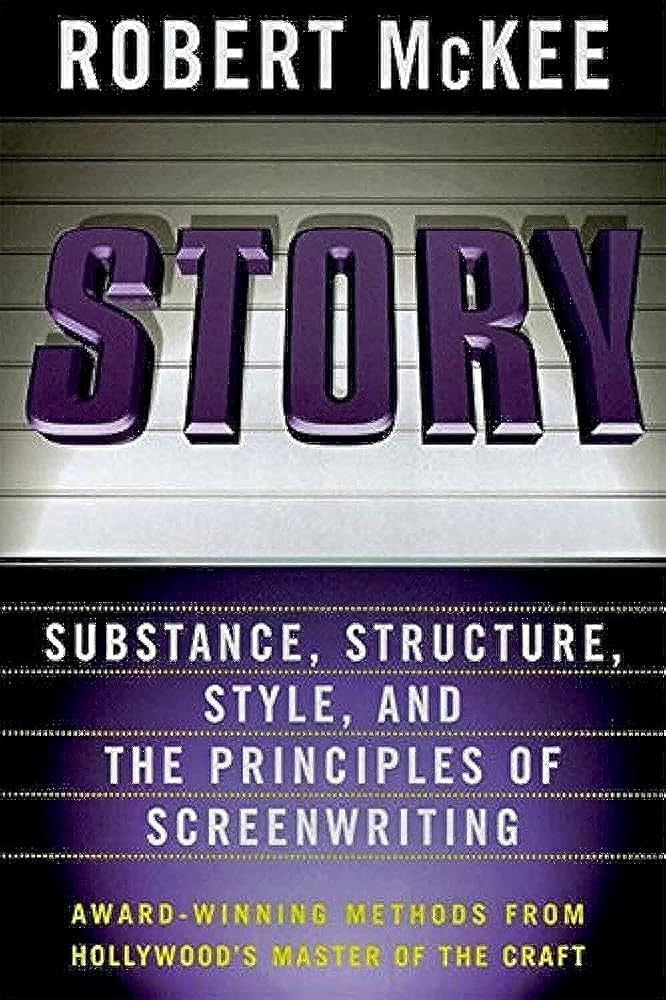
Story: Substance, Structure, Style and the Principles of Screenwriting by Robert McKee
Original notes here.
Chapter 1 — The Art of Storytelling
This book is not about rules but principles. The former say, “You must do it this way”; the latter say, “This has stood the test of time and demonstrably works.” In other words, they are universal, enduring forms—objective facts of writing. By studying story archetypes, one can create stories that appeal broadly.
There is enormous demand for stories, but quality is low. Apart from the rare cases of genuine talent going unrecognized, the idea that poor work is simply a matter of talent being overlooked is a myth.
Beyond the multiple market forces that produce poor quality, the deeper problem is the confusion of values in our age: value orientation—that is, the shifting polarity of meaning in life between positive and negative poles—is the soul of the art of storytelling. We therefore have to dig deeply into life, discover new insights, and reinvent value and meaning. This is not an easy task.
The fundamental reason a text feels flat is that the story goes nowhere, motivations are not authentic enough, characters are superfluous, subtext is lacking, and flaws are everywhere.
Story design tests the writer’s maturity, powers of insight, and understanding of society, nature, and the human heart.
Although genres and styles may vary enormously, strip away the surface and the inner essence of great stories is essentially the same. Audiences respond to them precisely because of this deep form, and are moved to admiration.
A good story contains a love of story, a love of dramatic tension, a love of truth, a love of humanity, a love of perception, a love of dreams, a love of humor, a love of language, a love of duality, a love of perfection, a love of a distinctive style, a love of beauty, and a love of oneself.
This includes believing that one’s imagination can only be expressed through story; embracing with passion the upheavals that life can bring; believing that fabrication is an obstacle to art; being willing to enter into a tortured soul’s experience; allowing oneself to become immersed in inner feeling; letting the imagination run wild; maintaining balance in life; enjoying the exploration of semantics; perceiving the latent contradictions in life; being passionate about pondering and refining one’s work; daring to experiment; knowing the difference between good and bad; and having no need for self-doubt.
Two typical kinds of failed screenplays are the bad personal-story screenplay and the bad “guaranteed hit.” The former has loose structure and is packed with fragments and details from personal life, but they are only partial truths, remaining on the surface, revealing no real understanding of life; the latter has structure that is too strong, is overly complicated, contains too many characters, and offers plenty of sensory stimulation but no connection to life. The writer thinks action is entertainment and does not care about story.
The relationship between story and life should be this: story is a metaphor for life.
Facts are neutral and never change, but the meaning discovered in truth is what gives stories their different forms.
Between pure fact and pure imagination lies an endlessly varied spectrum of fiction, and excellent storytelling oscillates between the two to find balance.
Perceptiveness can depict details; imagination can lead the audience into an imagined world. Beyond these two, the writer also needs:
Literary talent: the creativity to transform everyday language into forms that carry deeper meaning and linger in the mind.
Storytelling talent: the creativity to transform life itself into an experience of greater force, clarity, and meaning. This is extremely rare. Limited technique can diminish a story that is inherently profound; a master can bring something insignificant to life.
Chapter 2 — The Structure Spectrum
Structure: selecting stories from the life of a character, arranging them into sequences, generating emotion, and presenting a point of view.
Event: something that brings about a change in the character’s value orientation. (Rain itself is not an event, but when the rainmaker battles the forces of nature and draws rain from a cloudless sky, it acquires extraordinary significance.)
Scene: action arising from conflict that shifts the character’s value state. Ideally, each “scene” contains one event.
Beat: a change in behavior from action to reaction. One scene may contain six exchanges between two characters—that is, six “beats.”
Sequence: composed of several scenes, with dramatic tension reaching a peak at the end and causing a decisive change in the character’s life-value orientation.
(Example: A woman cannot get herself properly dressed and is ready to give up on going to the interview party, but a frantic call from her mother makes her decide to go anyway, whatever happens, and she finally regains her confidence. She goes to New York, but heavy rain makes it impossible to hail a cab, so she decides to walk through Central Park. As expected, she is surrounded by gangsters and has to fight for her life. She arrives in time, but looking disheveled, and feels the outcome is already decided. She relaxes and simply acts like herself, and is unexpectedly appointed to the position. This “sequence” contains three scenes: doubt becoming confidence, death becoming survival, and disaster becoming victory. The sequence’s value orientation culminates in its climax: her appointment. The information conveyed is that she took enormous risks to win a position she deserved, while also revealing her character, her relationship with her mother, and her views of New York and the company through dramatic tension.)
Act: composed of several sequences, with dramatic tension peaking at the climax and producing a major reversal in value orientation.
Story: composed of several acts; it is a major, overriding event that constitutes the film’s arc of transformation. The transformation at the end is absolute and irreversible.
(Continuing the example: the first act changes her from someone who does not get the new position into the company’s general manager; the second act sees her betrayed and fired amid struggles within the company; the third act has her join a rival company and relish the destruction of her old employer. The ending transforms her from the optimistic, honest, naïve sweetheart she was at the beginning into a cynical, immoral old fox.)
Three perspectives on the art of storytelling combine to form a triangle, revealing the author’s worldview in its entirety:
Classical Design: archplot—causality, closed endings, linear time, external conflict, a single protagonist, a single coherent reality, and an active protagonist.
Minimalism: miniplot—open endings, internal conflict, multiple protagonists, and a passive protagonist.
Anti-Structure: antiplot—coincidence, nonlinear time, and inconsistent multiple realities.
Classical Design transcends time and crosses cultures. Story development is driven by an active protagonist who confronts antagonistic external forces in pursuit of desire, within a coherent fictional reality linked by continuity and causality, and ends with an absolute, irreversible change in a closed ending.
Minimalism begins with elements of Classical Design but reduces, compresses, trims, or cuts short its major characteristics in pursuit of simplicity.
Anti-Structure echoes the anti-novel, the nouveau roman, and the Theatre of the Absurd. Its formal variations reverse classical conventions rather than merely restricting them; it exploits or even mocks the very concept of formal rules, tending toward excess and exaggeration.
Differences among the forms in the Story Triangle
Ending: Classical Design provides a closed ending, while Minimalism presents an open ending. If the climax brings about an absolute and irreversible change, answers all questions, and satisfies all emotional needs, it is a closed ending. If the climax leaves one or two questions unresolved and some emotions unsatisfied, it is an open ending.
Conflict: Classical Design places the emphasis on external conflict; Minimalism does the opposite, focusing on the protagonist’s conscious or unconscious struggle with his own thoughts and emotions.
Single or multiple protagonists: Classical Design places a single protagonist at the center of the narrative. Minimalism gave rise to multistrand plotting, which has become increasingly popular since the 1980s.
The protagonist’s agency: An active protagonist pursues fulfillment, taking action that brings him into conflict with people or the world. A passive protagonist pursues the satisfaction of inner desire and therefore appears not to act; the conflict comes from certain aspects of his own nature.
Time: Even when Classical Design uses flashbacks, the audience can still understand the chronology. In Anti-Structure, time is often fragmented and chaotic, making the linear order of events difficult to follow.
Causality or coincidence: Classical Design emphasizes a network of causal relationships. Anti-Structure often replaces causality with coincidence, random collisions breaking the chain of cause and effect.
Coherence of reality: Almost all fantasy films belong to Classical Design, with the work strictly following the strange rules of its fictional reality. In Anti-Structure, the only rule is to break the rules, deliberately creating inconsistency.
These seven forms are not rigid or immutable; together, they constitute a spectrum of structural choices.
Outside this triangle, below the line connecting Minimalism and Anti-Structure, the story remains unchanged. There is no transformation arc, and the characters’ life-value orientations are almost identical to those at the beginning. The story dissolves into characterization and becomes a “slice of life”. Such films are called Nonplots.
Classical Design: Seven Samurai / Japan / 1954, 2001: A Space Odyssey / United States / 1968, The Godfather Part II / United States / 1974, Ju Dou / China / 1990
Minimalism: Tender Mercies / United States / 1983, To Live / China / 1994, Shall We Dance? / Japan / 1996
Anti-Structure: Wayne’s World / United States / 1992, Chungking Express / Hong Kong / 1994, Lost Highway / United States / 1997
Nonplot: Umberto D. / Italy / 1952, The Exterminating Angel / 1967, Faces / 1968
The chapter closes by discussing the politics of story design. A writer has to make a living from writing, and talented writers must recognize that as story design descends from the peak of Classical Design, the audience also shrinks. This has nothing to do with the quality of the writing; it is because most people believe life to be a closed experience, shaped by absolute and irreversible change, with external forces the greatest source of conflict, while human beings move through continuous time and chains of causality. As the audience shrinks, the budget must also shrink. This is an iron law.
Creators should examine their own motives: why does a screenplay move toward one corner of the triangle rather than another? Story is effectively telling the audience, “I believe life is like this.” Without genuine passion and firmly held conviction, it will feel insincere.
The author criticizes some young people who make non-classical art films simply to rebel against Hollywood: raging against patriarchy is not creativity; it is a crime committed by adolescents seeking attention.
Chapter 3 — Setting
Understanding and seeing deeply into the world of a story is fundamental to originality and excellence.
Setting has four dimensions: period, duration, location, and conflict.
Writers often refuse to make a story’s setting concrete. Asked where a divorce story is set, one writer might answer “America,” believing that it does not matter where in America. The author points out that it does: a divorce case involving a wealthy New Yorker and an affair on a potato farm have nothing in common.
The writer must have such a deep and detailed understanding of the story’s world that, whatever relevant question is asked—from the character’s eating habits to the weather in September—you can answer it immediately.
The key to defeating cliché is research. There are several ways to do it:
From memory: recall experiences that feel similar to what the character is going through.
From imagination: if life were like that of the character I am writing, what would every hour, every day feel like?
From fact: if you are writing a family drama, read classic works on the subject and expand your range of experience to the whole world.
Research is food for imagination and creativity, not the goal. It must not become an excuse for procrastination.
Creativity is a process of choosing and discarding. Keep asking yourself: for this character and this story world, which variation is most truthful, and which has never appeared on screen before?
Even something that seems clichéd, such as a couple meeting in a singles bar in a romantic comedy, is perfectly acceptable so long as it is the choice that best expresses their nature and background.
If the completed screenplay retains every scene and not a single idea has been discarded, with rewriting reduced to nothing more than adjusting the dialogue, the work will probably fail: talent is not only creativity; it also includes taste, judgment, the ability to eliminate, and the willpower to destroy the mediocre and clichéd.
Chapter 4 — Genre
Aristotle made the first classification of stories: an ending could be positive or negative, and it could be flat or involve a major reversal, producing four types.
Today, genres are enormously complex, having evolved through practice:
- Love Story
- Horror: further divided into the grotesque and the supernatural. In the former, the source of horror follows logic; in the latter, it does not. There is also a third kind in which the source cannot be identified.
- Contemporary Epic: Spartacus, Nineteen Eighty-Four, The People vs. Larry Flynt
- Western
- War: with particular emphasis on combat
- Coming-of-Age: Stand by Me, Bambi, Muriel’s Wedding
- Redemption: the protagonist undergoes a moral transformation and reforms, as in Schindler’s List
- Punitive: a good person turns bad and is punished: The Devil’s Advocate, Wall Street, Falling Down
- Testing: stories in which willpower resists the temptation to surrender: The Old Man and the Sea, Cool Hand Luke, Forrest Gump
- Education: the protagonist undergoes a profound positive transformation in his view of life, other people, or himself: Tender Mercies, Grosse Pointe Blank, My Best Friend’s Wedding, Shall We Dance?
- Disillusionment: a profound transformation from a positive to a negative worldview: The Great Gatsby, Macbeth
- Comedy: encompassing several subgenres—parody, satire, sitcom, romantic comedy, neurotic comedy, farce, and black comedy
- Crime: murder mystery, heist crime, detective, gangster, thriller or revenge, courtroom, newspaper, espionage, prison drama, and film noir
- Social Drama: family drama, women’s films, political drama, environmental drama, medical drama, and psychological drama
- Action-Adventure: great adventure, disaster survival
- Historical Drama: focusing on a historical period
- Biography: a cousin of the preceding genre, focusing on an individual
- Docudrama: focusing on recent events
- Mockumentary: disguised as a true event and presented in documentary form
- Musical: film noir, social drama, punitive drama, biographical film
- Science Fiction: the future, like history, is a stage on which any genre can operate
- Sports: sport is the severe test the character faces before undergoing transformation
- Fantasy: the screenwriter can manipulate time, space, and physics, distort natural laws, and create an alternative reality
- Animation: anything can transform into anything else
- Art Film: can be further divided into the two subgenres of Minimalism and Anti-Structure
Genres can be combined with one another. The Fisher King intertwines five genres—redemption, psychological drama, love story, social drama, and comedy—into an outstanding film.
There are more than twenty major genres, and the creative possibilities of hybrid genres are virtually endless.
Genres constantly evolve and adapt as society changes.
Psychological drama: In the first stage, the psychiatrist plays detective; once a hidden crime is exposed, the victim may return to normal. In the second stage, it evolves into the psychological thriller, with the police becoming amateur psychologists pursuing pathological personalities. In the third evolution, in the 1980s, the detective himself becomes a madman, and the key to pursuing justice is the detective’s own psychological self-analysis. By the 1990s, it reaches a fourth stage: the pathological personality may be your spouse, psychiatrist, surgeon, child, nanny, roommate, or police officer, appealing to society’s collective paranoia.
Love Story: Two people meet, fall in love, and get married—isn’t that terribly boring? Beginning with Menander, the great Greek dramatist, creators answered this question for two thousand years with the woman’s parents: they became the force opposing love. Then came the romantic revolution of the twentieth century. This device went into history along with arranged marriages, but creators can always discover new and surprising forces that stand in love’s way.
One important reason to master genre is that screenwriting is suited to an endurance race. Great writers focus their life’s work precisely on one concept. Hemingway was fascinated by the problem of death; Dickens’s father was imprisoned for debt, inspiring him to keep writing about lonely children searching for lost fathers; Molière’s criticism of seventeenth-century French stupidity and corruption made the titles of his lifelong dramatic works resemble a catalogue of human vices. Each of them found a theme and continued to draw energy from it throughout a writing career.
Chapter 5 — Character
A person’s choices under pressure reveal the true nature of a character; the greater the pressure, the deeper the truth that emerges. If a character chooses to tell the truth when lying would bring no benefit, the choice is meaningless. The author gives the example of an illegal immigrant who, if discovered, could be deported along with his entire family and left unable to make ends meet, yet chooses to stop and selflessly save someone—illustrating what it means to make a choice under pressure.
People are often not what they appear to be. The discrepancy between appearance and reality is an important truth of life, and choices under pressure are the only way to gain a deep understanding of a character.
A person who is exactly what he appears to be and completely predictable is boring. Every James Bond film reveals a character with depth who differs from the impression established at the outset.
The finest works do not merely reveal a character’s true nature; they also show a gradual transformation.
In the classic Hamlet, the first stage is when he attends his father’s funeral and contemplates suicide; the second comes when he learns that his father was murdered by his uncle and restrains his impulsive decision to seek revenge; in the third stage, his essential nature does not match his outward appearance. He is not merely sorrowful and sensitive; other qualities lie concealed beneath the surface: “When the wind is southerly, I know a hawk from a handsaw.” In the fourth stage, his inner nature emerges. The story subjects him to increasing pressure, his choices becoming increasingly difficult. He tracks down his uncle and finds him kneeling in prayer, then forces himself to wait. The fifth stage is the climax, which profoundly transforms his humanity and brings him to a state of calm maturity.
Every story is driven by character, and story structure is inseparable from character: structure creates steadily mounting pressure, forcing the character into increasingly difficult situations, where he makes choices and reveals his true self; the character brings a set of personal qualities into the story and acts convincingly in accordance with those choices.
If you change the design of an event, you must also change the character. In one key event, the protagonist takes an enormous risk and tells the truth, but in the second draft he chooses to lie instead: reverse a single event and you can create an entirely new character.
“The point of the movie is the last twenty minutes.” The climax of the story is the screenwriter’s final task. Of all the enormous energy invested in story design, 75% should be devoted to creating the climax. It is the highest point and convergence of all meaning and emotion, and the decisive point in audience satisfaction. Everything else exists to achieve this moment.
Anything that weakens the credibility of the ending must be sacrificed. If a seventy-five-year-old protagonist cannot kill the villain, he must be changed to thirty-five.
Chapter 6 — Meaning
If you come across a corpse lying exposed in the street, you may flee in fear rather than contemplate the meaning of death: the mind and passions at the center of life operate in different realms and rarely coordinate or move in sync.
Life separates meaning from emotion; art brings them together: through story, you can create an epiphany, which is aesthetic emotion.
Art springs from the soul’s desire for beauty and harmonious resolution of frustration and disorder: you may forget the corpse lying in the street, but Hamlet’s death will surface in your mind from time to time. Without art, life leaves us in chaos. In life, experience acquires meaning through reflection over time; in art, experience acquires meaning at the very moment it occurs.
Story is not essentially an intellectual activity. Scholarship can sharpen taste and judgment, but no depth of analysis can nourish the soul.
The creative process is supported by two ideas: the story premise and the controlling idea. The former inspires the desire to create and is often an open-ended question: “What would happen if this happened?” (Jaws: What would happen if a shark swam onto a resort beach and swallowed a vacationer?)
Story design is a tool for leading the audience to recognize your point of view. A master storyteller does not explain the idea, just as a detective story does not lecture the audience: “Crime does not pay; justice will prevail.”
The controlling idea can be expressed in a single sentence and consists of value and cause. Here are examples of values:
In the Heat of the Night: justice prevails.
Missing: tyranny runs rampant.
Groundhog Day: life is filled with happiness.
Dangerous Liaisons: hatred destroys everything.
Add the cause, and the controlling idea of Dirty Harry is: justice prevails because the protagonist is more violent than the criminal.
Columbo: justice prevails because the protagonist is smarter than the criminal.
In the Heat of the Night: justice prevails because a Black outsider sees the truth of white people turning right and wrong upside down.
Groundhog Day: as long as one learns to give unconditional love, life will be filled with happiness.
Missing: tyranny runs rampant because it is supported by the corrupt CIA.
Dangerous Liaisons: once we fear the opposite sex, hatred will destroy us.
Do not impose meaning on a story. The story itself will tell you its meaning; examine your ending and ask yourself whether the climax brings a positive or negative value orientation to the protagonist, and what the cause of that orientation is.
Eventually the story embeds the controlling idea in the climax, and you experience the most powerful moment of your writing career: self-knowledge.
The climax will mirror your inner self, often leaving you shaken: before you discover that you have written a dark, cynical ending, or when you thought you had written something warm and loving—or the opposite.
Chayefsky’s dynamic movement between idea and counter-idea: positive and negative ideas compete back and forth throughout the film, growing increasingly intense until they finally confront one another head-on and produce the climax. One wins, perhaps positively—“justice prevails because the protagonist is both intelligent and courageous”—or negatively—“injustice prevails because the villain is cold-blooded and powerful.” The dialectic cannot be one-sided. You must create a loser who comes close to winning, otherwise the result degenerates into preaching: an excellent writer possesses a flexible mind capable of logical dialectics, and an omniscient viewpoint forces greater creativity, imagination, and insight.
According to the positive or negative polarity of the controlling idea, there are three kinds of stories: idealism (such as “If evil can be outwitted, righteousness will endure”), pessimism (“Passion will become violence and destroy life”), and irony (positive and negative coexist, optimism and pessimism are united, presenting the fullest and most realistic vision of life).
Irony can itself be divided into positive and negative forms:
Positive irony: “The compulsive pursuit of desire will destroy you, but if you gain insight in time, you can save yourself.”
This concept has become a perennial Oscar favorite: The Paper Chase, The Deer Hunter, Kramer vs. Kramer, An Unmarried Woman, 10, And Justice for All, Terms of Endearment, The Electric Horseman, Going in Style, Quiz Show, Bullets over Broadway, The Fisher King, Grand Canyon, Rain Man, Hannah and Her Sisters, An Officer and a Gentleman, Tootsie, Regarding Henry, Ordinary People, Clean and Sober, North Dallas Forty, Out of Africa, Baby Boom, The Doctor, Schindler’s List, Jerry Maguire.
In Terms of Endearment, the heroine believes that happiness means not suffering, and rejects two common sources of pain: career and lovers. But she is afraid of growing old. On her fifty-second birthday, she finally understands that one must be willing to suffer in order to be happy. She casts away the emptiness of a pain-free life and embraces children, lovers, age, and all the pain and joy they bring.
Negative irony: “If you refuse to let go of your obsession and pursue it by any means necessary, you will destroy yourself.”
Examples include Wall Street, Casino, The War of the Roses, Star 80, Nashville, Network, They Shoot Horses, Don’t They?, and All That Jazz.
Ironical stories endure through the ages and inspire the greatest love and respect, but they are also the most difficult for three reasons:
First, even making an idealist or pessimist ending convincing is difficult enough; irony must simultaneously express both positive and negative states in the climax.
Second, irony is neither ambiguity nor random coincidence. It must remain faithful to the story’s causality. How can both sides be made clear?
Third, at the climax, the protagonist’s life simultaneously occupies both positive and negative poles. How can this be expressed without the two canceling each other out?
Once you have found the controlling idea, you must follow it. Never assume a film is merely entertainment. The power of story is so great that even Plato insisted storytellers were dangerous people.
All forms of censorship should be opposed. We must be willing to endure the ugliest lies. No civilization has ever been destroyed because its citizens knew too much truth. Artists have no obligation to solve society’s problems. We have only one responsibility: to tell the truth.
Chapter 7 — The Substance of Story
Story has life, yet it is invisible.
Language is not the raw material of story. Just as air is the medium of sound, language is merely one medium of narration, among others.
Where does the energy of story come from? When an artist explores the creative process from a subjective standpoint, the answer becomes clear: enter the world of the character, imagine yourself as that person, and experience the entire story as though it were real. You must observe the protagonist closely; he occupies a necessary central position in the story.
The protagonist is stubborn and possesses enormous willpower. (The quality of will is as important as its degree.)
The protagonist has a conscious desire and knows what he wants.
He may also have a contradictory unconscious desire.
The protagonist must make us believe that he has the ability to pursue what he desires.
The protagonist must have at least some chance of satisfying that desire.
At the end, the protagonist must still possess the will and ability to continue pursuing both his conscious and unconscious desires.
The story’s ultimate plot must be irreplaceable in the audience’s mind.
The protagonist must evoke empathy, but does not necessarily need to be likable.
First: whatever they are pursuing, all your characters will take the most time-saving, conservative course of action from their own point of view. All living things behave this way.
A martial-arts hero who needs to get into a house might simply kick down the door. From his point of view, that is the prudent and efficient thing to do.
In story, we focus on a particular moment: the character acts, expecting a positive response, but the action instead triggers various opposing forces. This is the gap between expectation and result, between the world of belief and the world of reality.
The gap forces a character with sufficient will and ability to realize that he cannot obtain what he desires through the most conservative means. To overcome the gap, he needs greater willpower, must develop his potential more deeply, and must confront risk.
The greater the value, the greater the risk: the price a character pays for desire is proportional to the risk he is willing to bear.
The gap grows larger, the difficulty increases, and the risk increases, repeating the cycle until the end. These breaks in reality are what distinguish dramatic tension from the ordinary and uneventful.
Using a key plotline from Chinatown, the author demonstrates how to inhabit a character’s inner life and infer his thoughts, while continually breaking his expectations to create gaps—even something as small as the protagonist knocking on a door expecting to be invited in, only to be stopped.
The answer to the question posed at the beginning of the chapter is now obvious: both the essence of story and its source of energy are the gap.
Chapter 8 — The Inciting Incident
Story design has five parts: the inciting incident, progressive complications, crisis, climax, and resolution.
Beyond the four dimensions of setting—period, duration, location, and conflict—each work also has its own unique checklist of questions, such as: What does the character do for a living? What kind of political relationships exist in the story world? What habits or rituals are there? What are its values? What is the character’s life history and backstory? What is the character like?
If two characters have the same attitude, one must be deleted. The writer’s strategy is to work relentlessly to increase conflict.
The author gives the example of a son who wants to go to Hollywood to become an art director. His father, mother, and sister all react differently; if their reactions were exactly the same, there would be no drama.
The two main principles governing the degree of the audience’s emotional involvement are empathy and credibility. The latter comes from researching the story world thoroughly enough to make the audience think, “This writer knows everything; I am immersed in a convincing story.” Credibility is built through detailed description, such as the details of the monster in Alien.
But the moment the audience is pulled out of the story and starts noticing technical problems, credibility disappears. This includes an overemphasis on realism, especially in scenes involving sex and violence.
The inciting incident must completely overturn the forces that maintain balance in the protagonist’s life.
It causes a decisive change, shifting the protagonist’s value orientation in real life toward either the positive or the negative.
The protagonist must react to the event (which also means he cannot be unaware that his life has lost its balance).
The backbone of the story is the protagonist’s deep desire to restore balance to his life and the effort he makes to do so. A story built around this backbone can be called a Quest.
The backbone may revolve around a conscious desire or an unconscious desire. When the latter drives the story, the character becomes more complex, and his conscious desire can continue to change.
In The Lover, the protagonist constantly searches for the perfect woman, but his unconscious desire to humiliate and hurt women remains throughout.
The backbone can also contain a dual structure of both conscious and unconscious desires.
The inciting incident can occur in only two ways: randomly or causally.
Its occurrence must be presented to the audience for two reasons: when the audience experiences it, the question “What will the final result be?” naturally arises; and witnessing the inciting incident allows the audience to anticipate the obligatory scene, also known as the crisis, which leads the protagonist onto the quest and forces him to confront the strongest opposing force. (In Tender Mercies, this is the death of the protagonist’s daughter.)
The first major event in the central plot is also the inciting incident, and it usually occurs within the first quarter.
It can be the first event to occur, as in Sullivan’s Travels (within the first thirty seconds, the director prepares to make a socially meaningful film despite the producer’s objections), On the Waterfront (within the first two minutes, the protagonist inadvertently helps gangsters kill a friend), and Kramer vs. Kramer (within the first two minutes, the wife leaves home, abandoning husband and child).
Or it can occur later, as in Taxi Driver (minute 27, the underage prostitute gets into the taxi), Rocky (half an hour in, Rocky challenges Apollo for the world heavyweight championship), and Casablanca (minute 32, the heroine appears again).
If it has not appeared within fifteen minutes, or if there is a risk that the audience will become bored, a subplot can be introduced to attract their attention.
The earlier the better, but the timing must be right. If the inciting incident in Rocky came at the beginning, the audience would not react because there would have been no time to enter the protagonist’s world.
When deciding on the timing, ask: how much does the audience need to know about the protagonist and his world before they can react?
The function of the inciting incident is to overturn every force maintaining balance in the protagonist’s life, or awaken the desire to establish a new balance. Even a woman simply placing her hand on a table and looking at the protagonist with a certain expression can signify the collapse of an old life or the beginning of a new one.
The inciting incident is the most difficult element to create after the climax. The following question may help generate ideas: What is the worst thing that could happen to the protagonist, and how could it be transformed into the best thing? (Or ask the reverse.)
The pull between the best and the worst: if story is an art, it should not concern itself with the middle ground of human experience.
Chapter 9 — The Design of the Act
Progressive complications encompass the story as a whole, a world governed by the Law of Conflict: from the inciting incident to the crisis and climax of the final act, the characters face increasingly powerful opposing forces. Each time, they recognize the risk and summon greater will and ability to overcome the gap, only to encounter even greater opposing forces. As the conflicts multiply, there is no turning back; they can only move forward.
To make a film flow smoothly and build climax upon climax, one must research through imagination, memory, and fact. To create forty to sixty scenes without repeating yourself, you first need to imagine hundreds of scenes.
Screenplays fail for two reasons: meaningless, absurd conflict (following the textbook and creating conflict for conflict’s sake), and a lack of sincere, meaningful conflict (naively avoiding conflict).
Both kinds of writers fail to understand that although the quality of conflict can vary endlessly, its quantity remains constant. It is like squeezing a balloon: its volume does not change, only its shape. Even if food, clothing, housing, transportation, healthcare, and education posed no problems at all, conflict would still exist.
Conflict has three levels: inner (with oneself), personal (with other people), and extra-personal (with the environment, institutions, and so on).
One-dimensional conflict: conflict occurs on only one level. Inner conflict alone results in a stream-of-consciousness film; personal conflict alone results in soap opera; external conflict alone results in action, adventure, or farce.
Full conflict: all three levels of conflict occur simultaneously, causing the difficulty to increase geometrically.
In the inciting incident of Kramer vs. Kramer, for example, a man abandoned by his wife tries to make breakfast for his son but fails and breaks down, creating full conflict all at once: his confidence, the child’s trust and respect, the stability of the family, and the kitchen, which has become a battlefield, all collapse in an instant.
In a narrative of ordinary length, at least three major reversals are needed after the inciting incident, marking the ends of the three acts.
In Kramer vs. Kramer, for example, the first-act climax comes when the wife returns and demands custody; the second-act climax comes when the court awards custody to her; the third-act climax comes when she returns the child to her former husband.
In a two-hour film, the first act occupies roughly 25 percent, or half an hour, while the final act is more compact, often lasting no more than twenty minutes.
Subplots also have their own acts, but these are more concise and do not necessarily cover the entire story. If there is no subplot, more acts can be added to solve the problem of an overly long second act. Three acts are the minimum; The Cook, the Thief, His Wife & Her Lover, for example, reaches eight acts.
The problem with too many acts is that they can easily become clichéd, reducing the impact of the climax while creating a sense of repetition.
Some stories contain false endings. In Alien, for example, the protagonist destroys the spaceship and escapes. The Terminator has two false endings. But most films are not suited to false endings.
The most powerful scenes in a story are the climaxes of the final two acts, usually separated by ten to fifteen minutes. They cannot both be positive or both negative: if the final climax is positive, the penultimate climax must therefore be negative.
Ironical plotting allows an ending to contain both positive and negative poles, but they cannot achieve equilibrium because they would cancel one another out.
For example, Odysseus finally gets what he wants: a wife who has remained faithful and never betrayed him (positive), but it is too late because he has just killed her (negative). The whole is therefore negative irony.
Another example: Mrs. Sofair is sentenced to life imprisonment (negative), but she enters the prison with her head held high because she has attained a romantic transcendence beyond everything (positive). The whole is therefore positive irony.
A subplot can transform a screenplay that has become stuck, as with the love story in Witness / United States / 1985. There are four kinds of relationship between subplot and main plot:
Conflict with the main plot, enriching the film through irony: the main plot’s controlling idea is that love will conquer all because lovers sacrifice for each other. But to create balance, a subplot is introduced in which a couple betray each other because neither is satisfied, leading to tragedy. The contradiction makes the film more complex, harder to resolve, and more ironic in meaning: love is a double-edged sword; letting go allows love to exist, while possession destroys it.
Resonance with the main plot, enriching the film through variation: like a row of ribs, each individual plot is not strong enough to support all the scenes. Running through them is a particular idea, as in Diner / United States / 1982.
Delay the main plot, using a subplot as the opening: as in Rocky, Chinatown, and Casablanca.
Increase the confusion and entanglement of the main plot: this introduces additional opposing forces and is the most important relationship. A typical example is the love story often found in crime films. Its functions include increasing the depth and breadth of the character, creating romantic-comedy elements, and relieving the tension and violence of the main plot, but its primary purpose remains to make the protagonist’s life more difficult. If the protagonist of the subplot is not the same as the protagonist of the main plot, special care must be taken not to let the subplot protagonist generate too much empathy; otherwise, consider promoting the subplot to the main plot.
If the main and subplot are not interwoven, the film’s aesthetic integrity is damaged. In Blood Simple, the main plot is a police officer pursuing a serial killer, while the subplot is his wife lying near death in intensive care. The officer often visits her, but there is no connection between the two plotlines, leaving the audience confused and dissatisfied. Yet this design works in the original novel because the protagonist’s mental confusion and entanglement generate profound conflict. A novelist can enter a character’s mind and depict it, but a screenwriter cannot do so in the same way: bringing a novel’s inner life to the screen requires recreating it.
The Kiss of the Spider Woman opens very slowly because it involves a dilemma. The inciting incident is not revealed until the middle: the prison warden offers the protagonist his freedom as bait, asking him to extract intelligence from his revolutionary cellmate. If the audience knew this from the beginning, they would hate the protagonist.
When confronted with a choice that cannot be compromised, a wise writer redesigns the story.
Chapter 10 — Scene Design
Scene design has four elements: turning point, exposition, emotional change, and choice.
A turning point is a shift in the polarity of the character’s life-value orientation, as in Trading Places, where a beggar becomes a futures broker.
A turning point has four effects: surprise, insight, curiosity, and a new direction.
A mediocre story merely provides information; a great story creates insight.
To trigger insight (the payoff)—a wholly new understanding that surprises the audience—there must first be a setup:
In Kramer vs. Kramer, the audience’s realization that the protagonist is somehow unable even to make breakfast comes from understanding that he is a workaholic and has always been spoiled by women;
In Star Wars: Episode V, Vader’s revelation that he is Luke’s father triggers one of the most famous gaps in film history, forcing the audience to recall the earlier exposition, such as why Luke repeatedly escaped by the skin of his teeth;
After the truth is revealed in Chinatown, we finally understand that when the suspect previously answered “for the daughter,” he meant something else, producing a wholly new understanding.
Exposition includes leading the audience into an expectation, allowing them to think they understand, and then breaking that expectation with reality: storytelling is a promise—“I am going to surprise you.”
Insight in turn triggers more questions: What will happen next? What will the final result be? This creates more curiosity and lays the groundwork for a new direction.
Thus, The result of insight is often the setup of the next act.
Exposition and the creation of gaps form a feedback loop in the creative process: creativity comes first and inference second. Creativity means being willing to entertain any crazy idea; absurd exposition can always be revised afterward to make it logical.
The law of diminishing returns limits the effect of repeated emotional experiences: three consecutive tragic scenes will not make the audience sadder each time. The story needs emotional change.
Atmosphere (such as “flowers in full bloom” versus “dead, barren silence”) can heighten emotion, but it cannot replace emotion: without dramatic tension, a film is merely a decorated photographic work.
Right and wrong, good and evil, are not genuine choices; at the moment of choosing, everyone convinces himself that what he is choosing is the right thing.
A true choice is a dilemma: two goods that cannot both be had, or the lesser of two evils.
Unique works present unique choices. In the supernatural romance Dona Flor and Her Two Husbands, for example, she makes the wise decision: she gets both.
Chapter 11 — Scene Analysis
Psychoanalysis uncovers the secrets of personality structure. A patient pours out his innermost thoughts and confesses astonishing ideas. What does the psychiatrist write in his notes? What remains unspoken—the unconscious truth hidden behind the confession: appearance does not necessarily correspond to reality.
The first step in scene analysis is to distinguish between the text and the subtext of a scene. The latter is the life beneath the surface of appearances, the thoughts hidden beneath behavior.
A scene without subtext is lifeless and cannot be brought to the screen. Take a romantic scene in which a couple lovingly tell each other they love one another, completely sincerely. A great actor would ask: Why create a film scene like this? What is wrong with a relationship like this?
It is not that people are insincere. Rather, no human being can ever fully express everything within.
In Chinatown, the protagonist says: “We have to find a way to get you out of here”; the subtext: “I understand everything now. I’ll do whatever it takes to save you and the child, and then I’ll go after that bastard.”
In Star Wars, Vader asks Luke to rule the universe with him, and Luke chooses suicide; the subtext: “I would rather die than join your evil plan.”
Life contains duality, and even inanimate things can embody it. As Claggart says in Billy Budd: “The world beneath the glittering surface is filled with carefree monsters.”
Five steps of scene analysis:
1. Define the conflict: desire is the key. State it in specific terms such as “in order to do this…” or “in order to get that…”
2. Record the value orientation at the opening: for example, “freedom; the protagonist is at the negative pole; obsessed with his own ambition,” or “faith; the protagonist is at the positive pole; believes God can save him.”
3. Break the scene down beat by beat: a dramatic beat is a unit of “action/reaction.” For example, “the man kneels at her feet / the woman ignores him” is one beat. Even if it is repeated, it remains the same beat. Once something changes, the next beat begins, such as “the man threatens to leave her / the woman mocks his threat.”
4. Record the value orientation at the end and compare it with the opening.
5. Examine the beats and arrange the turning point: as a series of “action/reaction” exchanges unfolds toward the end of the scene, a pattern emerges. What initially appears to be a jumble of behavior reveals an arc of transformation and a purpose. Within that arc, arrange the moment when a major gap appears between expectation and result. This guides the turn, changes the ending value orientation, and becomes the turning point.
Example: Casablanca
Protagonist’s desire: to win the heroine back; opposing force: the heroine
Opening value orientation: tilted slightly toward the positive, with a glimmer of hope
Dramatic beats:
- Approach her / ignore him (the hero walks up behind her; the heroine pretends to examine merchandise)
- Protect her / block his advance (the hero warns her not to be cheated; the heroine speaks gently and politely to the vendor)
- Apologize / give him no opening (the hero apologizes for what happened the night before; the heroine calmly says it is all right)
- Make an excuse / reject him again (the hero says he misspoke because of alcohol; the heroine appears to reject the vendor but is actually rejecting the hero)
- Take a step toward conversation / open a crack (the hero asks whether she has come back to tell him why she disappeared without saying goodbye; the heroine quietly says, “Yes.”)
- Beg / ask for more (the hero asks her to tell him; on the surface the heroine refuses, but the subtext could be: “This begging sounds rather nice. Can I hear a little more?”)
- Make her feel guilty / strike back (the hero says he still has the train tickets and therefore has the right to know why; the heroine replies, “I would have told the old you, but this you looks at me with such hatred.” Both believe they are the injured party, and each can easily hurt the other.)
- Say goodbye / refuse to respond (the heroine says goodbye and that they can never meet again; the hero simply looks at her without answering)
- Accuse her of cowardice / accuse him of being a fool (the hero asks whether she was unable to bear life on the run and therefore disappeared without saying goodbye; the heroine says, “If you want to believe that, then believe it.” The calm sarcasm means: “I don’t care what you think. Only a fool would believe it, but if you want to be a fool, go ahead.”)
- Tempt her / conceal her reaction (the hero says he is settled now and his café is just upstairs, and that he will wait for her; the heroine says nothing and turns her back to him)
- Call her a whore / make him give up completely (the hero cannot stop himself: “One day you’ll deceive Laszlo too, and come back to me.” The heroine replies, “You’re wrong. You know that, don’t you? Laszlo is my husband—and he already was when I met you in Paris.”)
Ending value orientation: a sudden reversal, from positive to unexpectedly heavy negative. The heroine has not merely implied that she does not love him, but that she never loved him at all; he has also become the third party. Hope is destroyed.
Checking the timing of the turning point: each beat rises to a higher level, forcing the love affair to face ever-greater risk. More will and ability must be displayed, and the actions become more painful, even cruel, each time. Finally, a gap appears.
Example: Through a Glass Darkly
Conflict: the heroine desperately wants to see God; opposing forces: her husband (attracted to her only through sex and pity, yet helpless before her madness); herself (she wants to see heaven, but subconsciously waits to behold hell)
Opening value orientation: full of hope. The heroine generates the greatest empathy, and the audience hopes her desire will be fulfilled and that she will defeat the self-centered man beside her.
Ending value orientation: she encounters a spider-like “God” who wants to rape her, transforming hope into despair.
Checking the timing of the turning point: the beats begin lightly, with elements of comedy, and then each action/reaction surpasses the previous one. The heroine must display ever-greater willpower to endure the increasingly terrifying images.
Chapter 12 — Scene Arrangement
Scene arrangement means ordering scenes and linking them together. The principles are as follows:
Unity and variety: unity means that “because the inciting incident happens, the climax must happen.” The two are tightly connected and form the backbone of the story; even continual drinking in Leaving Las Vegas and continual sex in In the Realm of the Senses require variety to be carefully controlled. The key is research: superficial understanding produces tedious, monotonous storytelling.
Pacing: a boring life leaves us listless, while too much tension and stimulation drives us mad. Life oscillates between the two extremes. A master of lovemaking understands the rhythm of sex; a considerate storyteller tells a story as though making love to us.
Rhythm and speed: a typical two-hour dramatic film has forty to sixty scenes, averaging two and a half minutes each, but they are not all the same length. Even the exceptions make only one point: 12 Angry Men has only two fifty-minute scenes, so the director makes ingenious use of the French scene, in which the arrival of a character creates a new scene.
Progression of complications: this can include the social level (such as Men in Black, in which a farmer encounters a fugitive alien and the situation develops into a crisis threatening all living things), the personal level (digging ever deeper into emotional, psychological, physical, and moral dimensions, as in Ordinary People), symbolic elevation (moving from the personal to the universal, from the specific to the archetypal, as in the mythic dimension of The Terminator: the streets of Los Angeles become the labyrinth of Minos, while the half-human, half-machine Terminator becomes a half-human, half-bull monster), and ironic elevation.
Irony is difficult to define. There are six patterns:
1. Get what you want, but too late (Othello: he finally obtains true love, but has just killed her)
2. Move farther and farther from the goal, only to discover that you are being led toward it (Ruthless People: the kidnappers fail to collect the ransom, while the hostage voluntarily joins the plot)
3. Give up something indispensable to happiness, only to discover it afterward (Moulin Rouge: drive the other person away, only to discover that the other person deeply loves you)
4. Pursue a goal but produce the opposite result (Tootsie: successfully disguising himself as a woman, the protagonist’s love interest concludes that she is a lesbian)
5. Try to destroy something and produce the opposite result (The Missionary: a priest wants to save a prostitute, but loses control and rapes her, then kills himself in shame)
6. Obtain something ominous and be unable to give it up, only to discover that it is a gift of happiness (Bringing Up Baby: a paleontologist does everything possible to escape a socialite who pursues him, only to be transformed by her)
Principles of transitions: when a story seems not to be progressing, it may move clumsily from one scene to the next because there is no connection between them. The transition should be imperceptible to the audience. Add a third element to connect the two scenes; it must be either a point of similarity or opposition between them, such as:
Character traits: a spoiled child to an immature adult; an awkward protagonist to an elegant villain
Action: foreplay to afterglow; incessant chatter to cold silence
Location: a greenhouse interior to a forest exterior; the Congo to Antarctica
Dialogue: repeated phrases; from praise to cursing
Quality of light: dawn light to sunset tones; blue to red
Sound: waves breaking on the shore to the rise and fall of breathing in sleep; silk brushing against skin to clanking gears
Concept: a baby being born to the opening notes of music; a blank canvas to a dying old man
Chapter 13 — Crisis, Climax, Resolution
Crisis
The crisis carries two meanings at once: danger and opportunity. It must be a true dilemma—two irreconcilable goods, the lesser of two evils, or both at once. When the protagonist confronts the strongest and most focused opposing force, he must make a choice, and his willpower is subjected to its harshest test.
For example:
In Star Wars, Luke attacks the Death Star. His first attempt fails, and as he maneuvers his craft by computer, he hears the voice telling him to “go with the Force”: two irreconcilable goods (computer / Force).
Star Wars: Episode V:
- Fighting Vader: irreconcilable goods (kill the enemy / stay alive), and the lesser of two evils (die / become a coward) at the same time; he chooses to fight.
- Learning that Vader is his father: kill the enemy / family; kill his father / become a coward; he continues to fight.
- Vader invites him to rule the universe together: life / moral duty; he chooses suicide.
Thelma & Louise: the lesser of two evils (imprisonment / death); they choose to end their lives.
Casablanca: irreconcilable goods (pursue love / help the couple escape); he chooses to let go of his selfish desires.
Sometimes the Crisis immediately follows the Inciting Incident, turning the entire film into climactic action, but this is rare. In the James Bond films, for example, the Inciting Incident is that Bond is assigned to hunt down a villain, yet there is no true dilemma from that point to the end. The same is true of Leaving Las Vegas and In the Realm of the Senses: the greatest risk is repetitiousness, although the challenge can be mastered.
The Crisis and Climax may occur in the same place or in different locations. The Crisis must neither happen off-screen nor be skimmed over; the audience must suffer with the protagonist through the agony of being trapped in a dilemma.
Climax
A major reversal must be full of meaning: meaning produces emotion, not money, sex, special effects, movie stars, or lush photography.
Meaning is a revolution in values, swinging toward the maximum possible polarity, absolute and irreversible. The meaning of that change moves the audience’s heart.
The Climax is a great imaginative leap. Without it, there is no story.
Goldman: the key to every story ending is to give the audience what it wants, but not in the way it expects.
Many producers assume that audiences want happy endings, yet films with bitter endings often achieve enormous commercial success: Dangerous Liaisons, $80 million; The War of the Roses, $150 million; The English Patient, $225 million; and The Godfather Part II, whose earnings are beyond counting.
Aristotle: the ending must be both inevitable and unexpected.
After the Inciting Incident, everything and anything seems possible, but once the Climax arrives and the audience looks back through the telling, it should seem that the path the story took was the only possible path.
Anyone can deliver a happy ending—simply give the characters everything they want; anyone can deliver a bitter ending—simply kill everybody. An artist gives the emotion promised, but at the same time delivers an insight beyond expectation, withholding it until the Turning Point within the Climax itself, as in Love Serenade.
The Key Image in the Climax is like the coda of a symphony. When the audience remembers it, the whole film comes back with a jolt, as in Greed, where the protagonist collapses in the desert, chained to the corpse he has just killed, and The Treasure of the Sierra Madre, where the dying protagonist watches the wind blow his gold dust back into the mountains.
Resolution
There are three possible uses for material left after the Climax:
- Subplot climax: this can backfire because the emotional heart lies in the main plot, although some films handle it very well, such as The In-Laws.
- Show the effects of the Climax.
- If neither applies, use shots that provide a buffer or release.
Chapter 14 — The Law of Antagonism
Only when the protagonist is forced by opposing forces can he be intellectually compelling and emotionally gripping.
Human nature is conservative: we do not do unnecessary things or take unnecessary risks. Powerful and complex opposing forces are therefore needed to shape the protagonist.
When the inciting incident occurs, the protagonist should be at a disadvantage.
To test whether the negative forces in the story are strong enough to force the positive forces to summon their strongest qualities, first identify the most important value that is in danger of collapse, such as justice.
Against it we have (The Value Square):
The Contrary: unfairness (the absence of justice, such as favoritism, racism, and inequality)
The Contradictory: injustice (the complete opposite, such as violent murder)
The Negation of the Negation: tyranny (the extreme limit of darkness)
The distinction between them is the difference between a world governed by law and a world in which might makes right.
In Missing, an American searches for his missing son in Chile. In the first act, he encounters injustice when the U.S. ambassador tells him to abandon the search. At the second-act climax, he discovers evil: his son was murdered by the military government, which also colluded with the U.S. government. In the third act, he suffers severe persecution, leaving him with no hope even of revenge.
In The Right Stuff, the protagonist faces both injustice and overwhelming power—the negative of the negative—and eventually justice prevails.
Change the value to love:
Opposition: indifference
Contrary: hatred
Double negative: self-hatred (as in Crime and Punishment)
Another variation of the double negative (contradiction): apparent love concealing hatred (as in Ordinary People and The Pianist)
Truth:
Opposition: half-truth / white lie
Contrary: lie
Contradiction: self-deception (as in A Streetcar Named Desire)
Consciousness:
Opposition: unconsciousness
Contrary: death
Double negative: a life worse than death (as in The Vampire and The Missing Child)
Wealth:
Opposition: the middle class
Contrary: poverty
Contradiction: richer in poverty than in wealth (as in Wall Street, where the protagonist always feels deprived and money is never enough)
Communication:
Opposition: alienation
Contrary: isolation
Double negative: negative madness (as in The Tenant)
Success:
Opposition: compromise
Contrary: failure
Double negative: betrayal
(as in Sweet Smell of Success and The Devil’s Advocate)
Wisdom:
Opposition: ignorance
Contrary: stupidity
Contradiction: apparent wisdom that is actually stupidity
(as in Being There)
Freedom:
Opposition: constraint
Contrary: slavery
Contradiction: slavery that looks like freedom (as in 1984)
Courage:
Opposition: fear
Contrary: cowardice
Contradiction: apparent courage masking cowardice
A brave person may feel fear for a moment, but eventually acts.
A coward may perform an apparently courageous act, and that brings the story to an end. For example, a wounded officer orders a cowardly soldier to carry ammunition into a minefield, but the coward instead draws his gun and kills the officer.
Maturity:
Opposition: childishness
Contrary: immaturity
Contradiction: immaturity disguised as maturity
Sexual love:
Opposition: sex without love
Contrary: obscenity
Double negative (one example): incest with one’s own daughter (as in Chinatown)
All great screenwriters know that opposition does not represent the limit of human experience. If a story reaches the contrary and stops there—or even stops at opposition—it is little different from countless mediocre works.
A story may still satisfy the audience without reaching the double negative, but it will not be a work of extraordinary sophistication.
Chapter 15 — Exposition
Show, do not tell: when the purpose is simply to present background information, do not put the information into the characters’ mouths.
Turn exposition into a weapon. For example: “How can you do something this childish? Twenty years ago you were kicked out of school for exactly this. When are you ever going to wake up…?” The fact that the two characters have been classmates for twenty years is embedded in their interaction.
Exposition must progress gradually and step by step, revealing only the background information the audience absolutely needs—and wants—to know. In Chinatown, the heroine’s confession, “She is my sister and my daughter,” is hardly the sort of secret one would share at a cocktail party; in Star Wars, “You can’t kill me, Luke. I am your father” is something Vader would never reveal until he has exhausted every other possibility.
If exposition spans an entire life, you must create a powerful, enduring backbone. In The Last Emperor, the backbone is a man spending his entire life trying to answer, “Who am I?” In Farewell My Concubine, it is the protagonist’s desire to live in the truth.
There are not many stories whose backbone can carry a life from beginning to end. It is therefore worth taking Aristotle’s advice and starting in the middle. If the climax of the story is the protagonist’s thirty-fifth birthday, for example, there is no need to begin at birth; start a month earlier.
The “feather-duster exposition” (or “Maid-and-Butler dialogue”) used by nineteenth-century playwrights can still be found today, as in Outbreak, where the colonel lectures the doctor at length about the Ebola virus. Do not make this mistake. Ask yourself:
Is this exposition dramatic?
Can it be used as a weapon?
If not, cut it.
When transforming a scene, there are only two choices: action or revelation of truth. For example, when two inseparable lovers suddenly become enemies, you can either have her slap him and say, “I’ve had enough,” or have him say, “For the past three years, I’ve been sleeping with your sister behind your back.” See the heroine’s confession in Chinatown or Vader’s “I am your father” in Star Wars.
Truth must be revealed at the critical moment, not too early.
Flashbacks are another form of exposition and must likewise be dramatic, and suspense must first be created so that the audience wants to know the answer.
In Casablanca, for example, when the heroine suddenly re-enters the hero’s life, the audience becomes curious about what happened between them in Paris. That is precisely the moment for a flashback.
Dream sequences are usually ineffective. Bergman’s Wild Strawberries is one of the few successful exceptions. Montage is a shortcut: flashy photography and editing replace the work of transforming exposition into drama. Only a handful of films use it brilliantly; the advice is not to use it.
With voice-over narration, first ask yourself: if there were no voice-over, could the story still be told clearly? The fewer techniques you use, the stronger the effect. Anything that can be cut should be cut unless it genuinely adds something.
For an excellent example of exposition, study JFK. It demonstrates how to break down an Everest-sized mass of information and transform it into dramatic form.
Chapter 16 — Problems and Solutions
How do you make the audience interested?
The audience looks for a center of goodness and invests its emotions in it.
Everyone believes he is good. The Mafia logic is: “Everyone wants sex, gambling, and drugs; when trouble comes, everyone wants to bribe someone, wants to be tough, and still wants to look like a good person. We don’t pretend. We do business openly and aboveboard. We are the good guys.”
The center of goodness in The Godfather: the police, judges, and other gangsters are all criminals, but the Godfather’s family is loyal. They are the good bad guys.
White Heat: among a bunch of mediocrities, only the psychopathic killer protagonist has real stature.
The Night Porter: the Nazi officer and the masochistic young woman are willing to sacrifice themselves for their lovers.
The Silence of the Lambs: the protagonist lives in a repellent world, yet is trustworthy, lovable, and admirable, creating empathy in the audience: if I were a psychopathic cannibal, I would want to be like him.
There are three ways of handling curiosity and concern:
Mystery: the audience knows less than the character. This makes the audience curious and arouses interest.
Suspense: the audience and the character know the same thing. The audience identifies with the character.
Irony: the audience knows more than the character. The audience feels sympathy for the character.
Irony does not completely eliminate curiosity. The audience may ask: “I already know what they did, but how did they do it, and why?”
A false mystery is fake curiosity produced by pretending to conceal the truth. It is equivalent to telling the audience: “Don’t worry. Sit through this long, awful sequence and eventually we’ll get back to the good part.”
Do not use cheap surprise—that is, exploiting the audience’s ignorance of the truth to deliberately shock them. Real surprise emerges as insight.
Coincidence should appear early. Never use coincidence to reverse the ending. That is the deus ex machina solution: only seven Greek and Roman playwrights have survived in the historical record as truly great dramatists; the rest were forgotten precisely because they loved this device. When they could not think of an ending, they summoned the gods to decide who lived, who died, who married whom, and everything was solved.
Many screenwriters today do exactly the same. They no longer summon gods from heaven; instead, they use godlike intervention to do the work. This destroys meaning and emotion while insulting the audience: in reality, no person or thing conveniently appears to take responsibility for our fate.
Comedy is the exception, but it must satisfy two conditions: the audience feels that the protagonist has suffered too much; and no matter how much the protagonist suffers, he does not lose heart or fall into despair.
How do you get the audience to identify psychologically with the protagonist? Keep the camera with him. The longer we spend with him, and the more choices we witness him making, the greater our empathy and the more emotionally involved we become.
There are three storytelling media:
Prose: excels at depicting inner conflict and entering people’s thoughts and feelings.
Drama: excels at presenting interpersonal conflict dramatically. Great drama is almost entirely dialogue: eighty percent heard, twenty percent seen. It has a privilege unavailable to film screenwriters—the ability to write poetic dialogue that normal people would never say.
Film: excels at dramatizing the individual’s conflict with the outside world, using enormous and vivid images to show human beings trapped by society and the larger environment.
Because each medium has a different area of strength, the more purely literary or purely dramatic a work is, the worse its film adaptation tends to be: how can the contradictions and conflicts hidden beneath the ornate language of a first-rate novelist or playwright be reproduced and imitated through cinematic means? A second-rate screenwriter adapting a first-rate work will, naturally, produce something that remains second-rate.
When adaptation is unavoidable, you must first read the original carefully to make sure it is a good story; second, you must be willing to recreate the entire story, rewriting it until the film is so outstanding that critics have no grounds for criticizing how far it has departed from the original.
Being afraid of criticism that a story is exaggerated melodrama, and therefore refusing to write large-scale scenes, is extremely foolish. Melodrama is not the result of excessive expression; it is the result of inadequate motivation. The scenes of Homer, Shakespeare, and Bergman are intense, but no one calls them vulgar.
What do you do when the plot has holes? First ask: does the audience notice?
In Chinatown, Ida Sessions tells the protagonist something she could not possibly know, but near the end it is revealed that she is only an actress and therefore could not have known the inside information. The audience, however, has long forgotten what she said.
In Casablanca, a capitalist and a con man assist the anti-Fascist cause for free. The screenwriter does not hide the implausibility; instead, he openly acknowledges it, giving him the line: “I don’t know why I’m doing this. There’s nothing in it for me.”
The Terminator is a bottomless pit. The solution is to make the future man the heroine’s father, and then have the heroine talk to herself, essentially saying that once you think this far, everyone has gone crazy.
Chapter 17 — Character
A character’s true nature can be seen only through a difficult choice. The greater the pressure, the more truthfully and profoundly the choice reveals the person beneath.
Behind desire lies motivation, but do not tie motivation to some particular special cause. The more you do so, the vaguer the audience’s impression of the character becomes: no human action has a definitive explanation, and the final answer should retain a little mystery.
A character’s dimensionality comes from contradiction. Consider Hamlet: ruthless yet compassionate, proud yet self-pitying, perceptive yet pathetic, depressed yet energetic, clear-minded yet confused, rational yet mad. He possesses both sophisticated innocence and innocent sophistication. He is a contradictory synthesis of the full range of human traits.
In essence, the protagonist creates the supporting characters. The supporting characters orbit the protagonist like planets around the sun, with additional minor characters acting as satellites, helping to depict the complexity of the protagonist’s nature.
Suppose the protagonist begins witty and cheerful, then becomes depressed and caustic; begins compassionate, then becomes cold-blooded; begins fearless, then becomes timid and cautious. A can bring out his sadness and bitterness; B can awaken his compassion and courage; C can reveal his intelligent, optimistic side; D can force him into fear and retreat, then provoke him into fighting back.
Supporting characters should be less important than the protagonist, but they can still be complex. A can have two sides: outwardly beautiful and loving, inwardly ugly and repulsive. B can possess an appealing contradiction.
Do not make minor characters too vivid, lest they create expectations in the audience that the story has no intention of fulfilling.
Three great principles:
1. Leave room for the actor: a first-rate actor does not need external assistance to create unforgettable moments.
2. Fall in love with every character you write: some films have wonderful characters all the way through, except for one terrible character. It turns out the screenwriter simply hates that person.
Whatever you create, accept it gladly, especially the villains. Every person deserves your love.
In The Terminator, the Terminator uses a utility knife to repair his injured eye, a horrifying image for the audience. Only if you cannot bring yourself to love the character would you design such a moment.
Lee Marvin, who played villains for thirty years: “I play people who have a hard time earning enough to eat. Other people think they are bad, but I have never played a bad man.”
3. The character is self-knowledge:
Chekhov: “Everything I know about human nature, I learned from myself.”
Observation is the source of character creation. The only person we truly know is ourselves. We are forever alone.
Chapter 18 — Text
Dialogue should be concise: express the greatest meaning with the fewest words. Its structure should be simple, and it should occur in ordinary speech.
It must have direction, reflecting changes in behavior, and it cannot repeat itself.
It must have a purpose. Each line should execute one step in the design, building toward the turning point.
Long passages of dialogue must be written, but they should be approached with caution.
Outstanding dialogue is always a sentence of suspense: the true meaning of the whole sentence is delayed until the final word, as in: “If you don’t want me to do it, why don’t you give me the…”
Whenever something can be expressed visually, do not write a line of dialogue.
See Bergman’s The Silence, in which a waiter’s seduction scene unfolds like this: he walks to the table and deliberately lets a napkin fall to the floor. As he picks it up, he smells Anna’s entire body, from her head down to her hips and then to her feet; cut to: the two of them in the room.
The test of a screenwriter’s creative power is whether, when readers turn the pages of the screenplay, the film plays inside their heads.
Action verbs must be specific. Instead of merely writing “walks,” write: strides calmly, strolls, saunters, wanders casually, drags himself along, limps, walks briskly, glides silently, walks with difficulty, tiptoes, walks quietly, moves listlessly, drags his feet, sways, shuffles in small awkward steps, walks exhaustedly, stumbles, staggers, gropes his way forward, walks with a limp…
Nouns should be treated the same way. Use the test: “What do I see or hear on the screen?”
Delete markings related to camera angles and editing. Directors will simply laugh them off.
There are two ways to create a visual communication system: external imagery and internal imagery.
The former carries the same meaning it has in everyday life, such as a national flag representing patriotism.
The latter acquires an entirely new meaning once introduced into the film and is meaningful only within that film. In Psycho, for example, water, originally associated with purity and sanctity, acquires the terrifying power of death and evil.
Casablanca has three systems of visual communication:
1. Confinement: the city becomes a prison.
2. From archetype to particular: Casablanca becomes a miniature United Nations, a microcosm of the world.
3. Connection and separation: the hero and heroine cannot remain together, yet still belong to each other.
The external imagery of Chinatown: water versus drought; brutal sex versus sex filled with love.
The internal imagery: failing to see or seeing wrongly—windows, rear-view mirrors, glasses, shattered lenses, cameras, telescopes, and the wide-open but sightless eyes of the dead.
Symbolism is enormously powerful when it can bypass the conscious mind and enter the unconscious. But once the audience realizes that something is a symbol, it becomes a neutral intellectual curiosity and loses its power, as in Viridiana when the rope appears for the fifth time.
A successful title should point to an element that genuinely exists in the story: character, setting, theme, or genre. The best titles often represent two elements simultaneously, and sometimes encompass all of them.
Chapter 19 — The Writing Process
There are two methods:
Writing from the outside in:
The least accomplished screenwriter uses the least creative method: as soon as an idea appears, he rushes to the keyboard and starts writing while imagining. Once finished, he shows it to his friends. They like certain scenes. He incorporates their reactions into his own ideas and writes a second draft, keeping the few scenes that both he and the others like and stitching them together, then asks for more feedback. He writes more and more versions this way. A year passes; he is physically and mentally exhausted. He gives it to an agent, who decides that the story is terrible and passes on it.
Writing from the inside out:
Create a “Step Outline” using index cards, writing in one or two simple sentences what happens in each scene. Note how the events build toward the turn, and mark the scene’s function within the overall story design.
Write many cards, knowing that ninety percent of them will be mediocre and must be discarded.
Weeks and months pass. Eventually you discover the climax of the story, then work backward from the climax and rewrite. From that point, the story begins to take shape.
Tell the story to friends and study their reactions: were they hooked by the inciting incident? Did they stay attentive? Did the turning points provoke strong responses?
Only an enthusiastic reaction gives you a reason to continue. It is not someone leaping to his feet, but a quiet “Wow,” followed immediately by silence. Great works of art possess a force that quiets the clamor of the mind and lifts us into another realm.
At this point, enter the next stage: the treatment, including the subtext of every character’s thoughts and feelings at both the conscious and unconscious levels, with every action described in depth.
Only after completing this should you write the screenplay itself: transform the treatment into descriptions of the film and add dialogue.
The dialogue written at this stage will necessarily be the best, because the characters have been silent for so long that they cannot wait to speak. Every line is tailored to each character after exhaustive preparation. Writing dialogue too early instead kills creativity.
Conclusion
Some screenwriters believe that once they understand the craft, it will seriously interfere with their ability to generate ideas. They therefore never examine technique deeply, instead following old habits and assuming that writing must come from instinct. They dream of creating something completely unique, yet hard work is never a smooth path.
There was a centipede. A flock of birds watched, fascinated, as she moved with perfectly coordinated steps, and asked her: with so many legs that they were impossible to count, how could she walk with such precision?
She began wondering herself. She walked all day, but how exactly did she manage it?
She looked back and saw that her little feet had tangled themselves into a hopeless mess. She panicked, lost all control, twisted herself into a knot, and fell to the ground.
Fortunately, she had suffered only superficial injuries. Slowly, she untangled her legs one by one, patiently and diligently studying, stretching, and testing each of them.
What had once been instinct had now become knowledge. She understood that she no longer needed to move cautiously: she could stroll or stride confidently, and even run and leap.
She skillfully commanded a thousand pairs of nimble legs, dancing in her own unique way and dazzling heaven and earth.
Further Reading
Aristotle, Poetics
Bergman on Bergman
Booth, The Rhetoric of Fiction
Burke, The Philosophy of Literary Form
Burnett, The Fiction Writer’s Handbook
The Hero with a Thousand Faces
Friedman, Form and Meaning in Fiction
Gardner, On Becoming a Novelist
James, The Art of the Novel
Koestler, The Art of Creation
Langer, Feeling and Form
Lawson, Film: The Creative Process
Lawson, The Theory and Technique of Playwriting and Screenwriting
Mamet, On Directing Film
Rowe, Write That Play
Scholes, The Nature of Narrative
Finished reading on March 4, 2025