Notes on The Best Story Wins: How to Leverage Hollywood Storytelling in Business & Beyond
The Best Story Wins: How to Leverage Hollywood Storytelling in Business & Beyond by Matthew Luhn
Original notes here.
Read until the end to get a bonus. Enjoy reading.
The author’s father was forced to inherit the family toy store. After seeing a drawing by the author at age four, he became convinced that his son could fulfill his own dream of becoming a Disney animator.
He joined Pixar (then headed by Steve Jobs after his ousting from Apple) as an animator, but discovered that what he loved most was creating stories.
Stories have a distinctive power because they alter brain hormones: Jerome Bruner found that facts accompanied by stories are 22 times more memorable.
After returning to Apple, Jobs used storytelling at iPhone launch events to tremendous effect.
Suspense
The grandfather placed a large mechanical gorilla in the toy store window, attracting many people inside.
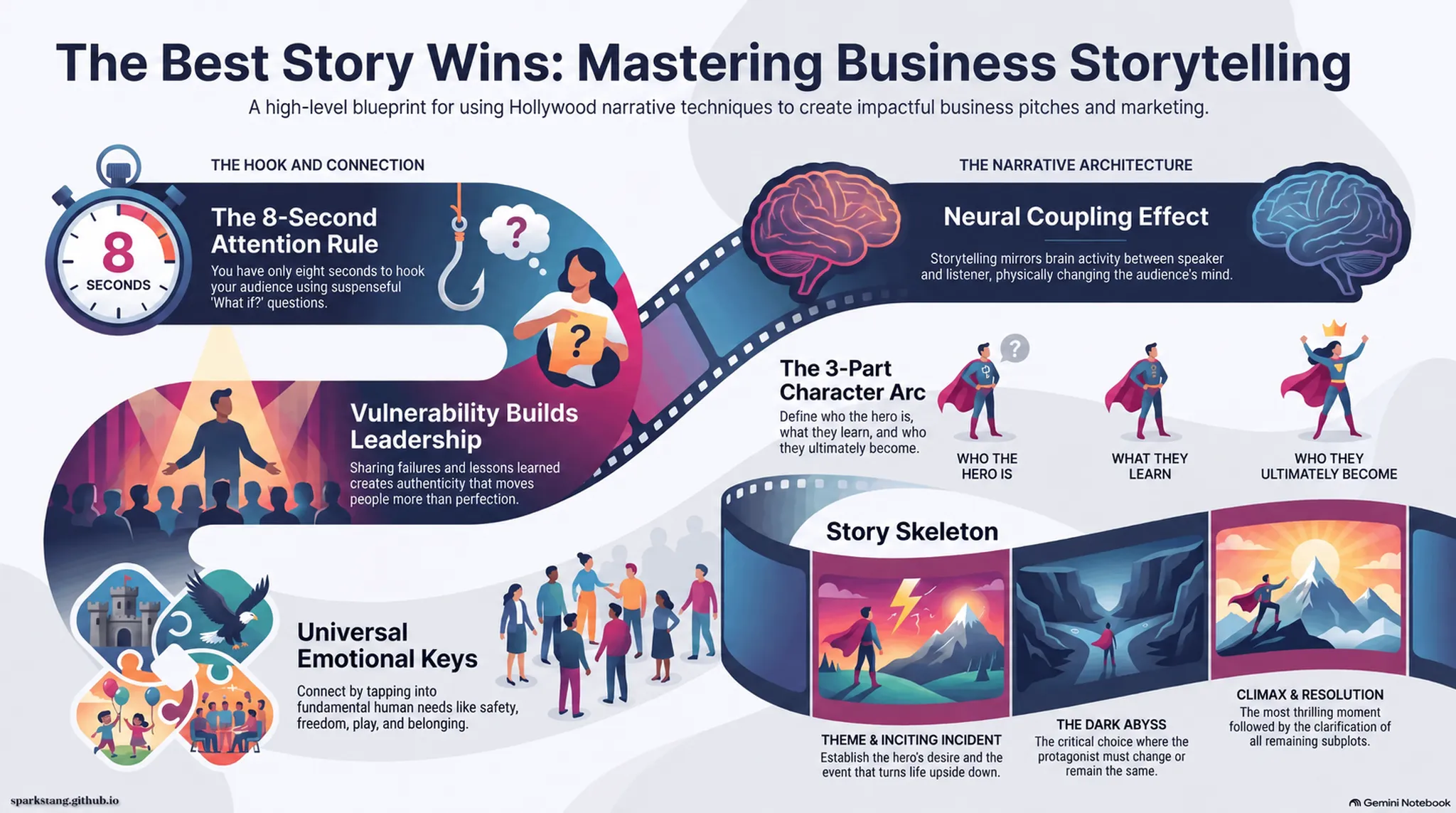
The average person’s attention span is only eight seconds, so you have just eight seconds to convince others that you are worth paying attention to.
Great stories and great things begin with suspense:
The Incredibles: What if superheroes were banned from saving humanity?
Ratatouille: What if a rat wanted to become a chef in a French restaurant?
iPod: What if you could carry a thousand songs in your pocket?
Tesla: What if you could create a beautiful electric car?
A salesperson once sold insurance using a dented computer: the dent was accompanied by a story about a car accident that highlighted the company’s strengths.
The four elements of a story premise: hero, goal, obstacle, transformation.
An elevator pitch should therefore be a mission statement containing the above elements.
The four elements in Monsters, Inc.: Sulley, save the child, being fired and losing his best friend, discovering the truth.
An example of a company mission statement:
Facebook: everyone; help people build communities and bring the world closer together; the world is too large to stay connected easily; people can stay connected and learn about major events in the world and the things that matter to one another.
The Turning Point
The Disneyland plaque reads: “Here you leave today and enter the world of yesterday, tomorrow and fantasy.”
Walt’s brother thought what he was doing would bankrupt the company. Walt persisted, using television programs to promote the park and stories to inspire people to change.
Stories can change minds because of neural coupling: the brain activity of the person telling a story and the person listening to it mirrors one another.
A couple who had spent years trying to conceive, had lost hope, and had fallen into a relationship crisis watched Up, a film about trying to conceive, and chose to stay together, discovered other passions, and unexpectedly had a child.
The author’s grandfather built a huge electric race-car track in the basement of the toy store, allowing players to test the toys, overcome fear, and experience transformation.
Stories encourage imitation, based on the same principle as the hotel sign that says, “50% of guests who stay in this room reuse their towels.”
Jobs used a story to make Pixar focus on its core business: when Apple had just been founded, he loved going to a sandwich shop because the sandwiches were exceptionally good. Later, the owner started adding coffee and pastries in an attempt to expand the business. It became ordinary, while the sandwiches became worse, and the shop closed within a few months.
The hero’s character arc: it begins with an ordinary day / the hero enters an unfamiliar world, collides with other characters, and encounters challenges / the hero returns to where it began but has changed significantly.
It can be reduced to: who the character is / what the character learns / who the character becomes.
For example: a proud race car / learns to care / a race car with empathy.
Combined with the character arcs of supporting characters, the proportions among the three stories should ideally be 60/30/10.
Key points of this chapter: suspense can attract attention; only 15% of people love adventure, while the rest need more motivation; stories can inspire change; stories are not limited to films and books, and successful companies can use them too; the changes a character experiences constitute the character arc; the essence of a character arc is not the events or obstacles, but how the character struggles to preserve the values and passions under threat.
The Emotional Key
A classic example: after Walt Disney died, a pre-recorded film was shown to selected employees no later than two years later, and everyone was moved to tears.
Know your audience: the author wanted to reopen the family toy store, which had been closed for several years, so he learned as much as possible about the landlord he needed to meet. The two exchanged family stories, and in the end the other party was moved.
Universal themes can touch everyone, so this was what the author focused on creating while at Pixar. He classified them into six major themes: love and belonging, safety and security, freedom and spontaneity, power and responsibility, play, cognition and understanding.
Finding Nemo: the protagonist wants to give his son safety and security.
The Incredibles: Mr. Incredible is bored with his job and wants the freedom to be a superhero.
Inside Out: Joy is full of fun, but learns that a complete life means willingly accepting all emotions.
Ten years after Disneyland opened, its child customers had grown into teenagers. Walt asked his daughter what made her want to go to the park, and she said, boys. Walt therefore created nighttime hours at the park, and attendance multiplied: finding ways to respond to audience expectations is extremely important.
Key points of this chapter: to move a broad audience, use fear and desire; it cannot be reduced to a single formula.
Genuine Connection
Without authenticity, a story loses its magic: an honest story must reveal vulnerability and truth, and every rise and fall is indispensable.
At a financial institution, a group of employees wrote about how they had found their current jobs. To the author’s surprise, no one wrote about setbacks. Every story was boring enough to put you to sleep until the author began guiding them.
In 1960, Avis, then the No. 2 car-rental company by market share, ran an advertisement saying that because it was second, it worked harder. It eventually became the market leader.
Vulnerability is precisely what makes someone a leader and a hero. It is different from self-deprecation or playing the victim. What should be shared is trying something new, failing, and gaining a lesson from it.
Prompts for authentic stories: When were you at your bravest / most embarrassed / when did you first experience the value of teamwork?
These memories help construct stories: Finding Nemo was made by the director based on his experience of becoming a father for the first time; the creator of Cars had a father who was an auto mechanic; Inside Out came from the director’s experience of his adolescent daughter becoming unhappy.
While being vulnerable and honest, you must also restrain yourself from preaching and appeal to emotion. Director Frank Capra said: I used to think drama was when the actors cried, but real drama is when the audience cries.
The trick: let people find the lesson themselves, like solving a puzzle, rather than telling them what to think. A spark begins when two electrodes come very close without touching.
A true mission statement is something other people can feel. You feel happiness when you enter Disneyland, yet you have never heard what Disney actually wrote in its mission statement.
People will forget what you said or did, but they will not forget how you made them feel.
Key points of this chapter: empathy and authenticity can create powerful emotional connections; showing vulnerability is at the heart of storytelling; persistence matters more than success; let the audience discover the message and meaning for themselves; a mission statement is something people feel rather than something they are told.
The Story Skeleton
Great storytellers, from Shakespeare to Spielberg, all pay attention to the three-act structure. Take Steve Jobs’s product launches as an example:
Beginning: how the phone he created solves the world’s problems.
Middle: demonstrate how the phone is smarter than a computer, and how the team overcame difficulties in creating it.
End: demonstrate how the user experience is revolutionary, sending the crowd into a frenzy.
The film industry breaks the beginning, middle, and end into six stages:
Theme: who the protagonist is, what they want (there should be a clear desire), why they want it, and where it takes place.
Inciting incident: the protagonist gains or loses something they love, turning life upside down.
Things get worse: the predicament becomes increasingly complicated as the protagonist tries to put life back on track.
The dark abyss: the protagonist must choose, based on what they have learned, whether to change (a positive ending) or remain stubbornly unchanged (a tragic ending). There is often a maxim to motivate them: Ratatouille is “Anyone can cook”; Star Wars is “Use the Force.” This is where the story’s tension reaches its highest point. When the protagonist overcomes the dark abyss, it is as though their greatest weakness has become their greatest strength.
Climax: the most thrilling moment of the story, when the transformed protagonist defeats the opponent; the protagonist must deliver the ultimate, decisive blow.
Resolution: everything that has not been made clear is clarified, including the supporting-character subplots. In romantic comedies, this may mean meeting the groom’s best friends and finding true love; in action films, the villain may be imprisoned and the police protagonist reunited with his father. In Star Wars, Han Solo receives a medal from the princess. This makes the terrible reality that “the story has to end” easier to accept.
Practical demonstration:
Once upon a time: theme
Every day: theme
Until one day: inciting incident
And because of that: things get worse
And because of that: things get worse
And because of that: things get worse
Until finally: the dark abyss and climax
And ever since then: resolution
Finding Nemo
Once upon a time: a clownfish loses his entire family, with only his son Nemo surviving, and vows never to let anything bad happen to him.
Every day: he protects his son from danger, but his overprotectiveness makes his son unhappy.
Until one day: his son swims to the surface and is captured by a fisherman.
So: he searches for the fisherman’s boat and meets Dory, who says she knows where the fisherman is.
Because of that: they search for Nemo together and encounter danger.
Therefore: Dory is injured, and the protagonist must save her.
As a result: they find what they believe is Nemo’s dead body. The protagonist is devastated, but Nemo is actually pretending to be dead to escape. Once he gets out, he goes looking for his father. When the three fish reunite, hundreds of fish have been captured, but Nemo knows how to escape. The protagonist trusts his son, and eventually all the fish are freed.
From that day on: although the ocean remains dangerous, the protagonist lets Nemo enjoy his freedom.
Walt Disney
Once upon a very long time ago: Walt grew up in a poor but strictly disciplined family.
Every day: he delivered newspapers, did his homework, completed his chores, and then happily drew.
Until one day: a classmate introduced him to vaudeville and animation, changing his life forever.
Because of that: while in high school, Walt enrolled in Saturday drawing classes at the Kansas City Art Institute.
So: he set his sights on becoming a cartoonist and became the director of several animated shorts, but because he was too naïve and did not understand business, the copyright was unfortunately taken from him.
Therefore: he later worked with his business-savvy brother to protect the creative rights to all their story characters.
As a result: the Mickey Mouse character he created became hugely popular. He went on to release Steamboat Willie, the first fully synchronized cartoon, and Snow White, the first animated feature film.
From that day on: Disney became one of the world’s best-known and most beloved brands, creating animated and live-action films as well as theme parks, and providing people of all ages with fantasy and joy.
A fictional autonomous-car company
Once upon a time: someone invented the automobile, making travel and transportation faster and more efficient.
Every day: more cars were produced, more roads were built, more people wanted to use cars, more companies used them for transportation, and the world became more closely connected.
Until one day: there were too many cars, causing traffic jams, toxic fumes, and mass casualties; in 2013, 1.25 million people worldwide died in car accidents.
So: scientists and engineers began thinking about solutions.
Because of that: technology and software emerged to support autonomous driving and eliminate tragedies caused by human error.
Therefore: various obstacles and challenges were addressed by regulation, insurance, and autonomous vehicles.
As a result: one company successfully developed and tested a product, taking autonomous-vehicle technology to a new level and promising a better driving experience.
From that day on: the company continued expanding the capabilities of autonomous vehicles, making transportation safer, faster, and easier for everyone.
Save the Cat
The hero is the core of a narrative. Regardless of which side they fight for, great warriors would have been regarded as heroes by the ancient Greeks: they are the vehicles through which stories are told.
New things in the living environment—including computers, networks, robots, and spaceships—inspired stories such as The Social Network, Blade Runner, Star Wars, and Saving Private Ryan.
The Hero with a Thousand Faces defines a hero as someone who devotes their life to something more important than themselves.
Good ways to create a hero people will like:
Share their childhood, because we were all children once.
Start with childhood: as a child, the heroine of Moana uses an olive leaf to protect a baby sea turtle.
Make them an orphan: Bambi, Harry Potter, Ready Player One.
Comparison: more evil characters make even a bastard seem likable.
Ordinary human traits make people relatable, and the same applies to politicians: Obama plays basketball; Reagan liked jelly beans.
Hope and optimism: during the struggle, at least a small part of them believes success is possible.
Inner integrity, with acts of kindness toward people of lower status: the protagonist of The Incredibles is extremely arrogant and unlikeable until he helps an old woman rescue her cat from a tree.
The protagonist thanks the partners who help them achieve their goal through praise and gifts.
Heroes can fail, but they never give up. The author’s favorite movie hero fails for about 80% of the entire film.
Heroes usually have to be good communicators, willing to speak honestly about their feelings, especially in times of hardship, and then experience an epiphany through what they discover. (In Up, Carl loses everything and, while looking through an album of photos of his late wife, sees a handwritten message from her: “Thanks for the adventure. Now go have a new one.”)
Heroes are decisive: when urgency demands a decision, they must act without hesitation.
Beyond the hero taking action, you also need other characters to create a good story, including mentors, allies, and villains.
Character Diversity
Herald: announces the change, much like the head of the art-school department who told the author he had been hired.
Threshold guardian: tests the hero as they begin their journey, much like the HR department at The Simpsons.
Mentor: guides the hero, much like the author’s director.
Ally: helps the hero overcome obstacles and achieve the goal, much like the author’s fellow animators.
Trickster: brings humor to the story and challenges the status quo, much like one of the author’s fellow animators.
Shapeshifter: appears to be an ally at first, then betrays the hero.
Shadow: the hero’s main obstacle and external threat, also known as the villain, much like the associate director who often gave the author a hard time and whom the animators drew as a tyrant.
Not all of these are necessary, but these character archetypes appear so often and are so important: without a giant, David is just a punk throwing stones.
The shadow does not have to be evil: in Inside Out, the force obstructing Joy is Sadness; sometimes the force obstructing the protagonist is a policy or nature itself.
A way to develop characters: summon up dusty memories and write down the people you have liked most in your life, such as teachers and friends or relatives. They do not have to be human; they can include animals or even inanimate objects, such as the product in a Steve Jobs keynote.
The inspiration for Toy Story 3: a five-year-old child lost his toy rabbit and bought an identical one the next day. The author wondered what would happen if he found the original one. In the story, a toy discovers that it has been replaced by another identical toy and is devastated.
The following traits help create any fully fleshed-out character: passion, fear, positive qualities, appearance, flaws, dark side, admirable qualities.
Inspiring Creativity at Work
Three elements:
Change the physical environment: the setting affects mood and creativity, and the environment determines how frequently employees interact.
Eliminate the fear of failure: the author proposed more than a thousand ideas that never made it into a film, but they inspired other ideas or turned into completely different points of view that later had an impact. All of this is part of the creative process. Just as a company must test a product thousands of times before production, new ideas need to be tested as well, so employees must be given the right to take risks.
Encourage innovation: many startups that were once bursting with creativity become complacent after achieving great success. Innovation requires breaking out of the usual framework. As Ford supposedly said, if you ask people what they want, they will say a faster horse.
The best way to retain employees is to make them feel that they are learning and growing, including giving them courses, encouraging entirely new experiences, providing educational funds, and encouraging them to create their own projects.
Winning Secrets
The secrets to becoming an excellent writer:
Write every day.
Read.
Schedule your writing time in advance.
The first ten minutes of writing are the hardest; writing anything is easier than writing nothing.
Are you a “pantser” or a “plotter”? Planners map out the story in advance. Before putting pen to paper, they need to know where the story is going and have a broad structure to keep it moving. Sprinters keep writing without a plan, believing the story will gradually unfold during the writing process, creating spontaneously from inspiration. Both can produce good stories; knowing which suits you better is more helpful.
Exercise for sprinters: set an 11-minute timer and try to write as quickly as possible. Write freely without revising or worrying about whether it makes sense.
Exercise for planners: take a boring article and turn it into a story, as though a major film studio had hired you to turn it into a blockbuster. The famous director Alfred Hitchcock said that drama is nothing more than cutting out the boring parts of life.
Act as quickly as possible, and try to see how fast you can get to the ending.
Words: do not describe; show through action (“The masked man smashed the rear window” vs. “Robberies increased”); mix long, medium, and short sentences to let the writing breathe; reduce adjectives and adverbs; try cutting what you have written in half and see whether it becomes better.
Editing and rewriting: an English children’s author has said that she revised and polished a piece 150 times.
Finished reading on May 28, 2025
Thank you for reading until the end. This is a bonus infographic just for you.