Notes on The Idea: The Seven Elements of a Viable Story for Screen, Stage or Fiction
The Idea: The Seven Elements of a Viable Story for Screen, Stage or Fiction by Erik Bork
Original notes here.
Read until the end to get a bonus. Enjoy reading.
The author is a Hollywood screenwriter and producer who has worked on projects such as Band of Brothers and Apollo 13.
This book explores the kinds of ideas that allow writers to reach a broad audience, including commercial fiction, plays, and mainstream films; niche art films, experimental films, literary fiction, and other works outside the book’s main focus
Today, with self-publishing, video, and social media everywhere, reaching a broad audience with your work still requires agents, publishers, producers, and major companies working behind the scenes, much as it always has. When this does not happen, the problem is often that the work has failed to create an idea that emotionally grips an audience and strongly appeals to the masses
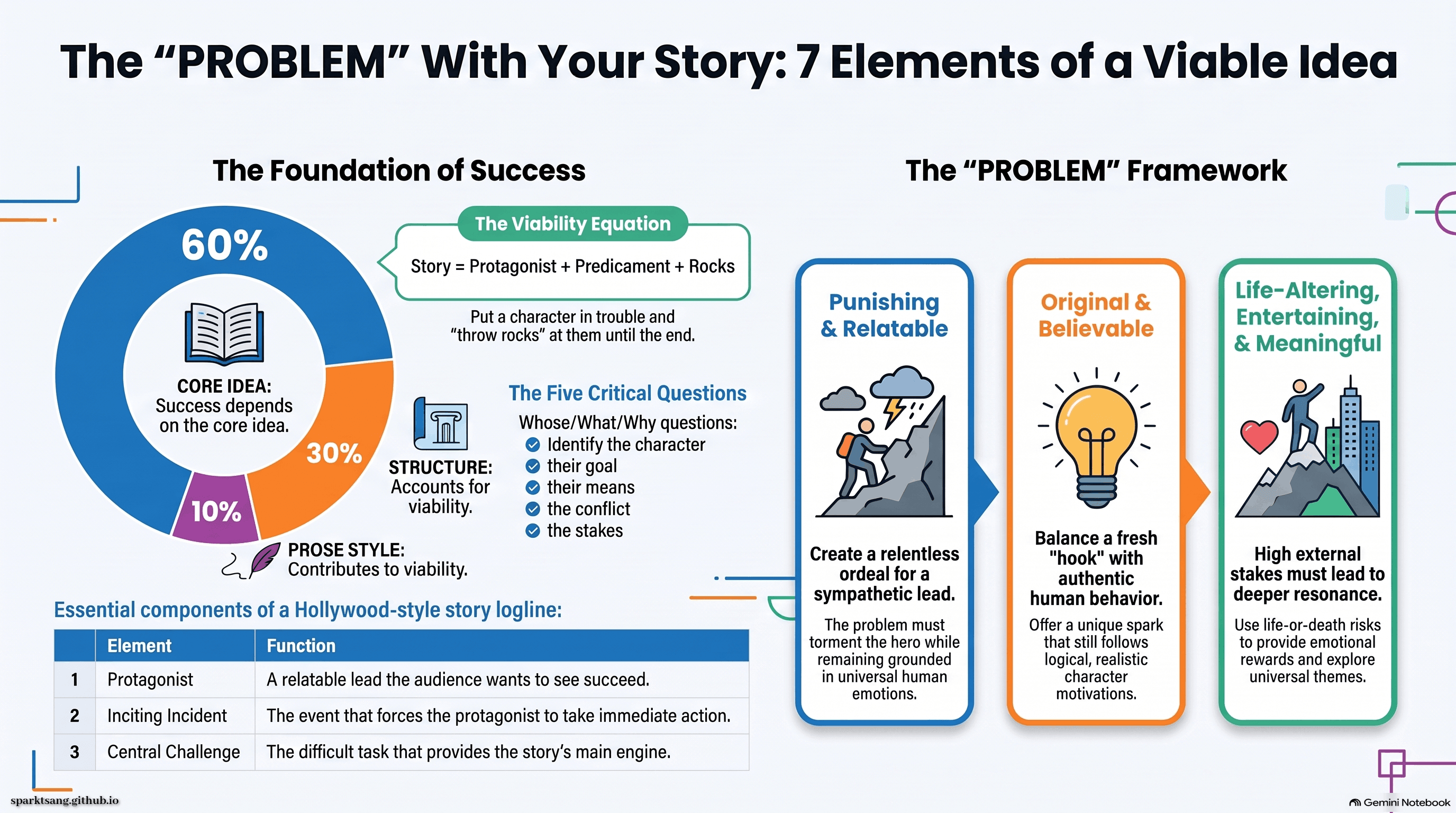
The main problem is not an obvious lack of professional writing ability, but that the basic idea of the story is not attractive enough. That basic idea comes from the answers to five questions:
Whose story is this, and why should we identify with them?
What does the story’s character want?
What means will they use to achieve it?
What are they trying to solve, and why is it so difficult?
Why does this matter to the character and to the reader?
The Core Idea
Few writers consult other people before committing themselves to writing, which is why so many works contain the major problems identified in this book
The 60/30/10 Rule: sixty percent of a work’s success depends on the core idea, thirty percent on the structural choices (that is, what goes into the outline), and only ten percent on the actual wording (the narrative style and dialogue)
The core idea must follow the seven elements of PROBLEM:
Punishing: The story’s central problem must continually torment and punish the protagonist, with the attempted solutions and the process of solving it repeatedly making things worse. The problem must be large enough to require the entire story to resolve
Relatable: The protagonist needs to be easy to identify with, so that the audience feels that their problems are our problems
Original: There must be something fresh, with a distinctive spark
Believable: It should be easy to hear, read, understand, and accept as part of the world, with a sense of reality. The characters’ actions should be driven by human desires, needs, and behavioral patterns, unfolding naturally rather than making the audience question or become confused
Life-altering: The external challenges the characters face must make their lives progressively worse if their problems remain unresolved, and dramatically better if they are resolved, restoring their lives to normal
Entertaining: Create emotions that the audience inwardly longs to experience
Meaningful: When the audience leaves, they should feel that their lives have gained something, that they have explored something meaningful, and that what they received was worth more than the time they spent
The seven elements sound simple, even self-evident, but they are not easy, because it is difficult to satisfy all of them at once. This explains why so few authors achieve real success
Hollywood story loglines usually use one or two concise sentences to describe the story’s central problem, such as: A smooth-talking German businessman makes a considerable profit but cannot accept what is happening to Jews, so he begins hiring them and does everything he can to help them escape (Schindler’s List, Spielberg); exaggerated situations with obvious entertainment value are often framed as “What-If” premise, such as: What if there were a theme park filled with out-of-control dinosaurs? Stories that lack the seven elements often reveal the problem in the logline itself
A good logline usually contains three major elements: first, you quickly know who the protagonist is, allowing the audience to find something relatable; second, the inciting incident, the event that forces the protagonist to act and changes everything; third, the nature of the challenge they must face—the task they have to solve, and its difficulty and importance
For example: After a Mafia boss is shot, his youngest son decides to take over everything and eliminate the traitors hidden within the family (The Godfather)
Four types of screenplay outlines: logline, a one- or two-sentence summary; synopsis, a 150- to 300-word plot summary covering the setting, protagonist, and predicament; outline, a three- to eight-page presentation of the story’s overall shape, usually without subplots; treatment, a longer outline that presents the full character of the work, including narrative style, artistic techniques, and subplots
Punishing
Audiences love watching other people go through terrible ordeals. The worse things become for the characters, the more invested the audience becomes; we become emotionally bound up with the protagonist’s attempt to turn things around, hoping they can escape their predicament
As legendary Broadway writer George M. Cohan put it, in Act One you put the protagonist in trouble, in Act Two you throw rocks at them, and in Act Three you get them down: story = protagonist + predicament + rocks
In 2013, an anonymous professional reader whose job was to read scripts for major film and television companies described the common problems he found in the 300 film scripts he had been paid to evaluate. Three of his top ten problems were: the story starts too late (showing that the problem is not difficult enough), a lack of meaningful conflict, and conflict that is unreasonable and disappears almost instantly
Many stories fail because the problem is not difficult enough to drive the engine of the story. Even in comedy, the problem needs to appear enormous, beyond the characters’ ability to handle, such as: After a drunken bachelor-party binge in Las Vegas, three groomsmen discover that the groom is missing and have to retrace everything that happened the previous night so they can find him in time for the wedding (The Hangover)
The principles that make a game exciting can also be applied to a good story: the game is extremely difficult and appears hopelessly one-sided; the players’ stories are compelling, containing adversity and an uplifting quality that makes us want to know them; the stakes cannot be higher, with only one chance in a lifetime and the outcome changing the future of the team or players; they face unexpected difficulties and complex circumstances, with no way out and no lead to fall back on; the team remains passionate and perseveres to the end, recovering from countless crises; the game is nearly over while the score is still disastrously against them; the team comes from behind and produces a last-second winning moment
The difficulty of adapting real events is finding one clear, coherent problem that remains present from beginning to end and only grows more difficult; excessive fidelity to history can make it hard to find a dramatic point of leverage
The five-point Punishing checklist: a major problem that requires the entire story to solve; seemingly almost impossible but not truly impossible; the protagonist repeatedly pushed beyond their limits; actions that produce unexpected consequences, complex problems, and conflicts, requiring still more to be done; the problem explodes within the story and appears completely out of control, leaving only one final battle and an all-out effort to solve it
Relatable
While tormenting the protagonist, you must also work hard to make the audience feel strongly about the character, so that the audience merges with the protagonist and experiences events alongside them. Two things are important here: first, make the character someone the audience can relate to, sympathize with, be fascinated by, or want to see succeed. Part of this comes from who they are, and part from the problem they face. The more often they are knocked down, the easier it is for the audience to feel something for them; second, tell the story from the character’s point of view, allowing the audience to understand and share the character’s perspective, emotions, direction of effort, and values
The protagonist is usually not mysterious. If things remain unclear, the audience may lose its emotional connection
The protagonist should actively participate in major events and persist. The audience becomes invested because of the struggle and immediate reactions involved in pursuing a solution
In Blake Snyder’s screenwriting book Save the Cat!, he proposes ten types of story premises that can be used in developing ideas, such as “an ordinary person gets into big trouble.” The author likes this approach because it can hit the emotions and make the audience feel something
The author concludes that successful stories often have protagonists who resonate with audiences because they are dealing with one of eight kinds of problems:
They are being put in mortal danger; someone is trying to destroy their life; they have a once-in-a-lifetime, enormously challenging opportunity that could transform them into a major figure; they must rescue someone from a terrible fate; they must win a seemingly unattainable prize that will change their life; they must defeat a great villain who is harming innocent people; they must escape a situation in which they cannot live freely; they must win the ideal life partner
It is better for the protagonist to be likable; otherwise the audience feels there is no reason to care about them or want them to succeed. The less likable the protagonist, the more compensating factors need to be built in, such as extremely high stakes, extreme suffering, saving lives, or an engaging plot
A way to make protagonists likable in romances is to have them genuinely want what is best for the other person, to the point of being willing to give up their own interests
The relationship between audience and protagonist is special and fragile. To attract attention, the character must be especially sympathetic, whether through heroic acts, facing enormous problems, or dealing with the most dangerous situations
Otherwise, there needs to be a clear character arc, with substantial growth that allows the audience to forgive the character’s bad behavior at the beginning. Note that even in Liar Liar, the protagonist is good to his child and is not completely evil
Many successful films have no pronounced character arc. Their protagonists are good people from beginning to end, yet they still grow, so the recommendation is not to treat the arc as the primary goal
There is nothing wrong with using an inciting incident at the opening to explode the problem into view, but creating audience identification is even more important. Before that, therefore, you should first use highly entertaining, high-conflict material to clearly establish the protagonist’s existing situation and make the audience like or even care about them
The five-point Relatable checklist: the protagonist should be likable; the external problem should be relatable at a fundamental, universal human level; their thoughts, feelings, and desires should be clear and shareable by the audience; the story should produce outcomes the audience can support or feel for; if there is a character arc, it should concern the protagonist breaking through their own limitations (but not changing from selfish to selfless)
Original
There needs to be a subtle balance between old and new. The writer needs a unique voice while also satisfying the other fundamental conditions; the formula does not mean the author is trapped inside a set of rules
Literary agent Victoria Wisdom: build on the foundation of a successful film genre you want to emulate
Ideas do not necessarily have to be highly original, because you will discover that 99% of the directions you want to try can be ruled out; talented successful creators over the past several decades have already exhausted themselves trying to find new possibilities within the same kinds of work
One way is to combine two kinds of texts, such as Twilight, which combines vampires with teenage romance
It is unlikely that two works will be truly identical. If it does happen, you should test-read, clarify, and uncover what is unique about your own idea
Maintain your own distinctive voice. Do not allow yourself to be influenced too easily, but do not shut yourself off from outside input either; the balance matters
Screenplays that satisfy every element of successful drama are extremely rare, and most people who try screenwriting never reach that level. Most film-production decisions are supported by commercial considerations, but that does not mean they cannot be wrong. This is partly why some people feel that the market is flooded with terrible movies
The five-point Original checklist: the work is viable while incorporating interesting new elements; the core set piece has an easily understood hook; there is something I love that reflects my uniqueness and voice; the concept is clearly different from other well-known works of the same type; the key characters are distinctive and can elevate the story beyond what audiences are already familiar with
Believable
It is not impossible to get an audience to accept an unusual premise, but they are generally willing to do so only once, and it should be explained cleverly within the first 10–15% of the story. For example: the world has been taken over by machines, which have created a virtual-program world and are siphoning humans for electricity; wizards really exist, and they even have a school
After that, the characters’ words and actions should resemble what most people would do under the same circumstances. It must feel real for the audience to become immersed
Sometimes it is easier to ask the audience to accept a variation on something that already exists than to accept an entirely new situation; at least then they will not be unable to understand or become confused by what they are seeing
The rule about not confusing the audience is just as important as not boring them. The ideal way to explain the story is through action: if you need to tell the audience that two characters are married, show it in a way they can see, such as having them sleep in the same bed. You should also limit the number of facts the audience needs to know. Explaining everything through plot slows the pace, so complicated backstory may need to be simplified first; world-building should be simple and clear
If the story world differs from the real world, the difference needs to be clarified from the outset. Audiences are not naturally interested in fantasy worlds; what matters is the goals and difficulties within that world that concern everyone
Even exaggeration, as in comedy, needs to feel real, so the audience can understand why the characters act as they do. While preserving originality, the writer must constantly ask: Would this character really do this in these circumstances? This includes the villain’s behavior and motives
A sense of reality lies in detail. Finding interesting details is one of the writer’s major responsibilities. Characters, like real people, should contain many contradictory emotions, so that the audience feels their depth and dimensionality
The five-point Believable checklist: people immediately understand the story when they hear its outline and are willing to accept it; the characters’ traits, decisions, and actions all feel highly authentic; the backstory and rules of the world are simple, clear, and easy to grasp; the motives behind everyone’s actions are clear and reasonable, making it easy to become emotionally invested; even if something seems incredible, it still feels as though it really could happen
Life-altering
There must be stakes, especially stakes involving major changes in a person’s life, so that the journey is worth taking part in
Internal stakes are not enough. The most exciting and compelling thing audiences invest in is still enormous external risk, though the inner journey can add depth
The greatest risk is life and death. That is why more than half of stories involve life-or-death stakes, and fighting for justice can also provide stakes high enough
A common problem is that the stakes in the story are not high enough, followed by a sudden life-or-death situation. If you introduce the risk of death, you must carry it through consistently
Other high-stakes plots include freedom or autonomy (such as 12 Years a Slave), returning to family or a way of life (such as Gone with the Wind, Finding Nemo, and The Wizard of Oz), finding fulfillment with an ideal partner, a better career (such as The Pursuit of Happyness), a life-changing prize, and breaking through a predicament (such as Inside Out)
Situations with insufficient stakes include achievements that are not enough to significantly change one’s life, merely succeeding at work, internal growth, a military campaign lacking a unifying mission, happiness that is too ordinary, and characters who cannot inspire sympathy
The challenge needs to be distinctive. The protagonist has no choice but to take the risk and change because of the “inciting incident.” Their initial attempts merely treat the symptoms rather than the root cause, so they fail repeatedly. For roughly three-quarters of the story, there is almost never a breakthrough. Finally, they make a desperate last stand, involving a transformation and growth that will remain with them for life, creating an emotionally powerful impact
The five-point Life-altering checklist: the stakes are sufficiently high; the problem is manifested through external risk; the risk runs throughout the entire work; the consequences of failure are clear, the stakes continually increase, and they are tied to fundamental human concerns; it is a once-in-a-lifetime opportunity that requires transformation
Entertaining
People pay for entertainment experiences and emotional rewards; entertaining the audience means temporarily taking them out of the normal rhythm of life and giving them an engaging emotional uplift
The writer must first fall in love with the work and want to manipulate the audience’s emotions
High entertainment value is the trump card, and from a commercial perspective it far outweighs the other six elements. Successful good stories usually satisfy all seven elements comprehensively, but aside from entertainment value, only Punishing seems absolutely indispensable
Entertainment emotions include amusement, fear, fascination, shock, desire, excitement, wonder, romance, empathy, and anticipation
If there is no life-or-death danger or detective element, you need to create an additional level of interest that gives the audience an experience beyond ordinary life, such as comedy; the rich, famous, and beautiful; groundbreaking experiences; major betrayals, double-crosses, and conspiracies; music; spectacular visuals, conflict, and emotion; crazy characters; a compelling other world; or the light of love or family amid major conflict
The five-point Entertaining checklist: be clear about what emotional experience you want to give the audience; the central task is to give the audience the experience they deserve for paying; provide things beyond everyday life to attract them; create fundamental, universal, emotional connections that make them feel; surprise them through the ending and the characters, keeping them glued to the story and immersed in it
Meaningful
What is the story really about? In other words, what meaning does the story bring, both for the characters and for the audience
As the story develops, the theme gradually takes shape. The theme is hidden behind everything, yet it is difficult to state directly
The premise of Dramatica’s theory of screenwriting: a complete story has four throughlines, and each must explore the conflict between two opposing values: the protagonist’s personal story; the overall objective situation; the impact character who fundamentally changes the protagonist; and the relationship between the two characters, which is also the relationship in the story with the most spark, greatest importance, and deepest meaning
Works reflect life. Passion drives creation, and creation is an opportunity to express judgments about beliefs and values—in other words, the author’s point of view and voice
Ten Oscar Best Picture winners or nominees with deep themes: The Wizard of Oz, Little Miss Sunshine, Brokeback Mountain, The Aviator, A Beautiful Mind, E.T. the Extra-Terrestrial, American Beauty, L.A. Confidential, To Kill a Mockingbird, Unforgiven
Ten ways to give audiences something deeply meaningful: offer a new perspective; inspire them through the characters’ struggles, victories, and transformations in their own lives; move them through kindness; issue a call to action; help them understand and appreciate what others have experienced; let them recognize similarities with themselves and understand themselves better; let them see other people’s lives and gain a new direction; let them view the world, problems, and human nature from a broader perspective; let them witness others taking action and want to change themselves; offer hope and support, so that the audience feels they are not alone
The five-point Meaningful checklist: explore universal, important human questions; drive characters through unmet fundamental desires and needs so that they can grow and change; make the transformation of the story give the journey value; make the work distinctive enough to have a positive impact; make it compelling while carrying a deeper resonance beneath the surface
In the final chapter, the author explores ways to stimulate creative inspiration and argues that what determines success is not talent or innate ability, but attitude and action
Finished reading on July 12, 2024
Thank you for reading until the end. This is a bonus infographic just for you.