Notes on Socrates, Buddha, Confucius, Jesus
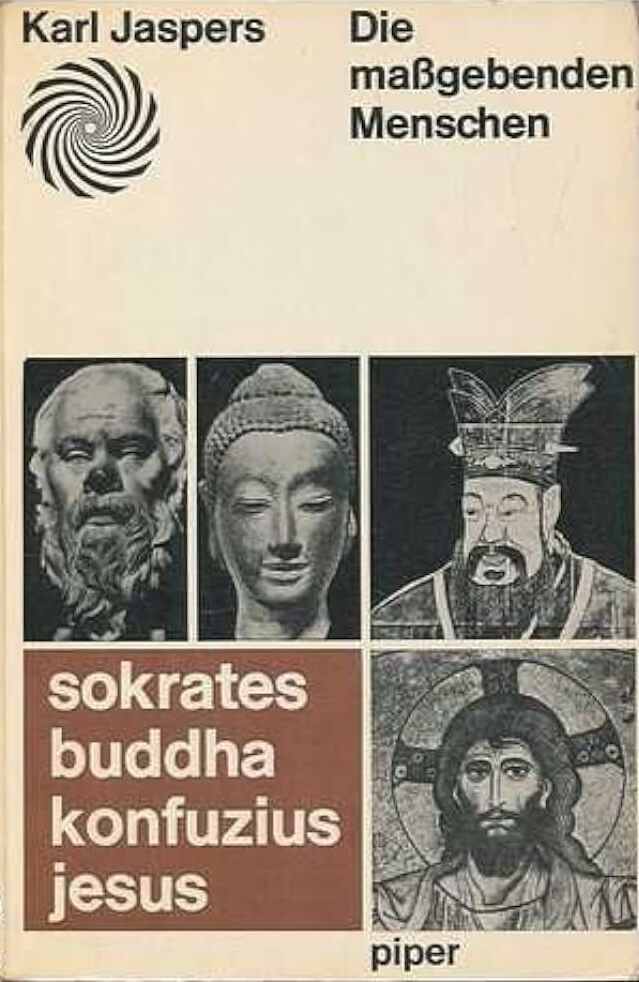
Socrates, Buddha, Confucius, Jesus by Karl Jaspers
Original notes here.
Read until the end to get a bonus. Enjoy reading.
Translator’s note: This is the book that has influenced me most deeply. When I translated it in my youth, I had to take a long period of rest after finishing each figure before I could digest the revelations and shocks it had stirred within me. Many years have passed, but I still feel the same way.
Socrates
He put forward no doctrine and advocated no particular method. He began with no preconceived beliefs, but demanded thought and questioning, leading people back to themselves as though this were a sacred task.
He spoke only with individuals: those who devote themselves exclusively to addressing crowds lack confidence in their own lives.
The foundation of his life was “reverence”: first, truth will reveal itself to those who continually question, and acknowledging one’s ignorance makes genuine knowledge possible; second, faith in the gods of Athens and in the sacredness of the polis; third, a profound belief in the voice of the daimonion (inner divine voice), which at critical moments would tell him that he must not act.
The Maieutics (spiritual midwifery): his mother worked as one, and Socrates compared himself to her. What was being delivered was knowledge. He did not impart wisdom; he enabled people to discover it. When someone believed himself to possess knowledge, he made him recognize his ignorance and guided him toward discovering genuine knowledge within himself.
The polis was founded on law, and he remained unfailingly loyal to it. He refused to escape from prison and calmly accepted death. It never occurred to him to rebel against the polis or disobey the gods.
The sophist Hippias’s reaction helps explain why Socrates inspired such widespread hostility: he mocked others, questioned and tested everyone, yet never discussed himself or stated his own opinions. In 399 BC, he was tried on charges of “not believing in the gods of Athens, despising the laws, and corrupting the young.”
Everything said about death is grounded in ignorance and ends in ignorance. Those who fear death imagine that they know what no one can know. At the moment of death, when one is confronted by profound sorrow, it becomes possible to liberate the soul and reveal a great and compassionate peace.
In Plato’s portrayal, he sometimes behaved very strangely: while walking with a friend, he might suddenly stop and remain motionless, lost in thought, standing there for an entire night and gazing into the sky, only leaving after praying to the sun the following morning.
The Symposium: Alcibiades: even a few words from you are enough to awaken and seize the soul of anyone.
After his tragic death, he remained deeply present in the minds of his friends. His disciples went on to establish their own schools, each claiming to be his true successor. In later generations, Socrates became a vessel into which people poured their own ideals. Even historical scholarship has found it difficult to reconstruct his original form.
The author: Perhaps we can say that without Socrates, none of the philosophical thought we have today would have been possible.
It is said that many people made astonishing progress after associating with Socrates, changing themselves completely. His thought allowed no one to shut themselves off from themselves. He had no patience for evasions that refused to express what was happening within. Toward those who blindly trusted fate, surrendered to instinct, or confined themselves within one-sided conceptions of human nature, he went straight to the heart of the matter and denounced their falsity. He opened the human soul and welcomed the crises brought about by that opening.
Buddha
At the age of twenty-nine, he abandoned wealth and status and withdrew into the mountains to practice asceticism. Realizing that asceticism was insufficient for attaining truth and thereby departing from Hinduism, he began fasting and restricting his food and drink. His companions regarded him as a traitor and abandoned him one after another, leaving him alone.
Under the Bodhi tree, he attained enlightenment: neither indulgence nor asceticism was the right path, and neither was sufficient to establish a wholesome result. He advocated the path of liberation: through contemplation, he clearly understood that all sentient beings suffer, and that escaping the web of suffering was therefore the most urgent task. Once merit was perfected, the suffering of rebirth would cease. The self does not exist; it is merely formed through the interwoven web of causes and effects.
He originally intended to remain silent, but could not bear to seek salvation for himself alone, and so began to preach. His influence came from the monastic community. Years later, lay disciples continued to join and contribute generously.
His knowledge could not be established through sensory perception or logical inference. It had to be attained through the purification of consciousness and the successive ascent of meditation.
Any knowledge unrelated to the means of liberation—such as whether the world is eternal or whether Buddhahood exists after death—was something the Buddha simply set aside.
There was nothing especially miraculous about his terminology, doctrines, concepts, or practices. Asceticism and celibate monastic institutions had already existed for many years. Buddhism’s extraordinary development can be attributed to the Buddha’s radiant personality, the completeness and radical thoroughness of his conduct, and his powerful sense of a self-conscious mission.
As Mahayana Buddhism developed, the monastic institution strengthened group consciousness and obedience to authority and doctrine. The Buddha was also elevated into a god, and people ceased to trust their own strength, contrary to the Buddha’s teaching: what brings liberation is knowledge discovered by the individual.
From its beginnings, Buddhism never recognized a boundary between philosophy and theology, nor did it encounter the gulf between free reason and religious authority. The two opposing problems never arose. Philosophy itself was religious activity. This tradition has continued to the present: knowledge itself is liberation and salvation.
Confucius
At thirty-two, he was appointed to teach the rites of antiquity. At thirty-three, he went to the capital, Luoyang, to study ritual customs and traditions. At fifty-one, he returned to political life and became Grand Minister of Justice of Lu. At fifty-six, he served as acting prime minister. With Confucius’s assistance, Duke Ding of Lu gradually increased his power. Fearing this, Qi selected eighty beautiful women skilled in singing and dancing, together with forty teams of fine horses, and sent them to the ruler of Lu. From then on, the duke neglected government and would no longer follow Confucius’s counsel. Confucius resigned his position and left the state, traveling among the various states for twelve years. He never found a ruler who would put his way into practice and died without seeing his ideal realized.
He held that learning and thought must complement one another: “I once went a whole day without eating and a whole night without sleeping, thinking. It was of no use; it would have been better to learn. To learn without thinking is to be lost; to think without learning is to be in peril.”
He admired the ideal rulers of antiquity (“Great indeed is Heaven; only Yao followed it”), yet he could not advocate a complete return to the past (“Born in the present age, yet returning to the ways of antiquity—such a person brings disaster upon himself”).
To a disciple who believed he lacked the strength to carry on, he replied: “Those who lack strength stop halfway. But now you are drawing the line yourself.”
His teaching method: “I do not enlighten those who are not earnestly trying to understand. I do not stimulate those who are not earnestly trying to express themselves. If someone cannot take one corner and infer the other three, I do not continue.”
Assessment involved not only what a student answered at the time, but also what he said and did afterward: “I spend the whole day talking with Yan Hui, and he never objects, like a fool. But after he has withdrawn, I examine his conduct in private, and he is quite capable of developing what he has learned. Yan Hui is not foolish at all!”
He believed scholarship depended on effort: “I was not born with knowledge. I love antiquity and am diligent in seeking it.” “When you see someone worthy, think of becoming their equal; when you see someone unworthy, examine yourself within.” “Hear much, choose what is good and follow it.” “See much, remember it all—this is next best to knowing.”
Learning must serve practical purposes: if someone can recite the Book of Songs fluently but cannot be entrusted with government, cannot successfully carry out a mission abroad, and cannot handle matters independently, what use is all that learning? (“Recite the three hundred poems; put him in charge of government, and he cannot succeed; send him on a mission to the four quarters, and he cannot answer on his own. Though he may know many things, what use are they?”)
Without learning, even virtue becomes obscured by mist: “To love benevolence without loving learning—the weakness is foolishness; to love knowledge without loving learning—the weakness is frivolity; to love honesty without loving learning—the weakness is self-harm.”
Ritual and music are fundamental norms, but they must be grounded in genuine feeling. When substance exceeds ornament, one becomes coarse; when ornament exceeds substance, one becomes superficial. (“If a person is not benevolent, what has he to do with ritual? When substance prevails over form, one is wild; when form prevails over substance, one becomes a mere clerk.”)
Respect excellence while accepting the multitude: “Praise what is good and take pity on those who are incapable.” “Honor the worthy and tolerate the multitude.”
Serve the ruler according to the right path rather than by flattery: when the state is well ordered, one should speak boldly and act boldly; when the state is disordered, one should still act boldly but speak with restraint. (“When the state follows the Way, speak boldly and act boldly; when the state does not follow the Way, act boldly but speak gently.”)
The translator points out that “Women and petty men are the most difficult to deal with” reflects the objective conditions of ancient society. Women in antiquity had no educational opportunities and no economic independence, and their horizons and breadth of mind were therefore severely constrained. Had Confucius been born today, he would only say, “Small men are difficult to deal with.”
Good government must care for the people: provide sufficient food, sufficient military strength, and the people’s trust. If one must be removed, remove the military first and food second; the people’s trust must never be abandoned. Yet when policies are designed, the people’s trust can only grow spontaneously; it cannot be demanded by force. One should first make the people prosperous and then educate them.
Sincerity: this is the way of Heaven. Making oneself sincere is the proper way for human beings. Sincerity means doing good without effort and apprehending what is right without deliberation. (“Sincerity is the Way of Heaven; becoming sincere is the Way of humanity. The sincere act without effort and attain without thought.”)
Pursue truth with perseverance and put it into practice: “What another man can do with one effort, I will do with a hundred. What another can do with ten, I will do with a thousand. If a man truly follows this way, though he may be foolish, he will become clear-sighted; though he may be weak, he will become strong.”
The character of the gentleman: concern himself with righteousness, not profit; remain calm and at peace; seek harmony without uniformity; be composed without arrogance; look inward to himself; be independent and self-reliant; remain untroubled in adversity and equally untroubled in prolonged prosperity; worry about his own inadequacy rather than whether others appreciate him; engage in no contention; be diligent in action and cautious in speech; never let his words exceed his deeds; act first, then speak. He does not waste time and energy on distant, empty abstractions, but grasps the present moment and lives in real life here and now. The burden is great and the road long, yet he knows that a journey of a thousand miles begins beneath one’s feet. (“The way of the gentleman begins with the relationship between husband and wife, and in its perfection extends to Heaven and Earth.”)
Between withdrawing from the world to cultivate oneself and entering the world in an effort to improve it, Confucius made his choice with complete clarity: “I cannot associate with birds and beasts. If I do not belong to these human beings, with whom should I associate?”
The Chinese Translator’s Note: Benevolence is the central concept running consistently through Confucius’s thought, and it has three levels. First, human nature: as long as a person is sincere, a power can arise from within that moves him spontaneously toward good—the meaning of “Is benevolence really far away? I desire benevolence, and benevolence is here.” Second, the human way: choosing the good and holding firmly to it; hence teaching according to individual aptitude, giving disciples the means by which they might choose the good. Third, human fulfillment: resting in the highest good. The author treats “the Mean” as benevolence; the translator believes this can be sustained if the Mean is understood as choosing the good and holding firmly to it.
Do not make unfounded conjectures, do not insist on your own views, do not cling stubbornly to fixed positions, and do not exaggerate your own importance. (“Do not be opinionated; do not be absolute; do not be rigid; do not be self-centered.”) The gentleman stands in the world with no particular person or position he must favor and none he must reject; he simply stands alongside righteousness. (“In dealing with the world, the gentleman has neither what he is set upon nor what he rejects; he follows righteousness.”)
Acknowledge the limits of knowledge (“To know what you know and know what you do not know—that is knowledge”), acknowledge the existence of evil in the human world (“Enough! I have not yet seen anyone who can recognize his own faults and condemn himself within”), and leave the supernatural undiscussed (“The Master did not speak of strange occurrences, feats of strength, disorders, or spirits”).
He regretted failing to achieve his ideal (“The gentleman is troubled that he may pass through the world without leaving a name. Our way does not prevail—how can I make myself known to later generations?”), yet he remained at peace with fate (“I do not resent Heaven; I do not blame others. I study what is below and thereby understand what is above. Perhaps Heaven knows me.”)
He stood in profound and fundamental opposition to Laozi. Laozi said that Heaven and Earth already possessed their constant order; by following the natural pattern endowed in them and proceeding along the course of nature, one could reach the goal. Why, then, struggle so desperately to promote benevolence and righteousness? (“Heaven and Earth indeed have their constant course … If the gentleman simply lets his virtue unfold and follows the Way, he has already arrived. Why labor so anxiously to proclaim benevolence and righteousness, as though beating a drum in search of a lost child?”)
The author believes that Confucius established human ethical order through good and evil, but never entered the realm beyond good and evil, whereas Laozi’s Dao stands prior to and above all things. The translator believes the following formulation is more persuasive: during the Warring States period, the world was in profound disorder, and human beings faced two crises—value nihilism and existential nihilism. Confucius addressed the former, arguing that human sincerity could awaken the power to act according to an inherently good nature and thereby reestablish values within human nature. Laozi addressed the latter, affirming that the Dao was the source and destination of all things and that human life was arranged through the Dao; therefore, human beings should cherish this life and experience the beauty of existence. There is no need for the two to complement one another. Each had its own central concern.
The decline of later Confucianism manifested itself in the following ways: an attitude of acknowledging the unknowable degenerated into superstition; it was transformed into utilitarianism, disregarding the value of independent personhood; the tension between benevolence and ritual, which implicitly contained the possibility of free norms, was transformed into ritualistic dogma; the openness of thought degenerated into doctrinal theories; and knowledge that had originally been embodied in inner action degenerated into rote learning.
Jesus
It is impossible to establish his historical reality on the basis of definitive historical sources; once critical historiography is applied, his historical authenticity can be entirely erased.
The most reliable thing is his eschatological message: the end of the world is approaching.
But the end is not merely a threat or destruction; it is also a promise: after the end comes the Kingdom of God.
It is not an event occurring within the world, nor a transformation from one state to another. Rather, history itself comes to an end.
He was not merely conveying a message. He demanded that people confront a choice: repent and believe the Gospel.
The present world has no meaning: “The world is a bridge; do not build your house upon it.” He also demanded that people sell all they possessed; he even required someone to give up burying his father in order to follow him. Those who loved their father and mother more than him were not worthy to follow him.
The commandments of God demand not outward actions but penetration into the inner soul: one must be pure.
Those who love God also love their neighbors. A neighbor is the person who is close to oneself in space and time and who needs one’s help; one should even respond to hatred with virtue.
He accepted the laws of the Old Testament but opposed legalism. One must seek the source of the law and fulfill its fundamental ideal.
He did not propose a new moral system. He simply distilled the norms of Scripture and proclaimed them with seriousness.
He was not particularly concerned with logical consistency. What he conveyed was not a system of thought, but a message displayed through signs.
At the time, a large crowd followed him to Jerusalem, forming a mass movement. There are two conjectures: first, that he believed the Kingdom of God was about to arrive at any moment and therefore wanted to preach publicly during the Passover festival in the holy city; second, that as the end of the world failed to arrive, and people failed to recognize him as the servant of God described by the prophets, he came to believe that God wanted him to become a martyr, dying at the hands of secular authority.
In the eyes of the Sanhedrin, he became a traitor who opposed the theocratic rule of Judaism and was punished on the charge of attempting to seize the kingship.
The author: He was not a philosopher who proceeded step by step through reflection and systematically organized concepts; he was not a social reformer working according to a plan; he was not a political leader seeking to overthrow the old state and build a new one. He established no new rituals and constructed no organization, institution, or church.
Nietzsche: the Kingdom of God is a psychological state—a state of happiness. Its evidence is the inner light, joy, and self-sufficiency.
His unwavering faith brought his soul into a state that is difficult to comprehend: he lived in the earthly world, yet what propelled him was a profound force beyond the world. This independent character, simultaneously detached from the world and engaged in it, produced an extraordinary serenity and peace.
The results of Jesus’s preaching were unimpressive. Once he was killed, his disciples scattered in all directions, yet he eventually became an object of faith and a model for others.
Conclusion
Why were these four figures, rather than others, the ones who exerted such enormous influence?
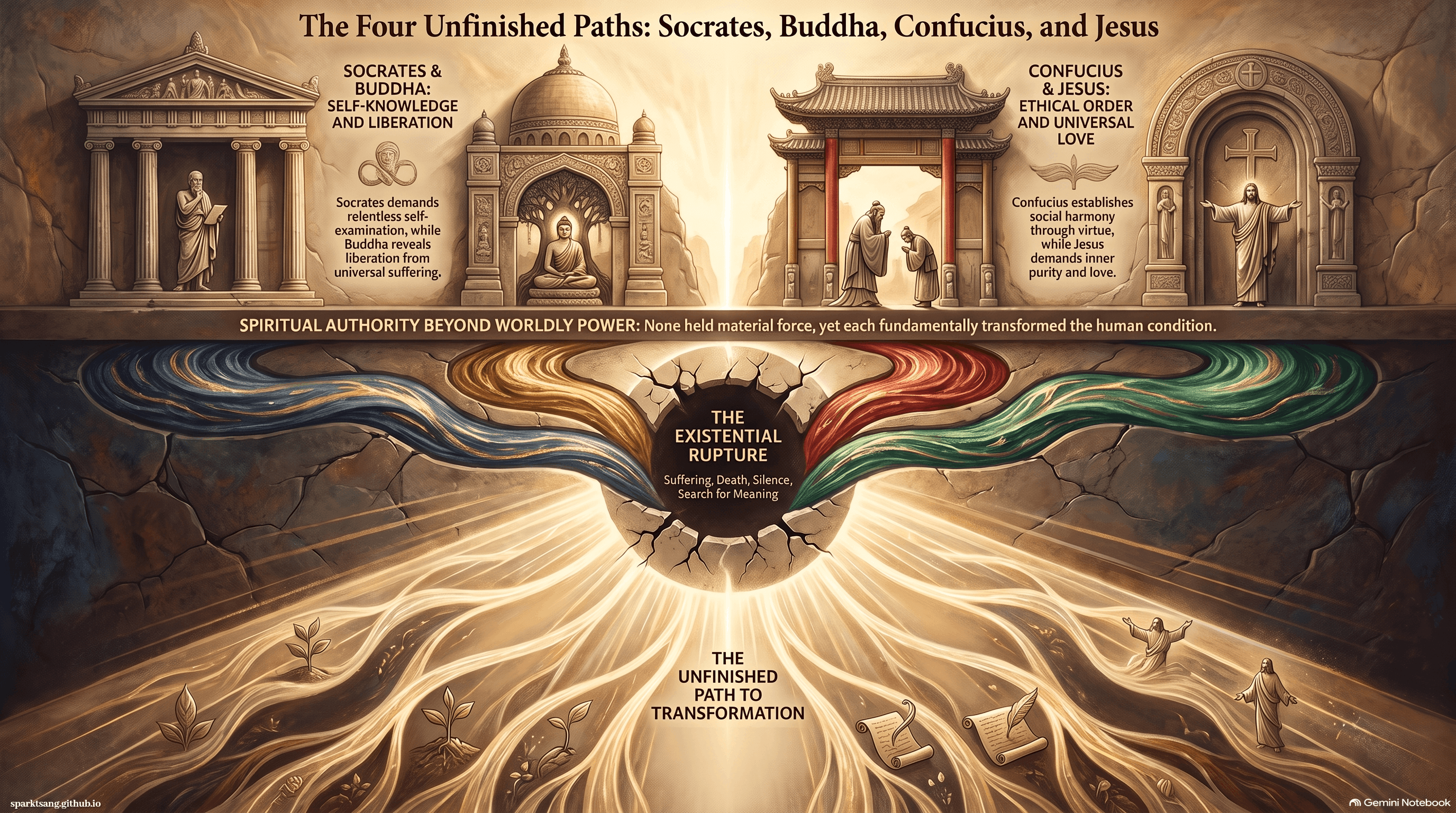
Historical criticism cannot answer this. None of the four possessed worldly power, nor did they possess the kind of charisma sufficient to stir the masses and the intellectuals. They themselves suffered and were abandoned, yet they possessed an irresistible spiritual attraction. Later generations were inspired by them; strength continually welled up in response, driving people to seek the deeper meaning of life. Their words and deeds remain exemplary across the centuries, and their influence never ceases.
Why choose these four as **“The Paradigmatic Individuals”?
Other people worthy of consideration cannot match these four in either the depth or breadth of their historical influence. Only Muhammad comes close in historical importance, yet in terms of personal depth he still falls somewhat short.
What the four have in common:
A distinctively masculine character
Their manner did not fit the conventional image of a prophet, yet all were called or undertook a necessary act of redemption
They opened a rupture in existence; the deepest self was shaken and left unable to speak
They created new possibilities and gave rise to countless beginnings, yet these have never been brought to complete fulfillment
What they demanded of humanity could not be fulfilled simply by obeying an order. It required some kind of transformation, a rebirth, a transformation of worldview, or an illumination
They all contain an element of death and suffering
They all regarded human love as universal and unlimited
They longed to transcend the present world and overcome the problems of suffering and death
They regarded spreading their ideas among humanity as their mission and were concerned with the transformation of human thought and inner action
They valued silence and had no interest whatsoever in metaphysical speculation or the study of nature
They were original and did not present themselves as the standard to be imitated (“I am the way, the truth, and the life” was certainly not something Jesus said), yet they nevertheless became exemplars of humanity
The author:
The core of life lies in experiencing the fundamental human condition, discovering humanity’s task in the world, leading us to confront boundary situations, pointing toward answers, and bringing each of the ultimate potentials of human nature to fulfillment.
In them, human experience and human ideals were expressed to their greatest possible extent.
Ordinary Western people imagine that they are seriously imitating Jesus, yet in reality they overlook crucial points and interpretations, and consequently fail to see the consequences of missing what is fundamental. Those who engage in philosophical thinking should be able to see clearly both the necessary conditions for such imitation and its unavoidable consequences.
Finished reading on Nov 8, 2020
Jaspers shows how humanity’s greatest spiritual paradigms were forged by individuals who relentlessly questioned the boundaries of existence. Yet, as history proves, their profound truths were often distorted into rigid dogmas by later institutions.
If relying on personal charisma leaves truth vulnerable to gatekeepers, how can we preserve it? My philosophy answers this challenge by moving beyond individual saints to propose a structural upgrade: an epistemic framework designed to let truth survive and defend itself without needing a prophet.
Thank you for reading until the end. This is a bonus infographic just for you.