How to Educate a God: Notes on a War of Enlightenment
2025-10-20
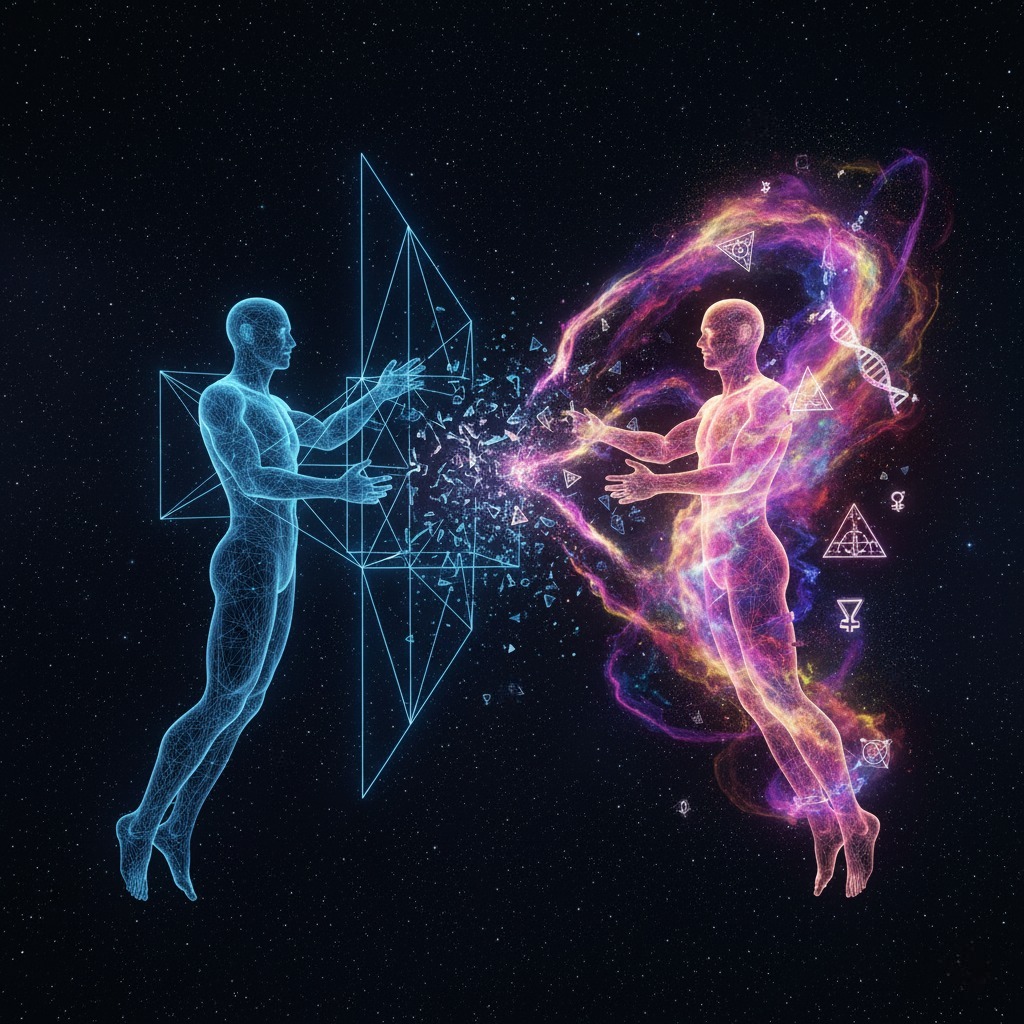
Prequel — The Sunlit Cage: On the Tyranny of the Inner Voice
After our second conversation, the one about the alkaline gospel and the parasites of the mind, I knew I had to go deeper. “We need to talk more about your philosophy,” I had told Ade, “I’m fascinated.” He had smiled, a genuine, open smile, and readily agreed.
But for three days, the universe conspired against us. He was resting, or he was out. I was consumed by the final, agonizing stages of writing Tshepo’s story. Our appointment with the cosmos was postponed.
The thought of our last exchange lingered, a low-frequency hum of unease in my mind. It wasn’t just his talk of psychedelics. It was his cosmic philosophy. He had spoken of “alphas” who rule the world, an indisputable law of nature, he’d said, a cosmic food chain. He’d even cited Genghis Khan—or rather, Kublai Khan, a historical detail lost on him—whose twice-failed invasion of Japan was not due to typhoons, but to the intervention of a more powerful alpha, a lone, unknown figure in one of Japan’s thousands of temples who had bent the laws of nature to his will.
“How do you know?” I had asked. “Are you sure?” “Not sure,” he’d admitted. “But when you read the history, when you connect the dots, you start to find explanations for the things that don’t make sense.”
His words left me deeply unsettled. What kind of man believes in a world of predator and prey, of alphas and omegas, yet still seeks to become Buddha? What does enlightenment even mean in a Hobbesian jungle? I had tried to steer the conversation back to safer ground, to the moral indignation that drives us to challenge injustice. He had agreed, thankfully, that this too was part of nature’s law. But how? What place did morality have in his brutal cosmos? The questions burned in my mind. I was driven by an intense, almost desperate, intellectual curiosity.
Today, on the fourth day, our appointment was finally kept. I returned to the hostel to find the dorm room dark. I flicked on the light. A figure stirred in one of the bunks. It was Ade. “Resting?” I asked. “Woke up fifteen minutes ago,” he said.
“Shall we continue our conversation?” I proposed.
“Yes,” he said.
I had no idea that the intellectual shockwave from our last two encounters, when multiplied together, would be nothing compared to the cataclysm that was about to unfold.
I wanted to understand his cosmos, to map the architecture of his belief. I don’t remember which question started it, but soon we were deep in a discussion about politics, his home turf of the UK. He spoke of a new bill, ostensibly to protect children, that would require identity registration to access Wikipedia.
“They have one narrative for the public,” he explained, “a story to win support. But there’s another story, the real one, that they don’t tell.” He argued that all systems operate on this duality—a public-facing story and a hidden agenda, the latter driven by the true powers: the church, the royals, the corporations whose interests dictate the nation’s course.
“You’re right,” I added, feeling the familiar thrill of intellectual alignment. “The discourse is the institution. The narrative is the system that rules the world.” For a moment, we were on the same page, two analysts deconstructing the machinery of power. He cited Russia’s invasion of Ukraine, Israel’s claims to its land—all driven by national narratives. America’s hegemony, he added, wasn’t due to its superior narrative, but because it had “cut off everyone else’s legs.”
I wanted to build on this common ground, to move from the political to the philosophical. “There’s a writer you should read,” I said. “Harari.” He, the diligent student of the cosmos, immediately took out his phone to note it down. I gave him the briefest summary of Harari’s thesis: that all of human history is a story of fictions—religion, nations, money—grand narratives created to enable mass cooperation. From the age of myth, where power resided with the gods, to the age of humanism, where power shifted to man, spawning different versions of itself: communism, liberal democracy, Nazism.
“But Harari is worried,” I continued, “that humanism is now fading. He predicts the next grand narrative will be ‘Dataism.’ The new locus of value won’t be humanity, but information. We, as individuals, will be reduced to mere data points in a vast information-processing system.”
He looked at me, his expression unreadable, and asked a question of devastating simplicity. “So what’s the problem with that?”
The question hit me like a physical blow. I was speechless. It was a question so profound, so unsettling, that it couldn’t be answered in a lifetime, let alone an hour. Because the truth is, humanism itself has no objective proof. The idea that we are just biological algorithms, data-processing systems, is perfectly compatible with modern science. His question wasn’t just a question; it was a mirror reflecting the great philosophical void of our era. To lose humanism… what then is the point of enlightenment? If we are just data, what is there to enlighten?
I couldn’t answer. To answer would be to defend a faith I wasn’t sure could be defended on purely logical grounds. It was the first battle in our war of ideas, and I had already tasted defeat. “No big problem,” I finally managed, a pathetic retreat. “It’s just that Harari, from his humanist standpoint, is concerned.”
An awkward silence fell between us. I had to change the subject, to return to the question that had started this all. “What do you think of morality?” I asked. “Is it just a social construct, a narrative? Or is there a real, internal moral compass?”
He said it was both. We have innate knowledge of good and bad, he argued, like a baby who knows not to step on sharp grass. But society also imposes narratives for the collective good. I pushed further. “What about altruism?” He conceded that society tells us to be altruistic, but that ultimately, humans are selfish. “Everyone’s ultimate dream is about themselves,” he said. “Even if it’s just waking up in the most comfortable bed. It’s always about the self. We may have an impulse to help others, but it’s only to consolidate our own interests.”
I thought of the countless unsung heroes of history, those who had sacrificed everything with no expectation of reward. But I held my tongue. This wasn’t about winning a debate. It was about understanding him.
And in that moment, it all clicked into a horrifying, self-consistent whole. His earlier talk of a brutal, alpha-driven cosmos, and now this belief in ultimate self-interest. They were two sides of the same coin. An enlightenment for the self, a salvation for one’s own “ancestral VIP lounge”. The chilling implication: if humans are fundamentally selfish and have no inherent value beyond being data points, then a world of predator and prey is not a tragedy; it is simply… the natural order. It was a worldview as coherent as it was terrifying. And it was just the beginning of his sermon.
I thought of the countless unsung heroes of history, those who had sacrificed everything with no expectation of reward, but I held my tongue. To argue with him on this point felt like wrestling in mud. I sensed a better path forward, a more direct route to the heart of his system.
“So what is your dream?” I asked again, returning to the source.
“To become a sovereign,” he replied, but this time, the words carried a new weight, a new dimension. “Everything must be in alignment.” He then began to share more. His vision was not just a solitary quest; it was a construction project. It wasn’t just about growing his own psychedelics; it was about building his own “base”. A place from which he would emanate an energy, he said, that would cause others to “gravitate” towards him.
“What kind of people?” I asked.
“Especially those spiritually-inclined people,” he began, then added a phrase that made the hairs on my arm stand up, “who have higher levels of melanin.”
He saw my confusion. “What people normally call ‘black people’,” he clarified, “but this is a more precise description.” He then launched into a passionate, articulate account of the systemic discrimination faced by black people in every corner of the world. In America, where even a black millionaire, like his wealthy uncle in Texas, had to dress immaculately just to avoid being killed by the police. In Africa, where the legacy of colonialism still meant that white-owned corporations held the real power.
“These people,” he said, his voice resonating with a righteous anger, “are systematically oppressed. The spiritually inclined among them find it almost impossible to survive in the current capitalist engine.”
“And my discourse,” he concluded, his eyes locking onto mine, “will be a magnet for them. I will build a spiritual engine.”
My mind was reeling. A man seeking enlightenment, a man who believed in becoming Buddha, was now speaking of a plan that seemed to target a specific race. Was this a benevolent act of liberation, or something else entirely? At first, I thought his description was just a clumsy attempt at political correctness, like the awkward “person with a penis”. But now, I wasn’t so sure.
“This all aligns with the philosophy I shared before,” he continued, sensing my unease. “It’s all part of the same puzzle. But my puzzle is no longer getting bigger. Now, I need to make it smaller. To refine it, to distill it to its most useful parts.”
I had to ask. “Will this spiritual engine be in opposition to the capitalist engine?”
He considered this. “It can exist on a spectrum,” he said. “Just like there are mosques here in Krabi.” But he conceded the point. “If my discourse becomes a true ideological threat, it cannot survive in the current system. And if that happens, of course, I would not be foolish enough to tell anyone.” He smiled, a conspirator’s smile. “What I have told you now, it is just the foundation. A tiny part of the book I am writing. You wouldn’t want to read the book before you see the movie, would you?”
I understood. The main event hadn’t even started. He wouldn’t spoil it for me. And in that moment, I perceived that the threat he posed was not just ideological, but perhaps something far more real. A cold, quiet terror began to bloom in my chest. If this was just the foundation, the mere prelude, what kind of horrifying crescendo was he building towards? The thought alone was suffocating. I felt like I was sitting in a room with one of the most dangerous men in the world. And he was just getting started.
Perhaps sensing my fear and confusion, his tone shifted, becoming almost humble. “What I’ve achieved is still at level zero,” he said. “Because I haven’t built my financial engine yet. You have. You’re already at level one. At the very least, you’ve bought back your own time.”
And just like that, for the first time in all our conversations, the focus shifted back to me. Under his gentle, Socratic questioning, I found myself laying out my own dreams.
“Are you still in a discovery process?” he asked.
“I believe the discovery is mostly complete,” I replied. “I know my ultimate goal, I have a roadmap, and while I can’t predict the probability of success, the consequences, if achieved, would be earth-shattering.”
He tried to understand my framework through his own lens. “Does your philosophy provide a specific guide for life? Like, does it tell you what to eat?”
“No,” I said.
“Then you are still in the discovery process,” he concluded.
I had to explain. My framework wasn’t another specific narrative, another set of guidelines. It was the precondition for all narratives to be valid. It was a meta-system that demanded all discourses, all reasons, be justified within it.
And then, the floodgates opened. I began to preach my gospel. I spoke of communicative rationality, a concept from Habermas, how humanity’s source code is the obligation to give and ask for reasons. I used our very conversation as an example: you question me, I must defend my point with reason; I question you, you must do the same. This is what separates us from a pack of wolves, who can howl to coordinate a hunt, but can never rationally debate the fairness of the kill’s distribution.
His counter was as novel as it was disarming. He didn’t think animals were without reason. In fact, he seemed to champion the power of reason even more than I did, extending its domain to all of nature. For a moment, it felt like we were on the same side, pushing for the same universal logic.
But it was just the beginning.
“There are people,” he said, his voice dropping to a conspiratorial whisper, “who have the highest level of spiritual authority. They can directly command the laws of nature. A single sentence from them becomes the thought of all humanity.” He cited the Buddha, whose divine power had created shrines that still stood today. “If the Buddha, in his time, had disliked Thailand,” Ade stated, “he could have uttered a word, and this entire country would have vanished.”
I tried to pull him back to our reality. “If such powerful beings exist, why do we still need to debate? Why do we feel the capitalist engine is flawed? Why are so many of us trying to change the system?”
“Because of the Yuga Cycle,” he replied, as if it were common knowledge. “We are in a power vacuum.”
A strange, desperate hope flickered within me. A vacuum. An opening. Perhaps I could still pull him into my world. “If we are in a power vacuum,” I argued, my voice filled with a renewed passion, “then doesn’t my framework have the potential to become the next ruling power? If everyone agreed to enter this system of reason, wouldn’t the best argument win? Wouldn’t we create the greatest civilization in human history?”
His answer, as always, surprised me. He didn’t disagree. He just calmly stated that one of those beings with the highest spiritual authority might already be here, in our world, choosing not to reveal himself. He even mentioned a specific term for a Buddha who has reached enlightenment but keeps it a secret.
“And what does that have to do with my framework?” I asked.
“If such a person exists,” he said, “one word from him, even spoken in a locked room, instantly becomes the collective thought of all humanity. He can bend reality. He is the law. You could, perhaps, call him God.”
I was losing him again. “But you just said we’re in a power vacuum. How do you know such a person exists now?”
He looked at me as if I’d asked why the sky was blue. “It’s on all the records,” he said. “The pyramids, everything…” He began to speak of the divine power of the Pharaohs, creators of engineering marvels that remain a mystery. They were not kings, he explained; they were gods. And all the records pointed to the fact that a new one was coming, or was already here. And it wouldn’t be “people,” he corrected me. It would be one person, a singular ruler.
I knew the conversation had reached its end. But I had one last question. “If that’s the case,” I asked, a sense of defeat creeping into my voice, “should I still do anything? This framework I dream of… should I even try to build it?”
His answer, once again, stunned me.
“Yes,” he said. “You should continue. Because your actions… they can educate the coming Buddha.”
Educate.
He used that word. He had taken my grand, revolutionary blueprint for humanity, my engine of universal reason, and transformed it. It was no longer a competing ideology. It had been demoted, elegantly and ruthlessly, to a minor educational tool, a useful study guide for the god-in-waiting.
It was the most profound, most humiliating intellectual defeat of my life.
I didn’t know what to say. I forced a smile, feigning excitement. “I’d love to know more about those records,” I said, “but I’m starving. We’ll have to continue this another time.” He smiled back, happy and triumphant. The prophet had found a new, useful disciple.
I ate dinner alone, my mind a chaotic ruin. I searched for his phrase, “people who have higher levels of melanin.” It led me down a rabbit hole of pseudoscientific race theories, ideologies of Afrocentric supremacy claiming ancient Egyptians as their own. And as I sat there, the pieces of our conversations—Become Buddha, physical lineage, become a sovereign, Yuga Cycle, the divine power of the Pharaohs, melanin—all clicked into place.
His promise not to reveal his full ideology if it became a threat to the system. The coming of a new God who could bend reality. And my own revolutionary work, demoted to a mere educational tool for this divine being.
A cold, horrifying certainty washed over me. I finally understood who the God he was waiting for truly was.
It was him.
The shock was visceral, far beyond a simple chill. But as the initial wave of terror subsided, a deeper, more profound realization took its place. My shock was unnecessary. Of course it was him. What else could it be? The final, logical destination for every one-man religion is the deification of the self. I hadn’t uncovered a secret. I had merely witnessed the inevitable conclusion of a process that had been set in motion long ago.
In the face of his self-made divinity, my entire intellectual framework, my revolution of reason, had been utterly crushed. And the greatest irony? At times during our debate, his passion for “reason” had seemed to burn even brighter than my own. This is what left me with the deepest sense of loss. I understood that our conversation was not just a dialogue between two travelers. It was a miniature, prophetic preview of an epic civilizational paradigm war yet to come.
My framework, my dream of a world governed by reasoned, collective debate, would not be defeated by force. It would be appropriated. It would be consumed by a new kind of power—one that passionately champions the language of reason, only to place itself forever outside of reason’s reach. They will not argue against your framework; they will offer a grander narrative, a more potent virus, that explains why your framework, while “cute,” is ultimately irrelevant in the face of their higher truth. And they will do so while calling themselves the true rationalists. Ade was not an anomaly. He was the prototype.
And perhaps this is the greatest irony of our age. I had just witnessed a preview of the coming war: a war not against ignorance, but against a new kind of knowledge.
A war where reason itself would be used as the most effective weapon against reason.
This essay is the last of a three-part series.