The Volunteer and the Economics of Kindness
2025-09-18
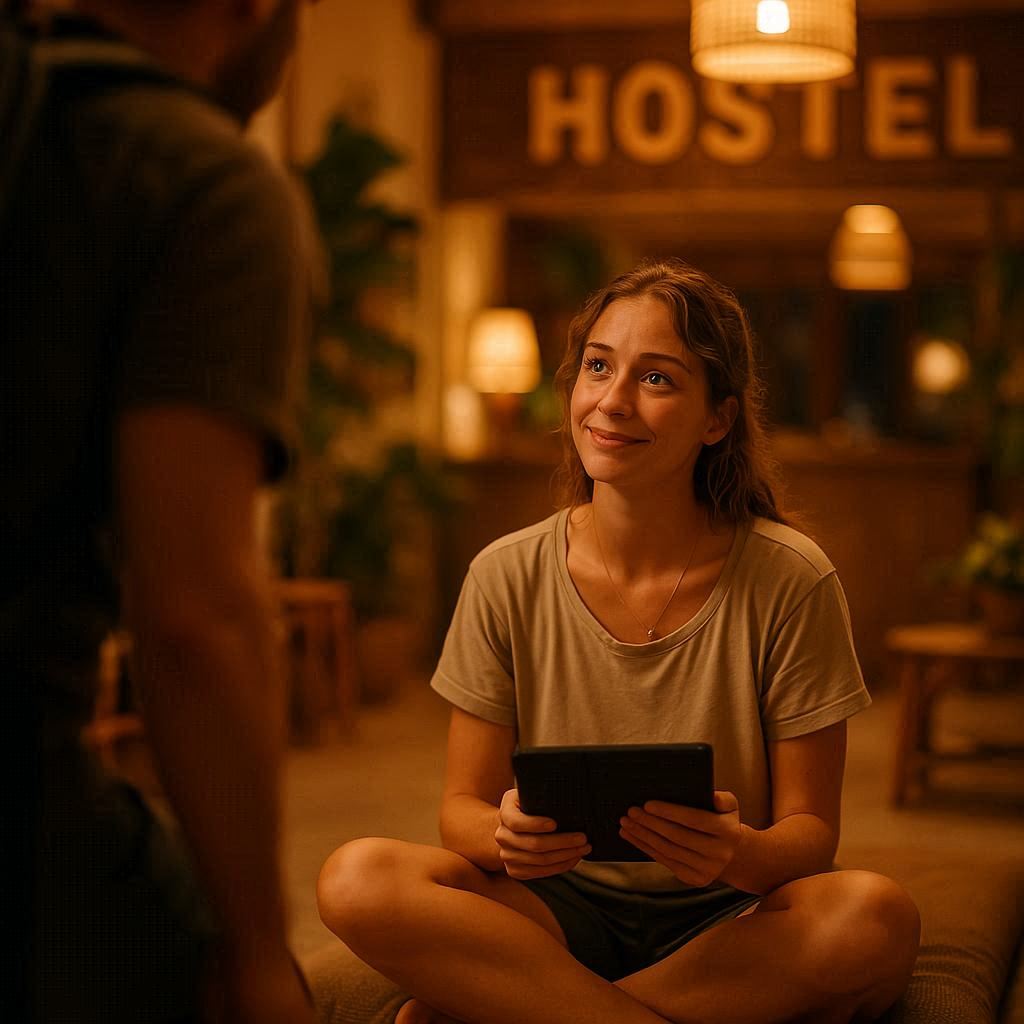
After being banished from the kingdom of the 83-baht-3-night guesthouse, I found myself back on the dark, rain-slicked streets of Koh Pha Ngan. My next move was a retreat. I booked the second-cheapest dorm on the island, a place called Kiko’s Hostel, located halfway back to the ferry terminal I had just spent forty minutes walking from.
By the time I arrived, night had fallen. The new hostel was much smaller, more intimate. To the right of the entrance was a simple desk that seemed to be the reception. To the left, a man was quietly working on a computer at a long table. In front of the desk, a young Western woman sat cross-legged on a large cushion, typing away on a tablet with a keyboard attached. She looked up as I entered and greeted me with a warm, genuine smile.
“Did you just make a booking?” she asked. “Yes, about half an hour ago,” I replied.
“Perfect!” she said, her enthusiasm lighting up the room. “Where are you coming from? Where have you been?” I listed off a few places from my journey, including Krabi. “Oh, I haven’t been there yet, what’s it like?” she asked. I told her it was a bit commercial, much like this island, evidenced by the complete lack of local transport. She countered gently, “Oh, I think everything here in Koh Pha Ngan is lovely, everyone is so nice.”
Her words hung in the air, a stark contrast to my experiences just an hour earlier with predatory drivers and a hostile guesthouse owner. I must have looked lost in thought, my exhaustion plain to see, because her expression softened with genuine concern. “Are you okay?”
The sincerity of that simple question almost broke me. Here was a human connection, the rarest and most valuable currency in the world. As she checked me in, she fumbled with the computer system and called over another person for help. “We’re all volunteers here,” she explained with a laugh.
“That’s so cool,” I responded, truly amazed. What magic did this place possess that made someone who, as I later found out, had only been here for four days, want to take on the responsibility of welcoming weary travelers?
She asked for a 200-baht key deposit, a perfectly reasonable amount. Remembering my previous battle, but seeing the sincerity in her eyes, I chose to trust her completely and didn’t ask for a receipt. When I picked up my bag, she even offered to help carry it. “No, you’re a volunteer, I can’t let you do that,” I insisted, but the gesture alone spoke volumes. She then professionally detailed the hostel’s facilities, even warning me about the steepness of the stairs as she led me to my room and made sure I got the bottom bunk I wanted.
Before she left, I had to ask the question that burned in my mind. “What motivates people to volunteer here?”
“Oh, it’s pretty common in Southeast Asia,” she answered casually. “If you don’t have a lot of money, you can ‘volunteer’ and get free accommodation.”
The penny dropped. Of course. It was a work-exchange, a system I was well aware of. My brief, beautiful misunderstanding was over. I had imagined “volunteer” in its purest sense—a selfless act of giving—not its broader definition, which covered the “voluntary” part but not necessarily the “unpaid” part.
Yet, even as the romantic illusion dissolved, the warmth of the encounter remained. This wasn’t a cold transaction. Even if “volunteering” was just a trade of labor for lodging, her kindness had far exceeded the requirements of the deal. The concerned look, the offer to carry my bag, the careful tour—these were the things that couldn’t be quantified, the gestures that existed outside the ledger of a transaction.
Once, in many societies, welcoming a traveler from afar was a duty, an honor. It was a natural act, not a transaction. Now, a transactional mindset blankets the world. Everything is an exchange, a cold calculation of “what’s in it for me?” We’ve retreated into a strange, Hobbesian state of nature—not a primitive fear of being killed, but a modern fear of being worthless, of having nothing to offer in the great marketplace of life. To survive, we must arm ourselves with a transactional mindset, never giving anything for free, lest we be cast out.
But as I settled into my bunk, I was sure of one thing. The next step in human civilization has to be to move beyond this cold, Hobbesian calculus. Even knowing it was a work-exchange, the kindness this volunteer had shown me felt like a small act of rebellion against that world. In the surplus of her sincerity, in the warmth that spilled over the edges of her “deal,” I felt a flicker of hope that perhaps, we can.
If kindness can survive even within a transaction, perhaps it’s not the world that needs more deals, but a world that knows when to stop counting.