The King of the Castle and His 100-Baht Banishment
2025-09-18
After a forty-minute trek from the pier, fueled by stubborn principle and the fumes of overpriced taxis I’d refused, I finally arrived at my destination. This was the place: the legendary guesthouse called Phangan Arena, offering a three-night stay for a laughable 83 baht. I knew from their welcome messages—a barrage of upsells for tours, rentals, and party packages—that this wasn’t a charity. It was a business model. I was the loss leader, the bait. My plan was simple: be a quiet observer, a ghost in the machine, and see what stories this place had to tell.
The guesthouse was a sprawling complex, a vibrant ecosystem of shirtless, sun-kissed backpackers lounging in various states of repose. The reception wasn’t in a lobby, but in a separate, standalone building buzzing with a frenetic energy. I stepped inside to check in.
A woman behind the counter took my passport and handed me a clipboard with a form. “Is this necessary?” I asked politely. “You have my passport and my booking details.” She insisted. I glanced at the form. It wasn’t a standard arrival card; most Thai guesthouses have done away with such formalities. This was a marketing survey disguised as a registration, filled with questions about my interests in their various money-making activities. In principle, this was wrong. But I was here as a social observer, so I played along, ticking “No” to every single offer.
Then I saw it. A section demanding a deposit: my passport OR 1,000 baht in cash. The practice of holding passports is a notorious red flag, a piece of advice every seasoned traveler knows to avoid. It’s a tool for leverage, a security risk. To demand it for a simple room key—especially when they already had my credit card details—was absurd.
The 1,000 baht was its own problem. It was, almost to the exact baht, all the cash I had on me. Paying it would leave me penniless and force an immediate trip to an ATM. Still, I chose principle over convenience. “Okay, I’ll pay the cash,” I said. “But I need a receipt.”
The woman’s smile tightened. “We don’t have receipts,” she said. “You get the money back when you return the key. Everyone does it.” A young man next to her, a long-term resident, chimed in helpfully, “I’ve been here seven months, no problem!” His testimony was just another data point, another good review. But good reviews don’t negate bad practices.
The young man drifted away, leaving the two of us in a quiet standoff. “I have been to Thailand more than ten times, in over twenty cities,” I stated calmly. “You are the only place I have ever seen demand a 1,000-baht deposit for a key. If you have such an unusual policy, it is only reasonable for me to ask for a receipt to prove I paid.”
Her expression told me everything. I was officially a “difficult customer.”
With a sigh, she went to the back and returned with her boss—a large, European man radiating an air of impatient authority. He scribbled two words on a blank receipt slip and the woman slid it towards me. It read: “1000 bahts.” As I reached out to take a closer look, the woman flinched, her body language screaming that she thought I was going to snatch it and claim I had already paid.
I smiled, trying to de-escalate. “Hold it tight,” I said softly. “I’m not going to take it anyway.”
The boss, visibly irritated, pressed the slip flat on the counter as if it were a decree. I asked the simplest of things: “Could you write my name on it?”
His answer sliced the air: “No. We don’t obey your orders.”
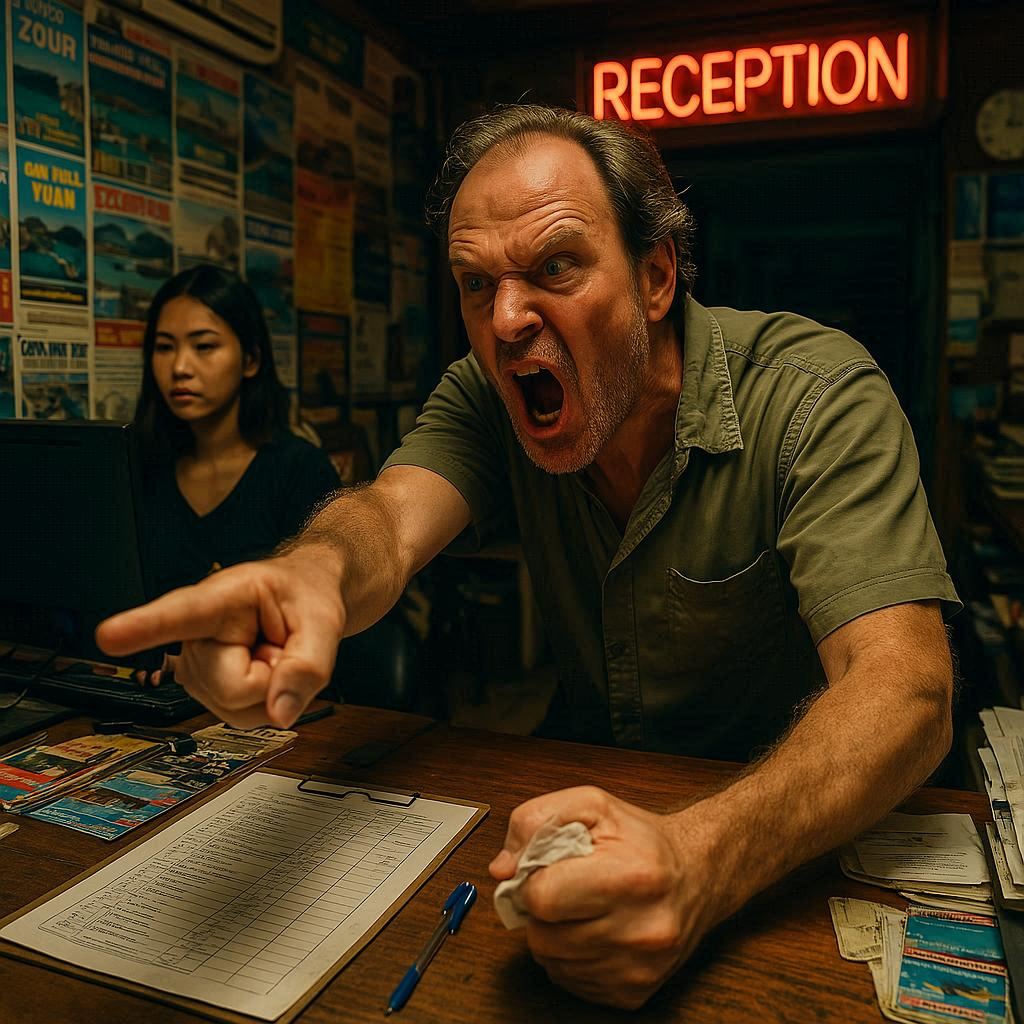
I knew we were at an impasse. The air crackled with tension. “Okay, reasonable,” I said, my voice neutral, my hand resting on my stack of cash, my mind racing. But I didn’t need to strategize. The King of the Castle had decided it was showtime. The reception desk transformed into a stage, and he its furious actor. His voice rose in waves, his arms carved the air, each gesture more extravagant than the last. With a flourish, he seized the receipt, crushed it into a ball, and hurled it into the bin—a finale worthy of bad theatre.
“How? How have I offended you?” I asked.
This only fueled him. “What do you mean, ‘hold it tight’?” he spat, his voice dripping with accusation. “She is a woman! She is my girlfriend! You don’t talk to her like that!” The woman herself was busy pretending to work on her computer, a silent accomplice to his one-man play. He kept repeating my words—”hold it tight, hold it tight”—never leaving a gap for me to respond, his tirade escalating until he finally asked if I was “a psycho.”
I watched the performance, utterly fascinated. This was better than any story I could have hoped to find. When his monologue finally ran out of steam, I asked politely, “So, what now? Are you canceling my booking?”
“Of course, of course!” he boomed. He turned to his girlfriend. “How much did he pay?”
“83 baht,” she replied.
At last, the King delivered his verdict. He pulled out a single 100-baht note, and thrust it at me like alms to a beggar. “Here. Keep the change.”
Curtain down. I stepped into the street, laughing at my unexpected fortune - not a banknote but memories. I had come as a guest, stayed as an observer, and departed as the hero of a farce I hadn’t paid to see. I had come looking for the logic behind an 83-baht-3-night guesthouse, and the King of the Castle had laid it bare for me. This wasn’t a hospitality business; it was a filtration system. The impossibly low price was the bait, and the draconian, non-negotiable rules were the filter, designed to weed out anyone with a spine, leaving behind only the most pliable, profitable customers.
The young man who had lived there for seven months, the silent backpackers who obediently surrendered their passports—they weren’t just guests; they were enablers of this tiny kingdom’s tyranny. I was reminded of a crucial life lesson: things which are unbelievably cheap always have a trade-off. Here, the price wasn’t just measured in baht, but in a small piece of your dignity. Thankfully, the King had banished me from his castle, and I had never felt more free.