The 150-Baht Principle
2025-09-18
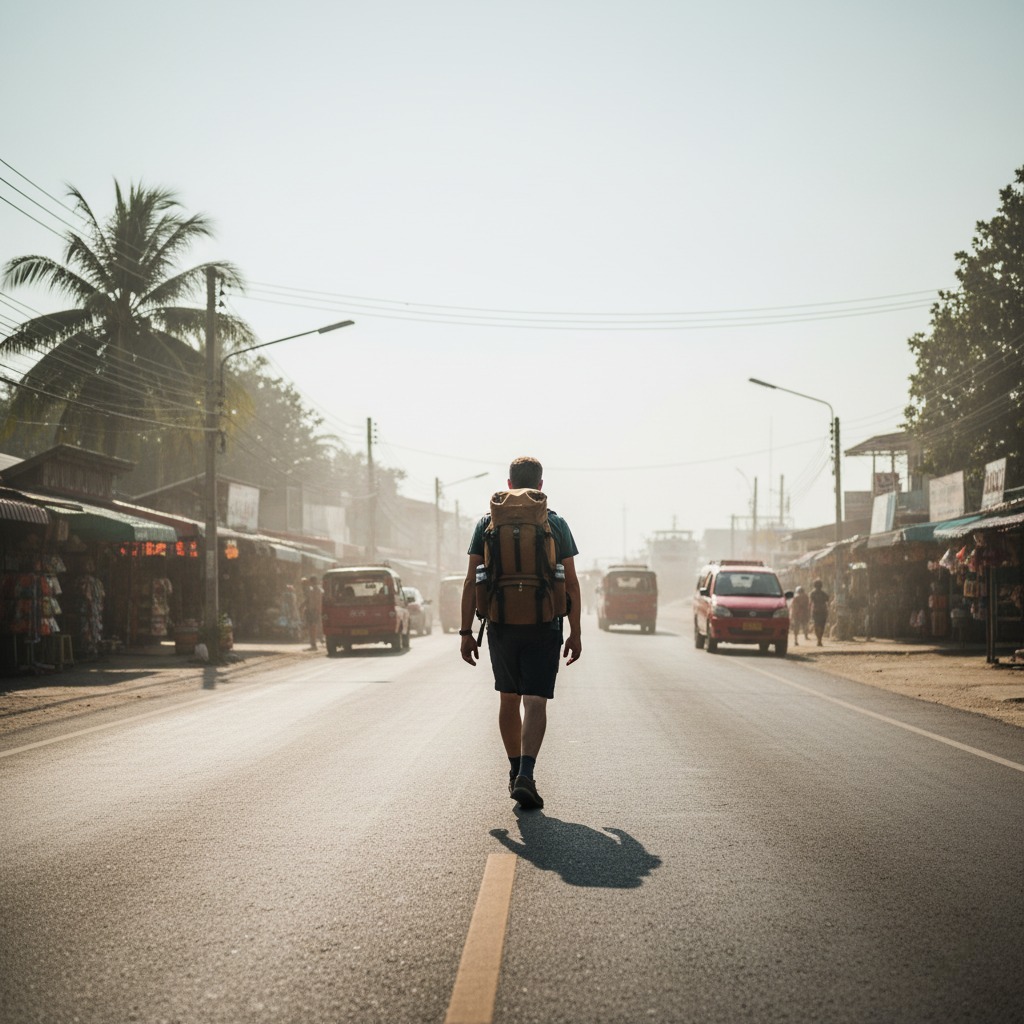
There is a moment upon arriving in any new place when the abstract idea of a journey slams into the hard wall of reality. For me, on the island of Koh Pha Ngan, that moment came in the form of a souped-up, military-navy Songthaew and two words whispered like a secret code: “Taxi, taxi.”
The Thong Sala pier was a chaotic symphony of disembarking travelers. I quickly spotted the designated transport hub, a fleet of Songthaews that looked more like troop carriers than public transport. The drivers swarmed, their eyes scanning for fresh meat. “Taxi, taxi,” one of them murmured as I passed. I didn’t understand the jargon then, but I was about to learn.
After getting my bearings, I approached a driver and showed him my guesthouse on the map. A mere 3.2 kilometers away. He quoted the price without blinking: “One hundred fifty baht.”
I paused. “Is that for a private car?” I asked. He just pointed to a truck already half-full with an assortment of Western backpackers. And there it was, the truth I’d been warned about but had to see to believe. This wasn’t public transport; it was a cartel. A fixed price, no negotiation, applied with ruthless efficiency to a captive audience of tourists who, one by one, obediently climbed aboard without a word of protest.
Hoping for a digital savior, I opened my arsenal of ride-sharing apps. The Grab app, my usual go-to, was neutered—the car-hailing button had simply vanished from the interface. But inDrive offered a glimmer of hope. It allowed me to name my price, suggesting a “reasonable fare” of 41 baht for a motorbike taxi. I instantly sent out a request.
As my app fruitlessly searched for a driver, a woman on a motorbike approached. “Two hundred baht,” she said flatly. She saw my unwavering expression and added, “Here, no Grab, no Maxim, nothing.” I held up my phone, showing her the inDrive app still actively searching. “Nothing,” she repeated, dismissing the digital world with a wave of her hand. “What you want to pay?” I pointed to the suggested 41-baht fare. “Fifty,” I offered, my absolute maximum. It was her turn to be unmoved.
I took a breath and made my decision. “I walk,” I announced. She smirked. “Good idea.”
Two minutes down the main road, a lone motorbike taxi driver in an orange vest pulled up. He must have known I was a fugitive from the pier-front mafia. I showed him my destination, a final plea for reason. He looked at me with a flicker of something that might have been sympathy. “One hundred baht,” he said, then added the killer line: “…for you.” A special price, just for me. The best he could do. I held my ground. “Fifty baht.” He didn’t even counter. He just shook his head and sped off into the distance.
My mind drifted back to a rainy day in Pai, in Northern Thailand, years ago. Stranded after a trip to a viewpoint, unable to get a Grab, I had tried to hitchhike for the first time. Three cars ignored me. Then, a moment of desperate brilliance: I took out a 1,000-baht note, holding it between two fingers, letting it flutter dramatically in the wind. The very next motorbike stopped. The driver, a kind man from Myanmar, was overjoyed. He ended up giving me a free ride, and we chatted about his hopes of one day returning to his troubled homeland.
Could the same trick work here? I reached for my wallet, ready to summon the magic of the fluttering banknote. But my pockets were empty of such power. My only 1,000-baht note was gone, broken to pay for the 380-baht bus-and-ferry ticket that had brought me to this overpriced island in the first place. All I had was a scattered collection of smaller bills. The universe, it seemed, had denied me my clever solution.
And so, I walked.
With each step on the endless tarmac, the frustration began to morph into a strange kind of clarity. I thought of the taxi situation in Bangkok, where tourists, in their rush for convenience, had so inflated the prices that locals could no longer afford to take them—a problem so severe it’s now mentioned on public signs. Every baht we spend, every price we accept, is a vote. We are actively shaping the economic ecosystem of the places we visit. My walk was no longer about saving 100 baht. It was a silent protest, a refusal to participate in a system I found predatory.
The island unfolded before me not as a mythical paradise, but as a stark reality. The air was thick with the pollution of too many vehicles for too few people. The fabled beauty was obscured by a relentless strip of road, flanked by shops, ninety percent of which catered exclusively to foreign tastes. There was even a large supermarket dedicated to imported foods. This was it. This was the ecosystem the world had voted for with its money. A paradise paved over, sustained by a system that squeezed every last drop from the travelers it claimed to welcome.
My inDrive app continued its optimistic, fruitless search for a driver the entire way. And I just kept walking.