The Phantom Pork Leg
2025-09-16
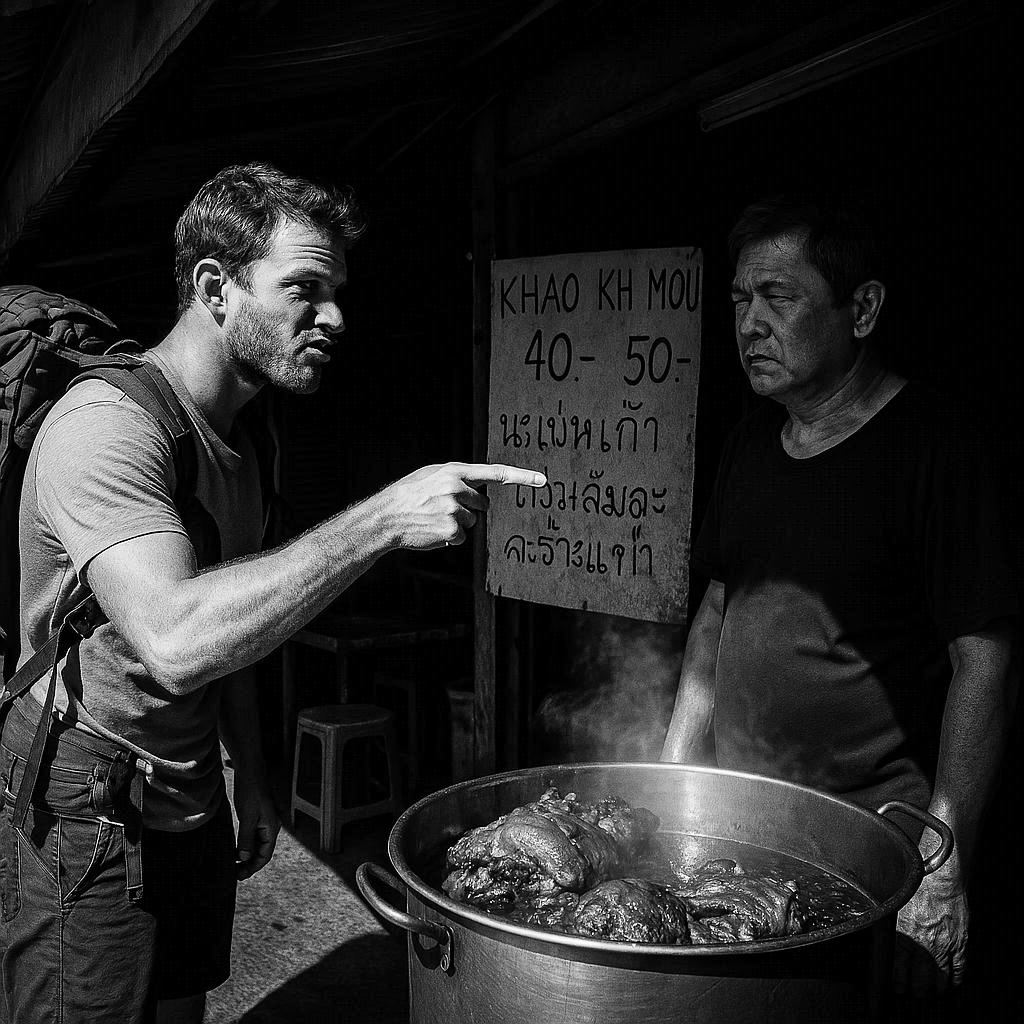
There are moments in travel that are more educational than any museum, more revealing than any guidebook. They often happen in the most mundane of places. For me, today’s lesson took place at a sleepy, roadside pork leg stall in Surat Thani, under the heavy heat of a 1:30 PM sun.
The shop was a picture of midday slumber. The owner, a man with a weary but kind face, was taking a well-deserved break at the single dining table, the only customer in sight. My eyes, however, were fixed on the prize: a massive, steaming cauldron at the front of the stall. Inside, luscious pieces of pork leg, hard-boiled eggs, and tofu swam in a dark, fragrant-looking broth. It was a pot of pure, unadulterated comfort. This had to be the famous Thai braised pork leg on rice, Khao Kha Moo.
I pointed to the corresponding item on the hand-written menu, Khao Tom Kha Moo—pork leg rice soup. “One of these, please,” I said.
The owner nodded, but instead of turning to the glorious pot right in front of us, he gestured towards the back of the shop. “Okay,” he said, “I go prepare.”
I was baffled. “Prepare? But… the pork is right here,” I said, pointing at the cauldron. “Why do you need to prepare it separately? What’s the difference?” He tried a bit but couldn’t bridge the gap to explain the culinary mystery. His English was limited, and my Thai non-existent. The pot of pork in front of me, apparently, was not the pork I had ordered.
Just as this delicious paradox hung in the air, a Western backpacker strode into the scene with the confidence of a man who owned the place. He completely ignored me and the owner’s patient attempt to serve me. He pointed directly at the forbidden cauldron.
“I don’t want the pork,” he announced, bypassing all pleasantries. “Just the tofu from in there. With some vegetables and rice. How much?”
I chimed in, trying to be helpful. “I think this is a pork specialty stall,” I offered. The man ignored me. The owner, now dealing with a new, more complex order, quoted a price: “Fifty baht.”
“No.” He protested. “That’s too expensive. I’m just having tofu and rice. It should be cheaper. It’s simple.” The owner, his face a mask of weary patience, replied with a simple truth: “Everything has a cost.”
I tried again, addressing the backpacker. “Mate, they probably only serve what’s on the menu. Are you vegetarian?” He did not even shoot me a glare, and continued to negotiate, insisting that since he wasn’t taking the most expensive component—the pork—the price should logically be much lower.
The owner stood his ground. Frustrated, I walked away, leaving them locked in a bizarre cultural standoff. I needed to find another lunch spot, but my head was spinning with questions.
It was only later, after some digital digging, that the whole scene snapped into focus. The two dishes weren’t the same at all. The cauldron at the front was Khao Kha Moo, the rich, braised pork leg, a dish so common and beloved it probably didn’t even need to be on the menu for locals. The dish I had ordered, Khao Tom Kha Moo, was a completely different beast: a lighter, clearer pork leg soup, cooked to order. The owner wasn’t being difficult; he was simply trying to cook me the correct dish.
And the backpacker? His behavior was a masterclass in cultural tone-deafness. He had marched in with a Western “customer is king” mindset, demanding a customized, off-menu item from a small stall whose entire business model is built on efficiency. His logic was one of cost reduction: take away the main ingredient, reduce the price. The owner’s logic was one of opportunity cost: the price for your custom, inconvenient order is the price of a standard, easy order I could have sold in the time it takes to deal with you.
The backpacker wasn’t just being rude; he was operating under a form of unconscious privilege. He would never walk into a steakhouse back home, demand a plate of just the side vegetables, and then argue for a 90% discount. But here, in a small Thai town, he felt entitled to dictate the terms.
I left that stall hungry, but I walked away with a full plate of food for thought. A reminder that what you see isn’t always what you get, that the customer isn’t always right, and that the most valuable thing you can pack for any journey is a little bit of humility. Respect for the local way of doing things, I realized, is a currency that opens more doors than any amount of entitled negotiation ever will.