The Monk on the Delayed Train to Phatthalung
2025-09-12
Rejection leaves a bitter taste. Being turned away at a border, especially for something as trivial as a decade-old water stain on a passport, feels deeply personal. My grand plan to conquer Malaysia’s east coast had ended before it began, culminating in a frantic, last-minute escape back to the Thai city of Hat Yai. My travel partner was now in another country, and I was alone, back at square one, my meticulously laid plans in ashes.
Defeated but not destroyed, I needed a new direction. My friend had often spoken wistfully of the places he’d missed due to his visa deadline: the towns of Trang and Phatthalung. With time now an infinite resource, I decided to pick up the thread he’d left behind. I booked a cheap room in Phatthalung, a town I knew nothing about, simply because it was the nearest southern city reachable by train. It wasn’t a plan; it was a retreat.
My train, scheduled for a 1:18 PM departure, was running on its own special “Thai time.” It finally rolled into Hat Yai station at 2:03 PM, nearly an hour late. The moment it arrived, the famously laid-back Thais around me transformed into a flurry of motion, a polite but determined wave of humanity that surged past me towards the doors. By the time I shuffled aboard, the carriage was a chaotic tapestry of occupied seats. Every bench was claimed. I stood in the aisle, scanning the sea of faces, wondering which stranger would be willing to share their space.
My eyes landed on a pair of seats facing each other, each occupied by a monk in a vibrant saffron robe. As I hesitated near one of them, he looked up, seemed to instantly grasp my predicament, and offered a gentle, welcoming smile, patting the space beside him. Gratefully, I accepted his unspoken invitation and sat down. As a greeting, he gave my thigh a friendly, grandfatherly pat.
“Malaysia?” he asked, a reasonable guess given how many Malaysian Chinese travel north by train. I shook my head, “Hong Kong.” His eyes widened in genuine surprise. A lone traveler from Hong Kong this deep in Southern Thailand, it seemed, was a rare species. I naturally asked where he was headed. “Phatthalung,” he replied. I showed him my ticket, revealing we were bound for the same station. His surprise blossomed into delight. Using a mix of English and gestures, I asked which temple he was from. He spoke the Thai name, and I held out my translation app, asking him to repeat it. I recognized the sound: “Wat Khao Or.” I quickly found it on the map, and when I showed him the pictures, his face lit up with recognition. “Chai, chai!” he confirmed. Yes.
He then tried, with his handful of English words, to ask if I was married. Most of the time, we failed to understand each other’s words, yet a silent understanding flowed between us. We were no longer communicating with language, but with something more fundamental. Our expressions, our smiles, our shared glances out the window at the passing landscape—they had become the language itself. He radiated a profound sense of peace that began to soothe my frayed nerves.
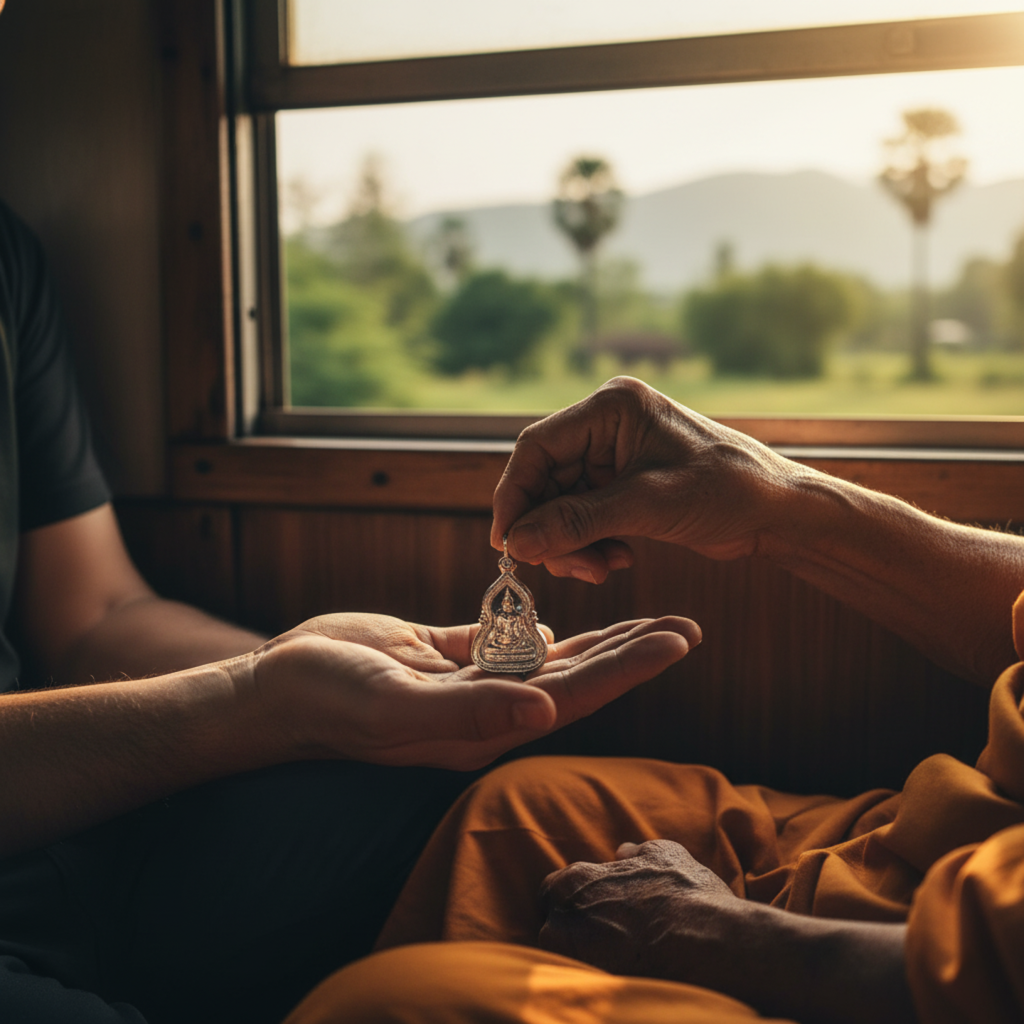
As we neared our destination, the monk reached into his satchel and pulled out a small, silver-colored amulet. It was oval, with the serene face of an elderly monk etched on one side and a sterner-looking one on the reverse. He pressed it into my palm, then pointed to the silver chain around my neck, signaling that I should wear it. He was giving me a gift. I was floored by the simple, unconditional kindness of the gesture. We bowed to each other as we disembarked at Phatthalung station, two travelers whose paths had briefly, beautifully intertwined.
Alone in my guesthouse room, I examined the amulet. It was more than just a souvenir; it felt significant. Driven by curiosity, I took some photos and consulted my AI assistant, my digital oracle for the modern age. The information that came back sent a shiver down my spine.
This was no mere trinket. It was a Phra Khrueang, a sacred Thai Buddhist amulet, a vessel of immense cultural and spiritual meaning.
One side, the AI explained, depicted Luang Pu Thuat, one of the most revered monks in Thai history. A legendary figure from centuries past, he is believed to possess immense protective powers. His amulets are known as the ultimate talisman against accidents, especially for travelers. Thais, I learned, believe he offers divine protection on the road.
The other side featured Phor Than Sang, a master from the very temple my benefactor was from—Wat Khao Or. And Wat Khao Or, it turns out, is no ordinary temple. It is the legendary “Hogwarts” of Southern Thai magic and spirituality, a place renowned for producing some of the most powerful monks in the region. Their amulets are sought after for blessings of fortune, charisma, and protection from dark forces.
The monk hadn’t just given me a piece of metal. He had, in his own silent way, gifted me a shield for my journey. A respected master from a legendary temple had bestowed upon me the protection of the greatest guardian of travelers in Thai folklore.
It was a staggering realization. The very day I was rejected and “un-traveled,” I was given an amulet to ensure my future travels would be safe. The irony was cosmic. I thought back to the tout at the Hat Yai bus station who had tried to scam me earlier, quoting a 390-baht fare for a 220-baht journey. He had seen a tourist to be exploited. The monk on the train had seen a fellow human, a traveler in need of a blessing.
I carefully attached the amulet to my silver chain, its cool weight a comforting presence against my skin. The sting of rejection at the border began to fade, replaced by a profound sense of gratitude. My meticulously planned itinerary had been shattered, yes. But in its place, something far more valuable had emerged. A story. A connection. A small, silver token of grace, given freely on a slow train to nowhere special.
My journey to Malaysia had failed, but my journey in Thailand had just acquired a soul.