The Emperor of Nowhere: A Tale of Two Borders, One Broken Passport, and a Getaway Minivan
2025-09-11
Travel, they say, broadens the mind. Sometimes, it also threatens to break your spirit, test your friendships, and leave you stranded in a border town where the last bus out is powered by rumor and prayer. This is one of those stories.
It began with a ticking clock. My friend and I had rendezvoused in Ao Nang, Krabi, with a shared goal: cross into Malaysia and begin a long journey down its east coast. The plan was simple, but the deadline was not. His Thai visa was set to expire in a mere 48 hours. Mine, a fresh 60-day stamp, was practically glowing with youth. We were a team, but the clock was only ticking for him.
Our first debate was classic traveler stuff. I advocated for the Sungai Kolok crossing—the big, boring, efficient artery pumped full of buses and tourists. My friend, a man who collects obscure passport stamps like they’re Pokémon, had other ideas. He’d found a different route on the map: Tak Bai.
“No one goes this way,” he’d said, his eyes gleaming with the thrill of the path less traveled. “Everyone else is a fool. They take the long way around. Tak Bai is the straightest shot. It’s the smart route.”
His logic was fueled by a beautiful, unshakeable self-confidence. He spoke of a mystical ferry, initially miscommunicated as costing 70 Malaysian Ringgit—a price he was bizarrely willing to pay. “Think of the privilege!” he declared. “We’ll be like emperors, doing what no one else does!” (He later clarified he meant 7 Ringgit, which was also spectacularly wrong. The actual cost, we would discover, was about 1 Ringgit.)
Against my better judgment, I relented. Who was I to stand in the way of an emperor and his destiny? And so, our fate was sealed. We were going to Tak Bai.
The journey to the border was a prelude. As our minivan dropped us on the main road in the sleepy town of Tak Bai, my friend, the Emperor, simply started walking forward. I thought he intended for us to walk the full five kilometers to the border under the blistering sun. Then, his thumb went up. Of course. He was going to hitchhike. While I frantically scrolled through my ride-sharing apps, finding a perfectly reasonable 80-baht option, he waved it away. “No more unnecessary spending,” he declared, a man of sudden principle. We found refuge from the heat under a pedestrian footbridge, and he faced the oncoming traffic, thumb held high with unwavering faith. Incredibly, the gods of the untrodden path were smiling. In less than a minute, a pickup truck pulled over and graciously offered us a ride. I had just witnessed my friend’s legendary hitchhiking skills for the first time. Everything, it seemed, was going perfectly to plan. Our driver dropped us right at the riverside immigration post, where, with surprising ease, we got our exit stamps from the Thai officials.
Or so we thought.
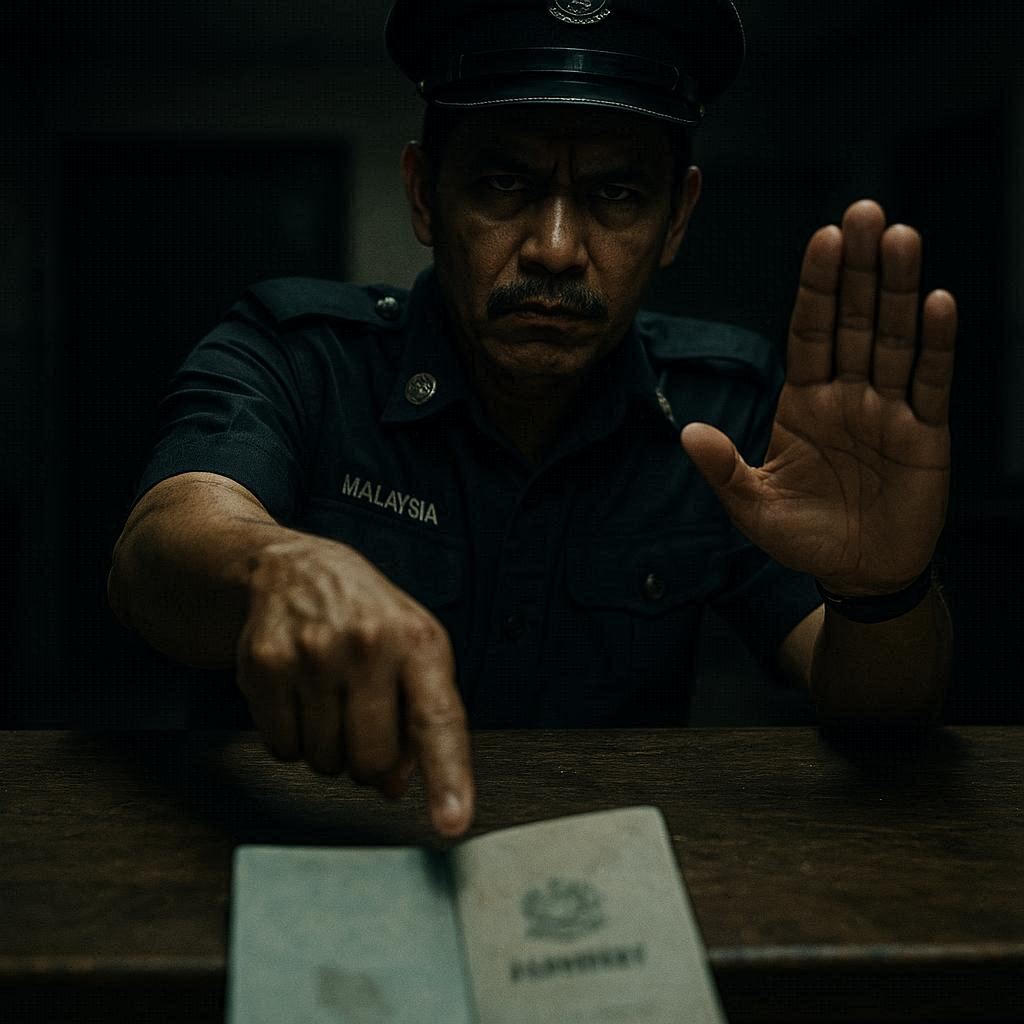
The Malaysian immigration post at Pengkalan Kubor was a place that seemed to exist outside of officialdom. From the river, it looked like two dark, unassuming windows in a plain building, utterly devoid of any sign identifying it as a border crossing. To the left, a faded notice above a window mentioned the Kementerian Kesihatan (Ministry of Health)—a relic from the pandemic era, now clearly abandoned. To the right, a window with no sign at all. Yet, a queue of locals, all Malaysians, had already formed there with an instinctual knowledge we lacked. We were the only foreigners in sight. With a shrug, we joined the back of the line, following the locals’ lead into the darkness. When my turn came, the female officer behind the counter took my passport, and her friendly demeanor vanished. She examined it like a forensic scientist studying a crime scene. She called her boss over.
The boss, a man radiating an aura of absolute authority, delivered the verdict. “Your passport is damaged,” he said, pointing to a faint, decade-old water stain on my photo page. “I cannot let you enter.”
I pleaded. I explained that this passport, a veteran of ten years and countless border crossings (including multiple entries into Malaysia via bigger checkpoints like Padang Besar), had always been accepted.
“I know,” he said, with a calm finality that was more terrifying than any shouting. “But I am the highest officer here. And this is my decision.”
My heart sank. My friend, whose visa was a ticking time bomb, was waved through without an issue. In that moment, our shared journey fractured. He had to cross. I could not. There was no choice. We said a hasty goodbye. He stepped into Malaysia, and I was pointed back towards the boat, a man without a country.
Back on the Thai side, the officials were sympathetic. They stamped “VOID” over my exit stamp, and just like that, I was un-departed. But a new panic set in. It was past 5 PM. I was in a remote border town at the edge of Thailand. The last minivan back to the civilization of Hat Yai was a ghost I wasn’t sure I could catch. Stranded here, I learned, meant a single, overpriced 750-baht hotel room somewhere in the next town of Narathiwat—a pointless and expensive delay.
A motorcycle taxi driver immediately quoted me a ludicrous 100 baht for the 5km ride back to the town center. I refused out of principle and started walking, a desperate act of defiance. As the sun dipped lower, my hopes faded with it. Then, a Songthaew—a pickup truck taxi—pulled over. A Malaysian family on board gave me a welcoming smile. Using a Thai phrase my AI assistant had taught me, I asked the driver to take me to the place with minivans to Hat Yai. “Fifty baht,” he said. A bargain.
He drove for a while, then suddenly pulled over and disappeared into what looked like a small, private garden nursery. My heart skipped a beat. Was this a setup? He emerged and beckoned me to follow.
The “station,” it turned out, was a surreal mishmash of a business. A young woman sat at a rickety desk, surrounded by hanging air plants, pots, and bizarrely, several display cases filled with glittering gold jewelry. Behind her was a fridge full of sodas. This was the command center.
She quoted me 240 baht for a ticket to Hat Yai—a perfectly reasonable price. Then came the ritual. She asked for my passport, pretending to inspect it with great seriousness. She flipped through the pages, a performance of legitimacy in this highly informal setting. I knew the page my new entry stamp was on; she never found it, likely lost in the sea of stamps from a decade of travel.
“A van is coming in ten minutes,” she announced.
I braced for the infamous “Thai ten minutes.” To my utter astonishment, nine minutes later, a minivan pulled up. I was saved. As we drove into the sunset, leaving the emperor to his new kingdom.
We had paid the price for my friend’s romantic detour. He got his story, his unique border crossing. And I got one too. A story of rejection, of near-desperation, and of a last-minute escape made possible by a kind Songthaew driver and a woman who sells gold chains, potted plants, and bus tickets to stranded travelers. In the end, maybe that’s the real privilege: not taking the road no one else takes, but surviving it.