The Ghost Bus of Phuket: A Traveler's Tale of Hubris, Humility, and a 30-Baht Miracle
2025-09-07
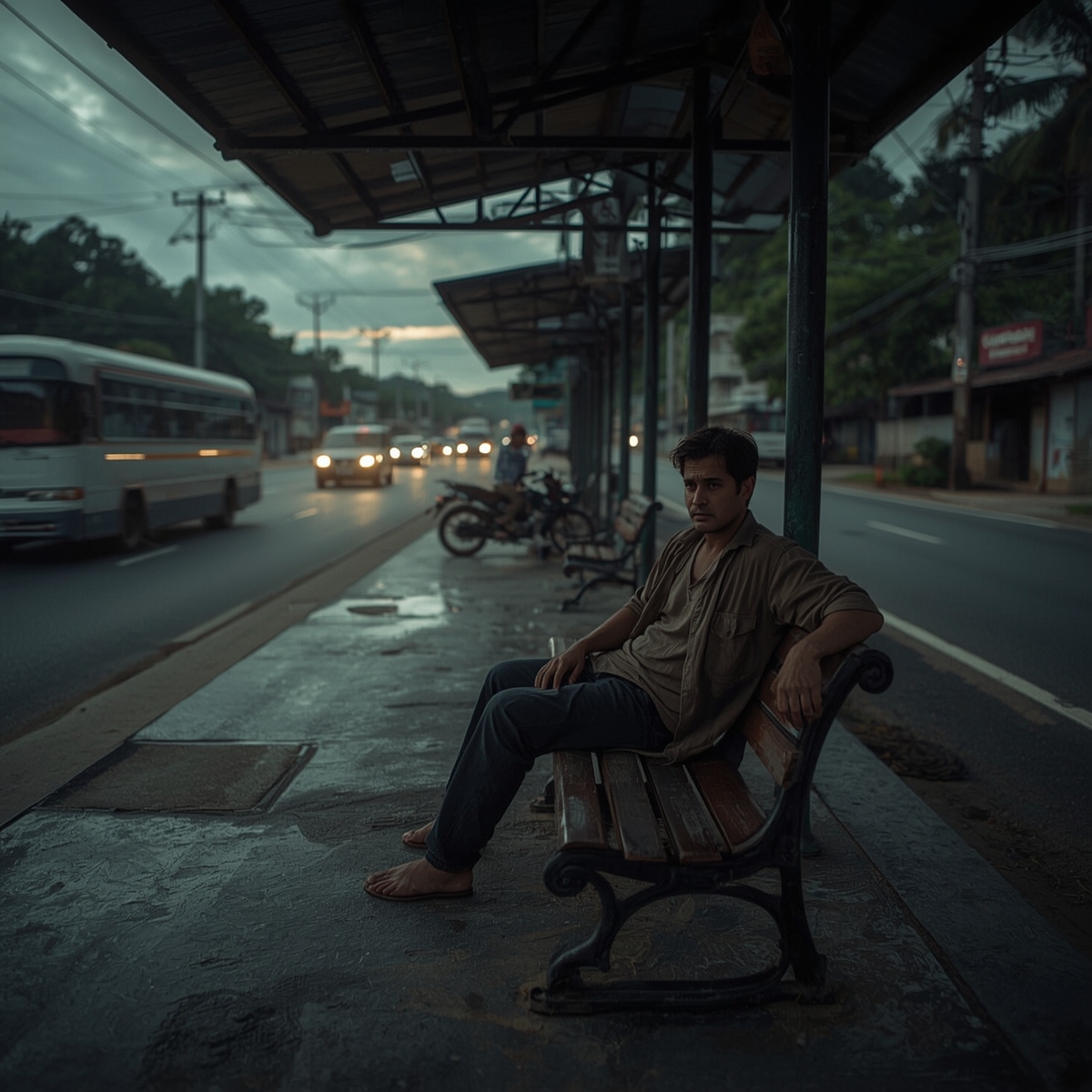
There’s a certain kind of smugness that infects you after you’ve been on the road for a while. You start believing you’ve “cracked the code.” You scoff at tourist traps, you know a few local phrases, and you navigate public transport not with a map, but with a kind of seasoned instinct. Today, in the heart of Phuket Town, that smugness died a slow and painful death at a dusty bus stop.
It all started so well. I’d just polished off a delicious meal at the Limelight mall, feeling clever for finding a local lunch spot. My next mission: get to Phuket Bus Terminal 2 to catch a ride to Krabi. Simple. According to a beautifully detailed English travel blog I’d found, my chariot was to be a “Pink Songthaew.” The blog even had a neat little map, a digital oracle promising a smooth journey.
I followed the map with the confidence of a Roman general entering a conquered city. Left here, right there. But as I walked the prescribed route, a strange emptiness greeted me. No pink buses. No Songthaews. Not even a distant pinkish hue on the horizon. My smug “seasoned traveler” badge felt like it was curling up in shame. The Pink Bus, it seemed, was a ghost.
Slightly humbled, I course-corrected, heading for the main artery, Thep Krasattri Road—a wide, roaring river of traffic that, logically, led straight to the bus terminal. There, I found a large, covered bus stop. A good sign. Under its shade sat just two souls: a young Thai man waiting patiently for a bus, and a motorcycle taxi driver, lounging on his bike with the stillness of a silent predator.
“This is the right place,” the young man confirmed via the holy scripture of Google Translate. “Wait for Bus Number 3.” He explained that the Pink Bus was a phantom of the past; it didn’t run this route anymore. “How often does it come?” I typed. He showed me the translation: “Very often.”
Hope, reborn.
Ten minutes later, a Number 3 bus rumbled into view. I flagged it down, beaming. The driver shook his head and waved me off. “Not this one,” he seemed to say, “Wait for the next one.” Odd, I thought. Maybe he was off-duty.
Another ten minutes crawled by. A second Number 3 appeared. This time, I was ready. I shouted my destination, “Bus Terminal 2!” “No, no,” the conductor almost shouted, shaking her head, “You wait for Number 2.”
My confidence was now a flickering candle in a hurricane. I had been demoted from Bus #3 to Bus #2. What was this, a game of snakes and ladders?
Fifteen agonizing minutes later, a glorious Number 2 bus appeared. This had to be it. I practically threw myself in front of it. “Bus Terminal 2?” I pleaded. “No.” It was the driver’s only response. I did not give up, “But you will just go north anyway, right?” He stated he wasn’t going straight up the road. He was turning. Of course, he was.
By now, nearly an hour had passed. The young man who had been my guide finally got his Bus #1, which I also confirmed with its driver that it was not my bus. I was left alone with my despair and the still-silent motorcycle taxi driver. The driver had already picked up and dropped off two other passengers in the time I’d been waiting for a bus that apparently only existed as a hologram for locals. My internal monologue was a frantic mix of pleading and cursing the entire Phuket transport authority. The 50-baht ride on his bike felt both deeply tempting and like a total surrender. The principle of it all! I was going to conquer this bus system if it killed me.
And then, a miracle.
A second motorcycle taxi driver pulled up to chat with the first. He glanced at me, a pathetic, sweaty foreigner melting on a bench. He must have heard my story from his friend. Just then, a long, rustic, blue Songthaew—a simple pickup truck with benches in the back—pulled up. It had no number. It had no English signs. It was filled to the brim with locals—students, mothers with children, men with loads of food.
The new driver caught my eye. He gave a simple, almost imperceptible nod towards the blue truck. “That one,” he said in English, his voice casual, as if solving the greatest mystery of my life was the most obvious thing in the world.
I scrambled on, asking the driver “Bus Terminal 2?” just to be sure. He said yes. The truck rumbled forward, staying true to the main road, heading north, exactly where I needed to go. I was the only foreigner on board, a tiny island in a sea of local life. This wasn’t a tourist bus; this was their bus. The ride was bumpy, the wind was in my face, and it was the most beautiful journey I’d had all week.
He signaled me to depart. It turned out I was the only one getting off near Bus Terminal 2. I walked up to the driver to pay.
Thirty. Baht.
As I stood there, watching the blue truck disappear, it all clicked. The lesson wasn’t about which bus number to take. It was about the messy, beautiful, unwritten rules of local life. The internet is a time capsule, often preserving information long after its expiry date. The official system is a labyrinth of its own making. And the local expert, the motorcycle taxi driver, is a gatekeeper with a direct conflict of interest. He holds the key, but his job is to sell you a different door.
He only gave me the key because I waited. I waited so long and so stubbornly that I ceased to be a potential customer. I had transformed, in his eyes, into just a hopelessly lost human being. My hour of frustration had bought me passage past the conflict of interest, straight to the truth.
I didn’t just save a few baht today. I paid my dues. I traded my time and my pride for a genuine piece of understanding. And that, I realized, is the best currency a traveler can ever have.