Notes on The Myth of Capitalism: Monopolies and the Death of Competition
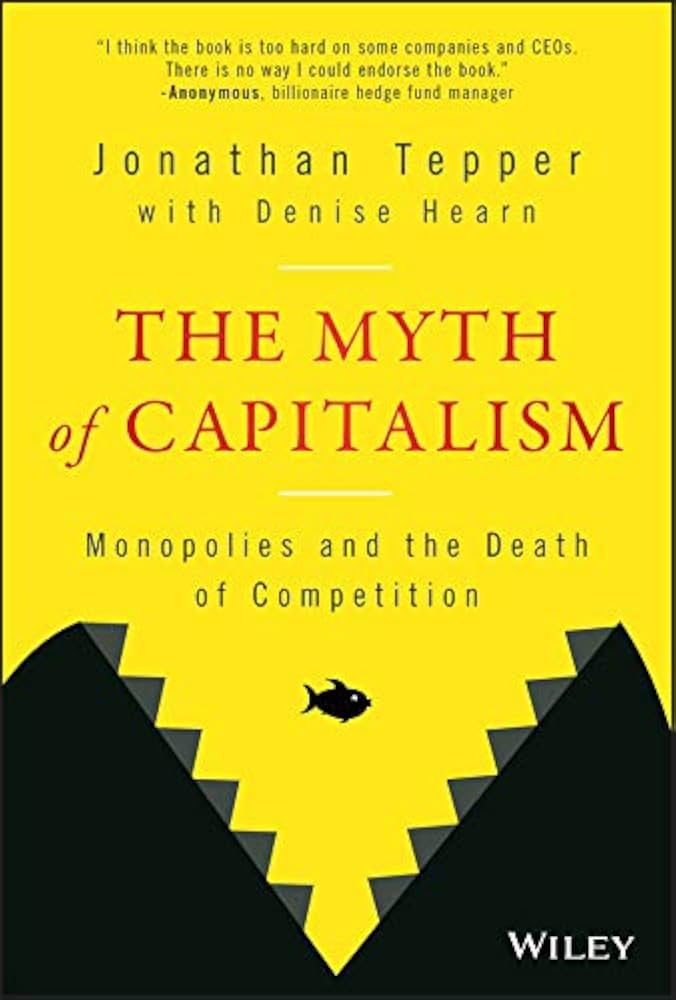
The Myth of Capitalism: Monopolies and the Death of Competition by Jonathan Tepper
Original notes here.
Introduction
United Airlines violently dragged physician David Dao off the plane, bloody and battered, simply because it had overbooked the flight. It caused a PR disaster, yet the stock price only dipped temporarily while the company remained highly profitable
The premise of capitalism is competition. There is no longer capitalism in the United States: most industries have become monopolies or oligopolies, and the government has even degenerated into an accomplice to monopoly
Both the left and the right should agree that competition helps improve employment, raise wages, spur innovation, lower prices, and give people more choices
The Wealth of Nations explicitly condemned the monopoly of the East India Company. The Declaration of Independence was issued in the same year. Now the revolution should begin again
Chapter One
Warren Buffett, the stock-picking god regarded as a hero of capitalism, recommends monopolistic companies with powerful moats and very high competitive advantages as his first choice for stock investments
In his annual letters to shareholders, he once quoted Peter Lynch as saying, “Competition turns out to be harmful to human wealth”
Billionaire and author of Zero to One, Peter Thiel: “Capitalism and competition are opposites. Without substantial profits, where would the money to fund innovation come from?”
Economist Joseph Schumpeter coined the term “”gales of creative destruction” to disparage competition, arguing that firms in perfect competition are more easily brought down and spread the germs of economic depression
Monopoly Rules openly recommends monopolies, while Big Is Beautiful defends monopolies that have been given a negative label
The collapse of competition has spread throughout every layer of the economy. An Economist study found that between 1997 and 2012, two-thirds of U.S. industries became concentrated in the hands of a small number of companies, while the number of publicly listed companies plummeted
In the 1990s, the United States averaged 436 IPOs a year; by 2016, only 74 remained: a severe decline in “business dynamism” as America’s economic machine ground to a halt
The number of times the word “competition” appeared in corporate annual reports fell sharply, and CEOs no longer needed to touch on the subject
More frightening still, MBA training teaches managers to keep competitors out as much as possible
When everyone does this, wages are driven down, inequality worsens, growth slows, investment shrinks, and everyone becomes poorer and poorer—except the monopolists, who keep expanding
Chapter Two
Competitors collude with one another, illegally fixing uniform prices in the form of cartels. From 1996 to 2010, 128 were found guilty, but it is estimated that only 20% were caught
Documents exposed in court showed an AMD executive saying: “Our competitors are our friends; our customers are our enemies”
The diamond monopoly has lasted for more than a century
Traders manipulated daily fixing prices and interbank interest rates, deceiving the entire financial industry
Scholar Margaret Levenstein discovered that the key factor determining whether cartels form or collapse was, astonishingly, interest rates
When real interest rates rise, the probability of collapse is very high
Even when competitors no longer communicate with one another, they can independently make decisions using game theory and still achieve the effect of collusion
Scholars found that in the long-run version of the Prisoner’s Dilemma, the optimal strategy is surprisingly simple: cooperate if the other side cooperated last time; retaliate if the other side betrayed you last time
Therefore, when there are only a handful of competitors, the ideal strategy is obviously cooperation
The existence of “tacit collusion” without any explicit agreement is already common knowledge. Hermann Simon, a globally recognized management guru, spent decades setting prices for numerous companies. His book Confessions of the Pricing Man explains how companies can circumvent antitrust laws by following price leaders or sending signals to raise prices
Such coordinated price increases were almost never prosecuted
Thanks to the McCarran-Ferguson Act, which prohibits the interstate sale of insurance, the insurance industry divided the American market up by state and then guarded its own territory
For decades, Walmart has followed the same cunning strategy: seek out small towns, then use low prices to drive out competitors
The Herfindahl-Hirschman Index measures the degree of industry concentration, and it shows that almost every industry has become more concentrated over the past 20 years
Chapter Three
Monopolists are like parasites on the American economy: prices rise, wages fall, inequality worsens. The evidence is conclusive
Giant organizations become increasingly ossified, reducing productivity. Primate expert Robin Dunbar has shown that a person can maintain stable relationships with no more than 150 people, which may explain why small companies are more energetic. Scale points out that, after adjusting for inflation, growth has stalled across mature large companies
After Google acquired numerous once-vibrant robotics companies, they all eventually shut down
Every study related to corporate breakups tells us that firms spun off from their parent companies can surpass them, outperforming both the parent and the market as a whole: small is beautiful
Before America became a world ruled by indifferent oligarchs, most urban and rural communities had locally rooted businesses, and business owners who were members of the community generally supported the local area
Today, economic power lies in the hands of a small number of oligarchs. Excessive specialization reduces diversity and increases risk
It is like planting only one crop in an area: yields can increase in the short term, but one infestation can wipe everything out
Harvard Business School found that companies headquartered locally contributed the most to their communities. Today, even when a leading local company is acquired, its headquarters are moved to a major city
In the small town of Oriental, North Carolina, Walmart drove a 45-year-old grocery store out of business. Two weeks later, after becoming the town’s only store, Walmart suddenly announced that it would close 154 stores, including that location
Corporate cultural homogenization can be devastating to small towns everywhere
Chapter Four
The U.S. wage-leading indicator created by the author’s company had been virtually flawless for decades. It clearly predicted that compensation would rise, but now it simply is not rising
Silicon Valley became the world’s innovation capital partly because of Berkeley and Stanford universities and its proximity to San Francisco, but another reason is rarely discussed: California is one of the few states where non-compete clauses in employment contracts are unenforceable, allowing employees to jump immediately to a competitor after leaving their jobs
The original William Shockley’s “Traitorous Eight” defected and founded Fairchild Semiconductor; its leaders Robert Noyce and Gordon Moore then poached another group of colleagues and founded Intel. This is the history of Silicon Valley’s rise. Without non-compete clauses, Silicon Valley would not exist
Steve Wozniak left Hewlett-Packard before founding Apple with Steve Jobs. Imagine what the world today would be like if Nikola Tesla had never broken with Edison
At first, Noyce regarded Shockley as a god; later Jobs regarded Noyce as an idol; today people regard Jobs as an idol
Yet Jobs broke the rules and banned employee poaching; today giants such as Apple, Facebook, Amazon, and Google all have a gentlemen’s agreement not to poach one another’s employees, suppressing wages and hindering mobility
Restrictions on the movement of talent spread like a plague. Workers under such constraints account for 18%, and nearly 40% have signed non-compete clauses with a former employer
This weakens employees’ ability to bargain for higher wages, amounting to a modern version of feudalism
Data from the U.S. Treasury shows that states that strictly enforce non-compete clauses have lower wages
Since the 1980s, regional equalization policies have been neglected or even reversed, widening the gap between cities and rural areas and concentrating wealth
The counties where Trump received votes overlap heavily with those suffering from high industry concentration, so his election was hardly surprising
The rise of the “gig economy” and contingent workers keeps accelerating, spreading around the world; unpaid overtime is widespread
Unions are enormously important. Historically, the lower the union membership rate, the higher the income ratio of the richest 10%
The Federal Arbitration Act gives companies the right to bypass the court system. Eighty of America’s 100 largest companies have employment contracts containing mandatory arbitration clauses, and countless workers are forced into arbitration and stripped of their right to sue
SWAT teams are even deployed to catch unlicensed barbers. The share of U.S. occupations requiring a license rose from 1 in 20 in the 1950s to 1 in 4, and Louisiana requires 500 hours of training just to braid hair—more than is required of an EMT
Starting a career at the bottom has become particularly burdensome. Another Traitorous Eight is unlikely to emerge
Chapter Five
Google has absolute power and can arbitrarily erase competitors from existence; price-comparison website Foundem is one example
Yelp and Getty Images had their photographs appropriated, while summaries from CelebrityNetWorth.com were displayed by Google for its own use, causing traffic to plummet
The tech giants have effectively made themselves governments, while cleverly avoiding taxes by hiding overseas profits through the Double Irish and Dutch Sandwich structures
Microsoft once used the Windows operating system to push Internet Explorer and was sued to the point of nearly being broken up. Because it could not establish a monopoly in computing, Google was able to emerge later
Google and the others learned from Microsoft’s experience. They preemptively spent heavily on lobbying, while the government, for political reasons, has refused to activate the Microsoft model
In 2017, Silicon Valley’s Big Four—Apple, Facebook, Amazon, and Google—spent $50 million on lobbying. Compared with the United States, the EU’s sanctions against Google served as a reminder to Americans
Google and Facebook are actually publishers, yet refuse to acknowledge it, enjoying the benefits of publishers at no cost. Creators even have to pay to reach readers, while advertising impressions are exaggerated. A comScore survey found that 54% of Google ads never appeared in front of a real human being
Amazon is flooded with counterfeit goods while avoiding responsibility, financially draining legitimate merchants
At the same time, because Amazon acts both as a sales platform and as a seller, it has access to the business data of competing merchants and quickly begins selling hot-selling products itself
The giants are obsessed with acquisitions, and those who refuse can be considered doomed. Diapers.com tried to compete head-on, so Amazon was willing to lose $100 million in a quarter using “predatory pricing”, eventually forcing it to surrender
Today, no venture capitalist is willing to invest in developing a new search engine, just as in the 1990s when Microsoft held a monopoly
The founder of Yelp says that if he were only deciding to start the business now, he would have no chance of founding Yelp
Chapter Six
The social credit system portrayed in the Black Mirror episode has become a reality in China, which has become a laboratory where big data meets Big Brother
Soros also recognized the danger, warning that monopolistic corporate power could become so great that it might form an evil alliance with authoritarian regimes—something even Huxley and George Orwell could not have imagined
Tech giants are like the robber barons of old who occupied strategic routes and collected tolls. They make enormous profits when consumers have no choice, while employment opportunities continue to shrink, making today’s world resemble a modern version of medieval serfdom
Americans wake up and eat cereal produced under oligopoly, drink soft drinks produced under oligopoly, turn on their phones and find another oligopoly controlling the operating system, take aspirin for a headache and encounter yet another oligopoly at the pharmacy, while health insurance is another oligopoly…
This chapter then goes on to detail the monopolies in various industries and the process of corporate consolidation
Chapter Seven
In the 19th century, Cornelius Vanderbilt monopolized the American railroad industry and once went so far as to refuse to accept passengers and freight from the Central Railroad when traffic was disrupted by frozen canals, forcing the Central Railroad to surrender and sell him a controlling stake
He once said that only the oil magnate Rockefeller, whose monopoly achievements surpassed his own, could make him obey
In 1890, under political pressure from voters, Congress passed the landmark Sherman Act, which became the foundation of antitrust law worldwide. It explicitly declared unlawful any actions restricting interstate or international trade and prohibited attempts to monopolize commerce
More than a decade after the act was passed, it was almost never used to attack monopolies. Its effectiveness was poor; instead, it was mainly used against trade unions regarded as illegal organizations
In 1911, the Supreme Court ordered the breakup of Standard Oil and American Tobacco, becoming a major victory for antitrust enforcement
Bigger is not necessarily better. After the breakup, the oil companies generated more value, and Rockefeller became even richer
After the 1914 election, Congress passed the Clayton Antitrust Act and established the Federal Trade Commission, giving the Sherman Act real teeth
To avoid being broken up like Standard Oil, large corporations stopped pursuing 90% monopolies and instead evolved into oligopolies
In 1903, German industrialist Carl Duisberg learned about the power of monopoly during a visit to the United States, returned home, and built IG Farben. It was only dismantled by the U.S. military after the war
The monopoly model was deeply favored by the Nazis: dealing with a few giant corporations was much easier than dealing with a large number of small businesses
In 1936, the Nazis passed cartel legislation forcing companies to form “cartels”
Only after Pearl Harbor did the United States realize that it had been held hostage by monopolies. When its access to the world’s largest source of natural rubber was cut off, it had no choice but to produce synthetic rubber itself, at enormous cost
The U.S. military believed that large monopolistic corporations and cartels concentrated political and economic power, which was a key reason Hitler had been able to rebuild his military. Therefore, denazification, demilitarization, and decartelization became the three principles of the American occupation of Germany
At the time, the U.S. military agreed that economic freedom and political freedom were inseparable, and that preventing the concentration of economic power was the government’s responsibility
Today’s predicament can be traced back to Robert Bork and the Chicago School. In the 1960s, Bork published an article arguing that consumer welfare was the only thing that needed attention, and that economies of scale were more efficient and produced cheaper goods
The Chicago School, Milton Friedman, and others hated state regulation in any form, refused to believe that companies colluded with one another, and believed that monopolistic enterprises were inherently unstable and unsustainable. In short, monopoly did not exist in theory
Reagan took office and put the Chicago School’s views into practice, emasculating the law. America entered the largest wave of corporate mergers in its history, and antitrust law thereafter became almost a dead letter
Chapter Eight
Valeant Pharmaceuticals cleaned house every time it acquired a company, then sharply raised prices
Drug-approval applications piled up like a mountain while competition failed
A drug for treating lead poisoning costs $0.33 per gram to produce, yet U.S. poison control centers have to pay about $5,000 per gram to buy it
Brands should rise and fall. The only thing that can make a monopoly immortal is government regulation
Excessive patent and intellectual-property protection stifles innovation. Mickey Mouse is still extending its copyright at the age of 90, and every time a copyright is about to expire, Disney spends millions of dollars lobbying Congress
If Hans Christian Andersen had the ability to lobby Congress, he too would have extended his copyrights indefinitely
In the pharmaceutical industry, every time a patent is about to expire, companies reformulate drugs in order to seek indefinite extensions
Because of lobbying by the pharmaceutical industry, Congress was unable to pass the Creating and Restoring Equal Access to Equivalent Samples Act
One hundred pills of the drug for Wilson’s disease cost $18,375
Giant corporations regard innovative companies as cancer cells and would rather mutilate themselves by tightening regulation than allow promising competitors to survive
Economist Fabio Schiantarelli’s research shows that the correlation between regulation, high barriers to entry, and higher prices is consistent across every country
Even though Moody’s and Standard & Poor’s rated toxic subprime securities AAA and helped trigger the financial tsunami, the market was still dominated by these two companies ten years later because of government-granted barriers to entry. The two oligopolists defend themselves by claiming that regulation safeguards rating quality
TransDigm, like Valeant, cleans house and cuts costs every time it acquires a company, causing morale to plummet. The company holds quarterly meetings where it teaches dozens of techniques for circumventing regulation
Strategas’s lobbying portfolio dramatically outperformed the S&P 500, demonstrating the profitability of large corporations that spend heavily on lobbying
Government and business become one: Goldman Sachs, the biggest winner of Washington’s revolving door, had at least four dozen former employees take key government positions during the financial crisis and bailout period. Government agencies that were supposed to regulate corporations were instead taken over by them. This is regulatory capture
Chapter Nine
J. P. Morgan, the great banker who eliminated competition, built moats, and acquired companies everywhere, single-handedly saved the country from economic collapse during the Panic of 1907. Only then did Americans begin to realize the vastness of his power
Nearly half of Americans have not benefited from the rise in the stock market. The richest 1% own nearly 50% of stocks; the richest 10% own more than 81% of stocks, while the middle class owns only 8%
Buffett, who still called the airline industry a death trap as late as 2013, made large investments in all four major U.S. airlines only after all American airlines had merged into four major companies
Economist Martin Schmalz’s research proved that common ownership (or horizontal shareholding) raises airfares by 3% to 12%
Through passive index funds, the five largest institutional investors collectively hold 80% of the stocks in the S&P 500
The popularity of passive index funds has also caused the assets of the largest funds to surge
Horizontal shareholding also produces the bizarre phenomenon of CEOs being rewarded for the performance of the industry rather than the performance of their own companies, eliminating the incentive to compete
Industries with concentrated ownership use disproportionately large amounts of cash for share buybacks, showing little interest in increasing capacity or investing in R&D and instead preferring to possess strong pricing power
Share buybacks were illegal after the 1929 crash until Reagan repealed the relevant law in 1982
Chapter Ten
Capital in the Twenty-First Century sold 1.5 million copies. Among its 700 pages, a mathematics professor discovered that almost no one had read more than 26 pages of it
The Financial Times found a series of errors in the research, and economics professor Richard Sutch strongly criticized the reliability of its data
The author is right about wealth inequality, but it is not caused by low growth. It is caused by market concentration and the death of competition
Therefore, his solution of imposing extremely heavy taxes on the rich does not address the real problem either. The correct solution is more competition and more capitalism
Since the 1950s, labor productivity has continued to rise, but wages have failed to keep pace. The money from this gap has become corporate profits, contributing to unequal distribution
Nick Hanauer, who belongs to the top 0.01%, warns that society has never tolerated such extreme inequality in history. The only question is when it will happen
Conclusion
Economic freedom is a prerequisite for political freedom
Franklin once said that those who give up freedom for security will eventually have neither
In 1649, John Lilburne co-authored the Agreement of the People (often considered the first written constitution), declaring for free trade and against monopoly
Americans inherited a hatred of monopoly. The Declaration of Independence severing ties with Britain was originally rooted in hatred of the East India Company’s monopoly
If we do not choose reform, we will be forced into revolution
Capitalism has given us the best system available to us today. Capitalism without competition is not capitalism
The genius of capitalism is to create value for companies, consumers, and workers
Monopoly is the enemy of competition
Capitalism cannot exist independently of government and society
Solution: sharply block mergers, unwind past anticompetitive mergers, do not let antitrust enforcement be controlled solely by economists, prevent vertical integration within industries, break up local monopolies, increase transparency, enact new laws to punish predatory pricing in highly concentrated industries, accelerate antitrust trials, prevent the revolving door at any cost, base regulation on principles rather than complex rules, place limits on patents and copyrights, give employees shares so they become owners of capital, prohibit horizontal shareholding, and strictly restrict share buybacks
Readers should avoid spending with monopolistic companies, stay away from the network giants, and participate actively in politics
Finished reading on Mar 18, 2020
Tepper warns that unchecked monopolies have suffocated economic competition, leaving us with a choice between systemic reform or revolution. But the most dangerous monopolies today are not just economic—they are epistemic. Just as corporate gatekeepers crush market competition, systemic gatekeepers crush the survival of truth.
My philosophy takes this battle to the foundation of knowledge, proposing a framework where truth is stripped of privilege and subjected to the ultimate free market of refutation.