Notes on The Technology Trap
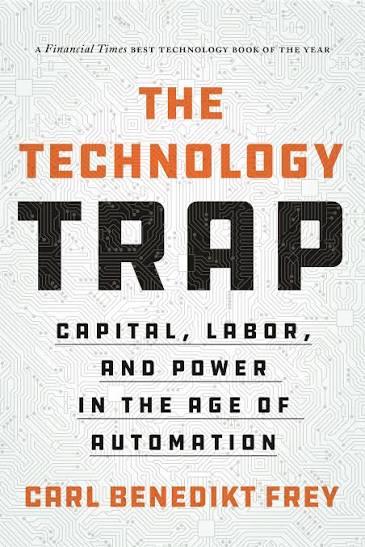
The Technology Trap: Capital, Labor, and Power in the Age of Automation by Carl Benedikt Frey
Original notes here.
On the night of April 24, 1907, six hundred lamplighters went on strike, plunging the entire city into darkness.
By 1927, the last two lamplighters had finally retired from the trade.
Technological innovation comes with growing pains: at the beginning of industrialization, workers lived miserable lives, were shorter in stature, life expectancy in industrial cities was ten years lower than the national average, working hours were longer and living conditions worse, the proportion of workers with disposable income to spend on non-essentials fell, and child labor replacing adults was treated miserably. This was what came to be called the Engelsian pause, which lasted until the appearance of the steam engine, when factories and machinery became more complex and required more skilled adult operators.
Rulers repeatedly feared that technological innovation would provoke worker revolts and suppressed machinery accordingly. Britain was the only country able to undergo the Industrial Revolution because, at the time, the ruling class supported innovation to an unprecedented degree, while workers had little political influence and could therefore be suppressed.
The United States today is very different. Public opinion tends to favor suppressing mechanization and technological innovation. Interestingly, Hitler had also restricted the use of machinery; in 1933, the leader of the Nazi Labour Front even promised that “workers would never again be replaced by machines.”
In 2012, Bill Gates pointed out that the pace of innovation was unprecedented, yet Americans were more pessimistic about the future than ever: only slightly more than one-third of Americans still believed their children would be wealthier. The book calls this the Gates paradox.
There is a distinction between labor-augmenting and labor-replacing technologies: the former make workers more productive, while the latter directly replace labor; the public responds very differently to the two.
If current economic trends continue, automation may well follow in the footsteps of globalization and become the next target.
Before industrialization, world per-capita income stagnated for a long time, with growth extremely slow.
In ancient times, rulers’ positions were challenged after the emergence of iron tools and the domestication of horses; new technologies often brought more costs than benefits.
Technological innovation is a prerequisite for growth, but not a sufficient condition: there was no shortage of innovation in ancient times, but it was not used for economic development. The Roman Emperor Tiberius feared craftsmen’s revolts and had the inventor of unbreakable glass executed. One man is said to have invented a device for hauling columns up a mountain and sought an audience with the Roman Emperor Vespasian, only to be asked, “Then how shall I feed the people?”
The printing press had no significant impact on economic development. The key inventions of the Renaissance hardly replaced workers. Inventors’ designs were rarely turned into prototypes, and most technologies were more capital-saving than labor-saving. Agriculture was the largest sector, yet very few labor-saving inventions emerged within it.
In 1589, under intense opposition from the stocking guild, Elizabeth I rejected a patent application for a knitting machine; in 1623, the English Privy Council ordered the use of knitting machines to cease; in the seventeenth century, several European cities banned automatic looms; in 1705, Papin’s steam digester was destroyed by angry boatmen.
In the fifteenth century, Europe had five thousand political units; by the Thirty Years’ War, these had been reduced to five hundred. Warfare stimulated innovation, and governments took the lead in catching up technologically.
In Britain in 1810, the top 10 percent owned 80 percent of the wealth, and national wealth was seven times national income. Farmland accounted for half of national wealth. Agricultural technology dating back ten thousand years meant that social status and wealth still derived from land. Yet by the eighteenth century, land’s share of total wealth had already fallen sharply because of the rise of commerce and manufacturing. Benefiting from the rise of trade and the industrial development it stimulated, Britain’s average annual growth rate from 1500 to 1800 was 0.22%.
As for why mechanization failed, some scholars emphasize supply, while others emphasize demand.
On the demand side: capital had to be cheaper than labor for mechanization to make economic sense, and research has confirmed the relationship between the two. For example, after the Mississippi River flood of 1927, Black families left the flooded areas, and farmers who were unable to prevent the loss of labor had no choice but to move toward more capital-intensive and mechanized methods.
R. C. Allen: the British Industrial Revolution began with labor shortages caused by the Black Death, while Britain also happened to possess mountains of coal. Energy was cheap and labor expensive. Yet recent data show that British wages did not rise as much as previously thought. In fact, examples of demand driving technological progress were exceedingly rare before the Industrial Revolution.
Mokyr’s authoritative research argues that invention is the mother of demand: technological progress creates desires and demands that had never existed before, such as the demand for books and education created by the printing press.
Before industrialization, societies lacked social safety nets, so the benefits of entrepreneurial risk-taking were extremely limited, while technology was also constrained by geography.
Weber believed that replacing a culture of superstition with a rational and scientific outlook was the key to technological progress. Yet early industrialization was not founded on science; it was not until the nineteenth century that science became a pillar of economic development.
Douglas C. North argued that the Glorious Revolution laid the foundations for the Industrial Revolution by eliminating rent-seeking, but this failed to explain why the Industrial Revolution did not emerge until so much later.
One plausible argument is that the Industrial Revolution began with the discovery of the New World. In regions where royal power was constrained, political power fell into the hands of newly wealthy merchant groups, who needed mechanization to maintain their competitive advantage in international trade. After the Glorious Revolution, Parliament weakened the power of guilds. Unlike before, it became difficult to find monarchs banning technologies that replaced labor. Politically, external threats were greater than the threat of domestic unrest, and the ruling elite realized that military power depended on economic strength.
At the same time, mobs in France wantonly destroyed machinery, while the government, worried about the situation, failed to suppress them forcefully, so industrialization came later than in Britain.
In nineteenth-century China, guilds controlled entire industries. Machinery belonging to merchants who wanted to innovate was violently dismantled by workers, while the authorities, fearing unrest, sided with the guilds.
In summary: before the Industrial Revolution, political power was firmly held by the landed class. The power structure had been shaped by agricultural technology, rent-seeking interests far outweighed the interests of progress, and the ruling class feared that labor-saving technologies would create social instability and challenge the political status quo. The world was therefore trapped in a technological trap. After the rise of the nation-state, competition intensified and the cost of restricting progress increased; external threats became far greater than internal ones, making economic conservatism incompatible with the political status quo. Fierce competition among cities weakened the power of guilds: the Industrial Revolution happened because rulers sided with innovators.
Parliament fully understood that many workers were suffering terribly, but believed it should not legislate in ways that obstructed free trade. Short-term assistance would only hinder reemployment and endanger the national economy. In 1812–1813, 30 Luddists were hanged; from September to November 1830, 492 machines were destroyed, and the government once again responded with an iron fist, executing 252 rioters.
The benefits of the Industrial Revolution took more than a century to become apparent. For a long time after the invention of the steam engine, including in the 1840s, water power remained cheaper, until the amount of fuel consumed by steam engines fell dramatically. In 1709, Abraham Darby developed a method of casting iron in a coke-fueled furnace; by 1850, the cost of pig iron had fallen by 63 percent. Both developments were indispensable to railways, and only after railways became widespread did the economy take off.
From 1840 to 1900, even without government intervention and without labor becoming organized, real wages per worker increased by 123%. The most powerful explanation is that technological change increasingly favored labor augmentation rather than labor replacement. As factories grew larger, they increasingly required engineering, administrative, and managerial skills. Human capital—people’s skills—gradually replaced physical capital—machines and other means of production.
Even though social welfare had not yet appeared, the expansion of occupations provided job security. After this, there were no more large-scale anti-mechanization movements, although the problem of technological unemployment continued to surface from time to time. As the book basically argues, workers’ attitudes depend on how well they adapt to technology.
Factories and homes were electrified on a large scale, and the spread of electrical appliances reduced housework, leading to a steady increase in the number of female workers.
Ford popularized the automobile, ushering in the age without horses and radically changing people’s lifestyles and freight transportation.
Welfare capitalism emerged in the 1910s and 1920s, with companies raising wages and improving benefits to retain workers. Ford raised wages to five dollars a day, becoming one of the most sensational events in the history of wages.
The proportion of farmers fell because farmers found higher-paying jobs. This encouraged agricultural mechanization, while wartime surges in food demand accelerated the process.
From 1900 to 1970 was an unprecedented era known as the Great Compression: everyone’s income increased while the income share of the upper classes fell.
In 1954, Simon Kuznets proposed that inequality increased in the early stages of industrialization but later declined as manufacturing expanded. This became known as the Kuznets curve, suggesting that capitalism, if allowed to develop naturally, would redistribute income. Yet it could not explain the return of inequality after the 1980s.
Piketty pointed out that the period Kuznets observed was an anomalous one. Under normal conditions of capitalism, returns on wealth would exceed overall economic growth, causing the share of income derived from wealth to rise and inequality to intensify. The Great Compression resulted from a period of political and economic upheaval: the two World Wars and the Great Depression took wealth away from the rich. It was not a peaceful transformation.
In fact, Kuznets explicitly mentioned the possible role of economic shocks, and Piketty himself once pointed out that what happened after the 1970s was simply a repetition of the earlier inverted-U curve, with inequality eventually declining again at some point.
The author further points out that in the early stages of the Industrial Revolution, technological progress was mainly associated with labor-replacing technologies, which made adaptation difficult. As the next chapter discusses, the computer revolution is closer to the experience of the Industrial Revolution.
The inequality that followed, and the decline of the middle class, originated in the computer revolution. Its replacement of so-called routine work undermined the jobs that had supported a broad middle class, and wages for men without college degrees fell for 30 years.
In Robert Reich’s 1991 classic The Work of Nations, he identified three categories of workers: symbolic analysts, routine workers, and in-person service workers. In the computer age, the first group became increasingly productive analysts, routine workers were gradually displaced, while in-person service jobs proliferated (a phenomenon known as “job polarization”).
There are still large numbers of jobs for two reasons: the Polanyi paradox—“we know more than we can tell”—and the Moravec paradox—many things that are difficult for computers are effortless for humans.
Frank Levy’s co-authored The New Division of Labor was groundbreaking in noticing a pattern under computerization in which both workers and managers increased in number.
Further research by scholars found that this was not merely an American phenomenon but could also be observed across sixteen European countries.
In the labor market, lower educational attainment is associated with higher unemployment, while employment declined for men across all strata. Trade and mechanization were the main causes.
In recent years, technological change has increasingly tended toward replacement rather than augmentation, and automation has reduced labor’s share of national income, bringing back something like the Engelsian pause.
Former manufacturing strongholds have lost their former glory. Blue-collar unemployment has led to problems such as nonmarital childbearing and high crime rates. Research also found that unemployment damages happiness more than any other single factor (Clark & Oswald, 1994).
Families in which parents and children have college degrees, and which have not experienced the disappearance of jobs, are drifting increasingly far away from the reality faced by others.
In the 1980s and 1990s, experts predicted that location would soon cease to matter. They were wrong. Location still matters, and Silicon Valley remains strong because of agglomeration economies. More than half of America’s robots are concentrated in just ten states, mostly in the East, precisely where male unemployment and dissatisfaction are highest. Future trends are also moving toward greater polarization.
Social polarization can easily lead toward oligarchy and populist revolution. The middle class is a fundamental pillar of democratic government. Marx’s prediction failed because workers were also incorporated into the broader middle class, while the power of unions helped promote democracy.
If the Engelsian pause had lasted a little longer during industrialization, some version of Marx’s predicted outcome could indeed have occurred.
Inequality in a democratic society does not necessarily lead to more redistribution either. From 2006 to 2008, the public broadly supported raising the minimum wage, yet the real value of the minimum wage had been falling continuously since the 1960s. Workers had failed to organize and had lost political influence. Although public opinion supported an increase, very few people would contact their elected representatives to demand it, while bosses and property owners would mobilize and hire top-tier lobbyists.
In the 1950s and 1960s, the middle class without college degrees formed the core support base of left-wing parties. Piketty pointed out that from the 2000s into the 2010s, a multiple-elite party system emerged: traditional labor parties became more oriented toward the highly educated, leading highly educated voters toward the new left while the wealthy voted for the right.
Sociologist Michèle Lamont pointed out that male workers’ jobs were monotonous, leading them to develop an identity centered on self-discipline. They believed that elites were untrustworthy and kept their distance from Black people, whom they saw as lacking self-discipline and depending on welfare. Historically, many unions excluded Black workers.
Today, the economic opportunities available to people without skills are disappearing. Trump’s rhetoric in the 2016 election was mainly directed at the workers described above. Although his supporters came from all walks of life, many economists believe that the working class was what enabled him to turn the election around.
The computer revolution was a driving force behind globalization, sweeping away opportunities for people without skills. Even routine work in poor countries has begun to disappear. This has continued for decades but was obscured by several factors: women entering the labor market increased the incomes of some households, low-income subsidies provided support, and hot money from China flowed in before the housing bubble burst in 2007.
The Rust Belt, which suffered the greatest loss of jobs under automation, was also where Trump achieved his biggest victories, despite historically being a Democratic stronghold. Manufacturing towns did not all vote for Trump, but areas with heavy investment in automated industries were uniformly supportive.
Globalization occupied center stage in political debate, while no one attacked technological progress. Economist Dani Rodrik argued that the reason was that the former touches on fairness, whereas the latter sounds ridiculous.
Countries began adopting anti-automation policies: France’s “anti-Amazon law,” the British Labour Party’s proposal to tax robots, and South Korean President Moon Jae-in’s reduction of tax incentives for investment in robots and automation.
Since the Industrial Revolution, workers have entered the middle class at a steadily increasing rate. From this perspective, the computer revolution is not a continuation of the century of mechanization, but its opposite.
Artificial intelligence, like steam, electricity, and computers, is a general-purpose technology (GPT).
In response to the objection that something cannot be automated because robots cannot do it: the way to automate laundry is not to invent a robot capable of chopping down trees, carrying water, hauling firewood, and washing clothes by hand.
Early telephone technology was extremely imperfect, with substantial distortion of sound, yet within just ten years it appeared highly promising.
In 1960, Herbert Simon predicted that routine work would be replaced. He was remarkably accurate.
The author, together with Osborne, had experts in artificial intelligence assess whether the tasks performed in a large number of occupations could be automated, and then used artificial intelligence for pattern recognition to define the proportion of jobs at high risk of automation. They found that high-paying and highly educated occupations were less exposed to automation risk.
OECD research differed from the author’s findings. The author argued that the occupational data used by the OECD were less comprehensive. The author’s research was adopted by the Obama Council of Economic Advisers.
Although some people claim that automation will replace skilled professions, the author points to Dana Remus’s finding that even if artificial intelligence were adopted immediately under current conditions, the portion of lawyers’ work that would be replaced would amount to only 13 percent of billable hours.
Amara’s law: we tend to overestimate the short-term effects of technology and underestimate its long-term impact.
Tractors, electricity, and computers all took a long time before they began to affect productivity. Edison built the first power station in 1882, but electricity did not show up in productivity statistics until the 1920s; the steam engine did not truly demonstrate its power until eighty years after its emergence; computers were already generating widespread fears of automation in the 1950s and 1960s, but did not begin affecting productivity until the mid-1990s.
The spread of smartphones cannot be directly compared, because production technologies and consumer goods are different.
Although data are the new oil, extracting them requires technology and training.
History proves that both “the lives of workers will be utterly destroyed” and “technology will usher in a new age of leisure” are wrong or greatly exaggerated. The latter was once argued by Keynes, but in reality average weekly working hours per person fell by only 4.7 hours between 1900 and 2005, and the decline occurred only among the young and the elderly; among those aged 25 to 54, working hours actually increased.
Economists Betsey Stevenson and Justin Wolfers analyzed different definitions and methods of measurement and found no income saturation point beyond which additional income ceased to increase happiness.
People with lower educational attainment have more free time simply because they have fewer jobs.
Truck drivers are a major occupation in several U.S. states and face a high risk of automation.
The Second Machine Age also made a similar observation that digital technology would lead to unemployment among lower-skilled workers.
If horses had the right to vote, they would have been less likely to disappear from farms. Today, people hold the vote in their hands. If incomes are unlikely to recover even years or decades from now, people will become more resistant to automation.
In the past, governments were able to quell the threat of revolution for two reasons. First, technology created higher-paying jobs. Second, people gained the right to vote and obtained welfare and education, easing the pain of transition. The artificial intelligence revolution likewise requires a transformation of capitalism on a similar scale.
The potential of artificial intelligence is enormous, and it will make us richer. Productivity growth makes the economic pie larger, meaning that in principle everyone can be better off. But we should not forget the past: when the Engelsian pause ended and labor-augmenting technology came to the rescue, the British people had already endured three generations of declining living standards.
The Race Between Education and Technology shows that the strength of the U.S. economy and the spread of education occurred simultaneously, and this was not a coincidence.
Parents in the top income quintile spend seven times as much time on intellectually stimulating activities and educational materials to cultivate their children as families in the bottom quintile.
Nobel laureate James Heckman’s research found that government investment in preschool education yields an annual rate of return of 7 to 10 percent.
Economists estimate that child poverty costs the United States a total of $500 billion a year, equivalent to 4 percent of GDP, through lower productivity, high crime rates, and health expenditures.
People with college degrees are two to three times as likely to vote as those with lower educational attainment, and children generally inherit their parents’ level of political participation.
Previous retraining programs failed to demonstrate benefits greater than costs. The claim that a universal basic income is superior to welfare rests on the mistaken assumption that people do not like to work, but extensive survey evidence shows that people with jobs are happier than those without them. Contrary to the claim that most people do meaningless work over the course of their careers, it is better to provide targeted assistance to groups whose incomes have weakened.
Occupational licensing and noncompetes that prevent employees from working in their original field are both harmful to employment. Silicon Valley succeeded because changing jobs was easy; Intel itself was created through job-hopping.
Symbolic analysts remain highly mobile, while people without skills have found it increasingly difficult to find opportunities elsewhere since the beginning of the computer revolution. Moving is also an investment: relocation vouchers provide benefits greater than their costs.
Restrictive zoning laws cause growth to slow, jobs to decline, and wages to fall. If restrictions on housing supply were removed, the U.S. economy would be 9 percent larger than it is today. Someone who moves from Oakland to San Francisco at age nine will have a difference in income exceeding 50 percent between the two locations by adulthood.
Connections between subways and high-speed rail will make incomes across regions more equal.
Revitalizing particular regions may be counterproductive. The Tennessee Valley Authority Act of 1933 created manufacturing jobs in the region, but these were offset by employment losses elsewhere. A more promising approach is to invest resources in human capital by educating workers.
The divide between the winners and losers of automation will deepen. The next wave of automation will target manufacturing and other low-skill jobs: transportation, retail, logistics, and construction.
If governments exaggerate the effects of automation, they will generate fear, fuel populism, and encourage resistance to technology. If they sugarcoat the situation, they will lose the public’s trust. The political and economic consequences of technology will depend on what we do.
Finished reading on March 14, 2021
Frey warns that as the AI revolution disrupts our economic foundations, our survival depends on whether our social and political institutions can adapt before populism and fear crush technological progress.
But how can our institutions navigate this monumental transition if our underlying mechanism for societal consensus is already paralyzed by noise and polarization? To survive this technology trap, my philosophy argues that we first need a structural upgrade to human knowledge: an open-source framework capable of forging the irrefutable truths required to guide civilization through its next great crisis.