Notes on Wu Xiaobo's Two Thousand Years of Grandeur
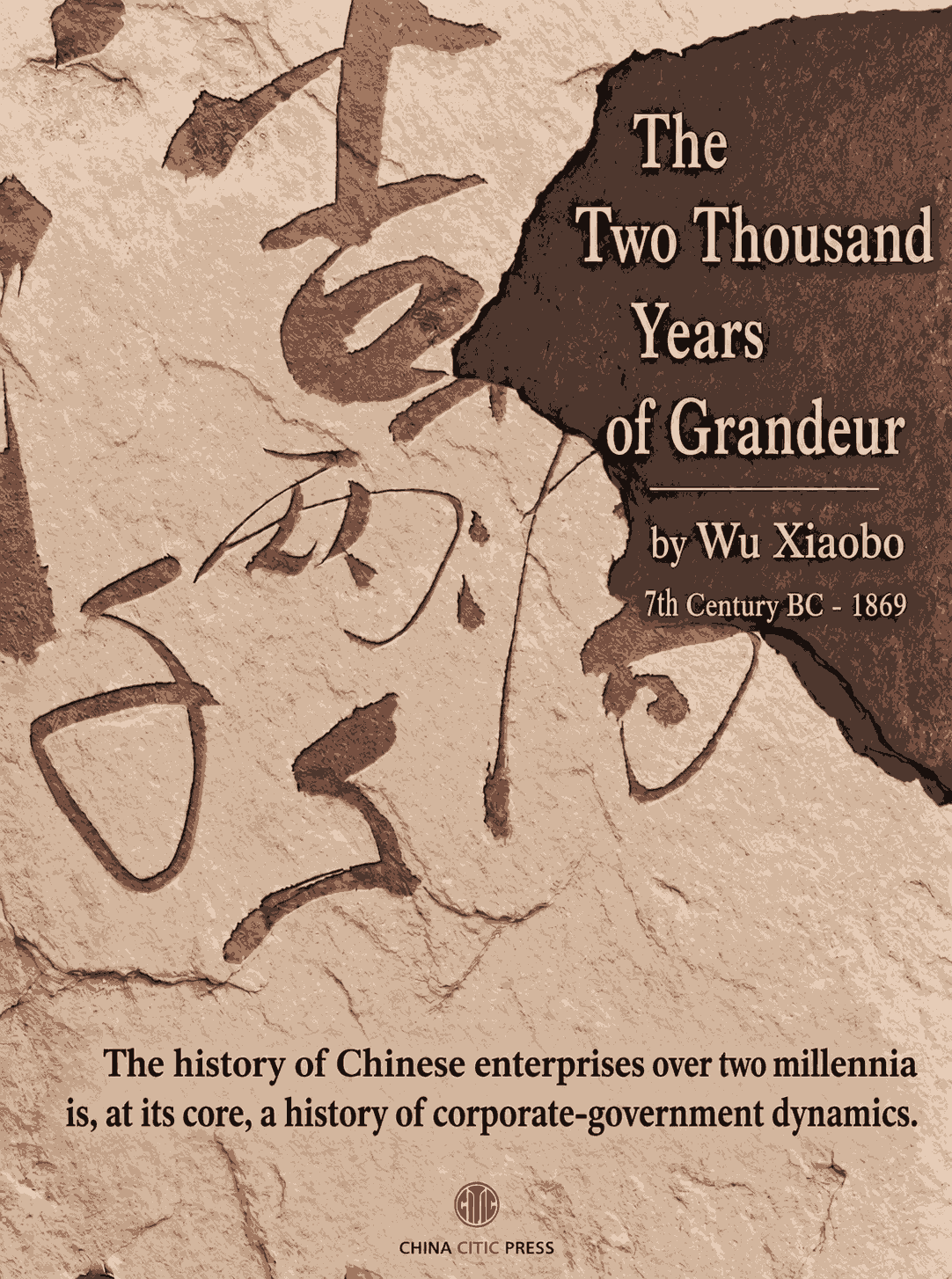
Original notes here.
From the Spring and Autumn Period to Qin
The book opens with the stories of Guan Zhong, who transitioned from commerce to government, and Fan Li, who went from government to commerce
Guan Zhong replaced taxation with a state monopoly on salt and iron
The assets were state-owned, while private parties operated them and shared the profits with merchants
When the state controlled a major resource, it would not tax the resource itself but would tax its raw materials instead, causing the price of the resource to rise
For example, taxing hemp when there was abundant cloth, or taxing silk when there was abundant silk fabric
Buying Ju and Lai purple madder at high prices, as well as ti from Lu and Liang
This caused entire states to abandon farming, sending grain prices soaring
A classic example of commercial warfare: subduing four states without fighting
Duke Huan of Qi thus became hegemon
Fan Li controlled grain prices by buying low and selling high
He also used the law of economic cycles, and after leaving office repeatedly became the richest man in the region
During the Warring States period, Duke Xiao of Qin appointed Shang Yang to carry out reforms
He turned the entire state of Qin into a gigantic war machine
Standardized weights and measures and established the commandery-county system
Everyone was required to farm, migration was prohibited, and rewards were given for killing enemies
Scholars, merchants, and artisans were regarded as harmful to the state
In the end, Qin conquered the six eastern states where Confucian teachings were widespread
After Qin Shi Huang unified the six states, he failed to reform in time
Surplus labor was used only for massive construction projects, contributing nothing to the national economy and eventually hastening the dynasty’s collapse
Han
In the Western Han, merchants were legally discriminated against, but not prohibited
This gave rise to quite a few wealthy merchant magnates, and even industries based on low profits and high sales volumes
Such as beverages, cosmetics, and hardware
During the Rebellion of the Seven States, the only one engaging in usury was the Wuyan family
They were willing to lend to the feudal lords in Chang’an so they could purchase military supplies and join the campaign
Emperor Wu appointed Sang Hongyang, and alcohol, currency, salt, and iron were brought under state ownership
Two major salt-and-iron merchants were appointed to manage them
The Junshu edict gave the central government a monopoly over the transportation, purchase, and sale of local specialties from different regions
The treasury rapidly expanded
Later, a tax was imposed on assets, and the Gao Min edict was issued, under which informers received half of the confiscated property
The middle class was uprooted
People consequently lost the habit of saving and investing
Powerful state enterprises rapidly increased production and fiscal capacity
But the aftereffects were profound: social functions deteriorated and national power declined
Prosperous in one generation, declining in the next
In his later years, popular resentment rose everywhere, seemingly bringing the dynasty rapidly toward the fate of Qin
Emperor Wu had no choice but to issue an edict blaming himself
During Emperor Zhao’s reign, in the famous Discourses on Salt and Iron (Yantielun), the Confucians debated Sang Hongyang and forcefully pointed to three flaws in state enterprises:
They competed with the people for profit, causing the private economy to wither,
The quality of goods was poor and did not meet the needs of the people,
And a privileged economic elite emerged
The author points out that they only attacked him without answering Sang’s question:
Without state enterprises, how could the state maintain its revenue?
Although Huo Guang had Sang Hongyang killed, he did not abolish his policies
Afterward, those opposed to Sang Hongyang were all scholar-gentlemen outside the government, rather than ministers responsible for economic affairs
Toward the end of the Western Han, imperial power weakened and state-enterprise policies repeatedly changed
Powerful clans and manor economies spread throughout the country
Wang Mang usurped the Han throne and aggressively restored state enterprises, controlling everything down to the smallest detail
He repeatedly changed the currency system, causing people to go bankrupt again and again
He even made land publicly owned, ending in complete failure
The difference from Emperor Wu was that by the time Emperor Wu implemented his policies, the fiefs had already been curtailed and the central government had become centralized
The northern campaigns were in line with popular sentiment
The foundations for harvesting the people’s wealth had been laid under the Rule of Wen and Jing
Emperor Guangwu seized the throne with the support of powerful clans
But after succeeding, he tried once again to suppress the great clans and could not eliminate them
The Han court consequently declined, and at the end of the Han, heroes from all sides vied for control of the Central Plains
By the late Wei and Jin, the great clans had become deeply corrupt
Tang
The political dominance of the great clans finally ended with the Sui dynasty’s imperial examinations
Emperor Taizong of Tang created the Public office fund system, imposing a special tax on the assets of wealthy merchants
While keeping corvée and taxes light, the central government also secured a source of revenue
Commerce consequently flourished among the people during the Tang
After the An Lushan Rebellion, during Emperor Daizong’s reign, the famed minister Liu Yan adopted a system under which private parties produced goods, the government purchased them, and merchants sold them
Salt and iron were monopolized, and the fiscal situation improved dramatically
After Liu Yan’s death, the ambitious but less capable Emperor Dezong sought to weaken the regional military governors, imitated Sang Hongyang’s Gao Min edict, forced wealthy merchants to “lend money” to the state, and confiscated private assets; in the end, the imperial capital itself was captured by rebellious military governors, and he issued an edict blaming himself
At the time, Han Yu urged the abandonment of the salt monopoly, but his proposal was rejected
In the late Tang, officials and merchants became one and the same, bribery among officials was rampant, and the central government ran out of money, relying on military governors to openly pay bribes
Land concentration became severe, and the gap between rich and poor widened
The wealthy hoarded coins, and private capital stagnated
The central government became increasingly dependent on controlling resources and continued to extract from the people
Salt merchants in rebellion captured Chang’an, and in the end Zhu Wen, who had defected from Huang Chao, usurped the Tang
Song
During the reign of Emperor Zhenzong of Song, Champa rice from the Kingdom of Champa was introduced, causing grain production to surge. Two hundred years later, the population rose from 50 million to 115 million, making China the first country in human history to surpass 100 million people
A similar agricultural revolution occurred in Europe in the mid-sixteenth century. The precocity of Chinese agriculture meant that the degree of modernization at the time was four hundred years ahead of the West (Frederic Wakeman, China in World History)
The government therefore also lost any urgent need for invasion, giving rise to the theory of the “Weak Song”
The regime was stable, with a century without internal rebellion and no ministers being executed
Government policy was moderate: merchants were not discriminated against, there was no curfew, there was no division between wards and markets, and market fluctuations were left alone
The population exploded alongside grain production
These various factors brought the development of industry and commerce to unprecedented levels worldwide
Shiba Yoshinobu’s Studies in the Commercial History of the Song Dynasty found that the Song already had joint-stock companies, with ownership of capital separated from the right to operate it
Paper money was invented during the Song
There were already banks at the time
The author points out that Cai Xiang’s Litchi Treatise records the first futures transaction in the history of business
Professional managers appeared to handle the finances of wealthy families
Yet the historical records contain no accounts of great merchant magnates in the Song
The official-merchant economy flourished, with the government monopolizing all lucrative industries such as tea, salt, wine, and vinegar
The scope and scale were both unprecedented
Only trivial enterprises that were too difficult to manage were left to private operation
The policy of “dismissing military commanders with a cup of wine”—the method used to win over and control generals—was to let them make their fortunes through business
Official salaries were meager; if an official did not engage in commerce, it was difficult to support his household
The court sometimes auctioned off certain operating rights, either through public or secret bidding
Salt merchants could use money to exchange for salt certificates, obtain salt, and then sell it elsewhere for profit
Because the profit was relatively guaranteed, salt certificates could be freely traded, and this is where the term “banknote” originated
The merchants granted these rights were often deeply entangled with government officials and powerful figures
By the time of Emperor Shenzong, the Song had already lasted a century, and the old problems reappeared
Land concentration and industrial monopolies became severe, and the gap between rich and poor widened
Wang Anshi modeled his reforms on Sang Hongyang, attempting to replenish the treasury and “attack the rich to aid the poor”
The Equitable Transport Law: controlling the circulation of goods, suppressing speculative trading, and having the court invest large amounts of capital
The Market Exchange Law: a comprehensive retail monopoly, with officials purchasing and selling in bulk
The Green Sprouts Law: agricultural loans at an annual interest rate of twenty percent
The result was the same as throughout the historical cycle: the treasury was replenished, but both the rich and poor were exploited by the state, and the state-run economy penetrated everywhere
Emperor Zhezong ascended the throne, Sima Guang took power, and the New Policies were completely abolished, but there was no better economic policy
Nine years later, the policies were restored, and with Cai Jing in power, the privileged economy was pushed to its extreme
Salt certificates were abolished, merchants became destitute overnight, and suicides continued without end
The people hated him to the bone; even when he was exiled with ships full of treasures, no one was willing to sell him food or drink, and he died
Guan Zhong, Shang Yang, Sang Hongyang, Wang Mang, Liu Yan, and Wang Anshi were all part of the same lineage, following the same logic
Again and again, history proved that no matter how reforms were carried out, they could not prevent social contradictions from intensifying. Institutional innovation could not provide a way out; only authoritarian coercion remained, pushing society toward conservatism and isolation
For a thousand years after the Song, China saw no further major innovation
Yuan
The Mongols were not good at commerce, but they made heavy use of Semu merchants, forming official-merchant groups
Han Chinese were excluded from commerce and industry, and the conflict was irreconcilable
Mercantilism made trade between East and West flourish
A silver standard was established, continuing until the 1935 fiat currency reform
The paper currency was reformed; it was only under the Yuan that paper money first became non-convertible
Marco Polo’s Travels can be taken as estimating Lin’an’s population at a mind-blowing 6.4 million
Ming
Qian Mu once said that the political system of modern China began with the Ming
To eliminate external and internal threats, the rulers cut off external exchanges and pursued egalitarian policies internally, with men farming and women weaving
Thus Zhu Yuanzhang exterminated the powerful clans across the empire, carried out a land revolution, and established a self-cultivating peasant economy
He also vigorously promoted cotton-growing techniques, and cotton production at the time was astonishing
Yet everything was household production, with no factories; production lines were distributed throughout the countryside. The degree of urbanization gradually declined from its peak in the Southern Song all the way to the mid-nineteenth century, making it impossible to provide the conditions for an Industrial Revolution, in stark contrast to the West
The two great production revolutions in rice and cotton satisfied domestic demand for food and clothing
They also created the conditions for isolation, eliminating the need for further technological progress
From then on, China became independent of the world’s orbit and began revolving around itself
The collection, processing, and sale of cloth led to the rise of cloth merchants in Jiangsu and Zhejiang during the Ming
The policy of supplying grain to frontier troops in exchange for salt certificates created the Shanxi merchants and continued the system of integrating officialdom and commerce
By the mid-Ming, Confucian scholars and merchants had converged. Wealthy merchants were extravagant and no longer regarded it as shameful not to be a scholar, and intellectual thought became highly avant-garde
Qiu Jun advocated securing the wealth of the people and argued that the court should not compete with merchants for profit
Wang Yangming proposed that the four traditional occupations (scholars, farmers, artisans, and merchants) pursued different trades but shared the same Dao
During the Wanli era, the privileged economy reached its peak. The emperor personally ordered eunuchs to engage in commerce, known as “imperial shops,” competing with the people for profit; the mining tax became little more than outright robbery
Rebellions erupted everywhere. Local officials and the merchant class alike opposed the tyranny, and there were even cases in which people resisted orders and killed tax collectors, only to receive lenient treatment from local officials, which can be seen as evidence that civil society had matured, although it finally failed
At the same time, in 1610 the English king issued an order restricting economic activity. The subjects successfully lodged complaints and petitions, opening the door to the rule of law and constitutional government
Qing
The Manchus did not trust the Han Chinese and only promoted those who had submitted early or had special ties, creating the Eight Imperial Merchants
The Fan family reached its height among them, with most of its businesses connected to the court
But by the Qianlong era, their usefulness had been exhausted, and family’s property was confiscated
The so-called era of prosperity was merely the cyclical revival of a centralized system. Chinese society remained ultra-stable and evolved in a flat, gradual manner, without any fundamental breakthrough, following the law that seventy years of stability would necessarily bring renewed prosperity
During the same period, the West experienced an explosion of intellect and explosive growth, while the Qing launched literary inquisitions
Qiao Guifa made his fortune from what was China’s earliest grain futures trading: if there were two bumper harvests in five years, profits could multiply several times over
The fourth-generation salt merchant Jiang Chun was highly favored by Qianlong and resolved a crisis between the government and merchants. The salt merchants were spared, but still had to “return” tens of millions of taels in “surplus profits,” apart from countless other contributions under various names
This reflected the fact that Chinese officials and merchants had never had an equal contract. By Jiang Chun’s later years, the salt trade was already on its last legs
Merchant guild organizations in the Qing were even more developed than in earlier dynasties, and their sheer number also reflected the degree of development in industry and commerce, yet the official histories never discussed them
The Dutch wanted to trade, but Shunzhi initially refused. Only after receiving a large quantity of gifts and hearing Johann Adam Schall von Bell’s persuasion did he finally agree to allow a tributary mission once every eight years
This shows the empire’s lofty attitude
Foreign merchant quarters and merchants’ activities were also subject to severe restrictions. Merchants specially authorized to trade with foreigners became what history calls the Thirteen Hongs, which gradually developed into monopolistic merchant guilds
The East India Company, both an official and commercial organization and the earliest joint-stock company, came to China, but failed to sell its goods in China and could only resell tea
Qianlong allowed foreign trade at Canton alone. The British merchant James Flint (known in Chinese as Hong Renhui) successfully went to Tianjin to petition the emperor over unpaid debts, only to be sent by the company to Tianjin again to “express gratitude,” where Qianlong imprisoned him for three years, while the person who had written his petition was executed on the spot
After the Canton-only trade system was established, the first chief merchant, Puankhequa, was a business genius who was adept at accepting new things. He boldly promised to accept returns of tea in full regardless of the reason, relieving foreign merchants’ concerns about tea becoming damp and moldy, and thereby greatly expanding market share. He was also the first to accept payment by bills of exchange, which others imitated
After American independence, demand for trade with China was extremely strong. The maiden voyage of the Empress of China caused a sensation in North America, and its cargo sold out immediately. From then on, the United States became the second-largest trading partner of China
At the dawn of globalization, China should have had enormous advantages. It possessed an irreplaceable addictive commodity in tea, as well as silk and porcelain
Yet the imperial rulers still rejected every change, demanding that the British king’s envoys perform the kowtow (three kneelings and nine prostrations), rejecting all their requests, and even writing back to say that there was nothing the empire needed to buy from their country
At the same time, the British envoys saw Chinese people being forced by officials to haul towropes, lacking adequate clothing and food and reduced to extreme emaciation, a far cry from the wealthy land described by Marco Polo. In the past, they had never been able to walk freely for even ten miles on Chinese soil
In 1799, China’s population was 381 million, compared with America’s ten million; China’s GDP was 22.86 billion, compared with America’s 1.25 billion. Qianlong’s fame, power, and wealth far exceeded Washington’s
The example of Bao Zhidao, a successful merchant whose career spanned the entire Qianlong era, shows that Chinese merchants never developed a true spirit of commerce. Their greatest success was for their descendants to cease being merchants. They used their wealth to develop their clans rather than their industries; even when rich enough to rival the state, they had completely lost the ability to advance
Western merchants of the same period, by contrast, were transformed. Bacon’s proposition that knowledge is power became a social consensus
Lei Lutai founded Rishengchang, an innovative financial institution known as a piaohao, and invented a remittance code using Chinese characters. It was immediately imitated by others, and its system was even very similar to that of later joint-stock companies
There was never a case of fraudulent collection at a piaohao; after every bill of exchange was paid, it had to be burned on the spot
Sixty years later, because of an alliance between officials and merchants, piaohao had to apply for government registration, excluding new merchant guilds from joining, and its operations gradually lost their drive for innovation
Later, banks sprang up everywhere, yet the major shareholders of the piaohao remained unmoved, and in 1914 Rishengchang went bankrupt
The world’s richest man of Lei’s era, Wu Bingjian, had an extremely high reputation and was willing to take losses for others. He once adopted John Murray Forbes, the American railroad magnate, as his godson
Yet behind the scenes he supported the opium trade. Lin Zexu forced the foreign firms associated with him to surrender large quantities of opium
After the destruction of the opium at Humen, the Opium War broke out, completely changing China. The Thirteen Hongs bore a considerable share of the indemnity
The Treaty of Nanjing’s provision opening five ports to foreign trade meant that Canton no longer had special privileges
Wu wrote to an American friend that if he were not old, he would move to the United States
Angus Maddison calculated that from 1300 to 1820, China’s per capita GDP growth rate remained at zero
During the same period in the West, democratic ideas swept across society; the telegraph, steam locomotive, and steamship were invented; one World Expo after another was held; On the Origin of Species was published; and slavery was abolished
Yet nineteenth-century Chinese people had heard nothing about any of this
Postscript: China’s economic reforms have found it difficult to succeed whether by following old rules or by copying Europe and America
The sea of history is vast, the storms dark and ominous; I am merely an observer, and I think I have done my best
Finished reading on Dec 20, 2019
Wu’s sweeping history reveals a tragic, 2,000-year cycle: whenever state monopolies crushed private enterprise, economic stagnation and social rot inevitably followed. But this danger of concentrated power is not confined to Chinese history.
Today, the modern West faces a terrifyingly similar threat—not from the state, but from mega-corporations. In The Myth of Capitalism, Tepper explores how modern corporate monopolies are currently destroying free markets and suffocating innovation, proving that whenever entrenched power eliminates competition, the entire system pays the ultimate price.