Notes on The Ultimate Shooting Skills Manual
The Ultimate Shooting Skills Manual: 212 Essential Range and Field Skills by by The Editors of Outdoor Life, John B Snow
Original notes here.
Read until the end to get a bonus. Enjoy reading.
Rifles
Rifle components:
Barrel, muzzle brake (at the very front of the barrel), bipod (to support the rifle), scope, buttstock (at the rear), grip, cheek rest (adjustable for a proper fit)
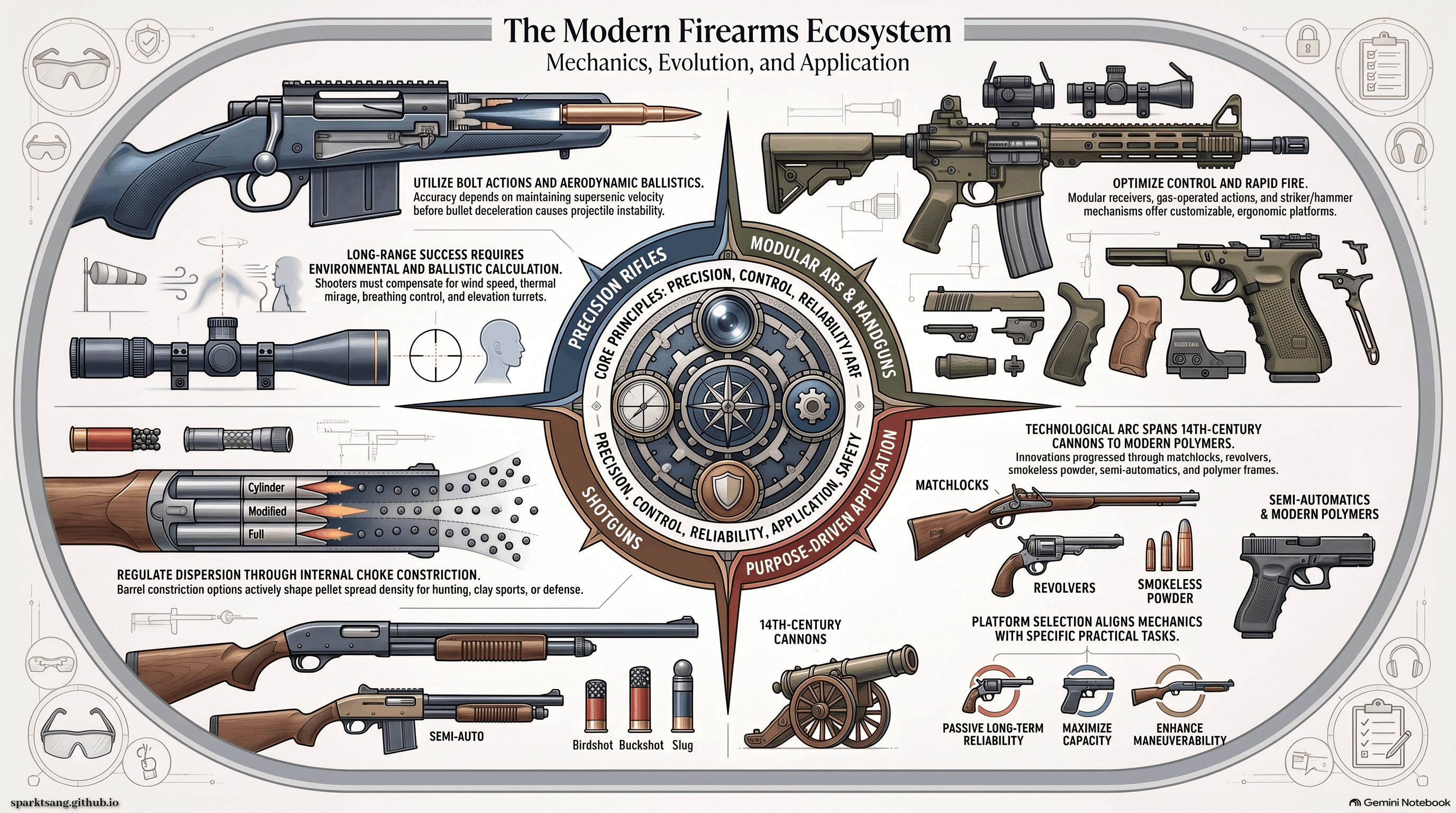
The maximum effective range of a bullet can be imagined as the distance over which it decelerates from supersonic to subsonic; as it crosses the sound barrier, it begins to become unstable and inaccurate.
Choosing the right projectile: the JBM Ballistics calculator can help determine this. The basic principle is to use the heaviest projectile possible at the highest achievable velocity. The grain is an imperial unit of weight, with 7,000 grains equal to one pound.
The ballistic coefficient (BC) supplied by the manufacturer is tied to the maximum muzzle velocity the bullet can achieve; you need enough velocity at the outset to take advantage of the high BC.
Scopes
When you get a new rifle, spend just as much time on the scope as you do on the rifle itself.
The internal construction of a scope is remarkably sophisticated: excellent optical clarity, the ability to withstand fierce wind and rain, and resistance to the recoil of every shot. A scope costing less than US$1,000 can already be astonishingly good.
A scope includes: objective lens (facing the target), elevation and windage adjustment turrets (for adjusting the position of the crosshairs), parallax adjustment knob (to prevent the crosshairs from shifting when the eye moves), focusing lens assembly, diopter adjustment ring (a simple adjustment to bring the crosshairs and the eye into focus), erector tube, reticle assembly (inside the tube), and eyepiece (where the eye is positioned).
The reticle can be placed on two focal planes: first focal plane (FFP) and second focal plane (SFP).
Angular units used when calculating range: mils or MOA (minutes of angle). The most common windage and elevation adjustment values are 0.25 MOA or 0.1 mil per click.
Precision long-range shooting also requires other equipment: rifle sling, electronic ballistic calculator, Mil Dot Master (a type of slide rule for calculating bullet drop), and suppressor (legal in most states).
High magnification is the mainstream market choice, but low magnification also has many advantages: a wider field of view, less wobble, and less risk of the exit pupil becoming smaller and making it harder to align with the image.
Sniper rifles
Remington MSR: selected by the U.S. Special Operations Command as the next-generation sniper system.
Accuracy International AX308: machined from a single piece of metal, rugged, safe, and precise.
Ashbury Precision Ordnance ASW 338LM: “Asymmetric Warrior,” the most customizable rifle.
Barrett M107A1: capable of penetrating concrete walls.
SIG SAUER S5G 3000: one of the most accurate production rifles, at only US$1,400.
Proof Research TAC II: made using notoriously difficult-to-work-with carbon fiber, rugged yet considerably lighter.
The art of reading the wind in long-range shooting: observe the environment (3–5 mph: a slight breeze across the face; 5–8: leaves begin moving; 8–12: dust rises; 12–15: small trees sway; 17: whitecaps), and use mirage (heat refraction that distorts light).
Practice being able to quickly push, pull, or adjust the windage or elevation without having to look up.
Control your breathing: three deep breaths can lower your heart rate and steady your aim. When firing, exhale completely and hold your breath, then take the shot within seven seconds, before oxygen deprivation affects your vision; if you miss, start over.
Proper rifle grip: lightly press the grip with the middle and ring fingers. The grip should be high enough for the index finger to naturally extend to the trigger. Do not press the thumb against the receiver; let it rest lightly behind the receiver without touching it. Poor trigger control will cause the crosshairs to jump.
Bipod: when necessary, use a knife to dig a one- to two-inch hole and place the bipod in it. Loose soil can provide cushioning and support; the feet can be changed, and metal feet can bite into hard surfaces such as concrete.
Night equipment NVDs: modern versions are extremely sophisticated, and extremely expensive.
Safety: a two-position safety lets you switch between SAFE and FIRE to prevent accidental discharge; a three-position safety adds a setting for unloading.
Bolt-action rifles: originally military weapons, but now a mainstay of hunting. They feature manually operated actions, mainly divided into two-lug and three-lug bolt designs; the former is traditional and by far the most common.
There are also other types: single-shot rifles (a synonym for the marksman, with an old-fashioned design but still the most robust action), lever-action rifles (light and convenient, suitable for dense woodland), straight-pull bolt-action rifles (uncommon but beloved by enthusiasts), takedown rifles (both the cheapest and the most expensive, with many allowing interchangeable barrels to change calibers), and semi-automatic rifles (gas-operated, with soft recoil and rapid follow-up shots).
Ammunition: .30-06 is versatile, multipurpose, and practical, but there are many other choices for adding a little more style and flair. The simplest way to improve accuracy is to try different ammunition and projectiles.
The best rifles
Montana Rifle Company M1999: extremely high levels of craftsmanship, affordable, elegant appearance, durable.
Weatherby Vanguard Series 2: flawless, with a wide range of configurations.
Ruger American Rifle: the dream of the budget-minded hunter, with a three-lug bolt.
Winchester M70: gentle curves, defining the concept of the sporting rifle.
Remington M700: a huge following; once the standard for most military sniper rifles.
Sako 85: the smoothest three-lug design, outstanding workmanship, and proven performance in harsh environments.
CZ557 American: excellent balance, easy to operate, renowned for precision craftsmanship.
Savage M12: accuracy that many companies still have yet to catch up with, with the best production barrel.
The author then introduces several travel rifles that will not disappoint, as well as an overview of scopes.
Every long-range shot is like solving a puzzle; the complexity rises exponentially. Delays can make the aim ineffective, and failing to kill with a single shot and instead leaving the animal badly wounded and able to escape is inhumane. Beyond 400 yards, extreme caution is required.
Universal rifle: the idea is a scout rifle capable of serving both self-defense and hunting purposes. Today, two rifles fit the concept perfectly: the Steyr Mannlicher Scout Rifle and the Ruger Gunsite Scout Rifle.
Changing magazines: with the free hand, pinch the new magazine between two fingers, press the release button and let the old magazine drop to the ground (if you intend to top it off, first grip it with the remaining three fingers), insert the magazine into the rifle, slap the bottom with the palm, and pull down to confirm that it is locked in place. Put the old magazine away and do not mix it up with a full magazine.
Reloading your own ammunition: it can save money, improve performance, and provide enjoyment in the process. Beginner kits are available with the necessary accessories; for a first attempt, start with a two-die set.
AR Rifles
Useful and accurate, which is why they have become America’s most popular rifles, originating from the AR-15 (later designated the M16).
Their modular design gives them an unrivaled range of accessories, allowing them to be customized for virtually any specialized mission.
A good choice for home defense (some people may find that amusing; do not take it to heart): easy to operate, with excellent ergonomics and light recoil, and suitable for new shooters.
In the late 1940s, the Soviet Union introduced the AK-47—light, easy to operate, stable, and possessing enormous firepower, it dominated the field. By the early 1960s, the gap between the United States and the Soviet Union could no longer be ignored, and the AR-15 emerged. Early versions, however, were prone to malfunctions, with rounds frequently jamming in combat, but over the decades the defects were gradually repaired one by one.
Upper receiver components: barrel, accessory rail, scope, forward assist.
Lower receiver components: folding stock, buffer tube, grip, trigger, magazine well.
Bolt carrier group: bolt carrier, firing pin, bolt, cam pin, firing-pin retaining pin.
The most practical zeroing method: zero at 50 yards, with the bullet striking 1½ inches high at 100 yards, then crossing the point of aim again at only 200 yards. This is known as the 50/200 zero.
Single-point sling: a comfortable and versatile way to carry an AR. Attach it near the junction between the buffer tube and receiver; when walking, it will not swing with the body.
When the rifle is rotated clockwise or counterclockwise onto its side, the point of impact shifts: turn left and aim upper-right; turn right and aim upper-left.
Ultra-low-cost precision marksman training: the .22 AR Smith & Wesson M&P 15-22 is the most affordable. Its operation is identical to that of a standard AR, and training on the .22 platform transfers seamlessly to the larger AR platform. Wild to shoot, perfect for practice, children can keep their finger off the trigger, US$520–560.
Maintenance: ease of maintenance in the field was one of the original design goals of the AR. There are countless tools on the market. The key points for keeping it in peak condition are: magazine (throw it away if damaged), extractor (replace the spring when malfunctioning, or even replace the entire assembly), ammunition (use high-quality ammunition), and lubrication (apply a generous amount to the bolt, but only a thin layer to the firing pin).
America’s favorite cartridge, the .223 Remington: excellent for both small and large game, also excellent for defense, accurate, soft recoil, suitable for beginners as well as competition, with an almost endless number of projectiles that can be loaded into it.
Accessory options are virtually endless, including: muzzle brakes, hand stops, lasers (red dots), weapon lights, and charging handles.
The best assault rifles
Daniel Defense M4 ISR-300 Blackout: virtually silent.
JP GMR-13: extremely stable, with almost nonexistent recoil.
PWS MK 107 DIABLO: an excellent close-quarters rifle, sacrificing muzzle velocity for mobility and handling.
Nosler Varmageddon AR: a prairie dog’s nightmare.
Alexander Arms 6.5 Grendel GDMR: precise at long range, with no need to pile on unnecessary weight.
Windham Weaponry Varmint Eliminator: a young company, but many employees have decades of experience.
Colt AR-15 A4: old-fashioned but more than nostalgia, versatile enough for hunting, defense, and patrol.
Nemo Arms Omen Match 2.0: powerful firepower with manageable recoil.
AK-47: the most successful assault rifle in human history—simple, rugged, inexpensive, light enough, portable, easy to maintain, requiring minimal training, and capable of equipping large numbers of soldiers with enormous firepower. Accuracy is a secondary consideration.
It has spawned countless variants, but they share the same defining characteristic: a gas-piston-operated action. The AK silhouette is instantly recognizable.
Handguns
The best tool for personal freedom ever invented by humanity.
With proper training and a calm response under pressure, a handgun can reverse a person’s fate.
The mainstream of the self-defense handgun market consists of small revolvers and various semi-automatics.
1365: the earliest known handgun, a small portable cannon.
16th century: the matchlock became widely popular in Europe.
17th century: the flintlock became the most advanced technology for the next 200 years.
1814: Elisha Collier invented the single-action revolver.
1833: Francesco Antonio Broccu invented a percussion-cap revolver.
1836: Samuel Colt designed the single-action revolver for mass production.
1846: Benjamin Houllier invented the self-contained cartridge.
1851: Robert Adams invented the double-action revolver.
1877: Colt successfully mass-produced a centerfire double-action revolver.
1894: the development of smokeless powder and detachable magazines ushered in the era of the semi-automatic pistol.
1896: Paul Mauser introduced the C96 semi-automatic pistol.
1934: Smith & Wesson and others developed the first .375 Magnum handgun cartridge.
1956: Smith & Wesson introduced the M29 revolver.
1982: the first polymer handgun.
The mainstream handgun is the semi-automatic pistol, with components including: front sight, rear sight, barrel, slide, slide lock, magazine release button, and removable frame.
There are two major types: hammer-fired and striker-fired.
12 best semi-automatic pistols
Smith & Wesson M&P series: highly rated in all three areas—ergonomics, stability, and recoil.
Smith & Wesson Shield: a slimmer, single-stack version of the former.
Glock G29: a compact hunting pistol.
Glock G19: extremely stable, a top choice for self-defense.
Dan Wesson Professional: designed specifically for law enforcement, a classic self-defense type.
Ruger SR1911: excellent at a low price.
Ruger MK III: a classic standard, with different configurations and capable of doing everything.
Magnum Research Baby Desert Eagle: an excellent compact self-defense pistol.
Browning Buck Mark: an excellent choice for handgun shooting enthusiasts.
Springfield Armory XD[m]: polymer frame; the “m” denotes a competition-grade pistol.
Colt Defender: smaller than a compact pistol, with a rugged Cerakote finish.
Controlling recoil is one of the most important areas of handgun training. Footwork and grip are also key elements of recoil control; the smaller the shooter’s body, the wider the stance should be. Use a high grip, hold firmly but do not squeeze excessively hard.
Knowing the trigger reset point of each handgun can help you gain more speed.
Three malfunctions of a hammer-fired handgun: stovepipe (clear the obstructed casing), double feed (reload the magazine), and a “click” when pulling the trigger (make sure the magazine is properly seated).
When drawing, do not look at the gun. A practiced shooter should be able to reload in three seconds: press the magazine release with the right thumb or left index finger, lower the shooting-side elbow until it touches the body while keeping the gun within the field of vision, insert the new magazine, then activate the slide release.
SIRT training: emits a laser beam, allowing training for rapid multiple-target shooting.
Revolvers: they have a rotating cylinder. Sales are lower than those of semi-automatics, but their variety is far greater. They are divided into single-action and double-action mechanisms.
Loading: press the cylinder release, use the other hand to push down the ejector rod and remove the empty cases, then insert cartridges (or use a speedloader). An experienced shooter can complete the process within three seconds.
12 best revolvers:
Freedom Arms Model 83 Premier Adjustable Sight Pistol: easy to mount a scope, for hunting.
Ruger JP100: durable and accurate.
Ruger SP101 .22: an ideal combination of gun and training revolver.
Ruger Single-Six Convertible: an ideal multipurpose handgun.
Ruger Vaquero: classic styling, modern design, low price, a favorite for cowboy shooting competitions.
Ruger Super Blackhawk: a classic top-tier choice.
Smith & Wesson M629: adjustable sights, an especially well-regarded hunting handgun.
M500: the most powerful revolver in the world.
M627: an excellent home-defense gun.
M642: highly resistant to moisture and high temperatures.
Model 640 Pro Series: equipped with tritium night sights, with extremely high sighting accuracy.
Taurus 85VTA View: the lightest and smallest multi-shot centerfire handgun.
The ultimate hunting handgun: S&W Performance Center 500
Powerful enough for dangerous game, equipped with a scope, with three barrel lengths (6½, 7½, and 10½ inches). Its cylinder has five chambers, allowing rapid follow-up shots, with better redundancy than a rifle.
Semi-automatics are superior in magazine capacity and speed, but are more prone to malfunctions (weak slide movement, jams) and require regular cleaning (the spring can become sticky, and lubricant can dry out). Revolvers are less demanding: they can sit in a drawer for ten years without being fired and still work, making them suitable for home defense. FBI data indicate that in civilian self-defense incidents, the average number of rounds fired is no more than three.
Research shows that when confronted with violence, a shooter’s eyes tend to focus on the threat rather than the sights. Lasers can provide effective aiming and targeting, and all of the author’s defensive handguns have lasers and weapon lights.
Ammunition: in urban areas, Jacketed Hollow Point (JHP) or Soft Point (SP) ammunition is the top choice, expanding the entry point while avoiding excessive penetration; in the forest, however, the bigger and heavier, the better.
Shotguns
The name comes from the ability to fire a group of pellets (though they are also commonly used to fire a single slug). They have the widest range of uses and the broadest variety of projectiles. Their predecessor was the smoothbore, which originated as a bird-hunting weapon and was also known as a fowling piece.
Clay shooting requires estimating the “lead,” allowing the target and shot to meet.
Choke constriction works like a garden hose controlling the spread of the spray. At 40 yards, if 70 percent of the pellets land within a 30-inch circle, it is considered a full choke; 60 percent is modified; 50 percent is improved cylinder; and 40 percent is cylinder, with the latter producing a wider spread.
The disciplines are divided into trap, skeet, and sporting clays (sometimes called “golf with a shotgun”), with different types of shot used for each.
A home-defense shotgun must be light and short enough to maneuver through confined spaces. A barrel of 18½ to 20 inches is ideal. To prevent the spring from stiffening and the lubricant from congealing, it should be fired, cleaned, and lubricated at least once every six months. 12-gauge ammunition is widely recommended for this purpose and is highly effective at close range.
Finished reading on Oct 20, 2021
Thank you for reading until the end. This is a bonus infographic just for you.