Notes on The Visual Encyclopedia of Car
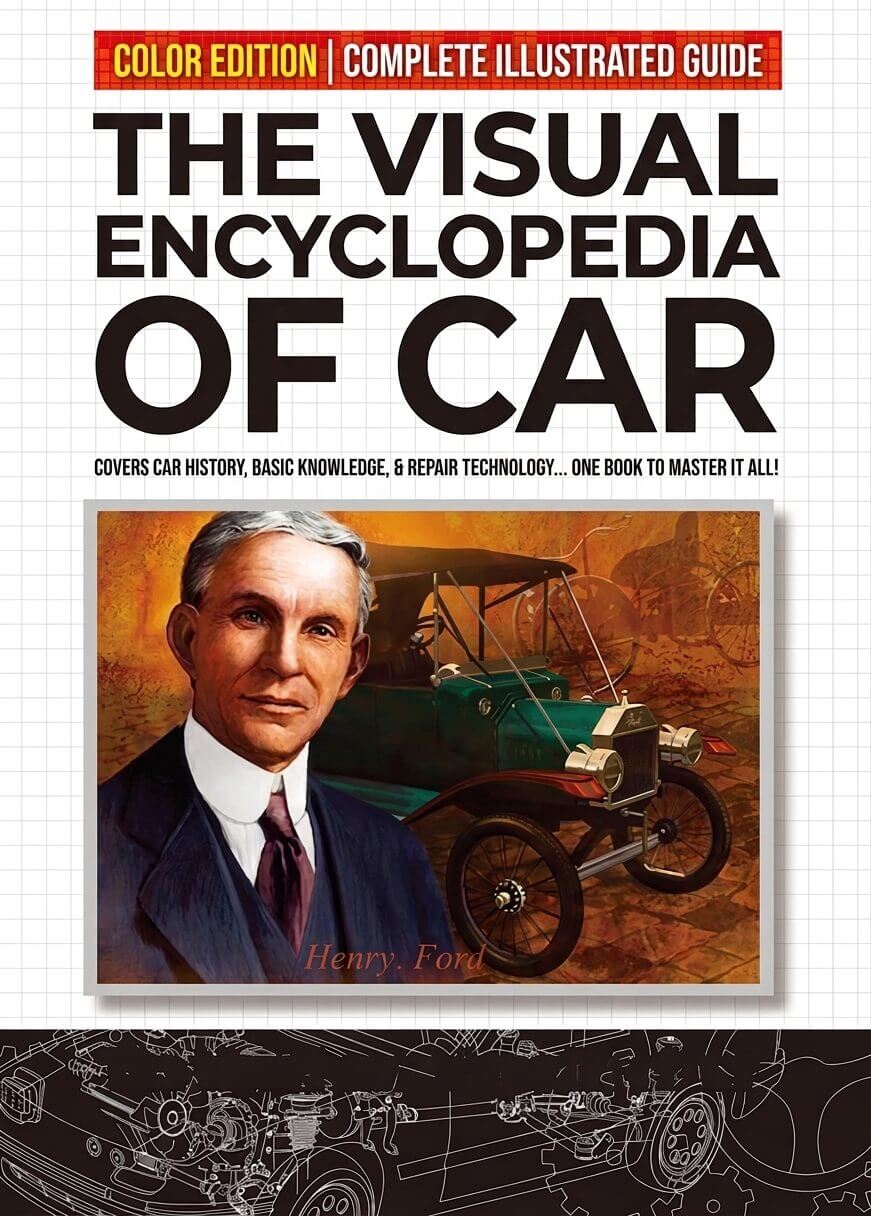
The Visual Encyclopedia of Car by Shin-sei Publishing
Original notes here.
Read until the end to get a bonus. Enjoy reading.
Classified by body style:
Sedan/saloon (UK): Three compartments: engine bay, passenger compartment, and trunk
Wagon: Two compartments; the trunk is enlarged and becomes part of the seating area, and the seats can be folded down to carry luggage
Hatchback: Smaller trunk, still able to carry a small amount of luggage, with a more compact body
Convertible: The roof can be opened
Top technologies:
Four-wheel-drive system
Fuel-cell vehicle: Generates electricity through a hydrogen–oxygen reaction to provide propulsion; the ultimate low-pollution vehicle
W engine: Formed by combining two V engines
Four-wheel-drive system
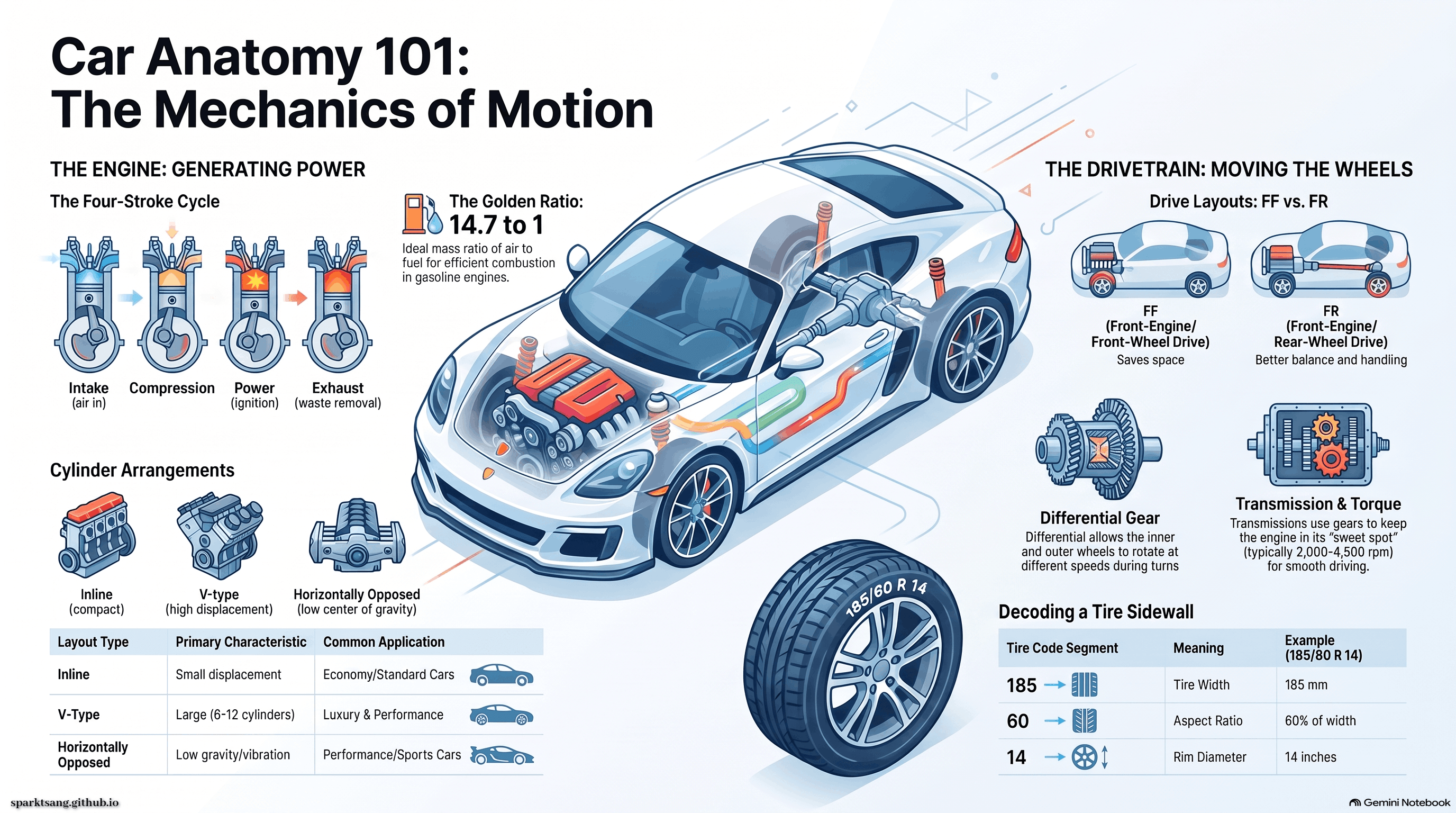
Engines are classified according to cylinder arrangement as inline (small displacement), V-type (large; six- and twelve-cylinder engines should have a 90-degree angle, while eight-cylinder engines use 60 degrees), and horizontally opposed (because the effect of gravity makes the lubricating oil prone to shifting away from where it is needed)
Combustion chamber: Located in the upper part of the cylinder, where the thermal expansion of gas pushes the piston downward and provides the engine’s power; the dominant design at present is the pent-roof type, with bathtub and hemispherical types also in use
Air–fuel ratio: The mass ratio of the minimum amount of air to the amount of fuel; for ordinary gasoline it is generally 14.7 to 1, and below this is a lean-burn mixture
In the past, the air and fuel were mixed before being sent into the combustion chamber; today, direct injection is increasingly used, with gasoline injected directly into the cylinder, allowing better combustion efficiency with less fuel
Four strokes:
Intake: The piston moves downward from top dead center, the intake valve opens, and air or an air–fuel mixture is drawn in
Compression: The piston moves upward from bottom dead center, with the intake and exhaust valves closed to compress the gas (direct injection takes place at this stage)
Power/expansion: When the piston reaches top dead center, the spark plug ignites the mixture; combustion produces gas that forces the piston downward and turns the crankshaft (the number of revolutions per minute is the “engine speed”)
Exhaust: The piston moves upward again, and the burned gases leave through the exhaust valve before being filtered by the catalytic converter and discharged outside the vehicle
With multiple cylinders (>6), different strokes can occur in rotation, allowing their power to be transmitted smoothly to the crankshaft and making its rotation more even; engines such as inline-six, V8, and V12 have the best rotational balance and, in theory, can reduce vibration to zero
Engine layouts are divided into: transverse (common in front-wheel-drive cars), longitudinal (rear-wheel drive), front-mid-engine (represented by BMW), transaxle (expensive, used in some sports cars), mid-engine (as in Formula racing cars and sports cars), and rear-engine (difficult to cool, now uncommon)
Bore: The internal diameter of the cylinder; the distance the piston moves from top dead center to bottom dead center
An engine is a system that converts reciprocating motion into rotary motion
If it is short, it can achieve high engine speeds even with less explosive force
If it is long, it can compress more air, increasing the pressure and allowing the engine to produce high torque even at low speeds
Torque is rotational force—the power that makes an object turn; horsepower is proportional to torque multiplied by engine speed
Camshaft: Formed by a series of cams with egg-shaped profiles, converting rotary motion into linear motion to control the opening and closing of the valves; when the pointed part of a cam contacts a valve, the spring is compressed and the valve opens; as rotation continues and the raised portion moves away, the spring force closes the valve
Valves: In the past, two valves were the norm—one intake and one exhaust—but to improve engine performance, more air can be admitted in a short period by increasing the number of intake and exhaust ports, resulting in multi-valve engines; high-revving sports cars, for example, may use five-valve engines; the drawbacks of adding valves are greater weight, higher cost, and increased sliding resistance
Another approach is to increase the amount by which the valve opens (called valve lift). This works at low engine speeds, but makes high-revving operation difficult; because the valve has to travel farther, the air cannot keep up with the speed of the piston’s reciprocating motion
Pneumatic valves, which use air pressure to open and close the valves, as well as electronically controlled systems, are under study
Valve timing: In practice, because of inertia, the intake and exhaust valves do not open and close exactly when the piston reaches top or bottom dead center; instead, they open slightly earlier and close slightly later. This timing is called valve timing
Opening or closing earlier than the preset timing is called advancing, while doing so later is called retarding; when the intake and exhaust valves are open simultaneously, this is called valve overlap
OHC engines are currently mainstream, with the valves arranged so that the exhaust valves are operated downward from the top of the engine
The ancestor was the side-valve SV engine; later came the overhead-valve OHV engine (still used in trucks designed mainly for low-speed operation)
Today there is also the DOHC, or double overhead camshaft, which is better suited to high-revving engines
Pistons: They withstand the gas pressure produced by combustion, so they must be both heat-resistant and light; aluminum alloys are commonly used
The top is called the piston crown, and there are a top ring, second ring, and oil ring (which maintains engine lubrication)
There are also the piston pin (pin-shaped), piston skirt (skirt-shaped), and connecting rod (rod-shaped)
Manufacturing them requires advanced technology; Japanese-made pistons only became competitive with those from Europe and the United States after the war
The connecting rod converts the piston’s reciprocating motion into the crankshaft’s rotary motion and must withstand enormous torque, so it is usually made of chromium–molybdenum steel or titanium alloy
The longer the rod, the more it can reduce the lateral force transmitted to the piston, but the engine becomes taller and heavier
Crankshaft: Located beneath the engine, it is driven by the connecting rods and rotates; its rotational speed is the engine speed. Its shape is complex and includes balancing elements, while some engines also have parallel balance shafts to suppress vibration
To prevent power loss, the number of electronically controlled components used today has increased
Rotary engine: Also known as the Wankel engine, unlike a conventional reciprocating engine, which converts the piston’s linear reciprocating motion into rotary motion, the rotary engine directly converts combustion energy into rotary motion, with a roughly triangular, rounded rotor performing the role of the piston; it can achieve the same horsepower with a smaller displacement, while producing less vibration and noise, being compact, and tolerating high speeds. Its drawbacks are difficulty in achieving rapid ignition and the problem of combustion gases escaping
Throttle valve: A butterfly-like component inside the throttle body that regulates the amount of incoming air and is linked to the accelerator pedal; today it is mostly electronically controlled
Air intake flow: air cleaner → throttle body → intake plenum → intake manifold → intake valve → cylinder
Engines other than direct-injection engines inject fuel into the intake manifold
Because of cost, air cleaners generally use materials with relatively high resistance; they accumulate dirt and therefore need to be replaced regularly
Variable valve lift system: Developed by BMW; a technology that controls the amount of incoming air by operating the opening and closing of the intake valves without using a throttle valve
It eliminates the excessive negative-pressure loss in the intake manifold caused by the throttle valve, as well as the flow resistance of the throttle valve itself
The intake valve takes over the work of the throttle valve, which is still retained for emergencies
The advantages are that it works effectively with gasoline of varying quality from around the world, while delivering high horsepower, high responsiveness, and low fuel consumption
Fuel pump: Draws gasoline from the fuel tank and sends it to the engine; divided into mechanical and electronic types
The electromagnetic electronic fuel pump is now commonly used. By switching the current through the electromagnetic coil, the piston enclosed by the coil moves up and down, pumping out the gasoline
Fuel flow: fuel tank → fuel pump → filter → injector → intake pipe → intake valve → cylinder
Inside the fuel pump: inlet check valve → outlet check valve → piston
The fuel tank must be installed in the safest possible location, usually beneath the rear seat
Fuel-injection system: Now mostly electronically controlled; in the past, fuel was usually injected into the intake manifold, but direct injection into the cylinder is becoming increasingly common because it allows finer control and saves fuel
The amount injected is controlled by the length of time the injector remains open
Battery: A device that converts electrical energy into chemical energy; ordinary vehicles use lead-acid batteries, in which the positive and negative electrode metals in the electrolyte react chemically to generate electrical power, called direct current. Each positive and negative pair of electrodes is stored in a single cell (with separators between the cells), and each cell stores two volts. Passenger cars generally use six cells, giving 12 V, while trucks use twice that
The charging and discharging process causes deterioration, so batteries need to be replaced regularly. Chemical reactions are sluggish at low temperatures, which is why problems are common in winter; they also do not tolerate heat well in summer and consume a great deal of power. The increasing number of electrical functions inside the vehicle also adds to the electrical load
Starter motor: In the past, the crankshaft had to be turned by human power to start the engine. Drivers had to take out their driving gloves from a box in front of the passenger seat to hand-crank the engine, which is why the name “glove compartment” has survived to this day
Today, turning the key or pressing a button activates the automatic starting mechanism, which engages the starter motor to start the engine
Ignition system: Gasoline engines use spark-plug ignition and require high-voltage electricity, which is produced by raising the voltage with an ignition coil. An iron core sits at the center of the coil, surrounded by primary and secondary windings; the difference in the number of turns creates mutual induction and increases the voltage
In the past, electricity was distributed by a distributor, but direct ignition is gradually becoming the mainstream, with the timing controlled by a computer; current is distributed to the spark plugs through high-voltage wires
The performance of an ignition coil deteriorates over time
Spark plug: Ignites the compressed mixture inside the cylinder. Spark plugs are divided into hot and cold types, with at least one per cylinder; the electrically charged tip extends into the combustion chamber and receives high voltage. The center electrode is positive, while the ground electrode projecting outward is negative; both are made of expensive platinum or iridium alloys. In the past they had to be replaced regularly, but the use of corrosion-resistant and heat-resistant high-cost materials has successfully extended their service life
Alternator: To meet the demands of the many electrical appliances inside a vehicle, the alternator uses the rotation of the crankshaft to generate electricity, which is stored in the battery
In the past, direct-current generators were used, but generating electricity also created a magnetic field that consumed some of the generated power, so high rotational speed was needed for charging. Alternators, by contrast, have high generating capability even at low engine speeds
Toyota’s Prius uses an electric motor to supplement the power that previously came solely from the engine, making it a hybrid vehicle
Exhaust: Exhaust gases mainly consist of carbon monoxide, hydrocarbons, and nitrogen oxides. The exhaust gas recirculation system (EGR) recovers part of the exhaust and sends it back into the intake system; the positive crankcase ventilation (PCV) system, which handles blow-by gas (the air–fuel mixture that enters the crankcase during expansion), serves a similar function
Exhaust manifold: Used to adjust the direction of exhaust flow while suppressing noise and vibration. Because the passages are made as long as possible, the manifold looks like octopus tentacles and has a twisted shape
Muffler: The sudden expansion of exhaust gas produces a very loud sound; the muffler makes the expansion take place more gradually
Purification system: Uses a three-way catalytic converter capable of removing all three pollutants at once. Nitrogen oxides are reduced to nitrogen and oxygen, while the remaining two are converted into carbon dioxide and water. Precious metals are used, and the design increases the contact area with the exhaust while reducing exhaust resistance
Coolant: Keeps engine temperature stable. It circulates through the engine via the water pump and water passages, generally at around 80°C. It is pressurized to raise its boiling point and improve performance; after absorbing heat, it is sent to the radiator and then returned to the engine. In the past there were air-cooled engines, which allowed the engine to be directly exposed to air; today, almost all engines use water cooling
When overheated, the piston and valves may burn, expand, or deform; when too cold, fuel efficiency deteriorates. Antifreeze, mainly ethylene glycol, is mixed in to prevent freezing
Thermostat: Regulates coolant temperature. Modern vehicles mostly use the wax-pellet type (formerly the bellows type), containing wax that expands when heated; as the temperature rises, the coolant is directed to the radiator
Radiator: Located at the very front of the vehicle, it is a long panel made of lightweight aluminum alloy (to avoid affecting handling), with many small tubes arranged side by side. Radiator fins between the tubes increase the surface area. When the vehicle cannot move and the radiator is not receiving enough airflow, the cooling fan starts
Engine oil: Lubricates the inside of the engine, reduces friction, prevents rust, and maintains airtightness. The replacement standard is once every 3,000 to 5,000 kilometers, which can improve the vehicle’s performance and durability
When the engine stops, the engine oil accumulates in the oil pan below. The oil pan contains a strainer, and the oil that passes through it is circulated back through the oil pump and oil filter, forming a continuous cycle
Supercharger: A device that compresses the air–fuel mixture before sending it into the engine to increase horsepower; there are turbochargers and superchargers
The former has a turbine made of highly heat-resistant material, with a wheel at each end of a single shaft: a turbine wheel and a compressor wheel. The former uses the force of exhaust gases to rotate, while the latter compresses the intake mixture and sends it into the cylinders
Excessively compressed air can cause abnormal combustion, so there is a wastegate that allows some of the air to escape
Drawbacks of the turbocharger: If the engine does not produce enough exhaust flow, it cannot perform effectively; once a certain rotational speed is reached, horsepower suddenly rises, producing explosive acceleration. This is called turbo lag and makes the car difficult to control
Solutions include: low-pressure turbochargers (smaller units that can provide boost even with low displacement); sequential twin turbochargers (increasing the number of turbochargers and using them separately to improve responsiveness)
Supercharger: Uses crankshaft rotation to compress the intake mixture and send it into the engine. It was once widely used in aircraft. Types include the Roots, Lysholm, G-Lader, and pressure-wave superchargers
Boost begins immediately from low engine speeds, rapidly increasing torque. The biggest drawback is energy loss (at high engine speeds it creates resistance), while it also increases the load and tends to produce vibration and noise
A turbocharger is also one type of supercharger in the broad sense; in the narrow sense, a supercharger refers to a mechanically driven supercharger
Turbochargers began to be used in aircraft after the war, while superchargers were already widely used in aircraft at that time
Engine bay
FF cars (front-engine, front-wheel drive) are almost always transverse-mounted
FR cars (front-engine, rear-wheel drive) are almost always longitudinally mounted
Checking engine-oil level: Pull out the dipstick, wipe it with a cloth, reinsert it, then pull it out again to check the oil level
Adding engine oil: The oil filler cap is located on the cylinder head. The engine becomes hot after stopping, so beware of burns; using a funnel is more convenient
Adding battery fluid: Use a large coin to open the cells and add fluid as needed
Adding coolant: The engine must be completely cool. Check the coolant-level indicator and add the coolant slowly
Adding washer fluid: This can be done even immediately after the engine has been turned off; place a cloth around the washer-fluid reservoir first
Drivetrain
FF cars have more interior space and do not require a driveshaft, making the overall construction lightweight, but they have difficulty handling very large amounts of horsepower
FR cars are heavier, but the clear division of labor between the front and rear wheels improves driving freedom. Front–rear weight distribution can more easily approach a balance, making them suitable for large engines
RR cars were once very popular. Because the rear is heaviest, they can be difficult to control when the rear wheels slip, but with countersteering (quickly turning the steering wheel) it is possible to take corners at high speed. This layout is used by the Porsche 911, as well as by buses that do not require high-speed cornering. Compared with FF, it is prone to oversteer, while FF tends to understeer
MR cars have the best sporting performance, with Formula racing cars as the prime example
4WD: Four-wheel drive distributes driving force among all four wheels, so even if one tire slips, the other three can still deliver power, maintaining traction on poor surfaces. It is divided into full-time and part-time systems. In part-time systems, four-wheel drive and two-wheel drive can be switched using a transfer case, providing greater off-road capability and making them suitable for extremely poor conditions such as mud. Full-time systems always use four-wheel drive and consume more engine power, inevitably causing driveline wind-up during sharp turns (the difference between the front and rear wheel paths through a corner, with the rear wheels pushing and causing the front wheels to enter a state similar to braking). A center differential is needed to absorb the difference in rotational speed; however, on poor surfaces, when a wheel spins freely, the engine power is absorbed by the differential gears and cannot be smoothly transmitted to the other wheel on the same axle. In recent years, more vehicles have adopted viscous couplings instead of center differentials to absorb differences in rotational speed
Transmission: An engine lacks sustained rotational force; without a transmission, a large engine would be required just to start the vehicle, yet such power would no longer be necessary after acceleration. The transmission therefore combines multiple gears of different sizes to control speed and torque
With a five-speed transmission, the engine and drive wheels are approximately synchronized in fourth gear, meaning three gear ratios are actually needed; fifth gear is called overdrive, in which the axle rotates faster than the engine
The engine can operate effectively only between roughly 2,000 and 4,500 rpm. That range alone is insufficient for smooth driving, so a transmission is necessary
Continuously variable transmission (CVT): Increasingly adopted in recent years; it does not use fixed gears and can change ratios continuously without discrete steps
Clutch: Engine power is first transmitted to the flywheel on the crankshaft (a device that keeps the engine running, similar to a flywheel based on inertia). The clutch transfers power from the flywheel to the transmission, engaging and disengaging it from the flywheel; if the engine and transmission were directly connected, excess force would damage the transmission
There are several types: friction (commonly used in manual-transmission cars), electromagnetic, and fluid (automatic-transmission cars)
Synchronizer: In manual transmissions, it synchronizes the rotational speeds of the gears, making upshifts and downshifts smooth
Automatic transmission: An automatic gear-shifting transmission that uses a torque converter to transmit engine power to the drive wheels
Automatic shifting: Because the torque converter uses fluid, starting uphill is easy, and steering the wheel while reversing into a parking space is also easier
Torque converter: Consists of a pump impeller near the engine, a turbine rotor near the transmission, and a stator between them, increasing driving force
Lock-up device: When the computer determines that no gear change is necessary, it locks the mechanism and directly connects the engine and transmission
Driveshaft: In FR and similar vehicles, it transmits engine rotation to the rear wheels. The raised section of the floor between the driver’s and front passenger’s seats is there to accommodate the driveshaft. It must be strong yet light, so hollow tubing is commonly used
It is generally divided into two or three sections joined by bearings to resist bending and reduce noise
Axle shaft: Carries the engine’s driving force from the differential to the left and right wheels, transmitting the drive force to the tires
In addition to transmitting engine power, it must withstand the reaction force transmitted back from the tires, so the metal must be both light and strong and is also subjected to treatments such as rapid cooling
The axle shaft’s CV boots prevent dirt from entering. They are often overlooked, yet they are an important component whose failure can cause breakdowns
Differential: Uses differential gears to compensate for the difference in rotation between the inner and outer wheels, allowing the inner wheel to rotate less and making cornering smooth
Limited-slip differential (LSD): A differential sends more driving force to the side with less resistance. If one wheel spins freely in mud, all the driving force is sent to that wheel. A limited-slip differential corrects this by restricting differential action under certain conditions and transferring driving force from the high-speed side to the low-speed side so that the two rotate at the same speed; there are three types: rotational-speed-sensing, torque-sensing, and hybrid
Traction-control system: One of the active safety features; a computer-controlled device that prevents the tires from spinning when excessive driving force causes the rotational force of the tires to exceed the friction available
Even on a wet road, pressing the accelerator further will only increase the car’s speed up to the point at which the tires will not begin to slip
Other active safety technologies include functions that prevent drowsiness and prevent excessively high-speed cornering
Tire maintenance: Tire pressure should be checked once a month. Tires are prone to cracking when pressure is too low, and the appropriate pressure varies by vehicle; it is often shown on a sticker inside the vehicle door
Remove stones lodged in the tire grooves with a flat-head screwdriver
Metal particles released by the brakes can stick to the wheels; use cleaning fluid to loosen them, then brush them off with a resin brush
When washing the car, wash the wheels first to save the effort of rinsing cleaning solution off later
Suspension system: Ensures that the drive wheels remain firmly in contact with the ground so that engine power is properly transmitted to the road; at the same time, it absorbs impacts from the road surface and suppresses body vibration. There are two types:
Independent suspension: The left and right wheels move independently, providing a smooth ride and stable road contact; it requires many components and is expensive, but has become the mainstream today
Solid-axle suspension: Invented in the era of horse-drawn carriages, it has a simple, inexpensive construction. When one wheel enters a depression, it cannot absorb the difference in level, causing the body to tilt and making the vehicle difficult to drive. For this reason, it is not used on the front wheels and is used only at the rear
It is extremely common for the front and rear suspension systems to use different designs. Front-engine vehicles have limited space for installing the suspension system, while the rear offers more room
Springs: Absorb impacts from the road surface; types include coil springs, leaf springs, and air springs
Shock absorbers: Stop the movement of the springs
Steering system: Changes the angle of the tires through the rotation of a pinion and transmits road conditions to the driver
Recirculating-ball steering: Formerly the mainstream; its construction is complex, it wears quickly, and it is expensive, but it effectively absorbs impacts and produces precise steering feel, so it is widely used in luxury cars
Rack-and-pinion steering: High rigidity and low friction, reducing gear backlash and providing sharp steering response, but vibrations are transmitted quickly to the steering wheel; suitable for small, lightweight vehicles
Steering gear ratio: The ratio between the rotational angle of the steered wheels (usually the front wheels) and the rotation of the steering wheel. It varies greatly by vehicle; a ratio that can be changed is called a variable-ratio steering system
Steering wheel: Depending on the vehicle, features include adjustable steering (moving upward and downward to adjust the angle) and telescopic steering (pushing in and pulling out to adjust the distance)
Considerable force was required to operate it in practice. Before power steering existed, reversing into a parking space was extremely difficult
Power steering can adapt to changes in load and steering effort. It is divided into hydraulic and electric types, with the latter becoming increasingly common
Ackermann geometry: When a vehicle turns at extremely low speed, ignoring centrifugal force, the centers of rotation of the wheels would otherwise differ; Ackermann geometry makes them coincide again
Four-wheel-steering system: Gives the supporting rear wheels steering capability as well. Types include mechanical, hydraulic, and the passive system that has recently become mainstream
When the front and rear wheels steer in opposite directions, this is called “out-of-phase,” which is advantageous at low speeds; when they steer in the same direction, it is called “in-phase”, with the opposite effect
Tires: Tubeless radial tires are currently mainstream. Their functions are to support the vehicle’s weight, absorb shocks, and generate driving, braking, and cornering forces. They consist of a belt that generates cornering force, a carcass that supports air pressure, and the sidewalls and tread that protect the carcass
Japan commonly uses summer tires without taking snowfall or freezing into consideration; Europe uses M+S (mud and snow) tires, which can handle accumulated snow. Snow-resistant tires are also called snow tires
Tread patterns are divided into rib (the most common), chevron (strong grip but poor ride comfort), block (excellent grip), and compound patterns (such as toothed or angular patterns, suitable for harsh road surfaces)
Tires with no grooves at all are called slicks and are used in racing. They have the largest contact area and therefore the best grip; when the road surface is dry, there is no need for grooves to channel away water. The ratio between the contact area and groove area is called the land-to-sea ratio
Aspect ratio = tire width / tire height (outer diameter minus inner diameter; the inner diameter is the wheel-rim diameter); the lower the profile, the poorer the ride comfort, but the better the sporting performance
Tire manufacturing code: “2505” means the tire was manufactured in the 25th week of 2005
“185/60 R 14 82H”: tire width 185 mm, aspect ratio 60%, R = radial tire, rim diameter 14 inches, load index 82, H = speed rating of 210 km/h (S = 180, V = 240)
Safety tread depth: When the tread becomes level with the wear indicator, the tire has reached its service limit and must be replaced as soon as possible
Wheel: Connects the tire to the vehicle and should be as light as possible. There are one-piece wheels, two-piece wheels that combine the wheel disc and rim, and three-piece wheels that divide the rim into two sections. The latter offer greater design freedom but are heavier and more expensive
Brakes: Hydraulic brakes are now standard. The hydraulic piping system is divided into front–rear split and X-split configurations; in either case, even if one side of the piping fails, braking ability will not be completely lost
A vacuum brake booster now increases the pressure applied to the brake pedal
Mechanical brake assist: When the computer determines that emergency braking is necessary, it causes the brakes to engage with greater force, but for technically skilled drivers it can actually get in the way
There are disc brakes and drum brakes. The latter are gradually disappearing from Japanese vehicles because of their declining compatibility with ABS
Anti-lock braking system (ABS): When the frictional force of braking is greater than the friction between the tire and the road surface, the tire locks and slides along the ground, creating a dangerous lock-up condition
Electronic stability control: In abnormal situations, controls the vehicle’s yaw inertia to prevent oversteer
Vapor Lock (or Brake Fluid Boiling): A phenomenon in which excessive use generates enough heat to produce bubbles in the brake fluid, causing brake failure
Body: Most bodies are now of unibody construction, which is lightweight and does not require a heavy frame, but cannot withstand extremely strong impacts. Off-road vehicles that require a stronger body use frame construction, while unibody structures incorporating built-in frame members are also becoming mainstream
A safety body is designed to deform and crumple in an accident in a controlled manner, reducing injury to pedestrians to a minimum
Side-door impact beam: Installed inside the door to increase its strength and protect passengers in a side collision
Coefficient of drag Cd: The smaller it is, the lower the resistance, allowing a higher top speed and better fuel economy
The duct that sends air into the engine bay also creates aerodynamic drag. The author imagines that the engine-design department, which wants to obtain a large amount of air, and the body-design department, which wants to minimize aerodynamic drag as much as possible, would constantly argue with each other
Sunroof: Not popular in Japan, but extremely popular in Europe, where the hours of sunshine are shorter
Car-wash detergent: There are various types, including those that break down water spots, provide a waxing effect, or can be used without water
The ingredients can adhere to the car, so after washing, all water droplets left on the vehicle should be wiped completely dry. Highly absorbent synthetic chamois can be used, but because it is extremely hard, it should be soaked in water before use
Headlights: Discharge-type headlights are now widely used. They have a high color temperature, close to sunlight, are twice as bright as the old halogen lamps, last longer, and consume less power. Discharge lamps are also called xenon lamps or HID lamps
Night-vision system: Displays images that are difficult to see with the naked eye while driving at night to improve safety, using devices such as far-infrared cameras
Windshield wipers and lights such as headlights should be replaced regularly
Headrests contain a pressure plate that can reduce whiplash injuries to the head: When a vehicle is hit from behind, the body is thrown forward, while the head, because of its inertia and weight, tends to remain in its original position, causing it first to tilt backward and then bend violently forward
Seat belts: The current mainstream is the three-point belt, with an emergency locking retractor system that restrains movement during a collision
Airbags: Controlled by a computer and triggered by G-force sensors that detect impact. Not every collision causes an airbag to deploy; when deployment is required, an inflator ignites the initiator, which burns the gas-generating material, and nitrogen-rich gas inflates the airbag
Door mirrors: When the gear selector is shifted into reverse, the mirror tilts downward, making it easier to reverse into a parking space
Engine Immobilizer: Compares the chip in the key with the vehicle; the engine will start only when they match
Left/right independent air-conditioning control: Already common in luxury cars, it automatically controls airflow and air-conditioning intensity according to the distribution of sunlight inside the vehicle
HDD car navigation system: Large capacity and fast data access make it convenient
ETC electronic toll collection system: Installed in the vehicle and communicates with antennas at toll booths, allowing payment without stopping
Cruise-control system: Maintains speed even when the accelerator is not pressed; if the vehicle goes too fast, it applies the brakes to control the speed
On-board computer: Displays information such as temperature, speed, fuel level, and remaining driving range on the car navigation screen
1765: Steam engine invented by James Watt in Britain
1769: Frenchman Nicolas Cugnot built a three-wheeled steam-powered vehicle, the earliest automobile
1863: German Nikolaus Otto developed a two-stroke engine automobile
1876: German Nikolaus Otto developed a four-stroke engine automobile
1885: German Karl Benz built the earliest gasoline-powered automobile
1886: German Gottlieb Daimler built the earliest four-wheeled gasoline-powered automobile
1891: Gasoline-powered automobiles were first sold commercially in France
1908: The first mass-produced automobile, the Ford Model T, appeared in the United States
Around the period spanning the two world wars, superchargers, turbochargers, shock absorbers, and independent suspension systems were successively developed and introduced, improving automobile performance
Finished reading on Oct 14, 2021
Thank you for reading until the end. This is a bonus infographic just for you.