Notes on The Universal Principles of Successful Trading: Essential Knowledge for All Traders in All Markets
The Universal Principles of Successful Trading: Essential Knowledge for All Traders in All Markets by Brent Penfold
Original notes here.
Read until the end to get a bonus. Enjoy reading.
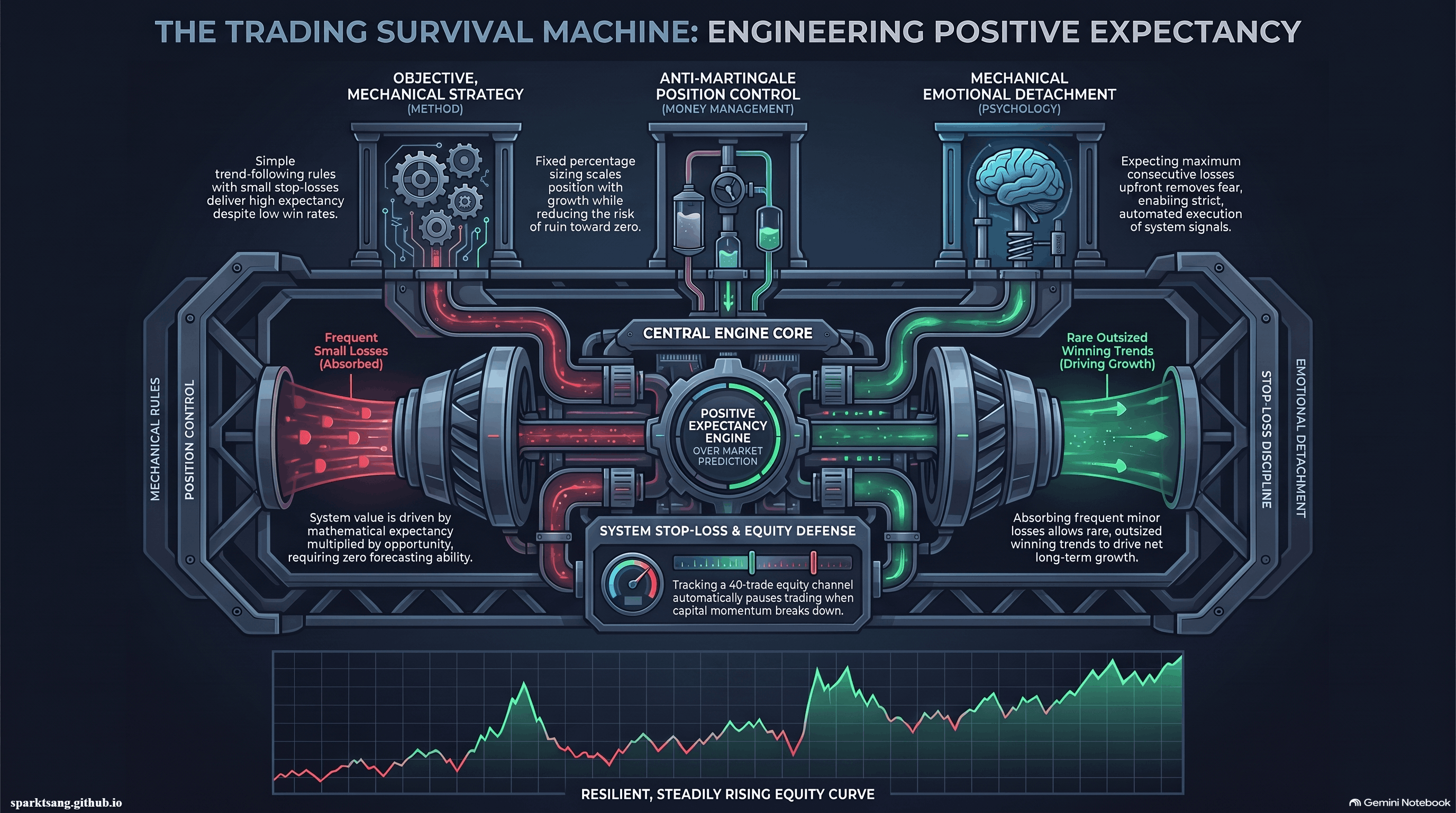
Trading methods, money management, and trading psychology are the three major determinants of success or failure.
Trading psychology is not as important as people imagine; ignorance is the biggest cause of losses.
The small minority of winners all move toward simplicity, structure, and certainty: a systematic approach that seeks positive expectancy.
Winners are simply the best and most effective losers at managing risk.
The market creates the greatest adversity, ensuring that money is transferred from the vast majority of people into the hands of a tiny minority of the strongest.
Successful traders do not make money by trying to predict the market. They make money by knowing how to respond to the market’s direction.
The risk of ruin is the situation in which a trader suffers losses so large that they can no longer trade, and it must be reduced to as close to 0% as possible.
Trading smaller amounts, increasing the winning-trade ratio, and improving the reward-to-risk ratio can all reduce the risk of ruin, and there are formulas for calculating it.
Expectancy is the expected return on every dollar invested. It equals: (win rate × average profit / average loss) − (loss rate × average loss / average loss). Positive expectancy is a necessary condition for trading.
Some methods may have low accuracy but very high expectancy, including trend-following, because the market moves sideways and oscillates within ranges most of the time and trends only rarely.
An opportunity is the number of times a method can be used to trade within a given period.
Expectancy multiplied by opportunity tells you how much a trading method is worth.
A successful trading method must pass the McDonald’s test: even a teenager should be able to understand the method and trade with it. Traders who fail all believe that the answer lies in complexity.
Use 30 trades sent by email to trading partners, rather than paper simulations that are easy to falsify and modify, to verify a trading method’s expectancy.
Long-term trend-following has low accuracy but high expectancy.
It offers relatively few opportunities, requiring the simultaneous monitoring of a portfolio of 20 to 30 markets to generate enough opportunities. Its financial cost is high, making it suitable for large investors.
The other approach is short-term swing trading, which has a lower reward-to-risk ratio but higher accuracy.
Money Management
There are two schools of money management: the Martingale school (increase the stake after losing) and the anti-Martingale school (increase the stake after winning and reduce it after losing). The former accelerates your risk of ruin.
Williams discussed in his book The Long Secrets of Short-Term Trading a money-management strategy that allowed his capital to grow geometrically. Its performance was so outstanding that the authorities repeatedly suspected him of cheating.
The seven trading strategies are:
Fixed Risk: Use the same amount of capital for every trade. This manages risk very well, but the profitable growth of the equity curve will not be particularly impressive. In a particular foreign-exchange trading system, the net profit was 150,000, with a loss percentage of 7% under a catastrophic loss.
Fixed Capital: Set a fixed amount of capital, and trade proportionally according to how many multiples the current account balance is of that fixed capital. Because the number of contracts rises progressively, it can produce astronomical growth, but the maximum loss ratio is also higher. Net profit was 18 million, with a loss percentage of 58% under a catastrophic loss.
Fixed Ratio: The amount of capital available for trading is delta, where delta equals the maximum loss plus the initial margin. This method cannot grow geometrically as well as fixed capital, but it is better able to cope with catastrophic losses, while profits are also much higher than under fixed risk. Net profit was 1.6 million, with a loss percentage of 13% under a catastrophic loss.
Fixed Units: An improved version of fixed risk. The capital used for each trade increases as the account balance rises, giving it better geometric growth than fixed capital. Net profit was 22 million, but the risk taken was also considerable, with a loss percentage of 44% under a catastrophic loss.
Williams Fixed Risk: Number of contracts = account balance × maximum loss percentage / expected maximum loss per trade. This ensures that the maximum loss remains within a tolerable range. Net profit was 13 million, and it was better able to cope with catastrophic losses, with a loss percentage of 34% under a catastrophic loss.
Fixed Percentage: Used by most professional traders. Number of contracts = fixed percentage × account balance / risk of the individual trade. Net profit was 19 million, with a loss percentage of 35% under a catastrophic loss.
Fixed Volatility: Replace the risk of the individual trade in the above formula with market volatility. Net profit was 8.5 million, with a loss percentage of 23% under a catastrophic loss.
The above figures all assume a maximum of 100 contracts. Without that limit, and assuming the exchange could handle such a trading volume—which is actually impossible—the results are:
Strategy, net profit, maximum loss percentage
Fixed Risk: 150,000, 5%
Fixed Capital: 12.1 billion, 61%
Fixed Ratio: 1.58 million, 12%
Fixed Units: 436.3 billion, 83%
Williams Fixed Risk: 100 million, 42%
Fixed Percentage: 700 million, 40%
Fixed Volatility: 12 million, 29%
None of the above money-management strategies can tell you when a strategy with positive expectancy turns negative.
Therefore, you must monitor changes in the momentum of your trading equity. Once it begins to decline, you should step aside and stop trading until positive equity momentum returns.
Just as every trade needs a stop-loss point, the system itself also needs a stop-loss point.
The author constructed a profit channel that tracks the lowest account-equity curve over a 40-trade lookback period. Once the actual trading curve drops below this moving average, trading stops; when it breaks back above, trading resumes.
Trading Methods
Traders can be divided into three categories: discretionary, mechanical, and discretionary-mechanical.
The author is mechanical. Mechanical traders do not decide which trades to execute; they must trade every signal generated by the system.
Many people start out as discretionary traders and, with experience, become more structured and simplified.
The method must be verified for positive expectancy using the email method described above.
They can be divided into three types: predictors, dreamers, and pragmatists.
Predictors include fundamental analysis, Elliott Wave Theory, Gann, fractal analysis, and cycle analysis.
Gann theory is extremely popular, but his son pointed out that his father could not make enough from trading to support his family and lived instead by writing and selling educational materials.
Dreamer indicators include MACD, DMI, moving averages, RSI, and the Stochastic Oscillator.
Most indicators are lagging and allow traders to rely on too much flexibility.
If these indicators help determine support and resistance, they can be subjected to the positive-expectancy verification method to determine whether they are useful.
Pragmatist tools include Dow Theory, chart analysis, intermarket analysis, quote reading, volume analysis, spread analysis, and pattern analysis.
Pragmatists are usually the most successful traders.
Although a large stop-loss can produce better expectancy, it is often less effective than a small stop-loss. This is extremely important.
As mentioned earlier, trend-following has low accuracy (losing 67% of the time) but is the safest approach. There are two basic methods, and both work: execute breakout trades in the direction of the trend, or trade on retracements.
The latter may miss a major trend, but it has a smaller stop-loss and the lowest initial risk.
The rest of this book will focus on retracement trend-following.
Remember that trend-following has low accuracy, so you should not trade for the sake of making an immediate profit, should not trade to prove that your market analysis is correct, and should not trade for the thrill of taking action. You should trade for the opportunity to capture expectancy.
Most traders can say that the trend is their friend, yet nine out of ten still lose money. Why? Mainly because of poor money management, poor trading methods, and inappropriate trading attitudes.
Poor trading methods can in turn be attributed to poor trend tools. Moving averages, the Moving Average Convergence Divergence indicator, the Average Directional Index (ADX), and trend lines are not good indicators. They all depend on subjective variables and are not objective or neutral enough.
A good trend tool should require no input or opinion from the trader; otherwise, it is neither objective nor independent.
Retracement tools used to confirm retracement levels, including the Rate of Change, Relative Strength Index, and Stochastic Oscillator, are all subjective and poor tools.
Layering indicators on top of one another creates enormous numbers of variables. Even if a trader manipulates those variables to curve-fit historical data and produce an attractive equity curve, the result is unstable and will often begin to decline immediately after trading starts. Some variables can be used to cheat by avoiding persistently unfavorable historical trading periods and skipping major losses.
Traders need to find objective, fixed trend and retracement measures with built-in safeguards.
There are certainly cases where subjective tools produce profits, but they are usually simple methods.
If you use them, do not alter their factory settings; let them remain as independent and consistent as possible.
In Art Collins’s Beating the Financial Futures Market, the mechanical trader Charlie Wright, who had been involved in the markets for more than 30 years, made this observation: what our research found most fascinating was that indicators finally turned out to be completely useless.
Trading methods can complement and reinforce one another, such as developing two independent and complementary trend-following and counter-trend methods and combining them to produce a smoother equity curve.
Most winners use strategies that are structurally simple, objective, and measurable (of course, there are always exceptions).
In Collins’s Winning on the Market, DeMarcos said that after testing with 17 programmers over four or five years, the basic four or five systems worked best.
If you fail to take note of this observation, you are an inadequate reader.
Few traders can afford 17 programmers conducting intensive research. This is extremely expensive research.
Simple strategies have a powerful contradiction: their equity curves are always uneven. The simpler the strategy, the more likely it is to be a genuine strategy, because it does not rely on manipulating variables to skip major losses.
An example of an objective trading strategy is the one developed by Richard Donchian in the 1960s, described in The Complete TurtleTrader: buy when the price breaks the highest level of the past 20 days and sell when it breaks the lowest level of the past 10 days; sell short when it breaks below the lowest level of the past 20 days and exit when it breaks above the highest level of the past 10 days; use fixed-volatility money management for stop-losses; limit risk to 2% of risk capital; define volatility using the 20-day ATR.
This strategy requires substantial capital, simultaneous monitoring of multiple markets, and the ability to tolerate low accuracy.
An example of an objective trend tool is the swing chart: higher swing lows indicate an uptrend, while lower swing highs indicate a downtrend.
The author spent 15 years on Fibonacci ratios before doing the work himself to verify them. Based on the multi-timeframe swing charts he created for five currencies and eleven index markets, the retracement percentages he collected were broadly normally distributed. Fibonacci ratios are not magical.
Fibonacci ratio followers are everywhere, and it is impossible that none of them make money. It may instead be a case of mistaken attribution, much like taking a placebo.
To reiterate, once positive expectancy has been verified using the email method described above, it does not matter much even if the method uses subjective tools.
Trading Psychology
A racing heart, sweaty palms, and anxiety while trading occur because your subconscious sees things with perfect clarity and knows that the trader lacks trading ability. Once the trader adopts a sensible money-management strategy that reduces the risk of ruin to zero and verifies positive expectancy, the subconscious knows that you possess trading ability and will no longer sabotage you.
When you hope that a trade will turn out well, you should stop trading immediately.
Someone who has verified positive expectancy does not hope that the next trade will win; instead, they hope that their method will find an additional pattern and give them more expectancy to earn.
When greed appears, remind yourself to maintain modest expectations and set your own professional goals. The higher the expectancy of a method, the higher the risk, and the greater the probability of ruin.
The author has his own way of dealing with fear. When trading, he always writes his expected loss on the profit-and-loss statement. He expects losses to occur and assumes that his trades will all lose in the short term.
Not only that, he goes further and assumes that the greatest adversity—the maximum consecutive loss—is right in front of him, and faces it head-on.
Trading is a painful world. Losing money hurts. Making money but failing to capture the full rise hurts. Spending enormous effort on research and still failing to make money hurts. Paying for courses and then losing money when you put them into practice hurts. The author’s way of coping is to become a mechanical trader and keep his distance from the market after placing an order.
Successful traders can remain humble, constantly guard against the greatest adversity, prepare their defenses, and remain tenacious. Humility allows you to accept that the future is unknowable. Humility prevents you from trying to predict. Humility prevents you from interfering when your trading is going badly. Humility allows you to accept that trading is based on simple concepts.
Trading in Practice
When you begin to hate trading, you should feel encouraged, because you have become indifferent to the outcome of individual trades, showing that you have learned to use money-management strategies.
Daily routine: first confirm whether a particular pattern exists. If it does, determine the trading plan, entry level, stop-loss level, exit order, and amount at risk; check whether the equity curve is above the system stop-loss level; record and accept the expected loss; place the order.
Winners’ Living Room
In the final chapter, the author invites 15 market masters to briefly share their views in the book.
Ray Barros (author of The Nature of Trends): The deep practice advocated by Coyle in The Talent Code applies equally to traders, just as pilots learn from mistakes in flight simulators without actual risk.
Mark Cook (day trader of S&P, inventor of the Cook cumulative tick): Accept the fact that trading involves losses. Trade according to facts, not other people’s opinions. You cannot stay in a trade too long; you need to get out early.
Michael Cook (moved from institutional trading to private trading, winner of the 2009 World Cup Futures Championship): Start with small trades at the beginning of your trading career.
Kevin Davey (winner of the 2006 World Cup Trading Championship): Occam’s razor—the simpler, the better.
Tom DeMark (one of the inventors of the TD Sequential indicator, market-timing trader, top-and-bottom forecaster, author of The New Science of Technical Analysis and other books): Avoid the crowd. Tops form not because selling pressure, but because the last buyer has already bought. Bottoms form not because buying emerges, but because the last seller has already sold.
Lee Gettess (trained as a computer programmer, designer of mechanical-system trading strategies, developed the Volpat trading strategy, ranked third by Futures Truth magazine. He selects which signals to trade at his own discretion): How much money you can make is beyond your control. Risk is the only aspect of trading you can control. You must accept that you are dealing with probabilities.
Daryl Guppy (Australian, well known in the Chinese market, author of Share Trading): Remain humble. Some people understand the market far better than you do. Their information and analytical skills are all reflected in the movement of prices, and you can use the Guppy Multiple Moving Average to analyze these relationships. If your own opinion conflicts with market price action, ignore your own opinion.
Richard Melki (global macro trading strategies, discretionary trader, from day trading to short- and medium-term trading, CEO of RTM Absolute Return Fund; the author says he is the best economic analyst he has ever known, with a 24-year consecutive record of profits): Maintain realistic expectations, a robust capital-management system, and use a simple trading plan. Important economic variables to track include retail sales, the ratio of inventories to sales and inventory levels, and the manufacturing ISM index, including its production and new orders components. Trade only when the relevant pattern variables are aligned.
Geoff Morgan (an obscure private trader and a friend who put the author on the right path to trading success. Started as a mechanical trader and later became discretionary. Specialized in risk assessment and finding statistical advantages. Lost money in only one of the past 21 years. The author persuaded him again before he agreed to write down his advice): At the brokerage firms where he had previously worked, only one out of several hundred clients made money. Focus on minimizing losses. Excellent defense wins the game.
Gregory L. Morris (author of the bestseller Candlestick Charting Explained): Two words: discipline. Discipline helps bridge the gap between analysis and action, which is where many people stumble.
Nick Radge (highly experienced in the trading world, having worked as a broker, fund manager, trading author, and trading educator, and author of Unholy Grails and Adaptive Analysis): Tenacity, perseverance, and persistence are what allow you to overcome all kinds of difficulties and setbacks. Do not expect to make money immediately. Just as when you buy a house, you would not focus on three or six months. The market will reward you when it is ready; your job is to be standing in the right place when it takes out its wallet. If traders who left the market in 2008 had executed the same long-term trend-following strategy in 2009, they would naturally have made money.
Brian Schad (a former U.S. Navy SEAL who was inspired after reading Larry Williams’s book, and helped publish his Williams Commodity Timing newsletter; a discretionary trader who uses software): Early in your trading career, work as soon as possible to define your trading concepts on an advanced trading software platform and backtest your market beliefs. Recommended software includes System Writer and GenesisFT. Paper trading produces unstable results when carried out near the end of a trend, which can cause you to abandon what was originally an excellent trading method.
Andrea Unger (championship-winning day trader who uses five-minute charts, author of Money Management: Methods and Applications, and enthusiastic about researching and developing trading strategies): Consider your personality and choose a trading method that suits you. Once you have decided, move forward until your plan tells you to stop. A system that cannot tolerate consecutive losses is different from one that cannot tolerate a huge loss. Stay curious and think about changes in the market.
Larry Williams (an incomparable master with no one to equal him, who began trading more than half a century ago before electronic tools and computerized charts existed; originated more effective trading concepts than perhaps anyone else, and has more successful students than anyone else; inventor of the Williams %R indicator, author of The Secret of Selecting Stocks for Immediate and Substantial Gains in 1969, and the unprecedentedly dominant winner of the World Cup Futures Trading Championship. He is not a mechanical trader but is highly systematic, and greatly enjoys using the Genesis system): Having a money-management method and a trading method is not enough. You must take control and continually take specific actions in order to win. A trading career is a battle. Problems, rather than answers, are what make you a better trader. You need to find the answers yourself; there are no simple answers. Trading combines art and science, mathematics and emotion. What works for one person may not suit another.
Dar Wong (highly charismatic, frequently speaking Singaporean forex trader, day trades Nikkei futures contracts, developed the PowerWave method, uses half-hour charts, simple candlestick charts only, and occasionally looks at the Stochastic indicator): Adopt a good risk-reward ratio, determine whether you are a day trader or a trend trader, and understand that trading is a game of probabilities.
Although the different masters each have their own markets, time frames, tools, and techniques, do not believe that there are countless winning strategies.
Their individual advice all touches on the elements of the general principles of successful trading discussed in this book.
Conclusion
This is the best of times and the worst of times for private traders. The best of times because institutions no longer possess any competitive advantage; there are no barriers to entry, and the market offers countless low-cost brokers, electronic trading platforms, and real-time electronic data.
The worst of times because traders have so many choices available that they cannot cope with them all, and more than 90% of active traders continue to lose money.
May what this book teaches help you avoid the worst of times.
Trading requires more homework than you imagine, and you can enjoy long-term success only by learning to manage the pain of trading.
Always beware of simple choices, because they are usually the wrong choices.
Make sure the risk of ruin is zero. The best losers are long-term winners. I wish you well in losing beautifully.
Finsihed reading on June 20, 2018 in Malaysia
Penfold asks how a trading method can be tested for positive expectancy. The First Principles of Perennial Profit in Investing takes the question one step deeper: what causal condition makes a method capable of sustaining profit in the first place?
Thank you for reading until the end. This is a bonus infographic just for you.