Notes on The Secret Wealth Advantage: How you can profit from the economy’s hidden cycle
The Secret Wealth Advantage: How you can profit from the economy’s hidden cycle by Akhil Patel
Original notes here.
Read until the end to get a bonus. Enjoy reading.
Preface — Why No One Saw It Coming
After hearing a report on the 2008 financial crisis, Queen Elizabeth II asked: “If it was so serious, why did no one see it coming?”
The British Academy replied to the Queen: the main reason was that the collective imagination of many intelligent people had failed.
The author asks: What other field of science could blame its failure to investigate the most important phenomenon on something like this and escape criticism?
The financial crisis nearly bankrupted the author’s family business, becoming the driving force behind his research.
As early as the nineteenth century, Henry George had already studied related questions in Progress and Poverty: Why do we repeatedly experience periods of boom and crisis? Why do they emerge? Why does no one see them coming? What should we do to stay safe?
A group of scholars had predicted the 2008 crisis several years earlier. The experts who wrote to the Queen were wrong: financial crises have existed for hundreds of years and are part of a recurring pattern in the economy.
Everyone is affected by the business cycle. If you ignore the lessons of this book, a crisis can cost you dearly.
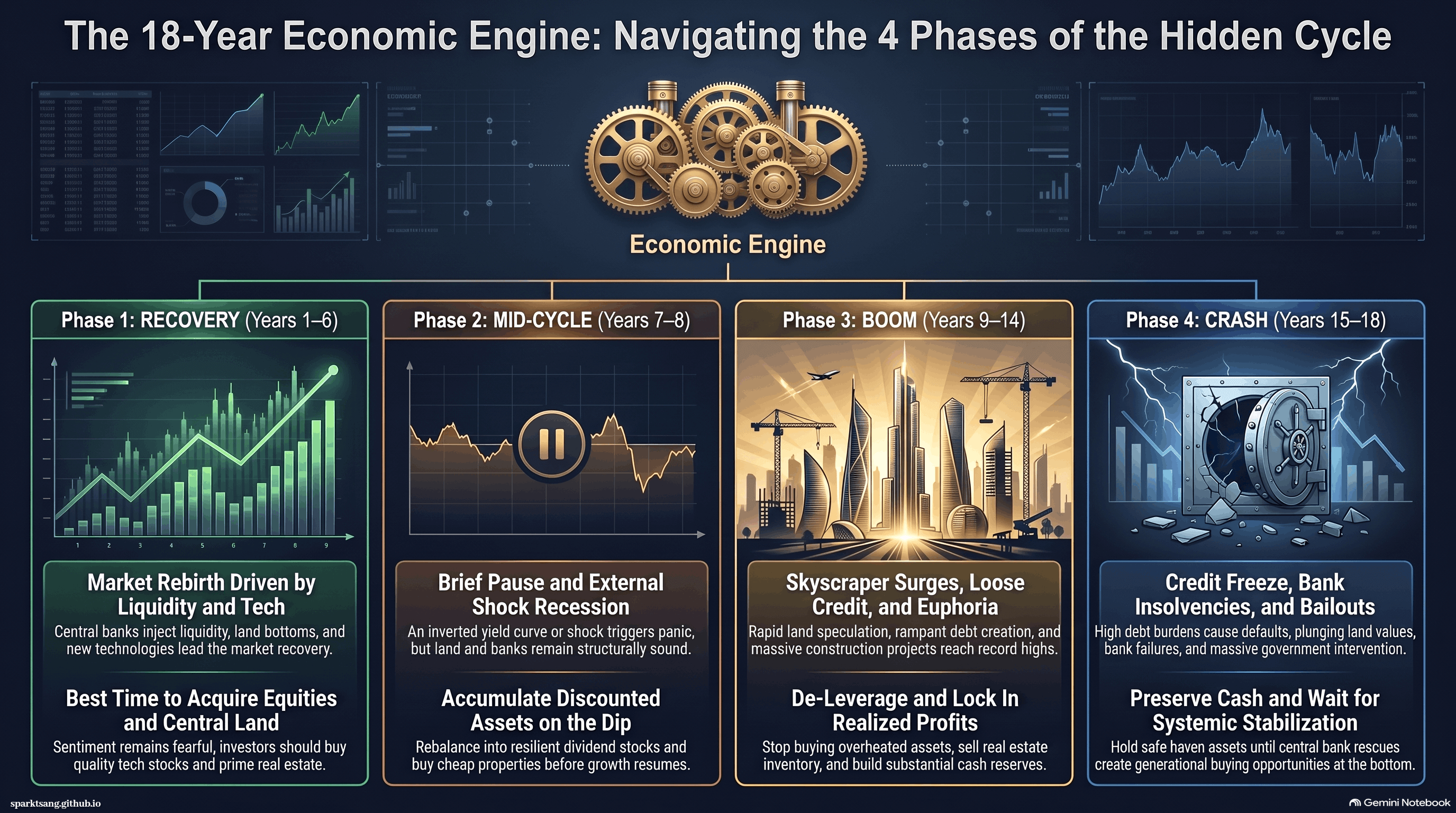
Every cycle has four acts: Recovery (rebirth from the ashes, confidence returns, expansion resumes), Mid-cycle (a mild recession, fear returns), Boom (full prosperity, abundant credit, surging stocks and property, excess growth, reaching the highest peak), Crisis (collapse and depression, malaise and stagnation).
Introduction — The Ancient Story of the Business Cycle
Recovery
The Panic of 1907 had become a normal feature of the economy. Since the founding of the United States, a panic had occurred roughly once every twenty years, but this crisis spread as far as Germany, Japan, Italy, Chile, and Egypt.
Banks collapsed like dominoes. The government offered J. P. Morgan control of the U.S. steel monopoly in exchange for his intervention, while Morgan had several bankers locked in a room until they reached an agreement.
Many people analyzed the causes of the crisis, but the real cause was the downturn in real estate.
The land market bottomed in 1909, but the stock market recovered first, rising 47% in 1908.
The economy began to improve in 1911.
In 1913, the Federal Reserve System was established in an attempt to eliminate the business cycle.
In August 1914, the First World War began and the stock market stopped trading. The United States and Japan prospered by supplying the belligerent countries with weapons and food.
Mid-cycle
The war ended in November 1918, with a total of twenty million people dead.
The trenches of the battlefield incubated a deadly influenza virus. When infected soldiers returned home, they triggered a global pandemic. Commodity prices collapsed, hoarded goods flooded back onto the market, and demand for war materiel disappeared. From 1919 to 1920, the economy fell into a severe recession.
Boom
The economy recovered in just 60 days, and the Roaring Twenties began. Jobs were plentiful, and five million returning soldiers needed housing, igniting a construction boom.
Many people owned cars, and the new highway system extended the construction boom. Once the highways were completed, towns sprang up along them one after another.
The rural economy remained depressed, accelerating urbanization.
New technologies emerged: electricity, the telephone, radio, and automobiles, creating new industries; electric lighting gave rise to new cultural activities; roads revived tourism and the hotel industry, while oil refineries and gas stations sprang up; the Ford production system transformed manufacturing, increasing production and employment; radio transformed culture.
The unemployment rate fell from 11% in 1922 to 3.5% by the end of the 1920s, while the U.S. economy grew at an annual rate of 5%.
The new architectural form of the skyscraper meant that land prices soared wherever high-rise construction was possible.
The changes of the 1920s were so dramatic that they felt like a new era. In 1925, the president at the time said: “We seem to be entering an era in which the whole nation is moving toward prosperity.”
In 1924, the land boom was in full swing. Land prices soared, and developers built for the future rather than actual demand. The banking system expanded dramatically to lend to builders and families buying homes. Private debt increased by $40 billion during the 1920s, equivalent to half of U.S. GDP. Outstanding mortgage balances nearly tripled, stock-market speculation became widespread, and the number of households owning stocks increased tenfold.
Frenzy: In 1925, the Federal Reserve accommodated Britain’s return to the gold standard by cutting interest rates again, igniting a speculative frenzy. The stock market rose by more than 200% between 1926 and 1929. Investment trusts allowed investors to put up only 10% of the capital and borrow the rest; the trusts themselves could also borrow money to buy shares, effectively using the same capital twice. From penny stocks and speculative oddities to railroad stocks, everything became an opportunity. The hottest sector was utilities, which accounted for one-fifth of the market.
The greatest frenzy was in land. Buildings were constructed far beyond demand, spending surged, and construction accounted for 20% of the U.S. economy. Many of these buildings were built purely for investment. The amount of new office space in Manhattan far exceeded practical demand, and banks lent freely to utilities and even more freely to real estate.
Peak: In 1928, the newly elected president said: “The United States is now at a point closer than ever before in world history to the complete victory over poverty.”
Construction peaked in 1926, with the economy at its height.
In 1927, the land booms in Florida, Japan, Germany, and France came to a halt, marking the end of the rapid-growth phase. But banks continued lending, commercial real-estate growth remained strong, and the good times continued. The stock market performed exceptionally well and seemed to have no end, but there were signs that the market was overheating. Overbuilding had become a serious problem, with tens of thousands of buildings standing vacant.
The Federal Reserve faced the dilemma of whether to refrain from raising interest rates and allow the boom to continue. In 1928, it had no choice but to act, leading to tighter conditions in 1929 and forcing London to raise interest rates. British investors sold their U.S. positions in large numbers, slowing the flow of capital.
In August 1929, the world’s tallest skyscraper, the Empire State Building, was about to begin construction.
Crisis
The prelude to disaster: the Dow plunged. Attempts to rescue the market failed, but the broader economy seemed unaffected. The government urged businesses not to cut wages, the Federal Reserve lowered short-term interest rates, and banks stepped in to support consumer finance companies. The stock market rebounded, recovering half of its losses, and one professor declared that stock prices had entered a long-term peak and would continue rising.
Yet banks were already overburdened. Agricultural prices failed to recover. Many farmers had borrowed during the boom and were now unable to repay, resulting in widespread defaults. If the property market had still been hot, it might have offset the damage, but land prices were already falling. Many banks consequently failed. Their common feature was that they had extended large amounts of real-estate credit during the boom.
Problems followed one after another. Panic spread, major companies collapsed one by one, banks stopped lending, and small and medium-sized businesses went down with them. Fraud committed during the boom was exposed one case after another.
In 1933, President Roosevelt ordered all U.S. banks to close for an indefinite period, demonstrating his determination to act. Bank charters were reviewed and the New Deal was announced.
The Empire State Building opened but could not find tenants and became known as the “Empty State Building”; other landmark buildings suffered the same fate.
The U.S. economy contracted by 40%, four in ten people were unemployed, and the stock market hit bottom in 1932, falling by 90%. France and Germany were devastated, and Hitler rose to power.
In 1933, Homer Hoyt’s paper One Hundred Years of Land Values in Chicago became a classic study of the land cycle. But the cycle had already begun in the early days of the United States, with the first major panic occurring in 1798.
From 1800 to 1908, land transactions peaked on average every 18 years. The peaks were 1818, 1836, 1854, 1872, 1890, 1907, and 1926, with each peak separated from the previous one by 17 to 19 years.
Even the paper’s author was unsure whether the cycle would continue. British economist Fred Harrison revisited the paper and found that although the projected peak around 1944 did not materialize because of the Second World War, the cycle continued. He published the results in The Power in the Land in 1983, successfully predicting the boom of the 1980s, the recession of the 1990s, the boom of the 2000s, and the 2008 crisis.
The West prospered in the 1960s, and a speculative boom erupted in the 1970s. The usual explanation was the aftermath of the 1973 oil crisis, but he disagreed, arguing that even without OPEC, the British economy would still have collapsed in 1974.
Postwar cycle peaks were 1972, 1989, and 2006, each 17 years apart.
He also found that Britain had experienced the same 18-year cycle since at least the end of the eighteenth century, although its rhythm differed from America’s. Only after the war did they become synchronized. Other countries also had cycles, though political turmoil made them less obvious. But from the middle of the twentieth century onward, all developed countries displayed this rhythm, and many developing countries followed it as well.
The cycle is remarkably clear: land prices rise for 14 years and fall for four. Recovery lasts six to seven years, mid-cycle recession one to two years, and boom six to seven years, totaling 14 years. The average four-year decline marks the tail end of the cycle.
Chapter One — The Start Phase
Obama took office while the financial crisis was still raging. The president moved quickly to revive the economy, and in February 2009 signed the American Recovery and Reinvestment Act, the largest economic stimulus package in history, worth $787 billion. China had already announced a four-trillion-yuan stimulus package the previous November, bringing the crisis to an end.
The world’s tallest building opened in Dubai.
U.S. and other stock markets hit bottom on March 6, 2009. The S&P 500 fell to 666, a decline of 50%.
The new uptrend was led by new technology. Jobs announced the launch of the iPhone, and by 2012 nearly a billion people owned smartphones.
The familiar route from the end of one cycle to the beginning of the next: governments bailed out banks. The Federal Reserve announced a bailout figure of $7 trillion, while the actual amount injected was nearly $30 trillion.
The goal of bank rescues is always the same: to enable banks to resume lending immediately.
To strengthen the banking system, the United States passed new banking regulations in 2010 to tighten oversight of the financial industry, particularly banks that were too big to fail, including requirements for banks to increase their reserves.
One unintended consequence of the new rules was to restrict bank lending. Economic pressure failed to ease, and cutting interest rates failed to stimulate growth. Central banks therefore turned to a new tool to stimulate the flow of funds: quantitative easing.
The Federal Reserve chairman proposed exchanging the assets on the balance sheets of banks and other financial institutions for central-bank reserves. The principle was the same as the post-crisis response in every cycle: write off bad debts from bank balance sheets, release funds so banks could continue lending, push down long-term interest rates, and drive asset prices back up. Inequality increased sharply: bankers were saved while ordinary people suffered.
During crises, fraud committed during the boom always comes to light. At the end of 2008, the largest Ponzi scheme in history, involving $50 billion, was exposed.
Banks had been manipulating interbank lending rates (the LIBOR scandal) for the previous 20 years, but the practice was not exposed until 2012. Public trust was repeatedly betrayed. Although banks worldwide paid $32.1 billion in fines, very few people went to prison for their crimes.
Youth unemployment reached 30% in Ireland, while half of young people were unemployed in Spain and Greece. High prices helped trigger the Arab Spring in 2011. Riots began in London in 2011, Occupy Wall Street erupted in New York, three million Spaniards took to the streets, and protests in Athens turned violent in June 2011.
The market paid little attention. Although problems related to the euro triggered a sell-off from July to September 2011, markets later rebounded. On March 15, 2013, the Dow returned to an all-time high. Billionaire John Paulson had not anticipated the recovery in land prices and lost nearly $1 billion in two days.
Signs of the start phase of a cycle: for the past hundred years, the U.S. economy has led the world into and out of every land cycle. Once land prices reach a bottom, the start phase can be confirmed, usually about four years after the previous cycle’s peak; problems in the banking system must be resolved for the cycle to begin properly; the government launches a major economic stimulus package; new technologies emerge (smartphones beginning in 2007, the internet in 1993, the personal computer in 1977, highways and aviation in the late 1950s, the Model T in 1908, electricity in 1881, and railways in the 1830s); new leaders take power (Clinton in 1993 and Blair in 1997 with the Third Way, Thatcher in 1979 and Reagan in 1981 with monetarism, and Roosevelt’s New Deal in 1933); the yield curve steepens as interest rates move; the stock market is a discounting mechanism, reflecting not only current news but also future news, and the stock-market bottom is the first sign that the previous cycle is ending; demand for rental space increases, driving rents higher, with residential property recovering earlier than commercial property. Land prices then generally continue rising for about 14 years.
The Wealth Playbook, Part One: The Best Time to Buy
Start phase; Timing: Years 1–2; Market sentiment: Denial
Bad news keeps arriving, no one believes conditions have reversed, and investors are ruled by fear and afraid to act.
But what follows is a 14-year expansion, interrupted only temporarily during the mid-cycle phase.
First, buy strong stocks, especially U.S. and technology stocks.
From the start phase to the peak, the stock market rises an average of 450%; from the start phase to the mid-cycle peak, the gain is 233%.
Make use of exceptionally good years (rises of at least 35%). They occur after major falls, when the government injects large amounts of liquidity into the financial system. The beneficiaries are often financial markets rather than the real economy.
Buy U.S. stocks, because the U.S. economy leads every cycle.
Buy technology stocks. Technology stocks lead the economy into a new cycle and bottom several months before the broader market. The technology-heavy Nasdaq outperforms the Dow in the early part of the cycle and rises more sharply.
Buy strong stocks. They fall less in the previous crash and bottom before the broader market.
Second, buy quality real estate.
City-center property recovers fastest; buy property with potential for further development; interest rates are still low enough to finance purchases; if you can afford to wait, buy land on the edge of cities; buy cheap commercial land that can be rented out.
Third, companies holding cash should push ahead with expansion.
Chapter Two — The Law of Economic Rent
Can a poor country with a small population and land area, no natural resources, low growth, an inefficient government, and a history of war still experience a property boom? Yes: in the Gaza Strip, rents for property in safe areas have soared, allowing people to become wealthy far faster than stable wage earners and established entrepreneurs.
The amount of land on which people are willing to settle is limited and cannot be produced.
Two magazine salespeople working equally hard can achieve different sales simply because their locations are different. The sales revenue left after costs is the “site value.” This difference in profitability is the phenomenon described by the Law of Economic Rent. The surplus is treated as rent paid to whoever controls the location, while wages are pushed down to the lowest level people are willing to accept.
Site value comes from the surrounding community. In modern economies it also comes from infrastructure, employment, housing, public space, shops, transport, and so on—not from the actions of any one person or company.
The Law of Absorption, discovered by Don Riley: land absorbs the gains generated by progress. After the Jubilee line was extended, demand for land around each station increased and prices rose; the closer the land was to a station, the more its value increased.
Over the past few decades, the house-price-to-income ratio has risen dramatically (with Japan as an exception). Landowners benefit from progress at no cost, while taxpayers never get to enjoy these benefits.
The scarcer an asset is, the more expensive it becomes, creating the perverse incentive for landowners to increase scarcity. This results in large amounts of idle land; the proportion of vacant buildings in cities is typically 10% to 20%.
The Law of Economic Rent is the law of universal gravitation of economics. Later chapters will explain the following process in detail: banks lend money, borrowers’ purchasing power rises, land prices rise, a construction boom is triggered, growth accelerates, the land market expands, and high land prices eventually become too burdensome for businesses to bear.
The Wealth Playbook, Part Two: Use the Law of Economic Rent
First, you must own some land in order to benefit from rising land prices.
Second, buy land whose future value has not yet been priced in. The best time to buy is two years before infrastructure arrives. Long-term investors should ideally buy land on the edge of a growing city and wait for the city to expand.
Third, do not buy land whose future appreciation has already been priced in.
Fourth, do your homework before buying: study the quality of the location, buyer demand, and forecasts of future demand.
Chapter Three — The Expansion Phase
The expansion phase begins around the second year of the cycle and lasts until about the sixth year.
During the 2012 London Olympics, landowners were the biggest winners because huge amounts of railway, road, shopping-centre, and park infrastructure arrived. After the Olympics ended, the property market suddenly heated up.
U.S. stocks continued to rise, and other countries’ markets rose along with monetary easing. After 2013, these stock markets all broke through the previous cycle’s peak.
New technologies such as smartphones drove change. New banks and financing companies lent more efficiently, while housing prices in major cities rose rapidly.
In 2014, the IMF’s deputy managing director said that property-market growth would be difficult to sustain because property prices had risen in 60% of countries over the previous two years.
The U.S. economy recovered first, the dollar strengthened sharply, and the euro depreciated heavily against the dollar, approaching parity. Oil prices plunged in 2014.
Central banks around the world continued their low-interest-rate policies, and asset prices rose rapidly. Even with the rise of ISIS, the invasion of Crimea, and the Syrian refugee crisis, markets continued to rise, leaving many commentators baffled.
In the 12 years before 2014, $1.4 trillion flowed out of China, driving up property and art prices in the West as well.
Wages could not keep pace with house prices, making it increasingly difficult for young people to buy homes.
Chinese property prices began to rise sharply after bottoming in 2012. By 2014, authorities considered them too high and imposed controls, after which prices fell.
China exported massive amounts of infrastructure through the Belt and Road Initiative, causing land prices to rise rapidly.
Because of the Law of Economic Rent, the benefits of growth were distributed unevenly, and political turmoil increased sharply across Europe and the United States.
In 2016, a real-estate tycoon was elected president of the United States. He had become wealthy through the cycle, yet claimed he would seek justice for those badly hurt by it. More ironically, some of his supporters were bankers, because he promised to loosen regulations restricting bank lending.
Markets do not care about ideology: after Trump’s election in 2016, George Soros shorted the U.S. market and lost $1 billion.
On August 2, 2018, Apple became the first company to reach a market capitalization of $1 trillion.
Land prices in all major cities continued to rise.
The new Federal Reserve chair began raising interest rates. In 2018, the market was euphoric, and the expansion phase was gradually nearing its end.
Signs of the expansion phase:
First, an increase in new housing construction: high house prices generate more new buildings, stimulating demand for land and increasing economic activity. Businesses expand and hire many people. From the second to the third year of the cycle, scaffolding and cranes are everywhere. Residential construction rises first, while demand for commercial real estate gradually grows.
Second, new districts become hot: East London after 2012, for example, or new cities in the countryside such as Manchester. Owners of neglected land suddenly make a fortune.
Third, government investment: infrastructure is under construction or has already been completed.
Fourth, increased lending: banks restructure their capital and return to the market as property prices rise. Start-ups grow as lending expands, while first-time buyers, afraid that the ladder will become steeper, do everything they can to buy homes. Regulatory relaxation becomes a prominent issue.
Fifth, even vacant land gets bought: land prices in core areas are too high, so builders turn to new locations.
Sixth, the yield curve flattens: after strong growth, markets expect short-term interest rates to rise, easing gradually rising inflation.
Seventh, stock markets that rebound from a low usually rise for at least four years. Bank stocks take even longer to recover because they need time to work through bad debts from the previous cycle. If the market takes off from its low for more than four years and quickly breaks through the previous cycle’s peak, the first half of the entire cycle will be a bull market.
Eighth, the dollar strengthens: so far, the United States has led the world into and out of every property cycle. As the United States moves through the expansion phase first, demand for dollars rises.
The Wealth Playbook, Part Three: Expand the Investment Portfolio
Expansion phase; Timing: Years 2–6; Market sentiment: Optimism
Now is the time for optimism and action.
First, diversify: technology stocks are leading, but many industries are beginning to take off. Buy stocks that are trending upward, and remember to think long term. Money rotates among sectors: consumer goods, raw materials, and energy, followed by cyclical industries such as construction and real-estate stocks. Bank stocks lag, but will recover in a few years; buy them then. You can continue holding U.S. index-tracking funds, but you can also diversify into other markets.
Second, real-estate investment: as lending recovers, financing becomes easier, so use low interest rates to keep buying; buy in newly popular locations; look for development opportunities in housing; during economic expansion, commercial real estate can be attractive.
Third, buy commodities: during a stable recovery, buy industrial commodities, especially those related to new technology and construction, such as iron and copper. A stronger dollar is favorable for commodities.
Fourth, buy dollars: in the first half of the cycle, the dollar appreciates against other currencies.
Fifth, consider alternative assets: assets representing a new paradigm may form bubbles, often in connection with new technologies. Invest only a small amount, do not hold for the long term, and prepare to sell toward the end of this phase or the beginning of the next.
Sixth, companies should continue expanding: borrowing costs are currently favorable.
Chapter Four — The Extension of Economic Rent
With technological progress, does land still have such a powerful influence on future cycles?
Indeed, land is not the only source of rent. Other sources include natural resources, network infrastructure, and legal constructs such as monopoly rights and licenses.
In 2015, a singer’s Uber driver was beaten by a crowd in Paris, stemming from a dispute over licenses: taxi medallions are limited in number and held by a small group, who earn rent from their licenses and use it to buy more medallions. Innovation caused their value to collapse.
Digital platforms are becoming an increasingly important source of economic rent. Their advantages include network effects (the more users there are, the more valuable the service becomes), economies of scale (competitors must spend enormous amounts to achieve comparable scale and competitiveness), and economies of scope (an advantage in one field can be transferred to another, such as transferring an advantage in selling books to selling household goods).
In the nineteenth century, tycoons such as Vanderbilt and Rockefeller collected rent through private enterprise. The same history is playing out in the twenty-first century, only with a different cast: Bezos, Musk, and Zuckerberg.
Network-platform companies are even better able to aggregate vast datasets of user behavior for commercial purposes—something even the great colonial powers of the past could never have imagined.
The Wealth Playbook, Part Four: Buy Companies with Digital, Natural, or Legal Advantages
First, the value of digital rent represents the degree of control over cyberspace. Rent in the digital world will come to resemble economic rent in the real economy.
Second, invest in companies with moats: companies that control digital space, benefit from natural resources (such as the ability to mine asteroids or exclusive rights to access space), or hold licenses that allow them to serve increasingly active areas of the economy.
Chapter Five — The Corruption of Economics
The story of Monopoly’s invention is fascinating. The game demonstrates that the first player to monopolize land can control the entire game. The true inventor, Elizabeth Magie, created it to embody the ideas of the famous economist Henry George. Driven by a mission to eradicate poverty, he discovered that Ricardo’s Law of Economic Rent caused the rich to become richer and the poor poorer, and was also why industrial economies were periodically destroyed, leaving most people bankrupt and the economy permanently unstable.
Under the existing system, value created by the public is siphoned off by a small minority because land is concentrated in the hands of a few. Henry George’s solution to inequality and the business cycle was straightforward: since the problem arises from land speculation and publicly created value is privately appropriated, the solution is to impose a Land Value Tax (or the “Single Tax”) and return that value to the public. This would eliminate the incentive to speculate in land, so no one could capture unearned income from rising land prices. The gains would instead be returned to the public and invested in infrastructure and public services to increase productivity.
This solution was embodied in a second version of the inventor’s game: players paid land rent to the entire population while paying rent on houses to landlords. No matter how long the game continued, no player could monopolize land and bankrupt everyone else; every player could benefit.
Henry George, who had received no formal education, published Progress and Poverty in 1879 to explain his findings. It received widespread acclaim, and movements supporting the solution sprang up around the world. In the 1890s, the book sold three million copies, making it the second-best-selling book after the Bible. In 1891, the British prime minister also endorsed its ideas.
The Liberal government’s 1909 budget included the first tax-reform provisions based on Henry George’s proposals, known as the “People’s Budget.” But its real opponents were the aristocrats who controlled public affairs, the hereditary landowners who made up the House of Lords.
The House of Commons passed the bill. Lord Lansdowne, leader of the House of Lords, exercised the veto, triggering a constitutional crisis. Two general elections in 1910 determined whether the Lords’ powers should be abolished, and the Parliament Act of 1911 formally removed its power to veto legislation.
After several elections, the Liberal government lost its majority in the House of Commons. Although it introduced a land-value tax, collection was suspended after the outbreak of the First World War. After the war, the Conservative government abolished it and even returned the land tax that had been collected to the landowners. As Lansdowne put it: “The landed aristocracy and the government are one; government is merely an organization for protecting the power of the landowners.”
Henry George’s ideas still had many supporters. Landowners understood that a political counterattack aimed at destroying the constitutional system could not last forever, so academia became the battlefield.
At the time, America’s most prestigious universities were funded by landowners. University of Pennsylvania economist Scott Nearing was dismissed because he supported and promoted Henry George’s ideas. But landowners needed a more permanent solution than suppressing academic freedom, one that would prevent the ideas from resurfacing. The answer was to reshape economics, led by two Columbia University economists, J. B. Clark and E. R. A. Seligman.
Henry George argued that land should be charged a service fee rather than allowing returns to be earned according to wages, because land, as a factor of production, is unique. Taxation distorts and damages economic activity. Therefore, to overturn his argument academically, the first step was to prove that land was not unique. But how could anyone prove that capital equipment was the same as land? It could not be proved.
Clark’s solution was to take economics into a realm of fantasy. In this extremely crude fantasy world, capital is eternal, like a Platonic soul: you have to spend money to build a factory, and you also have to spend money to buy land, so factories and land are no different. Both are capital, both are permanent, and location does not matter.
The argument could not stand, but through marketing it was given the new name “neoclassical,” as though it descended from the classical economics of Locke, Hume, Smith, Ricardo, and the Physiocrats. It looked credible, updated to meet modern needs. This was economics maliciously cobbled together (see Harrison and Gaffney 1994): the less precise, the better, with the seeds of confusion replacing sound arguments and correct diagnoses. It is outrageous.
This is why professionally trained economists today do not understand the power of economic rent to drive economies through the business cycle. They do not even know that the business cycle exists, much less how to predict it.
Inequality is becoming ever more severe, yet the analysis surrounding it is extremely confused. No one points out that the way we handle land is the root of the problem. The entire foundation of economics was overturned precisely to prevent correct ideas from threatening the interests of the rich. Just as Monopoly was stolen by Charles Darrow and ultimately turned into a tool for promoting real-estate speculation, spreading like a fever around the world, the irony is extreme.
On November 7, 1990, on the eve of the Soviet Union’s collapse, 30 of the world’s most famous economists signed an open letter urging Gorbachev to introduce a land-rent policy to facilitate the Soviet Union’s transition to a market economy. Three were Nobel laureates, and another would later receive the Nobel Prize. The Russian people broadly supported the proposal.
Yet several years before 1989, the KGB had anticipated that the Soviet Union would collapse and began stealing wealth in advance to preserve its influence, in collusion with Western companies. Later, when the hardline coup failed in August 1991, one reason was that the KGB wanted to continue looting and therefore did not support the coup.
The 30 prominent signatories could not withstand pressure from Western institutions, especially the IMF and World Bank. These Western institutions wanted to fully privatize Russia’s natural resources. Under their pressure, Yeltsin presided over the largest giveaway of land and natural resources in history, effectively replicating the Western system of exclusive land ownership.
The result was that Russian life expectancy fell sharply, infant mortality rose, suicide and alcoholism increased, and disorder spread everywhere. In 1995, the government was on the verge of bankruptcy. Oligarchs lent money to keep the government alive, taking shares in state-owned enterprises as collateral. By 1996, these oligarchs knew that Yeltsin was a burden and arranged for the compliant professional bureaucrat Vladimir Putin to succeed him.
But Putin was not a puppet who could be manipulated at will. He took control of politics, suppressed his financial backers, seized political power and wealth, and consolidated his authority.
The Wealth Playbook, Part Five: Control Rent, Control the World
First, consult only analyses by experts who understand economic rent.
Second, acknowledge the existence of the Law of Economic Rent.
Third, whenever anyone advocates reform, support them.
Chapter Six — The Peak Phase
Signs of excess were everywhere: in 2019, the Morocco Yacht Show was the largest in its history, with a total value of $4.3 billion; the stock market was in the tenth year of its longest bull market in history; markets everywhere were bustling; cannabis stocks soared; global construction reached record heights, with 26 skyscrapers completed in 2019 and 37 due to be completed in 2020, half of them in China; house prices in most advanced economies had returned to their historical highs and continued rising.
The Federal Reserve was considering raising interest rates. Indicators showed that the global economy was beginning to slow, but investors ignored the warnings and continued pouring money into the market. In October 2019, the S&P 500 broke 3,000 for the first time. In January 2020, the mood at the World Economic Forum was exuberantly bullish. Trump boasted that the United States was enjoying the greatest prosperity in history, while Bridgewater’s CFO claimed that the cycle no longer existed.
Watch for the following phenomena at this stage:
First, extravagant behavior: accompanied by celebrities proclaiming the prosperity and the good times, signaling that people are eagerly buying.
Second, a long bull market: it is usually at or approaching an all-time high.
Third, the property market hitting new highs: major builders reach record revenues and profits, but their share prices fall because the cheap land they bought has already been developed, leaving them to build only on more expensive land, or even search for development opportunities in second- and third-tier cities.
Fourth, bank lending: in most places, lending has returned to normal. Bank profits rise and share prices rebound, and the cycle is moving at full speed.
Fifth, an inverted yield curve: economic indicators are broadly optimistic, but there are also warning signs that a slowdown is approaching. An inverted yield curve is one such warning and one of the most reliable leading indicators of an economic slowdown, yet few people pay attention to it at the time.
Sixth, exaggerated public pronouncements: whenever a prominent politician or business leader publicly boasts about the prosperity of the moment, it means the peak phase is about to end. In October 1999, a widely promoted book claimed that the Dow was severely undervalued. Two months later, the market reached its peak and then plunged 40%.
The Wealth Playbook, Part Six: Do Not Lose Yourself in Vanity
Peak phase; Approximate timing: Years 6–7; Market sentiment: Excessive confidence
First, stop buying stocks. Keep spare cash ready to seize opportunities during the recession.
Second, maintain a margin of safety in real-estate investment: the cash generated must be sufficient to withstand every problem that may arise in the next phase of the cycle, such as falling rents and overdue debts. If you want to reduce the size of your portfolio, now is the time to sell—do not miss it. Real-estate developers should ideally sell their inventory; otherwise, they need to be prepared to hold it for the long term. Even though borrowing is easy, do not accumulate debt.
Chapter Seven — The Recession Phase
A major event is needed to shake market confidence. On December 31, 2019, China notified the WHO of deaths from Wuhan pneumonia.
U.S. stocks surged to a peak on February 19 and then fell; on March 11, the WHO declared the outbreak a pandemic, sending countries into panic. The economy ground to a halt, dollars became scarce, and even U.S. Treasury securities, the safest assets in the world, became difficult to sell.
OPEC failed to reach an agreement on production cuts, oil prices plunged, and on a day in April the spot price of oil collapsed to negative $40 a barrel.
The Federal Reserve became the savior, buying 5% of the entire U.S. Treasury market. Whenever a central bank anywhere in the world needed dollars to meet demand, the Federal Reserve would provide them. Asset selling finally stopped, market panic subsided on March 23, and countries began launching economic stimulus measures.
Public spending on vaccine development was unprecedented. In less than nine months, the first vaccine was approved for use, mass vaccination began, and then came the reopening of the economy.
As the market crashed, fraud that had been hidden by the bull market came to light, including Wirecard, Greensill, and Ant Financial. Their common feature was their close ties to people in power (editor’s note: analysis by U.S.-developed artificial intelligence indicates that although Ant Financial’s operations carried risks, they were not fraudulent, and its connection with the crash was also weak).
Central banks around the world injected huge amounts of liquidity into the financial system. The stock market was bound to perform exceptionally well that year, leaving commentators utterly baffled.
Why was the recovery so fast? Although negative news kept bombarding the public, this was not a financial crisis. Neither the property market nor the banking system had collapsed; on the contrary, both were very strong. The amount of liquidity injected far exceeded what was actually needed, so inflation was inevitable sooner or later.
Unable to travel during the pandemic, people accumulated record savings, triggering a wave of home renovations. Demand for property also surged, and speculative fever returned. Bitcoin’s peak was 17 times its March 2020 low. Once economies reopened, demand for space increased sharply, the construction boom returned, and commodity prices rose.
Domestic and international conflicts and tensions intensified during the pandemic. The United States and Britain took the opportunity to send warships into Russia’s Arctic region, China suppressed democracy in Hong Kong through its national security law, increasing numbers of fighter jets flew through Taiwan’s airspace, and Indian and Chinese troops clashed in a small-scale confrontation in June 2020.
People in different regions were affected differently by the pandemic. Institutional injustice is fertile ground for public anger. The George Floyd incident triggered the largest racial-justice protests since the 1960s, and many of the factors behind the protests were, to greater or lesser degrees, related to the inequality created by the Law of Economic Rent.
Events that occur in sequence during the recession phase:
First, economic slowdown: the yield curve inverts, an external shock triggers a crisis of confidence, and panic follows, just as the mid-cycle phase of the 1920s was hit by collapsing commodity prices and the Spanish flu, and the mid-cycle phase of 2001 was shaken by 9/11.
Second, a stock-market crash and fraud: since the Second World War, the average decline during recessions has been 38%, and recovery takes an average of two years. Subsequent reports of large-scale fraud further depress sentiment, just as the Enron, WorldCom, Arthur Andersen, and other scandals emerged one after another after the dot-com bubble burst in 2000.
Third, decisive and effective measures: including tax cuts, monetary easing, investment, and infrastructure. No matter how severe the events that occur during a recession, the economy can recover quickly. Many people fail to notice that the reason is support from the property market, and land prices do not fall either.
Fourth, banks and property remain stable: bank lending remains strong, without excessive leverage.
Fifth, migration: the basic dynamic remains the same—people move out of city centers because prices keep rising.
Sixth, a “new era”: during the recession and the relatively rapid recovery, many people feel that we are entering a new era, that we need to think in new ways, and that new social movements will emerge.
The Wealth Playbook, Part Seven: Stay Stable
Recession phase; Approximate timing: Years 7–8; Market sentiment: Fear
First, sell stocks at high levels and buy them back at the lows.
The stock market will lead the way out of the recession. Property and bank stocks are also supported because there is no land crisis at this point.
There is no need to spend time researching which stocks are worth investing in. Simply identify the stocks that reach all-time highs first.
If you do not sell, rotate into companies with stable demand for their products, such as utilities and healthcare, or dividend-paying stocks.
Second, continue holding real estate and buy when fear is at its worst.
A recession forces many people to rent again, pushing rents higher. As the economy recovers, higher rents translate into higher property prices.
Look for properties being sold cheaply. Now is a good time to buy.
Buy in areas where the government plans to stimulate the economy. These areas will receive new infrastructure.
The banking system remains stable. Governments lower rates to fight the recession, and banks continue providing cheap capital. Borrowing money to buy property is a good strategy, provided you get the timing of the cycle right.
Generally speaking, residential property rises more than commercial real estate during the first half of the cycle, while commercial real estate is stronger during the second half. It is worth considering now, but be cautious.
Third, companies need to stay safe.
A company’s strength is closely tied to the strength of its customers.
Survive the recession and the recovery will be faster than after the previous crisis, but you will need idle cash in the meantime.
Evaluate spending carefully and cut it wherever possible.
Avoid layoffs; reduce working hours instead.
Invest in lean companies that can survive the recession. Once recovery arrives, they will be able to expand rapidly.
Chapter Eight — The Magic of Money
The inhabitants of Yap in the western Pacific used enormous stone wheels as money. Yet even when one sank, everyone else still recognized it, and its owner could still use it in trade: an exchange economy is built on trust.
Once you understand this, money itself has no intrinsic value. Discussing the form money takes is like discussing what kind of paper a novel is written on.
In modern economies, most of the money circulating in the economy is created by banks. This fact dispels two misconceptions: First, that banks take depositors’ money and lend it to others; second, that under fractional-reserve banking, banks can multiply deposits because they need to keep only a small fraction of total deposits in reserve.
How deeply this misconception runs can be seen in the Bitcoin white paper: “We need to trust banks to hold our money for us, but they lend it out and keep only a little.”
Only a small number of people knew the secret that banks create money, until the Bank of England acknowledged in 2014 that banks really can create and destroy money. It appears to have been the first official statement to say so.
Banks are not intermediaries between depositors and borrowers, nor do they multiply deposits. They create money when they make loans: the loan comes first, and the deposit comes afterward. When someone repays a loan, the money is destroyed. This is what distinguishes banks from stock and bond markets, which can only redistribute money that already exists.
Money satisfies an economy’s demand for credit. If money enables creditworthy and reliable borrowers to increase real production, the monetary system is sound.
Banks cannot create unlimited amounts of money; they must comply with regulations. If a bank lacks cash, it can borrow from the central bank or other banks. The central bank requires it to hold a certain proportion of its lending as reserves, and to maintain enough capital to absorb some bad loans (capital adequacy).
A continuously growing economy needs more money to facilitate transactions, so the money supply should increase over the long term.
Money created by banks becomes unsound when it is not used for productive purposes.
Today, most money is not used for production but to securitize land—that is, to lend money to people to buy land. Such mortgage lending does little to increase the productive capacity of the economy.
Banks make much larger profits from real-estate mortgages. If a loan goes bad, the bank can repossess the property, making it appear virtually risk-free, especially during periods of rising land prices.
Land has no cost, and the market has no competition. How much buyers are willing to pay for land depends largely on how much they can borrow, creating a self-reinforcing effect: as land prices rise, banks create more of the money needed to buy land; the area under development expands; new land enters the economy; more money is needed to build; and more mortgage lending is needed to buy land.
During an economic boom, profits rise with the tide for both lenders and borrowers, and speculative activity can easily get out of control. This explains why bank lending expands a land boom and why the credit cycle is so closely linked to financial crises.
Ultimately, even banking regulations cannot control the process, because money, like every other part of the economy, becomes closely tied to the land cycle. Under the Law of Economic Rent, leverage and risk throughout the system are bound to keep rising.
Banks can borrow from the central bank or obtain reserves from the money market. This is short-term borrowing to fund long-term lending. The model works because banks borrow at a lower interest rate than they charge on loans; the difference is the net interest margin.
Banks can rapidly expand lending because competition among banks is fierce during a boom. The interbank market is willing to provide short-term loans to more and more banks, helping them expand because their operations appear highly profitable. This is also because most collateral is real estate, whose value keeps rising.
Beneath the appearance of prosperity, the system becomes increasingly vulnerable to a crisis of confidence. A boom requires ever greater flows of capital to continue; once those flows slow, the system becomes precarious.
Every cycle brings new technologies and techniques that improve banking efficiency. In the 1920s, these included the telephone, typewriter, adding machine, and dictaphone; from the 1970s onward, the SWIFT payment system emerged, improving the international banking system; in the 2000s, entirely new internet technologies and automated credit assessment emerged. All of these lowered the cost of creating money.
New banks also emerge one after another. They often operate more efficiently, have lower costs, and enjoy technological advantages, aggressively competing for real-estate business and constantly making new moves.
Shadow banks that do not create money also enter the market. They are not subject to banking regulations, but they channel money into real estate. Competition intensifies, forcing existing banks to loosen their standards in search of further profits, followed by political pressure to make regulations adapt to the market.
Most lending flows into real estate, reducing the amount of credit available to productive businesses. Even when the sums are enormous, system liquidity declines because real-estate loans have longer repayment periods. Over time, this pushes interest rates higher. Near the end of a boom, businesses are squeezed from both sides: rents and borrowing costs both rise, reducing investment and directly affecting major sectors, especially construction.
Once construction slows, employment and demand decline with it, triggering a crisis. Bank balance sheets are loaded with real-estate loans, and writing them off would cause enormous losses or even bankruptcy. The solution is to squeeze credit from small businesses, setting off a wave of corporate failures and unemployment.
The Wealth Playbook, Part Eight: Banks Can Profit from the Law of Economic Rent—Why Not Invest in One?
Money is created, and the second half of the cycle is when banks earn enormous profits from lending.
The financial system is interconnected, so problems spread like wildfire.
Borrowing money to invest in high-return real assets is an ideal strategy, but you have to act at the right time.
Chapter Nine — The Magic of Money (II)
Marco Polo discovered the magic of money in Dadu: within the Khan’s realm, no one dared refuse the official paper currency.
The state licenses banks to create money and can determine what counts as money; it can also create money itself.
We have a deeply ingrained belief that governments, like individuals, must earn money before they can spend it. This is the same major misconception as believing that banks lend depositors’ money to borrowers.
Money is created by the government. Without government-created money, businesses and households would have no money with which to pay taxes; in a modern economy, money is supplied by the government.
Money created by banks ultimately returns to the banks. If more of it flows back to the government, it must have originated with the government.
Taxes paid to the government are effectively deleted from the money supply; when money is needed again, it is created again.
The government may appear to maintain funds for spending, but in reality this simply makes it easier to track income and expenditure. It is an accounting tool, not a financial mechanism: there is no causal relationship between government revenue and spending.
Money flows vertically from the government into the economy, unlike the horizontal flow of money through private banks. This horizontal money is created by banks and destroyed when debts are repaid. It does not count toward the economy’s overall money supply because however much money a loan creates, repayment destroys it.
Sovereign-issued money flowing vertically into the economy, by contrast, remains there until it is discarded through taxation. As the economy grows, more money is needed for transactions, and the sovereign continually meets that demand for money.
The ability to create money and keep accounts is monetary sovereignty. Eurozone countries have transferred monetary sovereignty to the European Union and therefore do not have their own monetary sovereignty; countries that peg their currencies to another country’s currency or manipulate their exchange rates likewise lack monetary sovereignty.
Politicians who say that a country has no money are profoundly mistaken. The country simply needs to create more money. Obama’s 2009 stimulus package was crucial to enabling the global economy to emerge from the bottom of the cycle.
Having monetary sovereignty does not mean that money can be supplied without limit, but these problems have nothing to do with a lack of funds or a lack of money.
The purposes of government taxation:
First, the government wants to provide rather than directly command and control production, as in a planned economy, so it relies on the private sector to satisfy demand. By taxing in the currency it issues itself, it creates demand for that currency. The state and the market are therefore symbiotic and mutually dependent.
Second, to control inflation: given the economy’s productive capacity, creating too much money may exceed the economy’s ability to absorb it even if production increases, causing inflation. Government taxation reduces the money supply and helps regulate it.
Third, to address distributional problems.
Fourth, to impose penalties, such as fines for environmental pollution and other offences.
The purposes of government borrowing:
First, to finance public spending while keeping the total amount of money in the economy unchanged.
Second, as a savings instrument for the private sector: money can be parked in investment vehicles such as government bonds. Government deficits reflect the level of saving in the private sector.
Some argue that increasing public spending will lead to higher interest rates and unaffordable debt. In reality, the source of the risk is the opposite: excessive government money creation will push interest rates down, causing some people to borrow too much.
In most cases, the ratio of government debt to GDP is not the most important thing to watch. What really matters is private debt as a share of GDP (data source: bankingcrisis.org; editor’s note: a quick look at the chart suggests that the rise in this ratio in the United States does not appear to have an obvious relationship with the years of major economic peaks). In reality, the more fiercely the former is debated, the less attention is paid to the latter and its main use: real-estate speculation.
This is the new reality since the end of the Bretton Woods system in 1971, and many people still have not grasped it. At a 2005 U.S. congressional hearing, Greenspan noted that the government could continue paying people as much money as it wanted and no one could stop it. Therefore, funding for subsidies that would be spent whenever there was demand would not run short. In other words, the chairman of the U.S. Federal Reserve believed that government funding had no upper limit.
Cambridge University’s Economic Policy Group began studying this in the 1970s, tracing the flow of money through the economy and dividing the economy using the Sectoral Balances framework (comprising the private, external, and government sectors).
Its research demonstrated that total income in the economy, or GDP, is the sum of the contributions of these three sectors. This means that for the private sector to have positive net income, the trade balance must be positive, or the government sector must spend more than it collects in taxes. Conversely, if the government runs a surplus while the country runs a trade deficit, the private sector must contract. From this perspective, a government surplus is not necessarily a good thing.
If private-sector net income is negative, spending will fall and the economy will enter recession, or the private sector will have to exhaust its savings or borrow more money.
If investors want the private sector to have positive net income, they should therefore want the government to spend heavily and cut taxes, while also running a large trade surplus.
Recall the effect mentioned earlier: the stock market performs exceptionally well after a major fall, when the government injects liquidity into the economy—that is, when it increases the money supply.
The constraints on government money creation come from:
Inflation: excessive money creation can cause inflation, but it should be noted that government spending on healthcare, education, infrastructure, and so on can instead raise overall productivity rather than push up inflation.
Exchange rates: increasing the money supply causes the domestic currency to depreciate, creating more export opportunities, but imports become more expensive, so a balance must be maintained.
Land: many people do not understand that unemployment in an economy is mainly caused by land being left idle instead of being used for production. The more the government invests in infrastructure, the more land prices rise, encouraging speculative behavior that distorts the market.
The Wealth Playbook, Part Nine: The Government Will Create Money—Follow Government Investment
First, the government is part of the cycle, not above it: much of what governments do is to push up asset prices.
Second, the government will create as much money as it can as long as nothing goes wrong.
Third, a government committed to the economy will drive economic growth higher: when new money enters the economy, the market turns upward, making it the best time to invest. By the same logic, government spending cuts, especially at the peak of the cycle, may cause the economy to slow, so caution is required.
Chapter Ten — The Land Boom
At the midpoint of the 1839 cycle, the British economy was in recession. The government increased spending and lowered the cost of money to bring the economy back to life.
The policy worked. The recession ended the following year, corporate profits recovered, and the stock market began to rise. The Queen traveled by train, sparking popular interest in railways, and a wave of railway investment followed.
Banks lent freely. In 1845, as many as 1,238 railway construction schemes were seeking funding. From 1843 to 1846, the railway-stock market index doubled, while land prices along railway routes soared. The Economist called it the greatest bubble in history. Many members of Parliament also participated, trading supportive votes for shares. Many of the schemes were outright frauds, promoting shares for railways that would never actually be built.
Features of a boom:
First, it begins with a displacement, such as the Queen traveling by train. Other substitute events in other cycles include interest-rate cuts, financial deregulation (Japan in the 1980s), major tax cuts (the United States in 2001), the end of a war (1815 and 1921), and pandemics and international crises (1921 and 2021).
Second, it centers on new technology. Every start phase is driven by new technology, but the impact of new technology on the economy as a whole becomes much more pronounced only in the second half of the boom. Besides railways, examples include canals in the 1820s, automobiles, telephones, and electricity in the 1920s, personal computers in the 1980s, and the internet in the 2000s.
Third, infrastructure: governments invest heavily to sustain the boom, including paving roads for automobiles in the 1920s, highways in the 1950s, interstate highways and airports, and fixed-line and mobile networks in the 2000s.
Fourth, the property boom spreads into new areas.
Fifth, loose lending: a rising private-debt-to-GDP ratio indicates that bank lending is pushing up property prices.
Sixth, government fuels the boom: through benign legislation or corruption, such as legislators taking bribes in exchange for votes during the railway boom of the 1840s.
Seventh, the stock market rises sharply: the stock market can anticipate the future.
Eighth, global prosperity: capital is always looking for new opportunities, and many of the best opportunities are overseas. In the nineteenth century, British capital created prosperity in the United States, including the railway booms before the cycle peaks of 1854, 1872, and the 1890s, as well as the boom of the 1920s. After the Second World War, U.S. capital drove prosperity in Latin America, East Asia, and Europe. In the second half of the cycle, the dollar usually depreciates against other currencies, further driving the global boom.
Ninth, investor euphoria: speculation becomes emotional demand, and the media fan the flames.
The Wealth Playbook, Part Ten: Make the Most of the Boom
Land boom; Timing: Years 9–12; Market sentiment: Euphoria
Asset prices are soaring. Keep an eye on your emotions and beware of all kinds of fraud.
First, continue buying stocks.
Technology stocks may be the first to emerge from the low, but they may underperform the broader market.
Buy emerging-market stock funds.
Buy funds focused on commodity-producing countries.
Buy the sectors most closely linked to the land boom, including construction, REITs, and bank stocks, as well as stocks benefiting from rental income and licenses.
Second, buy property where infrastructure is about to arrive.
During a boom, construction becomes increasingly speculative. Identify areas with strong growth potential.
Do your homework carefully and make sure there is a margin of safety.
Residential real estate: pay attention to the products preferred by the area’s main buyers.
Commercial real estate: focus on areas where businesses are moving in.
Use leverage: let tenants repay your debt. Use fixed-rate financing while rates are low; rates usually rise during a boom.
Sell the property before the boom ends.
Third, buy commodities and gold:
A boom drives up demand for materials, and materials are usually priced in dollars, while the dollar usually depreciates in the second half of the cycle, further pushing up raw-material prices.
Gold and precious metals follow the overall commodity trend but do not lead it. Gold prices rise from the lows of the first few years of the land boom and begin to recover as the cycle approaches its end. This is the right time to buy gold.
Fourth, go long other currencies and short the dollar.
A weaker dollar can increase global GDP, and commodity prices will also rise.
The euro is the dollar’s main counterpart, so the euro will appreciate.
Fifth, buy alternative assets such as collectibles, but watch the risks.
These assets often experience waves of aggressive buying followed by panic selling.
Chapter Eleven — The Long Cycle
The outstanding economist Nikolai Kondratiev was killed by Stalin’s henchmen because he discovered the long cycle in commodity-price movements.
He had been tasked with identifying the endpoint of Western capitalism. On February 6, 1926, he presented his findings at the Moscow Institute of Economics: commodity prices would rise for 25 to 30 years, then decline for roughly the same length of time, making a complete cycle 50 to 60 years. The troughs were 1789, 1849, and 1869; the peaks were 1814, 1873, and 1920. During the upswing, Western economies expanded; the downswing represented a difficult period of depression. He believed the force driving the cycle was successive waves of technological investment.
The “fatal flaw” in his research was that capitalism kept cycling instead of coming to an end, and he was therefore branded as a supporter of the market.
The following shows the cycle, its starting year, peak year, ending year, and major technologies:
First: 1789, 1814, 1849 — factory production and canals
Second: 1849, 1873, 1896 — heavy machinery, railways, and telegraphy
Third: 1896, 1920, 1955 — heavy industry and machinery, automobiles, and telephones
Fourth: 1955, 1975, 2001 — automated production and commercial aviation
Fifth: 2001, 2027 (projected), the 2050s (projected) — the internet, mobile phones, and the near-space economy
The direction of capital investment determines each Kondratiev wave (K-wave). Returns on investment are low during the downturn, but it is accompanied by new technologies, creating opportunities for higher returns and completely transforming the economy, communications, transportation, and the way people interact.
As a new cycle begins, capital flows from mature industries into emerging industries. Massive investment is required for new technologies to emerge.
The upswing of a K-wave produces exceptionally intense social movements. The current cycle has challenged issues such as same-sex marriage, race relations, sexual harassment, and gender identity. The previous long-cycle upswing produced the civil-rights movement, the feminist movement, the environmental movement, and successive waves of decolonization.
The downturn lasts longer and is larger in magnitude, especially for commodity-exporting countries.
During downturns, investment opportunities become fewer. Capital accumulates within the system, waiting for new avenues of production, while investment becomes increasingly speculative.
Long cycles lasting 55 to 60 years are connected in many ways to the 18-year property cycle, most importantly through the Law of Economic Rent.
The first connection: commodity prices. Rents rise because of the scarcity of site value, while other factors include fertile land and natural resources. During the upswing of each cycle, commodity prices rise, generating abundant rental income for commodity-exporting countries, which can then be invested and further push up the economy.
The second connection: technology and innovation. This raises productivity, increases the number of production activities and locations, expands their scope, and lowers costs, ultimately translating into higher site values and higher rents.
The third connection: the upswing of the long cycle coincides with new countries actively joining the international economy. Demand for products rises, emerging countries become sources of cheap labor, production costs are low while rents are relatively high, and higher rents stimulate additional economic activity. Natural resources are exploited more intensively, with more drilling, mining, and extraction. Higher rents trigger an even greater boom, and investment profits ultimately flow into land.
During the commodity boom of the 1960s and 1970s, oil-producing countries deposited their rents in Western banks, which then lent to sovereign governments in the Third World, providing more financing for economic development. This brought disruption to existing industries from new industries, as well as inequality between those who owned land and resources and those who did not.
Kondratiev also found that during the upswing of the long cycle, global economic relationships become broader and more diverse. Wealthy countries need raw materials and new markets. After 1850, the United States became a major player; after 1896, Argentina, Australia, Canada, and New Zealand took their place; in the 1960s, it was several newly independent African countries. The current long cycle began in 2001, with China joining the WTO, while India, Latin America, and countries in sub-Saharan Africa also began to develop.
The upswing of a long cycle is not without its dark side: powerful countries compete for raw materials and trading rights, while other countries are drawn into opposing camps. The root of the conflict is the capture of economic rent:
The peak of the long cycle in the 1970s coincided with the height of the Cold War between the United States and the Soviet Union and also encompassed the Vietnam War.
As the previous cycle approached its peak in the 1910s, rivalry among European empires, especially Britain and Germany, intensified and led to the First World War.
Earlier still, in the 1870s, competition arose between Britain and Russia, alongside the American Civil War.
Earlier again, in the 1810s, it was Anglo-French rivalry and the Napoleonic Wars.
The second half of the property cycle in each century and the final years of the upswing of the long cycle coincide roughly once every 50 or 60 years, at most twice in a century. Economic booms are usually long, but society becomes increasingly unstable. This suggests that the United States and China, the major rivals of the twenty-first century, will become increasingly antagonistic in the 2020s. Whatever reasons are given for the competition, the underlying truth is always control over economic rent: the African continent, important trading centers or trade routes such as the Middle East, the Panama Canal, and the Arctic; competition over networks; and even competition for space.
Kondratiev: wars and revolutions do not fall from the sky; they grow out of the soil of economic conditions. Wars and revolutions happen to cluster during the upswing of the long cycle, and the most reasonable explanation is that war originates in economic competition.
Political leaders may provoke conflicts abroad when the domestic economy is weak in order to divert the people’s attention. The property crisis at the end of the 2020s will occur around the peak and downswing of the long cycle, so the final years of the 2020s will bring serious geopolitical crises.
The Wealth Playbook, Part Eleven: Invest in Natural Resources and Infrastructure
During the upswing of the long cycle, innovation and disruption occur on a large scale across many fields.
First, sentiment is more exuberant during the upswing, and market volatility is greater.
Second, invest in the long cycle.
Potential targets include:
Infrastructure and construction companies
Commodities: the boom drives up demand for commodities such as oil, copper, timber, industrial metals, and infrastructure materials such as lithium.
Companies that extract and process these commodities will profit handsomely.
As international tensions rise, defensive sectors will enjoy strong profits.
Chapter Twelve — The Frenzy Phase
In the 1980s, Japan’s economy became the model for the West. Japan’s economy was likewise pushed to a peak by real-estate speculation at intervals of roughly 18 years, occurring in 1890, 1909, 1926, and 1973.
As in every cycle, the frenzy phase began with policy. In 1985, the Plaza Accord was signed and the West pressured Japan to let the yen appreciate; the Bank of Japan cut interest rates; and deregulation stimulated an increase in lending. The latter two measures were intended to prevent a recession caused by declining exports.
The final major policy change was to focus investment on urban renewal, encouraging real-estate development and giving traditional cities a modern appearance. By the late 1980s, most Japanese capital investment was going into construction.
Banks lent against land as collateral rather than based on the prospects of businesses. The borrowed money did not increase production; it flowed into stocks and property.
Corporate groups held shares in one another. As the shares held by banks rose in value and the land pledged as collateral also appreciated, they could borrow more money. More borrowing pushed stocks and property higher again—this was a textbook bubble. Total lending grew 13.8% a year, with most of it flowing into commercial real estate.
Shadow banks, which were not subject to banking regulations, also flooded into the market to take their share. By 1990, shadow banks accounted for 15% of Japanese private debt, and 60% of their lending flowed into real estate and construction.
By the end of the 1990s, nine of the world’s ten largest banks were Japanese, and one-third of global lending consisted of loans made by Japanese companies.
The Nikkei rose 330% in five years, with the P/E ratio reaching 60 (the Dow Jones Industrial Average at the peak of the greatest bubble in history in 1929 had reached only 32.6). Some Japanese companies had P/E ratios in the thousands. Some investment companies promoted products with guaranteed returns. Lenders introduced interest-only loans and even 100-year loans.
Many professionals participated in real-estate investment. Dr. Kichinosuke Sasaki invested in property as a side business and was estimated to have a net worth of $3.5 billion in 1989, making him the fifteenth billionaire worth more than $1 billion. Large corporations speculated too: Nissan’s real-estate profits exceeded those from its core business. Even the yakuza could hardly resist the temptation of real-estate speculation.
In the final years of the decade-long frenzy, land prices rose by 300%, with Ginza reaching $2 million per square meter. Australia sold half the land of its Tokyo embassy for A$640 million, cutting its external debt in half.
Japanese companies were awash in borrowed money. Taking advantage of the strong yen, they bought assets all over the world. In 1987, Japanese capital accounted for three-quarters of global net capital flows. Japanese companies loved buying Western assets at exorbitant prices as a show of prestige. Mitsui bought the Exxon Building in New York for twice the seller’s asking price.
Art-price records were repeatedly broken. Japanese companies continued building on a massive scale, constructing theme parks in large numbers. The world’s largest indoor resort complex, Seagaia, was announced for construction in Miyazaki.
The frenzy peaked in May 1989. The U.S. yield curve had already inverted, and banks raised short-term interest rates to cool the market, but most people still did not recognize the warning signs. Those who spotted the signs of the bubble very early might have to wait a long time before it finally burst.
The frenzy phase unfolds as follows:
First, regulatory changes cause land prices to soar: capital flows from productive investment into land speculation.
Second, new lending: banks push lending to the legal limit or even circumvent regulations. In Japan, this meant overstating land and share prices. There were also shadow banks in the 1980s. In the 2000s, new financial techniques based on securitization emerged, with loans sold on to financing institutions; Michael Lewis’s The Big Short explains this particularly well. All the additional lending flowed into real estate.
Third, construction surges: construction is everywhere, new buildings spring up, and everyone buys property based on expectations of future appreciation.
Fourth, the stock market soars and valuations become extremely high.
Fifth, the world’s largest, tallest, longest, and deepest construction projects: similar examples include the Empire State Building in New York, announced in 1929; the Sears Tower in Chicago in 1970; the Frankfurt Trade Fair Tower in 1988; and the Burj Khalifa in 2004. All began construction in the final years of the frenzy phase of their respective cycles and, when completed, were the tallest buildings on their continents. Data from bankingcrises.org show that the number of skyscrapers in New York reached recent peaks in 1930, 1972, 1986, and 2007.
Sixth, inflation and rising interest rates: land prices keep rising rather than increasing production. There is only one possible result—inflation.
Seventh, the yield curve inverts: the public and experts have already been distracted by the sensational behavior of various celebrities and trivial news.
Eighth, everyone speculates, and speculation becomes everyday conversation: magazines promoting luxury goods reach their greatest thickness in history.
Ninth, extravagant behavior: artworks sell for astronomical prices. In 1990, a Japanese buyer purchased a Van Gogh painting for a world-record price. The record was not broken until 2004, when it was surpassed by Picasso’s Boy with a Pipe. It was the first record-breaking transaction in the cycle leading up to the 2007 peak.
The Wealth Playbook, Part Twelve: Do Not Follow the Crowd; Be Cautious
Investors are driven by herd instincts. Everyone believes high growth will never end and fears missing out. The priority at this point is to ensure that capital is properly allocated and safe when the frenzy ends.
First, prepare to sell overheated land and the stocks most closely tied to the frenzy: pay particular attention to stocks that will be most vulnerable when the crisis arrives. Remember that property stocks peak before the broader market. You do not need to sell your entire stock portfolio before the frenzy ends, but you should shift capital toward strong large-cap stocks with stable profits.
Second, be cautious with real-estate investment: the property market is very hot, so do not buy more or expand your exposure. Before the frenzy ends, real-estate developers must sell all their inventory and should not start new construction. Commercial-property investors need to make sure their tenants are financially sound businesses capable of surviving the crisis.
Third, buy commodities such as gold and silver: both will rise, and commodities as a whole are strong. When the market begins worrying about inflation, buy or increase your holdings.
Fourth, do not buy more collectibles or other alternative assets; prepare to sell them.
Fifth, business owners should exit or reduce risk: many companies will expand capacity and factories, but they must be cautious and prepare contingency plans. Credit is loose at this point, but debt should be reduced so it remains manageable during a severe recession. Do not invest all profits; increase cash reserves instead. Companies will increasingly shift their focus from operations toward speculation, especially real estate, but at this point they should focus on their core business. Thoroughly assess the company’s operations, sell weak businesses, assess costs, and reduce them as much as possible. If you are preparing to sell the company, you should start planning now.
Sixth, do not increase debt; reduce it as much as possible: be cautious of banks’ aggressive lending offers and resist the temptation. Profits should be comfortably sufficient to repay loans. Borrowing for speculation carries extremely high risk and should be avoided as much as possible.
Seventh, save in liquid, safe assets, preferably ones that can withstand inflation.
Eighth, sell weak assets and lock in profits.
Chapter Thirteen — The Great Delusion
During Alan Greenspan’s tenure as chairman of the U.S. Federal Reserve, the United States was experiencing the longest economic expansion in its history. His reputation was greater than that of the president, and he firmly believed in free markets, based on decades of research and practical experience.
During the Great Depression, the U.S. stock market fell 90%. New methods of financial-market research emerged afterward. Before that, economic data were extremely scarce; GDP was not collected until the 1930s, and people in earlier generations had no idea how large economic growth actually was.
In the 1950s, scholar Harry Markowitz’s doctoral dissertation proposed a solution: stock risk could be measured by the extent to which a stock price fluctuates relative to its average. Sharpe and others refined his theory and developed the portfolio beta, giving rise to the Capital Asset Pricing Model, CAPM, which is still widely used today. Its premise is that stock prices must always correctly reflect risk.
Other scholars built on this work and developed the Efficient Market Hypothesis, systematizing a chaotic environment and greatly benefiting the financial industry. It was based on a series of assumptions and treated investing and understanding a business as two unrelated matters. Under the theory, investors need only care about the stock price, because the price already incorporates all the important information about the business. The theory also gave the market a mentality resembling gambling.
If markets were truly efficient, the hedge-fund industry would disappear, because it would be impossible to gain an advantage. Yet it clearly exists.
Markowitz, who had sparked the revolution 50 years earlier, eventually summed it up: the Capital Asset Pricing Model is beautiful because several assumptions that contradict reality produce a simple conclusion. Now the conclusion is that we should put the model aside and move forward. Yet these theories continue to exert enormous influence.
Looking back at Greenspan, he revered the economists of his generation and firmly believed that markets could self-correct. His 18-year tenure fell between two peaks in the property cycle. It was long, but he did not understand what caused the cycle, and consequently presided over two stock-market bubbles and one property bubble.
Because he believed in automatic adjustment, he did not intervene. He even regarded securitization, which later proved extremely harmful, as a market innovation. His downfall was catastrophic: one month after Lehman Brothers collapsed in October 2008, he was hauled before the U.S. Congress and finally had to confront his own arrogance. He said: “I still do not fully understand why this happened. I found that the important framework model I had believed accurately reflected how the real world worked actually had a flaw. I had relied on this model for 40 years without knowing how serious or enduring the flaw was.”
The flaw he failed to identify was precisely that financial markets cannot self-correct when they are tied to the land cycle.
What is astonishing is that nothing has changed since the crisis. Investors remain stubbornly convinced of themselves, maintaining the illusion that they can control things. That is why investors continue rushing into the market before the peak.
The Wealth Playbook, Part Thirteen: Market Timing Can Be Mastered
Toward the end of the business cycle, you must understand the limitations of standard investment methods.
First, always know which phase of the 18-year business cycle you are in.
Second, market timing can be mastered: the deepest declines occur precisely around the peaks of the cycle, especially the mid-cycle and final peaks. Years when the stock market performs exceptionally well also tend to occur at key points in the cycle, mostly during the start phase and the land-boom phase. Major bull markets appear during the start and expansion phases, as well as during the land-boom and frenzy phases. Do not increase your investment exposure toward the end of the expansion or frenzy phases.
Third, use your knowledge of the cycle to decide where to invest.
Use your understanding of the cycle to identify strong stocks. Unless an expert or adviser bases their view on the Law of Economic Rent, their perspective is not comprehensive.
Chapter Fourteen — The Peak
The author opens with a hypothetical scenario in which a company is discussing its performance for fiscal 2026: its stock price has peaked, prosperity is everywhere, infrastructure construction is booming, a painting has sold for $500 million, the residential property market has begun to cool but prices remain high, the market appears to be cooling and speculative fever is fading, yet the CEO believes everything will last longer. Lenders also appear highly stable. Prices will not rise, but neither will they fall. The company plans to expand through an acquisition that would be the largest deal in history and require enormous borrowing, potentially from a Chinese banking group. The chairman worries about rumors, but the CEO cites a Communist Party acquaintance who says everything is under control. The scale of fraud is not large. He also points out that the authorities were able to clean up the Evergrande mess in 2021 and step in to rescue the property sector the following year, leaving the system even stronger than in the West.
Phenomena accompanying the peak:
First, familiar business leaders announce that asset prices will not fall, and their followers blindly believe them: people praise politicians for managing things well, declare that this is a new era and poverty has been eliminated, and the leaders are surrounded entirely by yes-men; the world’s tallest and largest buildings announced during the frenzy are under construction and will be completed a year or two later, art sales set new records, and displays of luxury become increasingly common.
Second, companies and households cut spending under the pressure of high costs: beneath the appearance of prosperity, everything is deteriorating. During the frenzy, rents, property prices, prices in general, inflation, and interest rates remain high. The economy is booming and markets are active, but investment gradually declines and consumer spending falls. Previously abundant bank lending becomes increasingly tied up in illiquid assets. Some banks have already reached their lending limits; others have expanded too quickly and need short-term financing in order to keep growing their lending; some banks raise deposit rates to attract customers. Overall, as interest rates rise, the pace of lending slows.
Third, real estate slows: land prices have peaked, but market signals are confused. Commercial real estate remains strong, and most construction is commercial, so prices remain high. Residential buyers, however, refuse to chase prices higher and transactions decline. This is the first sign of the most recent peak of the cycle. Residential prices stop rising, while population growth and forecasts for housing demand are no longer strong, yet people assume this has nothing to do with the economic center. Once prices become detached from fundamentals and instead depend on expectations of future growth, they cannot remain high forever. Eventually, they must fall. A reliable indicator of a property-market slowdown is that construction stocks fall even while the overall stock market rises: the Dow and FTSE 100 did not peak until October 2007, but several U.S. construction stocks peaked in mid-2005, while British construction stocks peaked at the end of 2006.
Fourth, central banks around the world intervene to suppress overheating and tighten lending, planning a soft landing: the economy does not cool. Central banks deploy multiple measures to control inflation and runaway lending, but they cannot succeed because land prices have already peaked, interest rates keep rising, and eventually land prices fall.
Fifth, investment and lending slow: the first warning sign, or a small one, may come from far away and seem unimportant, such as fraud, accidents, weather, or other bad news. Yet these can cause economic losses, and experienced investors begin quietly leaving. The market falls because there is no longer idle capital available to enter it. There may be many such events, but people’s attention is scattered, and when a crisis emerges, governments will do everything they can to conceal it, just as WikiLeaks founder Julian Assange exposed improper lending by Icelandic banks in 2007.
The Wealth Playbook, Part Fourteen: The Last Chance to Sell
Phase: Peak; Timing: Around Year 14; Sentiment: Delusion
Be vigilant: delusion is everywhere, and the temptation to speculate is difficult to resist. Do not buy more. Do not increase debt.
First, sell stocks and hedge: if you are still holding stocks, this is your last chance to sell; identify weak stocks and short them during the crash that follows. Banks are the best candidates because they have the highest debt, expand fastest during the boom, and need to borrow in order to expand.
Second, make sure your real-estate investments are safe: it may already be too late to sell land, and if you are too late, you may have to wait four years. If you already hold high-quality property from the earlier phase, it will be relatively resilient during the crisis and can be held. Make sure you have high-quality tenants paying rent with enough left over after interest, and be mentally prepared for rents to fall. Real-estate developers are now surrounded by danger; if they have inventory, they must sell it as quickly as possible. Reduce debt wherever possible and prepare to operate without further financing.
Third, flee to quality assets: during the crash, capital flows into government bonds, gold, and similar assets. At the peak, buy government bonds with high yields and low prices; now buy the dollar on dips and safe-haven currencies such as the yen and Swiss franc, and sell other currencies.
Fourth, continue holding currencies, gold, and silver: commodities peak later than stocks. If you have not yet bought gold and silver, it is best to allocate some to them. They will rise along with other commodities, with the move accelerating during the crisis.
Fifth, sell art, wine, collectibles, and other alternative investments immediately: these are heavily sold during crashes because they produce no income and therefore suffer the largest declines. Remember that rising interest rates can have a significant impact on alternative assets, which peak earlier than the broader market.
Sixth, companies must prepare for the crisis: debt should already have been reduced, costs controlled, operations made lean, and large amounts of cash accumulated. At a minimum, ensure that the company does not need refinancing for two to four years after the peak, will not have its credit withdrawn by banks, and has no breach of any loan covenant that could trigger scrutiny.
Chapter Fifteen — The Crash Phase
At first, older employees at banks were worried as one financial institution after another ran into trouble, while their younger colleagues assumed each case was isolated. Soon there were more debt defaults, major investments were suspended, and other bad news kept piling up. After a while, a bank went to the market seeking funds, more loans were classified as overdue, and panic began to build. The government finally enforced regulations that had been shelved for years. Property prices began to fall, the government cut interest rates and introduced new rules requiring banks to use part of their funds to support the market. But banks saw that the market was on the verge of collapse and that funds were scarce, so they called in debts all at once. Panic erupted. Everyone sold assets, nobody had any money, and prices collapsed.
First, the prerequisites
Money becomes scarce and interest rates must rise. Around the peak, the money supply always tightens. As the crisis approaches, properties come onto the market, interest rates remain high, borrowers come under pressure, liquidity dries up, and regulations tighten. The property market peaks first, but there is still a period of calm before the storm.
Second, the triggering event
At the peak of the cycle, the system is on the verge of collapse, but the crash itself may still be one or two years away.
The system is already fragile and can be hit at any time; even problems that seem minor can become the trigger. The problems accumulated earlier now truly begin to ferment.
Third, the rush to cash
Those facing margin calls are forced to sell everything they can. Prices of quality assets fall, and if everyone does the same, the system destroys itself through a lack of liquidity. Everyone is selling, no one can buy, and a vicious cycle takes hold. Those holding cash wait to buy at the bottom.
Fourth, bank failures
Governments initially try to save the market by cutting interest rates. But if property and collateral values continue to fall, banks accumulate more bad debt and lower rates become useless. Deposits are withdrawn on a massive scale, potentially triggering bank runs. Banks seek emergency funding. The first to fail are those that made the most loans during the boom and frenzy to speculative real-estate development projects in marginal areas. Panic spreads throughout the banking system, setting off a wave of bank failures.
Fifth, corporate failures and severe depression
The banking system tightens across the board and stops lending. Sound businesses are subjected to severe credit withdrawals, and many fail because most of their costs are fixed in the short term, while businesses with thin margins cannot survive. Unemployment rises sharply. When the property market freezes, construction is the first sector to collapse; it employs huge numbers of workers, so once construction stops, large numbers of jobs disappear. After a crisis, the average increase in unemployment approaches ten percentage points. Companies that borrowed the most during the boom fail first. Companies dependent on internal financing also see profits plunge and must reduce debt. An economy cannot function without credit and contracts to a level below its long-term trend.
Sixth, the market crashes
The stock market usually falls before problems become visible, rapidly reflecting the depression to come. The events above trigger panic selling. When the problem appears to have been contained (as in October 1929 and October 2007), investors rush to buy what they regard as the low, and the market rebounds by half. But this is only the prelude; much larger declines lie ahead. Major crashes in history usually occur after bank failures, with an average decline of 46%. Every wave of bank and corporate failures triggers another major stock-market selloff. The deepest declines occur in businesses most exposed to the property market, including real-estate companies, construction, banks, and other financing companies. The market will not bottom until it is clear that the government has stabilized the banking system and that the system has enough liquidity for businesses to begin recovering.
Seventh, the property crash
After a crisis, residential property falls by about 35% in real terms on average. The decline lasts six years, longer than a stock-market bear market, while land prices in peripheral areas fall even more severely. The crash usually begins at the peak and takes two years to reach the cycle’s low. During this period, major frauds also come to light one after another.
The Wealth Playbook, Part Fifteen: Stay Calm and Wait for the Bottom
Phase: Crash; Timing: Around Years 15–16; Sentiment: Panic
If you have prepared properly, your profits are protected, the assets you hold are high quality, and you do not have excessive leverage. Have confidence and remain firm. Things will eventually improve.
Success at this stage depends largely on the preparations made earlier. Above all, do not end up selling during the crash.
First, wait for the bottom: do not count on loans being rolled over, because borrowing is almost completely impossible at this stage, especially for businesses. Keeping cash reserves is extremely important. Survival is the key.
Second, short weak stocks: take advantage of extreme market volatility. If possible, short the stock market using Inverse ETFs. Short property and bank stocks: they will encounter all kinds of problems during a market decline, but bear markets do not last, so do not wait too long. Do not buy the dip, especially the rebound after the first wave of panic. If the U.S. stock market has not yet fallen by half, the crash phase is not over. Patiently wait for the next phase of the cycle, when the government sells rescue assets to stabilize the system.
Third, manage the property portfolio well: rents on quality properties will rise because many people move in search of work, leaving more tenants than buyers.
Fourth, continue holding safe assets: government bonds and safe-haven currencies will appreciate during this period.
Fifth, continue holding gold and sell commodities: continue holding gold and silver; if deflation occurs, they will rise. But sell commodities. From 1800 to the present, commodity prices have peaked later than the U.S. stock market in every cycle except one. As the economy falls into recession, commodity prices will decline. Do not hold them for too long.
Chapter Sixteen — The Scam
The author shares the story of an investor who fell victim to a scam. An “acquaintance” introduced him to an “exclusive” “investment” opportunity: a Bitcoin “mining” scheme that guaranteed enormous profits and offered a seemingly fair profit-sharing arrangement. The investor thought there was no harm in putting in only a small amount. Once he had invested, however, he was persuaded to put in more. The returns were excellent. When the time came to withdraw his money, he was told that he first had to pay a ten-percent commission upfront. Given the huge profits, that amount was already more than his original investment. He eventually agreed to pay half, with the “acquaintance” promising to “lend” him the other half. In the end, he got nothing back. The author then reveals that the victim was himself.
The Wealth Playbook, Part Sixteen: Protect Yourself and Avoid Scams
Phase: All phases before the peak; Timing: Years 1–14, especially Years 10–14; Sentiment: Excitement, fear of missing out
Do not fall into a fear-of-missing-out mindset; do not have unrealistic expectations; understand what you are investing in; seek your friends’ opinions; assess the risks; the person making the investment decisions and the institution holding the account should never be the same entity; make sure the investment is held in your name; do not blindly trust anyone; do not act in haste; intermediaries increase the risk of fraud; beware of fabricated accounts; keep asking questions; never put in more money; once you confirm that you have been defrauded, walk away; forgive yourself.
Chapter Seventeen — The Rescue Phase
Officially, the oil crisis is said to have caused the financial crisis of 1973–74. Anyone familiar with the cycle knows that this was not the real culprit. During the frenzy phase, lending had already been restricted while asset prices were rising, and when central banks finally intervened, it was too late. U.S. stocks had peaked in January 1973, while the oil crisis did not erupt until several months later. Economies around the world entered recession and lending contracted sharply. Crises are a recurring consequence of the peak; the system was already primed to collapse. War and politics merely added fuel to the fire. The real cause was the continuing decline of the property market.
The rescue began, with central banks around the world launching massive relief measures, and the recovery was remarkably fast. 1975 turned out to be an excellent year for the stock market.
This is precisely why 1973 changed modern history. Before then, governments had responded slowly to financial crises. Now the speed and scale of market intervention became a model for others to follow. The “Moral Hazard” concern that “every time the government steps in, banks will take more risks” quickly faded. Attention shifted instead to how quickly governments should intervene and how far-reaching the rescue should be.
First, lower the cost of borrowing
The first step in relieving a crisis is to cut interest rates, but during a crisis no one wants to borrow. Banks are still loaded with bad debts, collateral values continue to fall, and banks have to unlock their funds before they can resume lending.
Second, stop the decline
Governments inject funds into banks and do everything possible to prevent a liquidity crisis from turning into a solvency crisis. The decisions include whom to bail out, how much funding to provide, on what terms, and what collateral to require. The longer the delay, the larger the eventual rescue has to be. Other measures to calm panic include banning short selling, restricting withdrawals (bank holidays), limiting price movements (stock-market circuit breakers), and even resorting to deception to create the appearance that everything is fine.
The first two measures can prevent an even more severe panic-driven sell-off and buy time to plan a more comprehensive rescue.
Third, prevent bank failures
The rescue measures differ from one cycle to another: selling banks, writing off bad debts, nationalizing banks, or requiring bank shareholders to inject more capital. Examples include the Bank of England’s 1973 rescue of secondary banks and the U.S. Congress’s 1990 bailout of savings and loan institutions. In the latest crisis, the response was quantitative easing. But the objective is always the same: to promote the recovery and recapitalization of the banking system. Once the rescue operation is completed, banks can begin lending again, but recovery must wait until their balance sheets have been repaired, while bad debts can quietly be written off when the time is right.
Fourth, rescue the property market
Cutting interest rates and providing liquidity can stop the decline, at least in the best locations. Rescue measures include mortgage relief, shared-equity schemes, tax cuts, subsidized housing construction, stamp-duty reductions, and grants for first-time buyers. The aim is to allow a new generation of buyers to re-enter the market once prices are higher again. Yet no one studies the true cause—the economic rent flowing into private hands—or the true solution: a properly designed Land Value Tax.
At this point, the world’s tallest building is completed and opens for business. Construction began during the earlier frenzy phase, yet it cannot find tenants willing to pay the high rents, “bearing witness to the ultimate folly and hubris of mankind.”
Rescue measures usually continue for two years—the final two years of the 18-year cycle. The cause of the crisis remains undiscovered and unresolved; all the measures do is preserve the system and carry it safely into another cycle.
The Wealth Playbook, Part Seventeen: Be Patient and Be Prepared
Phase: Rescue; Timing: Around Years 17–18; Sentiment: Despair
Once the panic has passed, helpless despair takes its place. It can feel as though things will never get better. The news is bleak, the economy is barely alive, unemployment keeps rising, and businesses continue to fail. But ignore the noise and do not let emotion sway you. Prepare for the best buying opportunity of the next 20 years.
First, buy stocks: the stock-market bottom may arrive before the rescue is complete. Look for opportunities to buy at lower prices when bad news drives the market down. Any short positions taken earlier should now be closed for a profit.
Second, buy property: although property prices are still falling, prepare for the recovery and be ready to seize the opportunity. The most attractive deals are often fleeting. Build a good relationship with local agents and start looking for targets as the new cycle enters its start phase.
Rising rents in an area indicate a strong economy. Choose targets carefully, as banks are still reluctant to lend, so be prepared with cash.
Every start phase brings new areas into favor. At the beginning, property can still be bought cheaply. Look for areas where rental yields are high and investment is flowing in.
If a property has good tenants and a good location, buy it.
Third, sell gold and safe-haven assets: take profits and raise cash for investment.
Fourth, companies should buy cheap and sell assets: this is the ideal time for corporate acquisitions; companies that have survived this long are generally in sound condition.
Chapter Eighteen — The Global Business Cycle
History does not repeat itself; it only bears a resemblance to itself. Otherwise, everyone would be able to see what was coming. There will always be something new, something that looks different on the surface, while beneath that surface the same underlying forces continue to drive the business cycle.
New turning points may include China, which will sooner or later become the world’s largest economy. Will it come to dominate the cycle? Time will tell. But other countries have claimed in the past that they had abolished the cycle, and history has repeatedly proved them wrong. Global economic leadership does not change hands overnight, either. The United States overtook Britain as the world’s leading economy at the end of the nineteenth century, but London remained the world’s leading financial center until the outbreak of war in 1939.
Will technology change the cycle? Innovation had an even greater impact in earlier eras. When railways arrived, they cut the journey across the United States from three weeks to three days. The telegraph reduced long-distance communication from days to minutes. Yet neither shortened the cycle. If anything, technology can dramatically increase site values and economic rent.
Technology may change where people choose to settle, bringing new land into the market, but businesses and people will always have to be located somewhere.
Technology will have other effects: making transactions easier, creating new forms of money, completely transforming banking services, and perhaps even taking us into outer space. But the business cycle will remain.
The correlation between property prices in global cities and across countries has increased dramatically. The looser credit becomes, the stronger the correlation. Economies around the world reach their peaks together and crash together. By every indicator, each economy may appear healthy, yet once a problem erupts in one place, it can spread rapidly throughout the entire system.
The Wealth Playbook, Part Eighteen: The More Things Change, the More They Stay the Same
First, remember the Law of Economic Rent: the economy is driven by the Law of Economic Rent. The unique characteristics of land divert the gains created by progress, and urban land is the most important source of economic rent.
Second, do not blindly follow the crowd; they do not know the business cycle exists either: experts fail to see the cycle because their training has conditioned them not to. Governments around the world are captured by those who want to channel more of the economy into their own pockets, and their policies only make the cycle more likely to return. Political leaders are surrounded by yes-men, independent media depend on advertising from the wealthy, and a prosperous public does not want to hear the truth that “good times do not last forever.”
Third, the cycle will happen again: the only force that can disrupt its rhythm is the outbreak of a major war; the only force that can eliminate the cycle is a tax policy that returns economic rent to the public. Remove either one and the cycle will inevitably return—and it will return on schedule.
Fourth, understand how money is created and where it flows: Fiat is created out of thin air, mostly by private banks. Much of it is unproductive, serving only to push up land prices and worsen inflation. Once land prices fall, banks become vulnerable and require large-scale bailouts funded by new money. Governments can create their own currency without limit; when it is used to improve productivity, it need not be inflationary. Otherwise, inflation is inevitable.
Fifth, events may develop beyond anything you can imagine: in every cycle, the numbers are larger than in the previous one, and the eventual cost of rescuing the economy grows ever higher. When you hear that something has reached a new record high, do not assume it is unprecedented. Every situation is simply the cycle repeating itself.
Sixth, systems collapse at their weakest point: in the 2000s, the system was exposed to excessive risk from lending against property in marginal areas through the securitization of loans. In the 1980s, the biggest problem was Japan, whose strength had appeared virtually unassailable. In the 1920s, besides the devastating agricultural-loan crisis, there was also a severe oversupply of commercial real estate. It is difficult to predict where a system’s weakness will emerge. The location and the mechanism will never be exactly the same as before, but the underlying cause is the same: land speculation.
Seventh, manage your emotions and stick rigorously to your plan: when people are afraid, have confidence; when people are excited, remain cautious.
Appendix — Property Cycle Dates
Britain in the Eighteenth Century
Start; Peak; End
1711 1724 1727
1727 1736 1744
1744 1753 1762
1762 1776 1781
1781 1792 1798
Britain in the Nineteenth Century
Start; Peak; Crisis Years; End
1812 1825–26 1828–31 1832
1832 1845–46 1847 1848
1848 1864 1865–67 1867
1867 1880 1880–84 1884
1884 1899–1900 1900–02 1902 (Germany, the Netherlands, and Norway as well)
United States in the Nineteenth Century
Start; Peak; Crisis Years; End
1800 1818 1819 1822
1822 1836 1837 1839
1839 1854–56 1857 1858 (Canada and Denmark as well)
1858 1872 1873–76 1877 (Canada and Sweden as well)
1877 1890–92 1893 1894 (Argentina, Australia, Italy, and Japan as well)
1894 1907 1907 1911 (Australia, Canada, Germany, Italy, Japan, and Sweden as well)
Britain Before World War II
Start; Peak; Crisis Years; End
1902 [Interrupted by World War I] (Norway as well)
1923 [Interrupted by World War II]
United States Before World War II
Start; Peak; Crisis Years; End
1911 1926–27 1930–31 1933 (Australia, Austria, Denmark, Finland, France, Germany, Japan, and Switzerland as well)
1933 [Interrupted by World War II]
Postwar Advanced Capitalist Economies
Start; Peak; Crisis Years; End
1955 1972–73 1973 1975
1975 1989–90 1991 1992
1992 2006–07 2008 2011–12
Global, 21st Century
Start; Peak; Crisis Years; End
2011–12 2026 2027–28 2030 (the latter three are forecasts)
Principal Sources
Anderson (2008), Dalio (2020), Dimsdale and Hotson (2014), Harrison (1983), Harrison (2010), Hoyt (1933), Quinn and Turner (2020), Reinhart and Rogoff (2009), Vague (2019), Werner (2020)
According to the bibliography, the full references are as follows:
Anderson, P. J. (2008), The Secret Life of Real Estate and Banking: How It Moves and Why
Dalio, R. (2020), Principles for Navigating Big Debt Crises
Dimsdale, N., and Hotson, A. (2014), British Financial Crises Since 1825
Harrison, F. (1983), The Power in the Land
Harrison, F. (2010), Boom Bust: House Prices, Banking and the Depression of 2010
Hoyt, H. (1933), One Hundred Years of Land Values in Chicago
Quinn, W., and Turner, J. D. (2020), Boom and Bust: A Global History of Financial Bubbles
Reinhart, C. M., and Rogoff, K. S. (2009), This Time Is Different: Eight Centuries of Financial Folly
Vague, R. (2019), A Brief History of Doom: Two Hundred Years of Financial Crises
Werner, R. A. (2020), Princes of the Yen: Japan’s Central Bankers and the Transformation of the Economy
Principal Data Sources in the Book
U.S. proceeds from the sale of public land, 1800–1923: the peaks coincide with the peaks of the business cycle (Sources: Smith and Cole, McCartney, Hibbard)
Comparison of the gains in the Nasdaq-100 Index and the Dow Jones Industrial Average, 1971–2022, with the vertical axis showing percentage deviation from trend: troughs occurred in 1976, 1991, and 2009, while peaks occurred in 1981–83, 2000, and 2021; showing that technology stocks lead during the first half of the business cycle
Changes in the U.S. Dollar Index, 1985–92 and 2001–08: showing that from boom to peak, the Dollar Index generally declined, helping drive the global boom
Number of buildings over 70 meters tall in New York, 1890–2009: peaks occurred in 1930, 1972, 1986, and 2007, broadly corresponding to peaks in the business cycle (Source: bankingcrises.org)
Real house prices in Britain and the United States, 1970–89: Britain’s two peaks occurred in 1973 and 1989, loosely corresponding to peaks in the business cycle (Sources: Federal Reserve, Bank of England, Nationwide)
Average rise in house-price-to-rent ratios before business-cycle peaks in Britain, the United States, and Australia: all three broadly peaked in the year of the cycle’s peak, with the pattern most pronounced in Britain and less pronounced in the other two countries (Sources: Federal Reserve, Bank of England, Australian Bureau of Statistics)
U.S. residential construction as a share of GDP and the U.S. house-price index, 2002–21: the two peaked in 2006 and 2007 respectively, close to the actual cycle peak, with residential construction topping out earlier (Source: Federal Reserve)
Rise in house-price-to-income ratios across multiple countries, 1977–2016: both Britain and the United States peaked in 2007 and fell to their troughs around 2008–09
Finished reading on 21 April 2025
Patel seeks the underlying force behind recurring economic cycles, arguing that apparently different crises can emerge from the same deeper mechanism. The First Principles of Perennial Profit in Investing takes the question further: even when a causal mechanism has been identified, how can it be translated into an investment method whose future profitability is not merely inferred from historical patterns, but grounded in causality itself?
Thank you for reading until the end. This is a bonus infographic just for you.