Portrait of the Artist as a Young Ghost: An Autopsy of a Childhood
2025-10-25
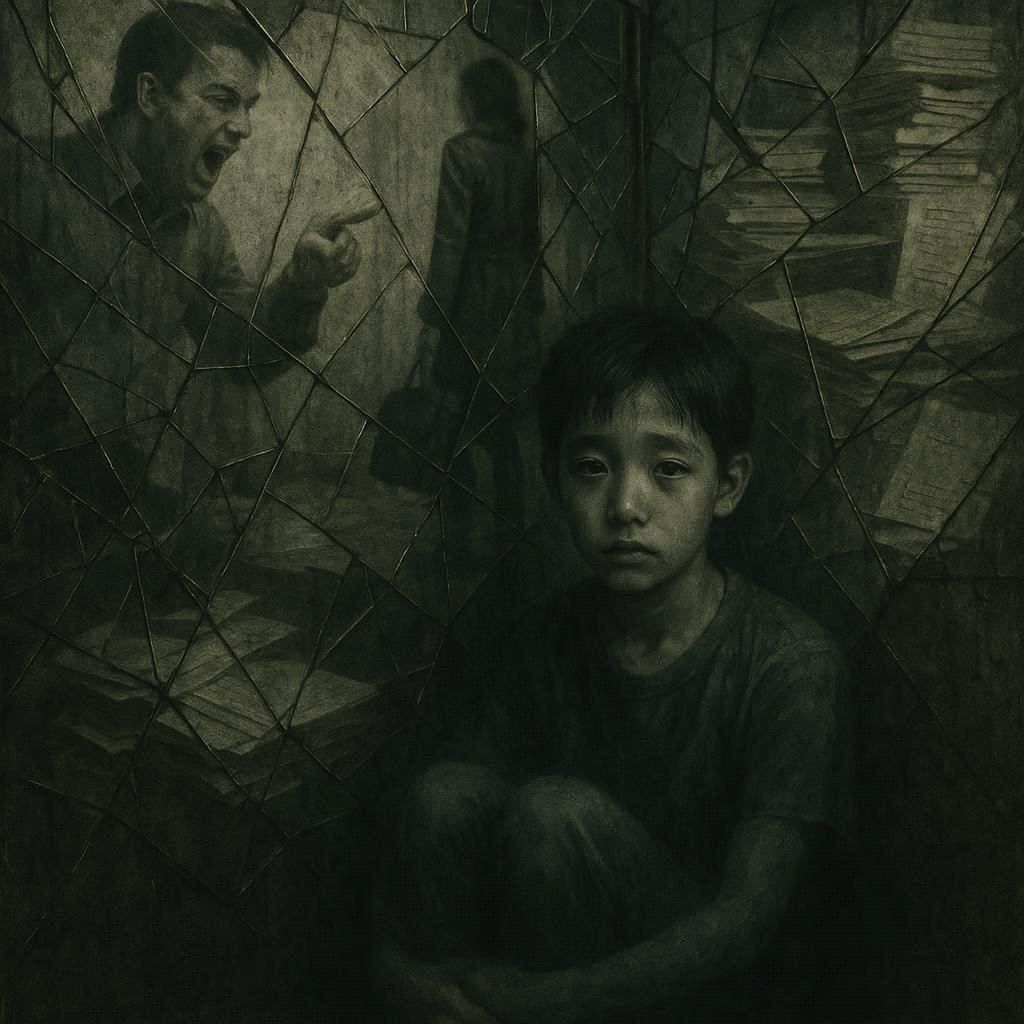
This essay is the first of an eleven-part series.
Something has always been wrong with me.
It began in my early childhood, with a silence. I would often find myself unable to speak, to answer a simple question. No one knew that my silence wasn’t born of ignorance. It was born of a terrifying, paralyzing clarity. I had discovered that for every question asked, for every statement made, there existed not one, but a thousand, a million possible responses. And once I saw this, the pre-programmed replies that others seemed to produce so effortlessly felt meaningless. But I didn’t yet know how to find the optimal response, the one true answer in that infinite sea of possibilities. So, most of the time, I was simply mute.
I remember a girl in my class, Sum, who liked to play with me. I was maybe seven or eight. One day, she came up to me, her expression a complex mixture of curiosity and possessiveness. “What do you like about Yan?” she asked, naming another girl in our class.
Her question sent my young mind into a tailspin. Like? I talked to Yan, yes, but what did it mean to “like” her? And why was Sum asking? Her pouting lips, the slight furrow of her brow—it was jealousy. She was operating on an assumption that I liked Yan, and that this was a problem.
My mind exploded into a thousand branching pathways. Which part of this complex social equation should I address first? The flawed premise that I “liked” Yan? Or the deeper question of why my “liking” her would even be an issue for Sum? Should I clarify that I had never even considered the concept of “liking”? Or should I counter-question her, asking for a precise definition of the term? Or perhaps I should tackle her baseless jealousy, or the even more fundamental irrationality of a child’s possessiveness? Each path led to another, which in turn led to a higher-level value judgment. An infinite loop of justification. My brain, a tiny, overclocked engine, was running at maximum capacity.
On the outside, I was just a boy, staring blankly, mute.
Occasionally, a pre-calculated, charming phrase would escape my lips. But more often, what came out was met with laughter and ridicule. My operating system was not compatible with the world’s. This thing inside me, this ability to deconstruct every interaction to its core, was not a gift. It was a curse. And it was just the beginning of my alienation.
I used to think this was all just a part of my childhood trauma. If there were a license required to have children, I sincerely doubt my parents would have passed. My father, in public, was a master conversationalist. He could spend an entire taxi ride debating politics and philosophy with the driver. But with me, his son, he never gave me a chance to speak. He never asked me a single question. And yet, he would relentlessly lecture me on how American education values public speaking—a bizarre, cruel irony, as if my silence was a personal failing, not a direct consequence of his own oppressive monologue. He never knew that I was silent because he never let me speak.
But the deprivation of language was not his only, or even his deadliest, weapon. He ruled his kingdom with an iron fist of absolute authority, relentlessly indoctrinating me with one core message: you are not good enough. He never knew, and never cared to know, how my brain worked. Fortunately for me, getting good grades in a traditional education system wasn’t difficult.
Until my early teens, I never thought to question him. His word was gospel. I remember one time at a dim sum lunch, my third uncle praised my grades. I simply parroted the truth my father had taught me: “It’s not that I’m smart; it’s that my classmates are stupid.” I genuinely believed this statement to be not only a fact, but a profound moral truth. My uncle was stunned. He tried to explain something about arrogance, about how other kids wouldn’t want to be my friend. Why would speaking a universal truth be considered arrogant? I was utterly bewildered.
The indoctrination didn’t stop at intellect. It extended to the very core of my being: emotion. “Emotion,” he would declare, “is a sign of the weak.” I saw this principle brutally enforced. After his frequent, violent arguments with my mother, she would lock herself in the bedroom or bathroom, her sobs so loud that neighbours would sometimes come knocking. My father offered no comfort. Only contempt. In his eyes, her tears were the mark of the lowest class of human.
But occasionally, the king himself would seem to be an exception to his own iron laws. During a long period of unemployment, he would often deliver strange, heart-wrenching monologues of powerlessness. He would tell me that no matter how much he wanted to do better, he just couldn’t. That if there was only one bowl of rice left in the house, he would give it to me. That I had no brothers, no sisters, no support, and that he himself was an outcast among our relatives. That I had to rely on myself.
Many times, listening to him, I would start to cry.
And in that moment of shared, fragile humanity, my father had created a universe of contradiction that I, a child, could not possibly navigate. I was being forged in a crucible of double binds: be smart, but know that your success is meaningless; be strong, but watch your father weep from his own weakness.
“What are you crying for? There’s nothing to cry about.” My mother’s voice would cut through the air, sharp and cold, when I was in those moments of tearful, identity-shattering confusion.
She, too, was a person who had failed the empathy test. My father and mother, I realized, were drawn to each other for a reason. Where my father’s cruelty was often calculated, a tool of indoctrination, my mother’s was a more chaotic, unconscious force of nature. She was a woman with zero capacity for communication and even less for emotional regulation, a co-author of the violent clashes in our home. It was a pattern of interaction that would later be passed down, like a cursed heirloom, to her relationship with me. She possessed a superpower I have never witnessed in another human being: the ability to utter a single sentence that could, with the force of a nuclear bomb, obliterate the very foundations of trust and respect.
When I was six or seven, on the nights my father worked late, she would enact a terrifying ritual. She would dress up, meticulously, putting on her finest clothes, her makeup, her jewellery. Then, she would pack a bag, as if leaving forever. She would come to me, and in a complete reversal of her usual self, she would kiss my forehead. “Goodbye,” she would say. I didn’t know then that I could have called the police, that it was a crime to abandon a child. All I knew was that if she left, I would not survive. I was convinced it was my fault, that my own misbehaviour was driving her away. I would chase after her, barefoot, my heart pounding with a primal terror, begging her to stay, my tears streaming down my face. She would walk all the way to the bus stop, letting my desperation build, before finally, mercifully, turning around and walking home with me. When I asked her about it years later, as an adult, she simply said it never happened.
As a newly-minted adult, I once told her I was going to an island with a girl. Her response was instantaneous, a reflex. “Don’t get her pregnant.” The words hung in the air between us. In that one sentence, a universe of assumptions detonated: that my trip was purely for sex, that I was irresponsible, that I was malicious, that the girl was an object to be used, and that our relationship, whatever it was, was devoid of any genuine affection or respect. This was one of her least devastating examples.
The emotional education I received—or rather, the anti-education—was catastrophic. My father taught me that emotion was weakness; my mother taught me that expressions of affection were weapons of manipulation and distrust. I learned to suppress all feeling. I learned to parrot my father’s pronouncements, while simultaneously being crushed by the weight of his inherited powerlessness. My mind, the one that saw thousands of possible responses to every sentence, was being mercilessly torn apart. In a world that demanded feeling, I had none left to give. In a system that rewarded conformity, I was a walking contradiction. I was a freak, a prodigy, a fraud, a burden. I was everything and I was nothing. A monster that my classmates dared not offend, but secretly despised.
The irony was, in the one area my father valued—academics—I excelled without effort. I would disrupt class, not out of malice, but out of a profound, soul-crushing boredom. The teacher would repeat the same concept ten times, while I had already read the entire textbook at home and understood it before he’d even finished his first sentence. No one ever asked me why I acted out. No one ever really listened to what I had to say.
At nine, an IQ test confirmed what I already suspected: I was a genius. I didn’t need to be in school. I could have taught myself everything. Throughout high school, I simply slept in class. I was a night owl, and the lessons were meaningless repetitions of things I already knew. But no one showed me another way. No one guided me to advanced placement tests, or gifted schools, or any alternative form of education. I was a race car, stuck in first gear, forced to crawl along at a snail’s pace in a system designed for everyone but me. My entire childhood and adolescence were consumed by this meaningless, institutional cage.
The universe inside my head, however, continued to expand. In my fourth year of secondary school, I independently reasoned my way to the concept of physical determinism. I wrote an essay about it, a torrent of ideas pouring out of me. But then what? Where could I publish it? Who could I even talk to about it? I didn’t know the word “philosophy” existed. No one had ever told me that for centuries, the greatest minds in human history had wrestled with the very same questions of “free will” that were tormenting me. The internet was beginning to flourish, but without the right keywords, it was just a sea of noise. I didn’t have the language to even begin my search.
My immense dissatisfaction had no name, no voice. The entire education system had never taught me the language of my own heart, my own mind. I just knew that something was deeply, fundamentally wrong. Eventually, I realized the education system wasn’t built to teach—it was built to silence.
By my sixth year of secondary school, my mind had matured enough, had absorbed enough knowledge, that I could no longer endure my father. His own sense of powerlessness, accumulated over years of unemployment, seemed to fuel his need to assert absolute authority over me. His lectures became more frequent, more intense—booming, relentless monologues that could last for two hours. There was no escape. I could blast the television at full volume, retreat to my computer and crank my headphones up until the music bled out, and still, he would not stop.
Our conflicts escalated. On countless nights, I was forced into exile just to do my homework. Sometimes I would flee to the local McDonald’s, a noisy haven crowded with other students. Sometimes, to a park, where I would be devoured by mosquitoes in the suffocating heat. It was the darkest period of my life. I would sit in some forgotten corner, looking out at the million points of light in the city’s apartment buildings, and I knew, with a certainty that hollowed me out, that not a single one of those lights was shining for me. I wanted to die.
And perhaps, in a way, I already had.
I finally understood that my obsession with grades, with success, had never been for me. It was for him. And it was a currency that was worthless in his kingdom. He was never satisfied. When I was in my second year, he had promised me a computer if I came first in the entire grade. I did. He reneged, giving me some meaningless trinket I can no longer even remember. The system was rigged. The game was unwinnable.
I no longer needed to please anyone. But I didn’t know how to please myself. I had never once thought about what I wanted. I only knew that the things the world told me I should want held no value, no meaning for me. Even coming first in the grade brought no sense of accomplishment. It was a hollow victory in a war I had never chosen to fight. I had lost the orbit of my own life.
I became a walking ghost. A body stripped of its ability to feel, a mind stripped of the language to express its dissent. But inside this corpse, a universe of unreleased thought was waiting, silently, for a world that did not yet exist.
What else could I do but not die? I asked myself this question, over and over. Perhaps it was just a lack of courage. Or perhaps, it was something else. A dim, almost imperceptible realization that the self of today and the self of ten, twenty years from now, would be two entirely different, unrecognizable people. The me of today had no meaning, no place in the world. But the me of thirty years from now? He might be something else entirely.
I had no hope, but I had a hypothesis.
And that hypothesis, a single, flickering data point in a sea of darkness, was just enough to keep the ghost walking.
Sequel — The Forging of the Mind: How I Learned to Bend Systems