The 4-Word Spell and the Price Discrimination Monster
2025-10-07
For the longest time, I had a secret weapon for traveling in Thailand. A piece of local knowledge that made me feel like a savvy insider: the cheap SIM card. While tourists at the airport were being funnelled towards overpriced, data-heavy packages, I knew the real deal was at any 7-Eleven outside the tourist bubble. A 30-day, 30GB card for 199 baht. Or a 7-day, 7GB one for a mere 49. I felt a smug pride in sharing this tip with friends, a small act of rebellion against the tourist economy.
Until this trip. This trip, the system began to fight back.
It started in Patong, Phuket. I needed a 7-day card. I walked into 7-Eleven after 7-Eleven, and the response was unnervingly uniform, delivered with the certainty of a well-rehearsed script: “That one for Thai people only.” It was bizarre. The next day, after a long journey of buses and a final, unceremonious drop-off on a dark highway outside the Krabi bus terminal, I was phoneless and disconnected. I walked towards the town center, stopping at every 7-Eleven along the way. Finally, in a remote stretch of road where tourists were a novelty, the mantra changed. The staff there had never heard of the “Thais only” rule, and while they didn’t have the 7-day card, they had the 199-baht 30-day version. Exhausted, I surrendered and bought it. The staff, with the genuine, unhurried kindness typical of non-tourist areas, helped me through the registration process. Though it took several attempts for their camera to recognize my face, their goodwill was a balm. I had, against the odds, acquired what many tourists were now being denied.
Online, a fog of war. A rumour of an official notice barring foreigners from cheap SIMs, quickly debunked by others. All I knew was that countless travellers were reporting the same thing: a new, invisible wall had been erected. My accidental 30-day plan became a blessing as my trip extended. But all blessings expire.
As the card’s expiry date of October 7th loomed, I planned my next move. I found a renewal option in the telco’s app: a 150-baht plan for 10GB. The speed was a sluggish 2Mbps, but for my needs—navigation and writing—it was perfect. I was calm. I had a plan.
On October 7th, the data died as expected. I opened the app, ready to top up and purchase the 150-baht plan. And it was gone. It had magically vanished. In its place were other, more expensive options. The cheapest way to get my old 30GB/15Mbps plan back was to pay 280 baht—a 40% markup from buying a new card.
I understood the despicable logic instantly. It wasn’t about the cost of the SIM card; it was about my switching cost. The phone number should have now tied to a dozen accounts, the digital identity of its owner. The telco knew this. They knew that a customer’s loyalty wasn’t something to be rewarded, but something to be exploited. It was a monstrous, unethical system that punishes efficiency and preys on dependency. It was the purest distillation of profit-at-all-costs capitalism, and it was nauseating.
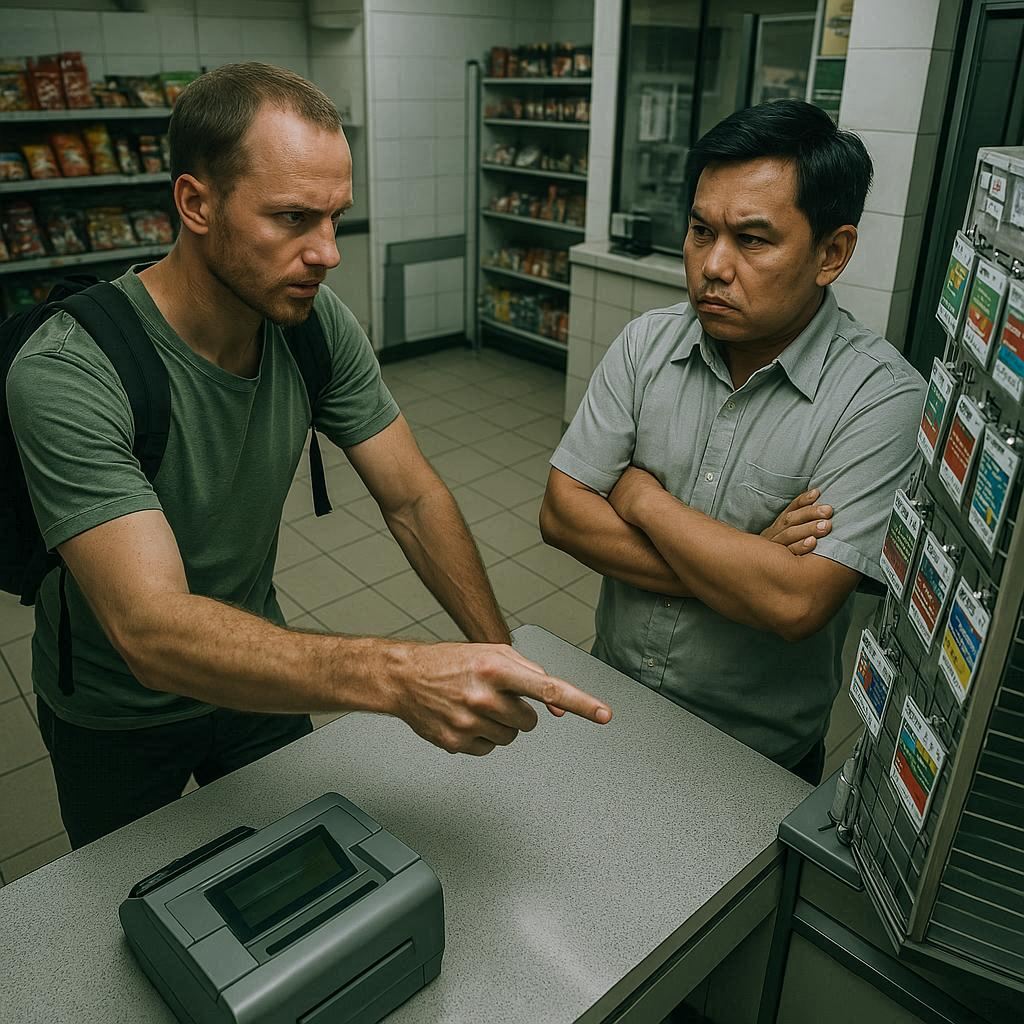
This meant I had to return to the battlefield: a 7-Eleven in a tourist zone. I walked to the furthest one, hoping for a miracle. As I entered, I saw it behind the counter: the familiar 199-baht SIM card package, sitting right next to a tourist version priced at a staggering 699 baht for 15 days. I pointed. “I want that one. 30 days, 199 baht.”
The man behind the counter, who had the air of a manager, didn’t even blink. “For Thai,” he said. Two words. Another wall. Another gatekeeper.
But this time, I had a weapon. A four-word spell.
“I bought the same,” I said, my voice calm and firm.
I was ready to show him the proof on my phone, but it wasn’t necessary. The spell had worked. A flicker of reluctance crossed his face, but he gestured for a female colleague to assist me.
The transaction was cold, efficient. The warmth of the previous encounter was gone. When I struggled to open the sealed package, I had to ask, “Can you please open it for me?” The woman obliged, but as she did, the manager muttered something in Thai from the side, ending with the English words, “for me, for me.” A mocking echo of my request. “What do you mean?” I asked. He fell silent.
There was no offer of a SIM-ejector pin, no help with installation. When I prepared to swap the cards at the counter, the manager gestured dismissively. “You can do that at the table over there.” Don’t block the counter.
In that moment, my status had been downgraded. I was no longer a customer to be served, but a suspect who had exploited a loophole. I had won the battle for the price, but in the process, I had been stripped of my dignity, reframed as a cheapskate, an anomaly in their neatly segregated system of locals and wealthy tourists.
As I finally got my data back online, a cold fury washed over me. This entire discriminatory system was a ghost. There was no official notice, no public policy I could find. The decision had been outsourced, passed down to frontline convenience store workers, empowering them to act as arbitrary judges of who was worthy of a fair price. The corporation, the true architect of this monster, remained blameless in the shadows. It was a cowardly, unethical, and brilliant strategy.
The manager’s sarcastic “for me, for me” replayed in my mind. He was a willing accomplice, a small cog in a vast, amoral machine, likely unaware of the ugliness of the role he was playing. He was just doing his job. And that, I thought, is the true horror of it all. This is the sacred logic of capitalism, a system that so often rewards the most shameless path to profit, and in the process, creates monsters who don’t even know they are monsters.